
What if cybersecurity was viewed as a strategic asset for growth rather than just a defensive hurdle? For many leaders across the country, the conversation around ransomware protection for nz businesses has become synonymous with technical jargon and “cyber doom” talk that feels more like a distraction than a solution. You might feel overwhelmed by the complexity or find yourself questioning if your current backups would actually hold up when it matters most. It’s a common concern, especially when you want to focus on your organisation’s long-term objectives rather than managing technical stress.
We believe that security should enable your success, not hinder it. In this guide, you’ll learn how to build a robust, non-fear-based ransomware defence that protects your organisation’s continuity and growth. We’re moving away from the frantic energy of reactive support to focus on practical, layered strategies that work for organisations nationwide. We will outline a clear path toward strategic resilience, ensuring you have the clarity to recover quickly and keep your business moving forward with a partner who speaks plain English.
Key Takeaways
- Reframe ransomware as a business continuity challenge rather than just a technical issue to better protect your organisation’s growth.
- Discover why a layered approach to ransomware protection for nz businesses is more effective than relying on a single security solution.
- Learn the difference between simple data backups and a complete business continuity plan that ensures you can keep working if an incident occurs.
- Identify practical, immediate actions like auditing administrative access and conducting risk assessments to strengthen your security posture.
- Understand how a strategic technology partnership focuses on long-term stability and resilience rather than just reactive support.
Understanding Ransomware Risks for NZ Organisations
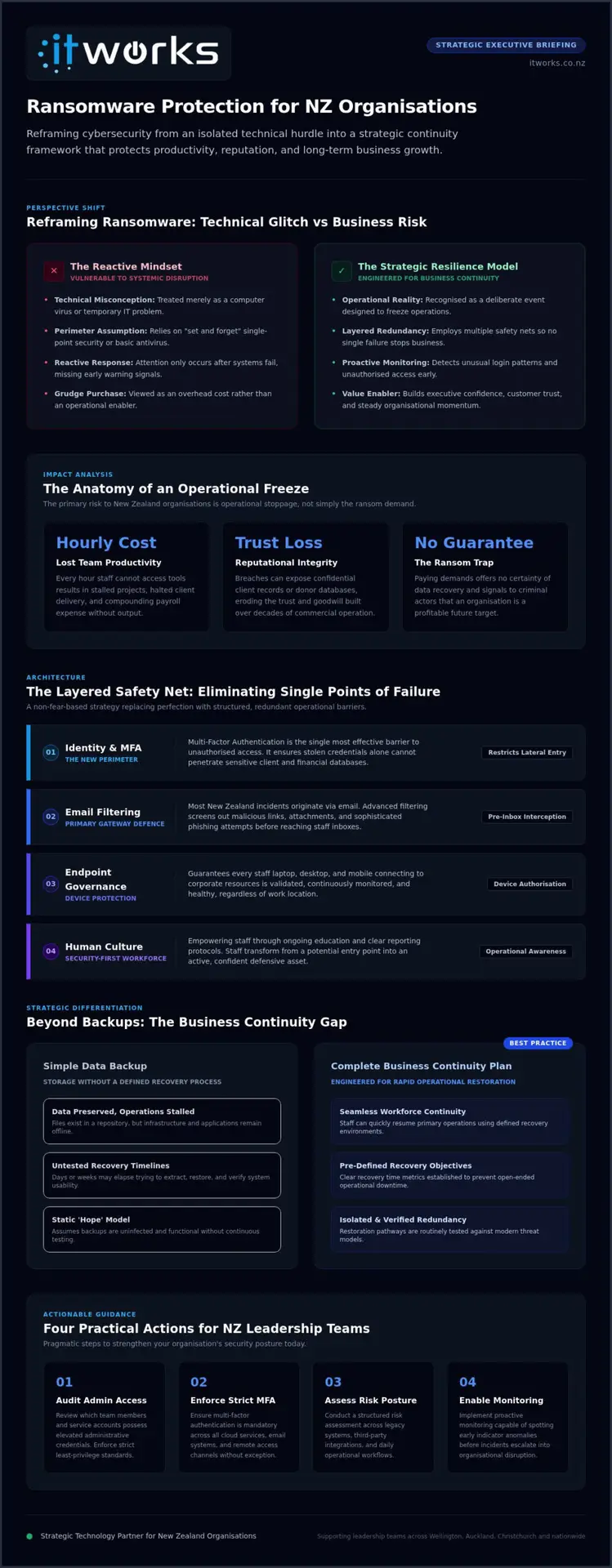
Ransomware is often misunderstood as a simple computer virus. In reality, ransomware is a deliberate business disruption event designed to halt your operations entirely. While the technical side involves the encryption of your files, the true impact for an organisation lies in the total freeze of productivity and the potential damage to your hard-earned reputation. For many leaders, the stress comes from the unknown, but shifting your perspective from a technical glitch to a business risk is the first step toward regaining control.
New Zealand organisations are frequently targeted because they are perceived to have softer defences compared to larger global hubs. This isn’t necessarily because our technology is inferior, but because our business culture is often built on trust and legacy systems that haven’t kept pace with modern threats. Strategic ransomware protection for nz businesses starts with accepting that a “set and forget” approach is no longer sufficient. Modern security is about resilience; it’s the ability to withstand a challenge and keep moving forward without losing your momentum.
The Real Cost of Downtime
When a disruption occurs, the most immediate pain isn’t the ransom demand itself. It’s the operational freeze. Every hour your team can’t access their tools is an hour of lost revenue, stalled projects, and mounting frustration. We often see business owners consider paying a ransom just to make the problem go away quickly. However, this is rarely a viable or recommended strategy. There’s no guarantee you’ll actually get your data back, and paying often signals to criminals that your organisation is a profitable target for future attempts. Clear accountability in your IT environment ensures that every layer of your system is managed with the goal of keeping you operational, rather than just hoping a backup exists somewhere.
Moving Beyond the “Break-Fix” Mentality
A reactive, break-fix approach to IT is one of the most significant vulnerabilities an organisation can have. If your technology provider only shows up when something is already broken, they’ve already missed the opportunity to prevent the disruption. Proactive monitoring allows for the identification of early warning signs, such as unusual login patterns or unauthorised access attempts, before they escalate into a full-scale crisis. Effective ransomware protection for nz businesses requires a shift in how we view the role of IT in our daily work. By positioning cybersecurity as a strategic investment rather than a grudge purchase, you create a foundation for sustainable growth. It’s about replacing the frantic energy of emergency repairs with the calm reliability of a managed, secure environment that supports your long-term goals.
Building a Layered Defence Without the Fear-Mongering
A resilient strategy for ransomware protection for nz businesses relies on the principle of redundancy. Think of it as a series of safety nets rather than a single perimeter wall. If a malicious link bypasses your email filter, your endpoint protection is there to catch it. If a password is compromised, your identity management layer steps in. This approach replaces the stress of perfection with the calm reliability of a system designed to handle the unexpected. By integrating multiple levels of security, you ensure that no single point of failure can bring your operations to a standstill.
Identity and Multi-Factor Authentication (MFA)
Identity is the new perimeter. Protecting who has access to your sensitive client data or financial records is fundamental to modern security. We often see MFA viewed as a daily nuisance for staff, but when implemented thoughtfully, it becomes a source of organisational confidence. Multi-Factor Authentication is the single most effective barrier to unauthorised access. By ensuring that a stolen password isn’t enough to breach your systems, you significantly reduce the risk of identity-based incidents. This is particularly vital for protecting the integrity of your donor or client databases.
Most incidents in New Zealand begin with a simple email. Robust email protection acts as your first line of defence, filtering out sophisticated phishing attempts before they reach an inbox. Similarly, endpoint protection secures the devices your team uses every day, such as laptops and mobiles. Securing these endpoints is about more than just installing software; it’s about ensuring every device that connects to your network is healthy and authorised, regardless of where your team is working.
Securing the Human Element
Technology is only part of the equation. Your team is your greatest asset, and a security-first culture is more powerful than any software tool. Effective security awareness training shouldn’t be condescending or based on fear. Instead, it should empower staff to recognise threats and feel comfortable reporting suspicious activity early. When people know they won’t be blamed for a mistake, they become proactive participants in your defence. You can discuss your cybersecurity priorities with our team to see how we help build these resilient cultures that support long-term stability and organisational growth.
Beyond Backups: Why Business Continuity is the Real Goal
Many organisations believe that having a backup is the same as being fully protected. While having a copy of your data is essential, it’s only half the story. The real objective of Backup and Disaster Recovery NZ is business continuity, which is the practical ability to keep your team working even when a core system fails. True ransomware protection for nz businesses means having a strategic roadmap that dictates exactly how you return to full operations, rather than just hoping your files are retrievable from a drive somewhere.
We advocate for the “3-2-1” rule to ensure your data remains resilient. This simple framework involves keeping three copies of your data, stored on two different types of media, with one copy kept entirely off-site and isolated from your main network. This structure ensures that even if a local incident occurs, you have a clean version of your information ready for restoration. It’s a methodical approach that replaces the frantic energy of a crisis with a structured, predictable recovery process.
Testing Your Recovery Speed
A backup that hasn’t been tested is a significant business risk. For an executive team, the most important metric isn’t the existence of a backup, but your Recovery Time Objective (RTO). In plain business terms, this is the maximum amount of time your organisation can afford to be offline before the impact on revenue and reputation becomes critical. Regular recovery testing replaces uncertainty with evidence. It gives you the peace of mind that your team can actually meet these timelines, ensuring that your business continuity plan is a functional tool rather than just a document on a shelf.
Cloud Resilience with Microsoft 365
There’s a common misconception that moving to the cloud removes the need for a dedicated backup strategy. While cloud platforms are highly reliable, they don’t always provide the granular, point-in-time recovery required to undo the effects of a sophisticated attack. Effective Microsoft 365 Management New Zealand includes third-party backups of your cloud environment. By securing your SharePoint, Teams, and email data independently, you ensure that your team can maintain productivity and continue serving your clients even while primary systems are being restored. This layered resilience is what allows an organisation to grow with confidence.
Practical Steps to Strengthen Your Security Posture Today
Building resilience is a deliberate process. It requires moving from broad concepts to specific, actionable routines. Ransomware protection for nz businesses is most effective when it is woven into the daily operations of the company rather than treated as a one-off project. By taking a structured approach to your security posture, you replace the typical stress of technical management with a sense of calm reliability.
Begin with a comprehensive cyber risk assessment. You can’t protect what you haven’t identified. Map out where your most valuable data sits, whether it’s financial records, intellectual property, or sensitive client information. This visibility allows you to prioritise your resources where they matter most. Next, review your administrative privileges. Ensure no one has more access than they strictly need for their daily tasks. Restricting these “keys to the kingdom” prevents a single compromised account from granting an intruder full access to your entire network.
Maintenance is just as critical as initial setup. Organise a strict schedule for regular software and infrastructure updates. Vulnerabilities are often patched by vendors long before they are exploited, so staying current is a simple way to close doors to potential threats. Finally, develop a clear incident response plan. Everyone should know their role if a disruption occurs, from who notifies the technology partner to how you will communicate with your staff and clients. Having this roadmap in place ensures you can act with composed, strategic presence during a crisis.
Aligning with NZ Standards (NCSC & CERT)
Government guidelines from the NCSC and CERT NZ provide an excellent baseline for local organisations. Integrating these standards into your monthly IT routine ensures you are following proven frameworks for risk reduction. This includes regular vulnerability management to identify and remediate weaknesses in your system before they can be used against you. For smaller organisations, focusing on these fundamentals is the core of Cyber Security for Small Business NZ, creating a culture of confidence and stability.
Governance and Risk Visibility
Security is a business risk, not just a technical one. The board and executive team need clear visibility of technology risks to make informed strategic decisions. A Technology Roadmap helps you plan and budget for security improvements without facing unexpected costs. It moves the conversation from emergency spending to purposeful investment. Accountability is also vital. You must define who is responsible for security within your organisation to ensure that these practical steps are consistently followed, measured, and improved over time.
Strategic Partnership: How IT Works Secures Your Growth
Choosing a technology partner is a strategic decision that impacts your organisation’s long-term trajectory. We don’t view ourselves as a distant helpdesk or a reactive service provider. Instead, IT Works acts as a steady extension of your team. This relationship is built on an outcome-focused approach to cybersecurity. We prioritise results that matter to your executive team, such as sustained operational uptime and the freedom to pursue new opportunities without the weight of technical anxiety. It’s about replacing the frantic energy of traditional support with a composed, professional presence.
Our team is entirely New Zealand-based, providing advisory and support to organisations across the country. This local presence is a vital part of our ransomware protection for nz businesses. We understand the specific regulatory environment and the unique market conditions that local organisations face every day. By combining high-level strategy with daily operational support, we ensure your security measures are both visionary and grounded in practical stability. It’s about creating a connected system where your technology and your business goals move forward in perfect harmony.
Building Your Technology Roadmap
Growth requires a plan that looks beyond the immediate horizon. We help you develop a Technology Roadmap that spans the next 12 to 36 months, providing a clear vision for your secure expansion and digital maturity. This planning process includes the safe integration of AI and automation into your existing workflows. We focus on responsible governance and practical productivity gains, ensuring these new developments enhance your team’s capabilities rather than creating unmanaged vulnerabilities. For a deeper look at how this strategic integration works, you can read our Guide to Managed IT Support for NZ Organisations.
Next Steps for Your Organisation
The path toward true resilience begins with a clear, honest understanding of where you stand today. We encourage a proactive audit of your current security gaps to identify any hidden risks before they can be exploited. This process isn’t about finding fault. It’s about building the calm reliability and organisational confidence that comes with professional, strategic management. When your technology is handled by a partner who is genuinely invested in your journey, you can stop reacting to crises and start focusing on your organisation’s core mission.
Securing Your Organisation’s Future with Confidence
Building a resilient organisation requires a shift from technical anxiety to strategic clarity. Effective ransomware protection for NZ businesses isn’t about finding a single perfect software tool; it’s about establishing a layered defence that ensures your team can keep working through any challenge. By prioritising identity management, testing your recovery speed, and aligning with local standards, you replace technical stress with the calm reliability of a professional system.
IT Works has spent over 20 years helping organisations across New Zealand grow securely. Our nationwide team provides the local expertise and strategic guidance needed to move beyond reactive support. We focus on risk reduction and business outcomes, acting as a supportive partner in your long-term journey. When you have a clear technology roadmap and a team that speaks plain English, you can focus on what truly matters: your organisation’s success.
Your technology should be an asset that enables your success, not a source of constant concern. With the right strategy in place, you can lead your organisation forward with total confidence.
Frequently Asked Questions
Is my NZ small business really a target for ransomware?
Yes, New Zealand organisations are frequently targeted because they are often perceived to have less sophisticated defences than global enterprises. Attackers frequently use automated tools that don’t distinguish between a large corporation and a local firm. This makes ransomware protection for nz businesses a critical priority regardless of your staff count. Shifting to a proactive security posture helps you move away from being a target of opportunity toward being a resilient, secure organisation.
What is the difference between data backup and business continuity?
A backup is simply a copy of your data stored in a separate location. Business continuity is the strategic framework that allows your team to remain productive during and after an incident. While backups are essential for data recovery, continuity planning ensures you have the right systems, processes, and roadmaps to maintain operations. It’s the difference between having your files saved and being able to actually use them to serve your clients and community.
How much should a business spend on ransomware protection?
Security spending should be viewed as a strategic investment in your organisation’s stability rather than a fixed cost. The amount typically depends on your specific risk profile, the sensitivity of your data, and the cost of potential downtime. Instead of a one-size-fits-all budget, we recommend a Technology Roadmap. This helps you plan and prioritise investments over 12 to 36 months, ensuring your spending aligns with your growth goals and risk tolerance without surprises.
Does Microsoft 365 automatically protect me from ransomware?
Microsoft 365 includes built-in security features, but it doesn’t provide complete, automatic protection against all threats. Effective ransomware protection for nz businesses using cloud tools requires active management of identity, access, and email filtering. You also need a dedicated third-party backup for your cloud data. This ensures that if a breach occurs, you have a clean, independent copy of your SharePoint and Teams files to restore from, maintaining your organisational resilience.
What should I do immediately if I suspect a ransomware attack?
If you suspect a breach, your first step is to disconnect the affected device from the network and the internet to prevent the spread. Immediately notify your technology partner to trigger your incident response plan. Don’t attempt to delete files or pay any ransom demands, as this can complicate the recovery process. A calm, methodical response guided by experts is the most effective way to limit disruption and protect your organisation’s long-term reputation and data integrity.
Can insurance cover the costs of a ransomware incident?
Cyber insurance can help cover the financial impact of an incident, including recovery costs and legal fees. However, most insurers now require you to demonstrate a baseline level of security, such as MFA and regular backups, before they provide coverage. It’s important to view insurance as a final safety net rather than a primary defence. We work with organisations to ensure their security posture meets these requirements, building the confidence needed for sustainable growth and stability.
How often should we test our disaster recovery plan?
We recommend testing your disaster recovery plan at least once or twice a year. Testing should also occur whenever you make significant changes to your infrastructure or adopt new cloud services. Regular drills replace uncertainty with evidence, confirming that your team can meet your Recovery Time Objectives. This methodical approach ensures your plan is a functional tool that provides genuine peace of mind for your executive team and board, reflecting a mature security posture.
Do we need a full-time security officer for a team of 50?
For an organisation with 50 staff, a full-time security officer is often unnecessary and expensive. Most businesses find more value in a strategic partnership with a managed service provider. This gives you access to a broader range of specialist knowledge and proactive monitoring without the overhead of a dedicated internal role. It allows your leadership team to focus on growth while we handle the strategic and operational aspects of your cybersecurity and technology roadmap.