
What if your next security check was actually a strategic investment in your company’s growth, rather than just another administrative chore? Most New Zealand business leaders feel the weight of complex jargon and the constant worry that a single breach could halt operations. It’s understandable to feel uncertain about where to allocate a limited IT budget when the threats seem ever-changing. A professional cyber security audit for businesses moves your organisation beyond the standard routine of ticking boxes. It serves as a foundational step in creating a resilient environment where technology supports your long-term goals instead of creating hidden risks.
You deserve a clear understanding of your current posture without the frantic energy of reactive support. This guide explains how a structured audit identifies real-world risks and provides a prioritised roadmap for improvement. We’ll move past the technical noise to focus on practical outcomes that protect your team right across the country. By the end of this article, you’ll have the clarity needed to invest with confidence, ensuring your organisation remains secure, productive, and ready for what comes next.
Key Takeaways
- Learn why a comprehensive cyber security audit for businesses is a strategic health check that goes far beyond a simple technical scan.
- Understand the difference between merely ticking boxes for compliance and building the genuine operational resilience needed to protect your organisation.
- Discover how a layered review of identity, data, and devices provides a clear, jargon-free picture of your current security posture.
- Identify the practical steps to organise your leadership team and documentation for a smooth, stress-free audit process.
- Learn to transform audit findings into a prioritised technology roadmap that aligns with your annual budget and long-term business goals.
What is a Cyber Security Audit and Why Does Your Organisation Need One?
A comprehensive cyber security audit for businesses acts as a high-level health check for your digital environment. It’s a structured process that examines how your people, processes, and technology interact to protect sensitive information. For many New Zealand organisations, there’s often a ‘she’ll be right’ attitude toward technology; a belief that if things are working today, they’ll be fine tomorrow. However, a strategic audit moves past this reactive mindset. It identifies potential gaps before they become operational headaches, ensuring your business remains stable and productive.
While a broad information security audit covers various methodologies and objectives, the primary goal for a local firm is to ensure that digital defences align with operational reality. There’s a significant difference between a basic ‘quick scan’ and a human-led review. Automated tools might find missing updates, but they don’t understand your business goals or how your staff actually work. A strategic audit involves experienced advisors who look at the context behind the data. This provides a sense of calm reliability, replacing technical stress with a clear path forward.
Identifying the Gaps in Your Current Posture
Internal IT teams do an excellent job of keeping the lights on, but they often benefit from an external, fresh set of eyes. It’s easy to overlook risks when you’re immersed in daily support tasks. A review often uncovers ‘shadow IT’, which includes unauthorised apps used by staff, or legacy systems that haven’t been properly retired. We also frequently see user permissions that are far too broad, giving employees access to data they don’t need for their roles. The security gap is the space between your current technical defences and the constantly evolving nature of modern digital threats.
The Business Case for Security Resilience
Investing in a cyber security audit for businesses is a strategic move that protects your reputation with clients, partners, and donors. In cities like Wellington and Auckland, trust is a core business currency. A secure environment also ensures uninterrupted staff productivity; if your systems are down due to a preventable breach, your team cannot work. Proactive auditing is consistently more cost-effective than reactive incident response. It’s far better to invest in a structured roadmap than to face the high costs and stress of cleaning up after a security event. This approach builds organisational confidence and supports long-term growth.
The Anatomy of a Strategic Cyber Security Audit
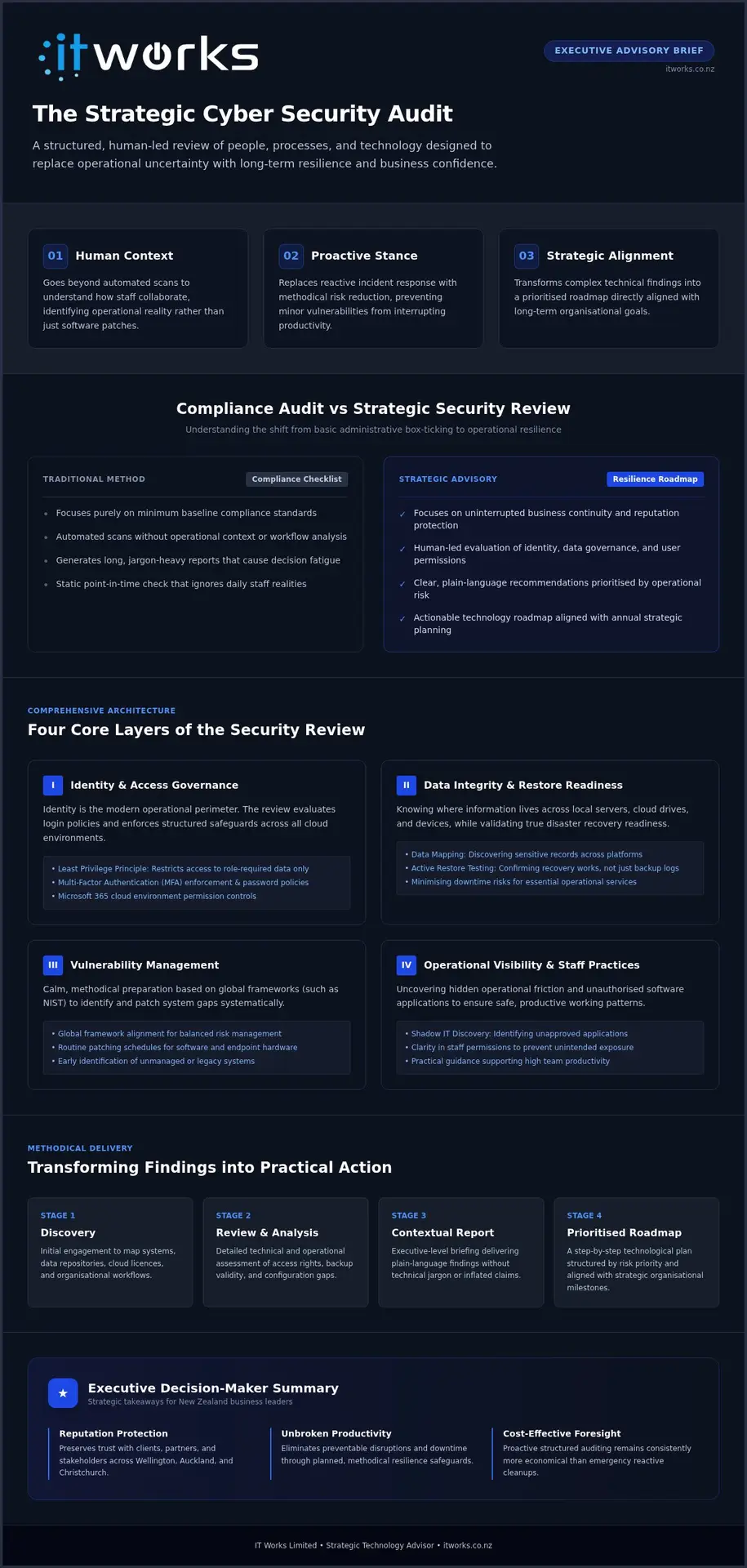
A strategic cyber security audit for businesses is much more than a technical checklist. It’s a comprehensive look at the different layers that keep your organisation running, from the software you use to the people who use it. By following global standards like the NIST Cybersecurity Framework, an audit provides a logical structure for identifying and managing risks. One key component is vulnerability management. Rather than being a scary technical hurdle, this is simply the process of identifying and patching small weaknesses in your systems before they can be exploited. It’s about staying one step ahead with calm, methodical preparation.
Identity and Access Management: The New Perimeter
Staff identity has become the most critical layer of your security environment. We evaluate how your team logs in, looking closely at password policies and the effectiveness of Multi-Factor Authentication (MFA). A core part of the audit involves applying the ‘least privilege’ principle. This ensures that people only have access to the specific data and systems required for their roles, which prevents a small issue from spreading across the entire network. This approach is a fundamental element of the Microsoft 365 management New Zealand organisations use to keep their cloud environments organised and secure.
Data Integrity and Backup Readiness
Understanding where your sensitive organisation data actually lives is the next step. It’s common for data to be spread across local servers, cloud drives, and even individual staff devices. A strategic audit assesses your current backup and disaster recovery NZ plan to ensure it’s functional and reliable. It’s not enough to simply check that a backup ran successfully. We focus on testing the ‘restore’ process to ensure that if a system failure occurs, your team can get back to work quickly without significant data loss. This provides the practical stability needed for long-term growth.
Beyond the technical layers, we must consider the human element. Your staff are your most important asset, and their ability to recognise suspicious activity is a vital part of your defence. An audit assesses current security awareness and identifies where further training might help build confidence. We also look at the ‘extended’ network, specifically reviewing the access levels granted to third-party vendors and cloud providers. Ensuring that external partners only have the access they truly need reduces your overall risk profile and keeps your environment clean. You might like to talk to IT Works about your technology strategy to see how these layers fit within your specific business model.
Compliance Audit vs. Strategic Security Review: What’s the Difference?
Choosing a cyber security audit for businesses often involves deciding between two distinct paths: a formal compliance audit or a strategic security review. While the terms are sometimes used interchangeably, they serve very different purposes. A compliance audit is essentially a snapshot in time designed to prove you meet a specific standard, such as a certificate to hang on the wall or show to a major client. A strategic review, however, is a deeper look at how your security actually functions within your daily operations. It’s about building genuine resilience rather than just ticking boxes on a checklist.
The difference often comes down to the intended outcome. You can be technically compliant with a standard but still remain vulnerable to common threats if your staff haven’t adopted the right habits. We focus on an outcome-focused model that prioritises risks based on their actual impact on your specific organisation. This ensures your investment goes toward the areas that provide the most protection, helping you move from a state of uncertainty to one of calm reliability.
When Compliance is Mandatory
There are times when a formal compliance audit is a non-negotiable requirement. If your organisation is bidding for large government contracts or working with international partners, you might be asked for proof of standards like ISO 27001 or SOC 2. In certain New Zealand sectors, adherence to the New Zealand Information Security Manual (NZISM) is a strict requirement. In these cases, compliance is the necessary destination to unlock new business opportunities. However, it’s helpful to view compliance as the result of a good strategy, rather than the strategy itself. A well-planned security journey naturally leads to meeting these higher standards without the last-minute stress of a looming deadline.
The Practical Strategic Review for NZ SMEs
The needs of a 20-person firm in Christchurch are vastly different from those of a 2000-person global enterprise. Applying enterprise-level frameworks to a smaller organisation is often overkill and can lead to unnecessary complexity. For most New Zealand SMEs, a strategic review focuses on the ‘Essential Eight’ style controls that offer the most significant protection for the least effort. We look for the ‘high-risk, low-effort’ wins first, such as tightening cloud access or refining backup schedules. This tailored approach ensures the process is helpful and educational rather than overwhelming. By focusing on practical outcomes, we help you build a secure environment that supports your team’s productivity and your organisation’s long-term growth.
How to Organise Your Business for a Successful Security Audit
Preparing for a cyber security audit for businesses shouldn’t feel like preparing for a stressful tax inspection. It’s a strategic opportunity to align your technology with your commercial goals. By setting the right expectations early, you can turn a potentially daunting project into a constructive exercise that builds team confidence. The most effective audits are those approached as a partnership, where the goal is to find practical ways to make your organisation more resilient rather than catching people out for mistakes.
When you approach the process as a collaborative effort, you reduce internal friction and get far more accurate results. It’s about replacing technical anxiety with a sense of calm reliability. Whether your team is based in a single Wellington office or spread across Auckland and Christchurch, the preparation steps remain the same. You don’t need to have every policy perfectly polished before the process begins; the audit itself is designed to help you identify and fill those gaps.
Preparing Your People and Processes
Clear communication is the foundation of a smooth review. Start by explaining the ‘why’ to your staff to ensure buy-in and transparency. When people understand that security improvements protect their own work and the company’s reputation, they’re much more likely to provide honest insights. You’ll also need to identify key ‘data owners’ within your organisation, such as those heading up finance, HR, or operations. These individuals provide the necessary context that technical scans often miss. A successful audit functions as a collaborative discovery rather than a technical test.
What to Expect During the On-site and Remote Review
For a typical mid-sized New Zealand organisation, the review process usually spans two to four weeks. Modern auditors use non-intrusive tools to gather data quietly in the background, ensuring your daily operations aren’t interrupted. This means your staff can continue their work while the technical assessment happens. The most valuable part of the entire process is the final debrief session for the executive team. This is where complex findings are translated into a business-focused summary, giving you a clear, prioritised roadmap for your next steps. It’s this structured approach that ensures your investment leads to functional, sustainable results.
Turning Audit Findings into a Practical Technology Roadmap
Receiving the results of a cyber security audit for businesses is a pivotal moment for any leadership team. It marks the transition from uncertainty to absolute clarity. However, the true value of the process isn’t found in the document itself, but in how you translate those findings into a functional technology roadmap. We focus on prioritising ‘high-risk, low-effort’ wins first. These are the practical changes, such as tightening identity controls or refining backup schedules, that provide immediate protection without disrupting your staff’s daily workflow. This methodical approach ensures that your security posture strengthens steadily and sustainably.
Integrating these improvements into your annual budget and IT roadmap allows you to treat security as a strategic investment rather than an unexpected cost. A managed IT partner plays a vital role in this phase, acting as a strategic ally to execute the remediation plan. This partnership replaces the frantic energy of reactive support with a composed, forward-thinking presence. By aligning your technology with your business goals, you ensure that every security measure taken actually supports your organisation’s growth and resilience.
From Risk Assessment to Actionable Strategy
A 50-page technical report is often overwhelming and can end up sitting in a drawer if it’s too complex to act upon. We believe a report is only useful if it’s accompanied by a concise, one-page action plan that your board or stakeholders can easily understand. This allows you to communicate risks in business terms, linking security spend directly to long-term business value. When you can show how a specific investment protects your reputation or ensures staff productivity, it becomes much easier to gain the necessary buy-in for your technology strategy.
Building a Long-Term Security Partnership
Security is a continuous improvement programme, not a one-time project that you can complete and forget. As your organisation evolves, your digital environment must remain aligned with new developments and emerging requirements. Having a local NZ-based team to support your ongoing posture provides a level of calm reliability that’s hard to find with distant service providers. Our team understands the specific operational context of businesses in Wellington, Auckland, and Christchurch, ensuring our guidance remains pragmatic and grounded in the real world. Talk to IT Works about your technology strategy and how a cyber security audit for businesses can provide the clarity you need to build a resilient, confident organisation.
Building a Resilient Future for Your Organisation
A strategic cyber security audit for businesses provides the clarity needed to move from a reactive posture to a proactive, resilient one. By prioritising practical wins and aligning technology with your commercial goals, you ensure your systems support growth rather than creating hidden risks. This process replaces technical uncertainty with a clear, manageable roadmap for long-term success. It’s about moving beyond simple box-ticking to build a foundation that protects your reputation and your people.
Since being established in 2004, IT Works has focused on providing outcome-focused strategic advice that makes sense for local organisations. Our NZ-based expert team understands the unique challenges of the New Zealand market, offering the calm reliability you need to lead your business forward. You don’t have to navigate these technical complexities alone. With the right guidance, you can build a secure environment that empowers your team to work with complete confidence and focus on what truly matters for your growth.
Learn how IT Works can strengthen your cybersecurity posture
Your organisation’s resilience is a journey that starts with a single, purposeful step toward better visibility and smarter investment.
Frequently Asked Questions
How much does a cyber security audit for a business cost in NZ?
The cost of a cyber security audit for businesses varies depending on the scale of your network and the depth of the review required. Rather than a fixed price, it’s typically treated as a project-based professional service fee tailored to your organisation’s specific needs. Factors such as the number of staff, the complexity of your cloud environment, and any specific contractual compliance requirements will influence the final investment. This ensures you receive a bespoke strategy.
Will a security audit disrupt our daily operations or cause downtime?
A professional audit is designed to be non-intrusive and should not cause any downtime or disruption to your daily operations. Modern discovery tools work quietly in the background to gather technical data while our advisors engage with your team through brief, structured interviews. This approach allows your staff to remain productive while we identify potential risks. You’ll gain a clear picture of your security posture without the frantic energy often associated with reactive technical support.
How long does the entire audit process typically take?
For most mid-sized New Zealand organisations, the entire process typically takes between two and four weeks from the initial discovery session to the final executive debrief. This timeframe allows for a thorough analysis of your identity controls, data integrity, and third-party access levels without rushing the results. We focus on delivering a high-value, structured roadmap that your leadership team can actually use. Each step is methodical, ensuring the final recommendations are both practical and sustainable.
What is the difference between a penetration test and a security audit?
While a penetration test focuses on trying to exploit specific technical weaknesses through an ethical hack, a security audit is a much broader health check. The audit examines your entire digital ecosystem, including your people, processes, and long-term technology strategy. It’s designed to find the gaps in your overall resilience rather than just testing a single entry point. This holistic view provides the strategic clarity needed to align your security with your business goals.
Do we need to buy new hardware before we can have an audit?
You don’t need to upgrade your hardware or purchase new software before an audit begins. The purpose of the review is to assess your current environment exactly as it is today to identify any existing risks. Buying equipment beforehand can lead to wasted budget on tools that might not align with your actual security needs. For smaller operations and home offices looking to address everyday device issues without premature replacements, relying on small business IT support and repair specialists like Aspire Computing can ensure existing hardware remains dependable. We use the audit findings to help you prioritise future investments, ensuring every dollar spent on hardware supports your growth and resilience.
Most organisations should perform a formal cyber security review at least once a year to keep up with evolving threats and internal changes. It’s also wise to conduct a review after significant milestones, such as a major cloud migration or a shift in staff numbers. Treating security as a continuous improvement programme rather than a one-time project ensures your defences remain robust. Regular reviews provide the long-term partnership and steady guidance needed for a secure environment.
Will an audit help us with our insurance requirements?
Yes, a comprehensive audit is often a vital step in meeting the increasingly strict requirements of cyber insurance providers. Insurers now look for documented evidence of specific controls, such as multi-factor authentication and functional backup processes, before granting coverage or determining premiums. By completing an audit, you gain the professional documentation needed to demonstrate your commitment to risk management. This proactive approach builds organisational confidence and helps secure more favourable terms from your insurance partner.
What happens if the audit finds major security vulnerabilities?
If major vulnerabilities are discovered, they are documented and prioritised within a practical technology roadmap. We treat the audit as a collaborative discovery process, not an interrogation, so the focus remains on finding effective solutions. High-risk areas are addressed first through a structured remediation plan that fits your annual budget. This ensures that any gaps are closed methodically, replacing technical stress with a sense of calm reliability and a clear path toward improved resilience.