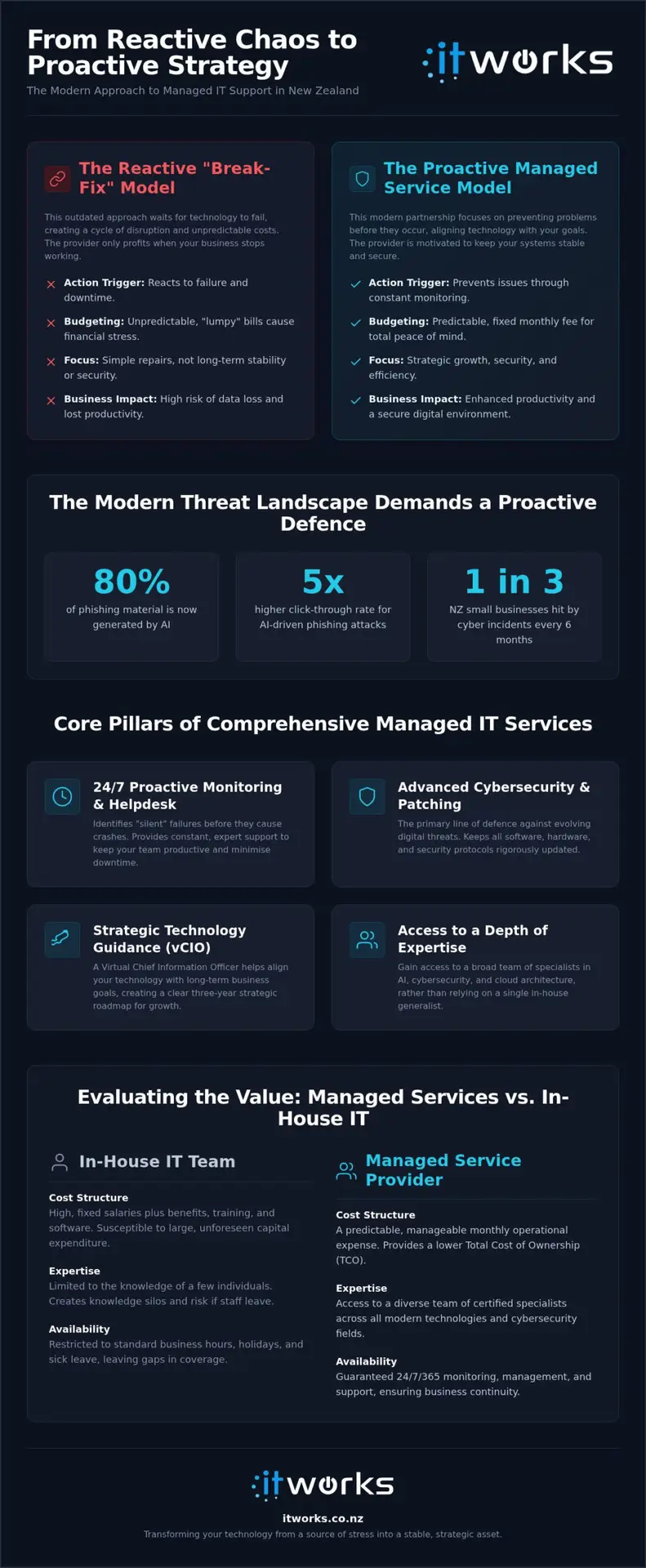
Did you know that 80% of phishing material is now generated by AI, leading to a click-through rate that is nearly five times higher than traditional methods? For New Zealand organisations, relying on a reactive “break-fix” model isn’t just outdated; it’s a significant financial and security risk. We understand the frustration of unpredictable IT bills and the constant worry that your team is falling behind on modern cloud tools. It’s difficult to focus on your core mission when you’re frequently reacting to technical disruptions.
This guide explains how modern managed it support services can transform your technology from a source of stress into a stable, strategic asset. You’ll learn how a proactive partnership secures your infrastructure against sophisticated threats while providing a clear roadmap for sustainable growth. We will walk you through the shift toward zero-stress management, the implications of the New Zealand Cyber Security Strategy 2026-2030, and how to achieve predictable monthly budgeting for your entire digital ecosystem.
Key Takeaways
- Understand why shifting from reactive repairs to proactive management eliminates the stress of unpredictable “break-fix” bills and technical disruptions.
- Learn how comprehensive managed it support services provide 24/7 helpdesk access to keep your team productive and minimise downtime.
- Discover why modern cybersecurity and AI integration are now essential foundations for protecting your organisation against sophisticated digital threats.
- Compare the total cost of ownership between in-house staff and managed providers to make an informed, budget-conscious decision for your growth.
- Identify how a Virtual CIO helps align your technology with your long-term goals through a clear, three-year strategic roadmap.
Understanding Managed IT Support Services: From Reactive to Proactive
At its core, managed it support services represent a fundamental shift in how organisations think about their digital health. Instead of treating technology like a series of isolated machines that occasionally fail, this model treats your entire infrastructure as a single, living system. It’s a holistic, subscription-based approach where a professional partner takes full responsibility for the ongoing health, security, and performance of your digital environment. According to Wikipedia’s definition of Managed Services, this involves the outsourcing of day-to-day management responsibilities as a strategic method for improving operations and cutting expenses.
The traditional “break-fix” model is inherently flawed because it relies on failure to generate revenue. Under that old system, your IT provider only makes money when your business stops working. This creates a fundamental misalignment of interests. In contrast, a modern managed partnership aligns incentives perfectly. Because you pay a fixed monthly fee, your provider is financially motivated to ensure your systems remain stable, secure, and efficient. If your network stays up and your staff stay productive, everyone wins. It transforms the relationship from a simple vendor transaction into a strategic alliance. Understanding the key differences in IT support vs managed services can help you determine which approach best aligns with your organisation’s needs and long-term goals.
Think of a Managed Service Provider (MSP) as your externalised IT department. This structure allows organisations of all sizes to access high-level technical resources that would otherwise be too expensive to maintain in-house. It’s about replacing the frantic energy of reactive repairs with a composed, strategic presence that looks ahead to prevent problems before they occur.
The Evolution of IT Support in New Zealand
Support has evolved rapidly across Aotearoa. A decade ago, IT was largely about physical hardware repair and local server maintenance. Today, the landscape is cloud-centric and highly distributed. The “wait until it breaks” mentality has become a massive liability for modern business continuity. With cyber threats becoming more sophisticated, reactive support is no longer enough to protect sensitive data. By 2026, 24/7 proactive monitoring has become the standard requirement for any organisation that values its reputation and operational uptime.
Why Organisations are Moving to Managed Service Providers (MSPs)
Managing a modern tech stack is no longer a one-person job. Between Microsoft 365 management, complex SaaS platforms, and the rise of remote work, the technical burden is overwhelming for DIY approaches. Moving to an MSP provides several distinct advantages:
- Financial Predictability: You turn unpredictable, “lumpy” capital expenditure into steady, manageable operational expenses.
- Depth of Expertise: You gain access to a broad team of specialists in AI, cybersecurity, and cloud architecture rather than relying on a single generalist.
- Strategic Growth: Instead of just fixing laptops, your partner focuses on how technology can actually drive your organisation’s long-term goals.
This transition allows leadership teams to stop worrying about server patches or software updates. It provides the calm reliability needed to focus on what actually matters: growing your organisation and serving your community.
The Core Pillars of a Comprehensive Managed Service Agreement
A high-quality agreement for managed it support services is far more than a simple insurance policy against technical failure. It’s a carefully constructed ecosystem designed to maintain stability while fostering growth. When you move away from the chaos of reactive repairs, you gain a structured framework that prioritises the health of your digital environment. This framework rests on several critical pillars that work in unison to ensure your team remains productive and your data stays secure.
One of the most vital components is proactive system monitoring. Modern tools allow your partner to identify “silent” failures, such as a degrading hard drive or a memory leak in a server, long before they result in a system crash. By catching these issues early, the “calm reliability” we strive for becomes a reality. This is paired with rigorous patch management, often leveraging specialised automation platforms like Apptimized to streamline software packaging and deployment. With cyber incidents affecting one in three small businesses in New Zealand every six months, keeping software and security protocols updated isn’t optional. It’s the primary line of defence in a landscape where AI-driven threats are becoming the norm.
24/7 Helpdesk and On-Site Support
Staff frustration often stems from small, recurring technical hurdles that disrupt their flow. A professional helpdesk provides immediate remote assistance for these quick fixes, ensuring that a forgotten password or a printer glitch doesn’t derail an entire afternoon. While remote support handles the majority of daily tickets, having a partner capable of providing on-site support for hardware issues is essential. This hybrid approach ensures that your team feels supported by experts who understand the specific nuances of your organisation’s culture and physical workspace.
Infrastructure and Network Management
Beyond the individual user, your managed provider oversees the “engine room” of your organisation. This includes managing Wi-Fi networks, cloud environments, and physical servers to ensure seamless connectivity across all locations. Effective infrastructure management also involves a disciplined approach to procurement and hardware lifecycles. By having your partner handle procurement, you ensure every new device is compatible, secure, and built for longevity. If you’re unsure if your current setup meets these standards, it may be time to explore how a tailored technology partner can simplify your operations.
Ultimately, these pillars work together to create a sense of order. Instead of wondering when the next “break-fix” bill will arrive, you can rely on a steady, methodical approach to technology that supports your long-term goals. It’s about building a foundation of practical stability that allows your organisation to look forward with confidence.
Beyond Troubleshooting: Integrating Cybersecurity and AI Automation
Modern technology management has moved past the era where security was a separate “add-on” feature. In the current environment, robust protection is the very foundation upon which all managed it support services are built. With the average cost of a data breach for a New Zealand small to medium-sized enterprise reaching $173,000 NZD, a reactive approach to security is no longer viable. We treat security as an intrinsic part of your daily operations, ensuring that every login, email, and file transfer is protected by a silent, sophisticated shield.
As we move through 2026, AI integration has emerged as the newest frontier for forward-thinking organisations. While AI offers incredible potential for productivity, it also introduces new risks. AI-related vulnerabilities now account for 14% of reported hacks in New Zealand, which is double the rate seen only a year ago. A strategic partner doesn’t just fix your hardware; they guide you through the safe implementation of tools like Microsoft Copilot, ensuring your team reaps the benefits of automation without exposing sensitive data to the public domain.
A Multi-Layered Approach to Cybersecurity
True resilience requires more than just a single firewall. We implement a multi-layered defence strategy that covers every aspect of your digital footprint. This includes:
- Endpoint Protection and MFA: Securing every device and requiring Multi-Factor Authentication to block unauthorised access.
- Advanced Email Security: Combating AI-generated phishing material, which currently sees a 54% click-through rate due to its convincing nature.
- Managed Backup and Disaster Recovery: Providing a definitive safety net that allows your organisation to restore operations quickly if a breach occurs.
The New Zealand Cyber Security Strategy 2026-2030 signals a shift toward mandatory obligations. This makes regular security audits and employee awareness training essential components of your support agreement. It’s about moving from voluntary compliance to a state of permanent readiness, where you can explore Managed Cybersecurity Services to ensure every vulnerability is addressed.
Leveraging AI and Business Process Automation
Beyond protection, a modern MSP identifies opportunities to streamline your internal workflows. Automation can handle repetitive data entry and administrative tasks, freeing your staff to focus on high-value work. We also use AI within our own systems for proactive monitoring, often predicting hardware failures before they even happen.
However, the rise of “Shadow AI”-the unauthorised use of AI tools by employees-is a growing concern. Research shows 43% of business leaders worry about accidental data exposure through these platforms. Our role is to provide the governance and structure needed to use these tools safely, ensuring your organisation remains both innovative and compliant with New Zealand’s evolving privacy standards.
Evaluating the Value: Managed Services vs. In-House IT Teams
Deciding between hiring an internal IT staff member or partnering with a provider of managed it support services is a pivotal choice for any New Zealand organisation. Many leaders naturally feel that having a technician physically present in the office ensures faster response times. However, this often overlooks the “single point of failure” risk. If your sole IT person is on leave, unwell, or busy with a major project, your daily support ground to a halt. A managed partnership replaces this vulnerability with a collective team of experts who provide consistent, uninterrupted coverage every day of the year.
The complexity of the modern digital environment also makes it difficult for a single generalist to stay ahead. In 2026, the technical requirements for cybersecurity, cloud architecture, and AI integration are incredibly specialised. It’s rare to find one individual who possesses deep expertise in all these areas simultaneously. By choosing a managed model, you gain access to a broad spectrum of specialists who act as a strategic extension of your leadership team, ensuring your technology remains a tool for growth rather than a bottleneck. For a deeper look at how these two approaches compare in practice, our guide on IT support vs managed services: choosing the right strategy for your organisation walks through the key considerations for New Zealand businesses.
The Cost Breakdown: Salary vs. Service Fees
When calculating the total cost of ownership, the true expense of an internal hire goes far beyond their base salary. You must account for recruitment fees, Kiwisaver contributions, ACC levies, and ongoing professional development. Furthermore, providing an internal hire with the enterprise-grade monitoring and security tools they need adds significant overhead. Managed services allow you to scale your support costs based on your actual headcount, turning unpredictable capital expenditure into a steady, predictable monthly budget.
The Co-Managed IT Model
It’s important to realise that this isn’t always an “either-or” decision. Many larger New Zealand organisations utilise a co-managed approach, where an MSP augments an existing internal IT manager. We handle the routine “drudge work”-such as patching, backups, and helpdesk tickets-which frees up your internal leader to focus on high-level business projects and digital transformation. This collaborative structure combines local organisational knowledge with our enterprise-level resources and strategic guidance. If you’re ready to see how this balance can work for you, book a strategic IT review to explore a tailored partnership.
Ultimately, the value of managed support lies in its ability to provide calm reliability. It removes the burden of technical management from your shoulders, allowing you to focus on your core mission while we ensure your foundation remains secure and optimised for the future.
Designing Your Digital Roadmap with a Strategic Technology Partner
True success in technology isn’t measured by the absence of support tickets. It’s measured by how effectively your digital environment propels your mission forward. While the operational basics of managed it support services ensure your systems stay upright, the ultimate goal is strategic alignment. This means your technology should never be a hurdle you have to clear; it should be the engine that drives your organisation’s growth and efficiency.
A Virtual CIO (vCIO) plays a pivotal role in this journey. Rather than just managing hardware, a vCIO acts as a steady guide for your leadership team. They help you translate complex technical developments into practical business outcomes. This partnership ensures that every dollar spent on technology is an investment in your future rather than a reactive cost. By providing high-level oversight, they bring a sense of calm reliability to your boardroom, allowing you to make decisions with absolute confidence.
The Role of Strategic IT Consulting
Strategic consulting marks the transition from fixing what is broken to building what is needed. We conduct regular business reviews to ensure your technology continues to meet your evolving organisational goals. For New Zealand non-profits and businesses, this often involves navigating complex digital transformations or cloud migrations. These aren’t just technical shifts; they’re opportunities to modernise how your team collaborates and delivers value to your community. We provide the structured pathway needed to ensure these transitions are smooth and successful.
Building a Future-Proof Technology Stack
A three-year IT roadmap is the most effective way to prevent “panic buying.” When you have a clear view of your technical requirements, you can avoid the stress of sudden, unbudgeted expenses. This roadmap identifies upcoming trends, such as advanced AI integration or new compliance standards under the New Zealand Cyber Security Strategy 2026-2030, before they become urgent problems. It also includes disciplined procurement and hardware lifecycle management, ensuring your equipment is replaced before it becomes a bottleneck to productivity.
By treating IT as a strategic asset, you create a foundation for sustainable growth. IT Works has spent over two decades acting as a collaborative partner for organisations across Aotearoa, providing the expertise needed to turn technical complexity into operational simplicity. Ready to simplify your technology? Organise a strategic IT review with IT Works and start building your roadmap today.
Securing Your Organisation’s Future through Strategic Partnership
Moving from the stress of unpredictable “break-fix” bills to a structured, proactive model is the most significant step you can take for your organisation’s stability. We’ve explored how constant monitoring and a multi-layered security approach protect you against evolving threats like AI-driven phishing. By implementing a clear three-year roadmap, you ensure that technology remains a catalyst for growth rather than a source of frustration.
IT Works brings over 20 years of experience to this journey, offering specialised support for both businesses and non-profit organisations across New Zealand. Our approach combines proactive 24/7 monitoring with high-level strategic guidance, ensuring your digital environment is always secure and optimised. When you choose modern managed it support services, you aren’t just hiring a vendor; you’re gaining a dedicated technology partner invested in your long-term success.
It’s time to replace technical uncertainty with calm reliability. Partner with IT Works for Stress-Free Managed IT Support. We’re here to help you navigate the complexities of the digital landscape so you can focus on what you do best.
Frequently Asked Questions
What is the difference between IT support and managed IT services?
Traditional IT support is usually reactive, meaning you call a technician only when something breaks. In contrast, managed it support services provide a proactive partnership where your systems are monitored 24/7 to prevent issues before they occur. This subscription-based model focuses on long-term stability and strategic growth rather than just fixing isolated technical failures as they arise.
How much do managed IT support services typically cost for a New Zealand business?
Pricing for managed services in New Zealand is typically calculated on a per-user or per-device monthly basis. This predictable fee varies depending on the complexity of your infrastructure, the level of cybersecurity required, and whether you need 24/7 helpdesk access. This model helps organisations move from unpredictable capital outlays to a steady operational budget that scales alongside their actual team size.
Does our organisation need to be a certain size to benefit from an MSP?
Organisations of all sizes benefit from a managed partnership, though the advantages shift depending on your scale. Smaller businesses gain access to enterprise-grade security tools and specialists they couldn’t afford to hire individually. Larger organisations often use these services to offload routine maintenance tasks, allowing their leadership to focus on high-level digital transformation and community impact projects.
How do managed services improve our cybersecurity posture?
Managed services integrate security into every layer of your technology stack rather than treating it as an afterthought. This includes implementing Multi-Factor Authentication (MFA), endpoint protection, and sophisticated email filtering to combat AI-generated phishing. We also ensure your organisation remains compliant with the New Zealand Cyber Security Strategy 2026-2030, providing a defensive shield that evolves as new threats emerge.
Can an MSP help us implement AI tools like Microsoft Copilot?
Yes, a modern managed provider is essential for the safe and effective rollout of AI tools across your organisation. We assist with the technical setup while establishing the necessary governance and data privacy controls to prevent accidental information exposure. This ensures your team can leverage the productivity benefits of managed it support services without compromising your sensitive organisational data.
What happens if we already have an internal IT person?
We often work alongside internal IT managers through a co-managed model. In this scenario, we handle the time-consuming daily tasks like server patching, backups, and helpdesk tickets. This partnership allows your internal staff member to stop “fighting fires” and instead focus on high-priority projects that require their specific internal knowledge and strategic attention.
How quickly can we expect a response when something goes wrong?
Response times are governed by a Service Level Agreement (SLA) that prioritises issues based on their impact on your operations. Because we utilise proactive monitoring, we often identify and resolve technical glitches before your staff even notice them. Critical system failures receive immediate priority, while standard helpdesk requests are handled by our remote team to ensure your staff stay productive.
Do managed IT services include hardware procurement and setups?
Comprehensive managed services include full lifecycle management of your hardware, from initial procurement to secure decommissioning. We handle the sourcing of compatible, business-grade equipment and manage the entire setup process for new staff members. This ensures that every laptop, server, and network device in your organisation is standardised, secure, and ready for use from day one.