
Paying for IT support only when something goes wrong feels like a sensible way to keep overheads low, yet for many New Zealand organisations, this reactive approach is actually the most expensive way to manage technology. It seems logical to pay for a fix only when a fault occurs, but the hidden reality often involves mounting costs and lost productivity.
You probably recognise the stress of an unpredictable monthly invoice or the frustration of recurring technical glitches that stall your team’s progress. It’s difficult to feel like a priority when your provider’s revenue depends on your systems failing. This guide explores the true impact of the break-fix-modell and demonstrates how a strategic partnership can replace technical volatility with calm reliability. We will examine how shifting from a reactive mindset to proactive managed services can help you achieve predictable costs, minimise downtime, and ensure your technology finally supports your long-term business goals.
Key Takeaways
- Understand why the reactive nature of the break-fix-modell often leads to higher long-term expenses and unpredictable technology budgets.
- Identify the hidden costs of staff downtime and learn how recurring technical glitches can stall your organisation’s momentum.
- Compare the incentive structures of managed services versus reactive support to see how outcome-based technology management reduces risk.
- Realise the importance of cybersecurity resilience as a strategic priority rather than just a technical fix.
- Learn how a structured onboarding process and a clear technology roadmap can stabilise your IT spend and boost productivity.
What is the Break-fix Model in IT Support?
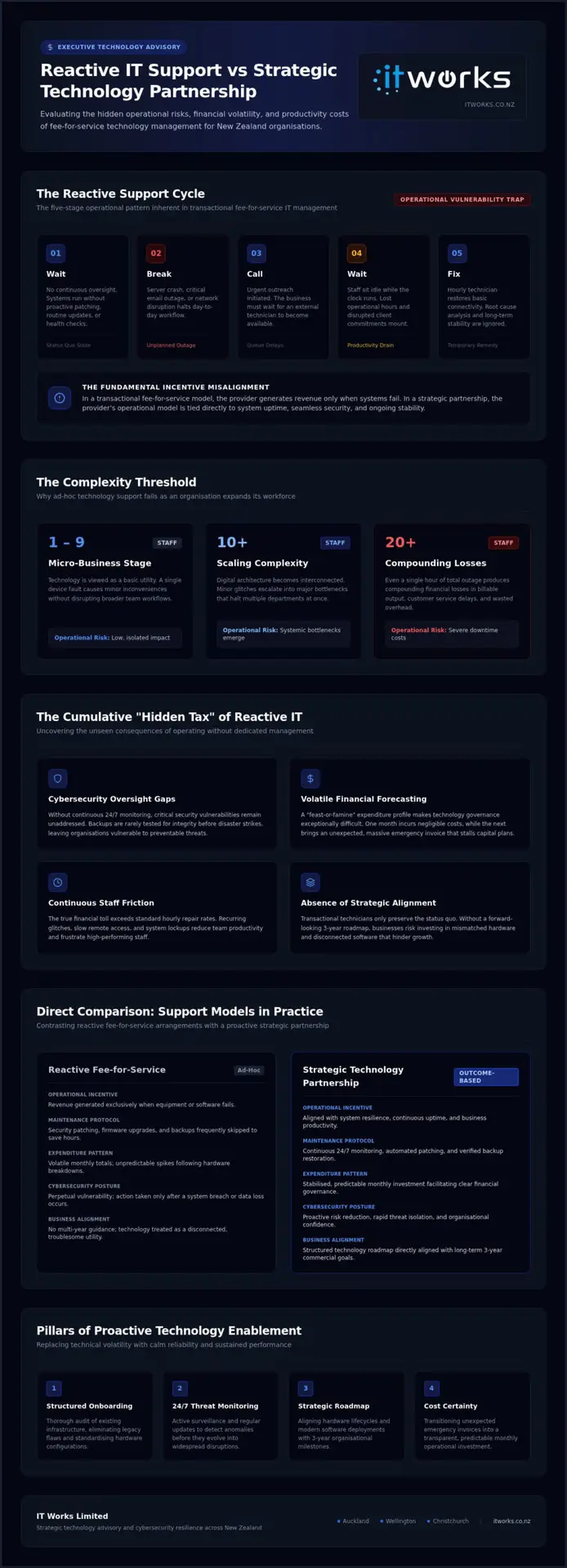
The break-fix model is a reactive approach to technology management where an organisation only contacts an IT provider when something is already broken. It’s often described as a “fee-for-service” relationship. In this scenario, the IT provider charges an hourly rate or a flat fee to resolve a specific issue. While this might seem cost-effective on the surface, it creates a fundamental misalignment between the business and the technician. Because the provider only generates revenue when your technology fails, there’s little financial incentive for them to ensure your systems remain stable in the long term. This transactional nature means you’re essentially paying for failure rather than uptime, which can lead to friction when you need support the most.
Common triggers for a call include server crashes, widespread email outages, or critical hardware failures. In a world where organisations rely on constant connectivity and robust security, waiting for a total failure before taking action is becoming increasingly risky. The break-fix-modell simply isn’t designed to handle the complexities of modern cybersecurity or the need for seamless remote access. It treats technology as an isolated component rather than a connected system that powers your daily operations.
How the Reactive Approach Works
The cycle follows a predictable, albeit stressful, pattern: “Wait, Break, Call, Wait, Fix”. When a system goes down, the business waits for a technician to become available. Once they arrive, the focus is almost entirely on speed of repair rather than identifying the root cause. Because you’re paying by the hour, the goal is to get the lights back on as quickly as possible. This approach often ignores ongoing maintenance, such as security patching or firmware updates, which are the very things that prevent future outages. Without a dedicated eye on the horizon, your technology remains in a state of perpetual vulnerability, leaving you open to risks that could have been avoided.
Who Typically Uses Break-fix?
This model is often the starting point for small startups or micro-businesses where technology is viewed as a simple utility. If a single laptop fails, the impact on the overall business is usually manageable, for standalone device troubles or component issues, one might simply check out Pleasanton Computer Repair or a specialist workshop for an isolated fix. However, as an organisation grows beyond 10 staff, the complexity of the digital environment increases significantly. What was once a minor inconvenience becomes a major bottleneck that affects multiple people simultaneously. For growing NZ organisations, relying on the break-fix-modell introduces operational risks that can stall growth and compromise data security. Scaling businesses need a strategic ally who understands their goals, not just a repair person who shows up when things go wrong.
The Hidden Risks and Costs of Reactive IT
While the initial bill for a single repair might seem low, the cumulative hidden tax of reactive IT can be staggering. When an organisation relies on the break-fix-modell, they’re essentially operating without a safety net. There’s no one monitoring for vulnerabilities or ensuring that backups are actually functional before a disaster strikes. This lack of oversight creates a significant cybersecurity gap. Instead of building resilience, the business remains in a state of high risk, waiting for a breach or a failure to trigger a response. True confidence comes from knowing your systems are being watched 24/7, not just when they stop working.
Beyond the immediate technical risks, there’s a profound lack of strategic alignment. In a reactive setup, no one is looking at how technology could actually enable your business success over the next three years. You’re simply maintaining the status quo. This absence of a big picture perspective means you might be investing in hardware or software that doesn’t fit your long-term goals, leading to wasted capital and missed opportunities for productivity gains. A strategic partner helps you avoid these pitfalls by aligning your IT roadmap with your actual business objectives.
Unpredictable Budgeting and Cash Flow
For executive teams, the feast or famine nature of reactive IT expenses makes financial governance incredibly difficult. One month, the IT spend might be negligible; the next, a major server failure or a complex network issue results in a massive, unbudgeted invoice. These unexpected costs can easily derail other critical business projects or expansion plans. Without predictable technology costs, it’s nearly impossible to forecast annual spend accurately, which often leads to unnecessary tension during board-level budget reviews. Transitioning away from the break-fix-modell allows for a stabilised, monthly investment that is much easier to manage.
The Productivity Drain
The true cost of an outage isn’t just the technician’s hourly rate. It’s the cost of your team sitting idle while the clock is ticking. For an organisation with 20 or more staff, even an hour of total downtime represents a significant loss in billable time or operational output. Beyond the major crashes, recurring minor glitches often erode staff morale and efficiency over time. When employees feel that their tools are unreliable, their engagement drops and frustration mounts. Fixing a problem after it has already stalled your team is always more expensive than preventing it through proactive management. You can discuss your technology strategy with a partner who prioritises your uptime and long-term stability.
Break-fix vs Managed IT Services: A Comparison
The fundamental choice for NZ organisations isn’t just about how you pay for support; it’s about what you’re actually buying. When you rely on the break-fix-modell, you’re purchasing a technician’s time to resolve a specific failure. In contrast, managed services allow you to purchase a specific business outcome: uninterrupted productivity. This shift from a transactional vendor relationship to a long-term technology partnership changes everything from your daily operations to your strategic planning. It moves the focus from “how do we fix this?” to “how do we ensure this never happens again?”
The most significant difference between these two models lies in the incentive structure. In a break-fix arrangement, the provider profits from your technical misfortune. If your server stays down for four hours, they earn four hours of revenue. There’s no financial penalty for them if the same issue recurs next month; in fact, it results in more billable work. This creates a natural friction between your need for stability and their need for billable hours.
Service Level Expectations
Reactive support typically operates on a “best effort” basis. When you call, you’re added to a queue, and your priority depends on how many other clients are currently experiencing failures. Managed IT services provide a much higher standard of care through proactive monitoring and dedicated helpdesk support. Because your partner knows your environment inside out, they can often resolve a potential failure before your staff even notice a glitch. For a deeper look at how this works, you can read our Guide to Managed IT Support for New Zealand Organisations. Having a team that is already familiar with your systems and business goals ensures that any support you do need is fast, accurate, and contextually relevant.
Why NZ Organisations are Prioritising Strategic Partnerships
The New Zealand technology landscape has evolved rapidly, moving far beyond the simple hardware setups of the past. For organisations in Auckland, Wellington, and Christchurch, the sheer complexity of modern systems means that the old break-fix-modell is no longer a viable strategy for success. Business leaders are increasingly realising that technology is the backbone of their operations, and any disruption carries significant financial and reputational weight. This shift in perspective has transformed cybersecurity from a niche technical concern into a central boardroom-level priority. It’s about building a foundation of resilience that allows your team to work with confidence, knowing their digital environment is secure and stable.
Strategic partnerships provide the foresight needed to navigate this complexity. Instead of patching holes as they appear, a dedicated partner helps you build a Technology Roadmap that aligns with your long-term growth. This is particularly crucial as we look toward AI readiness. Safe adoption of AI and automation requires a proactive management approach to ensure data governance and security are handled responsibly. By prioritising a connected system over isolated repairs, you ensure your organisation is ready to embrace new developments without compromising stability.
Building Organisational Resilience
Resilience isn’t just about having a backup; it’s about having a tested plan for business continuity. In the modern NZ market, layered security solutions and robust disaster recovery protocols are essential for protecting against disruption. By focusing on risk reduction and resilience, you create an environment where technical issues are caught before they become crises. This proactive stance is at the heart of Cyber Security for Small Business NZ: Building Resilience and Confidence. When your systems are designed for continuity, your organisation can weather unexpected challenges without stalling its momentum.
Technology as a Catalyst for Growth
The most successful organisations have moved away from simply “making it work” and are now focused on “making it better”. Strategic advisory plays a vital role here, helping General Managers and business owners make informed budget decisions based on long-term value rather than immediate repair costs. By integrating AI and automation into your workflows, you can significantly boost productivity for your SME. A strategic partner acts as a guide, identifying where these new developments can have the most impact while remaining grounded in practical stability. This approach turns technology into a purposeful tool for growth rather than a recurring source of stress.
Transitioning to Proactive Support with IT Works
Moving away from the technical volatility of the break-fix-modell is a significant step toward organisational maturity. It marks the moment you stop treating IT as a series of expensive problems and start viewing it as a strategic asset. IT Works acts as a seamless extension of your organisation, providing the deep expertise and steady guidance required to navigate modern technical challenges. Our goal is to replace the typical stress of system management with a sense of calm reliability, allowing your executive team to focus on the work that truly drives your business forward.
The journey begins with a comprehensive audit of your existing environment. This process identifies immediate risks and areas where productivity is being leaked through recurring glitches. We then translate these findings into a structured technology roadmap. This long-term plan ensures your investment is purposeful, focusing on security, stability, and growth. You gain the confidence that your systems aren’t just running; they’re actively supporting your organisational goals.
Our service delivery model provides a blend of 24/7 remote helpdesk support and on-site technical assistance across New Zealand. This national reach ensures that your team has access to expert help whether they are working in a central office or remotely. By combining rapid remote response with a physical presence when needed, we provide a complete support ecosystem that scales with your needs.
A Tailored Approach to Managed IT
Every organisation has different requirements based on their staff size and operational complexity. We don’t believe in rigid, generic packages. Instead, we design a service that fits your specific needs, whether you’re a growing team of 15 or a larger national entity. Being a New Zealand-based team, we offer a level of trust and cultural alignment that is essential for a long-term partnership. We understand the local market and the specific challenges faced by NZ businesses. For a closer look at how this works in a local context, you can explore our insights on Managed IT Services Wellington: Strategic Technology for NZ Organisations.
Taking the Next Step
If you’re constantly wondering when the next technical failure will occur, your current break-fix-modell is likely holding you back. Evaluating your current arrangement is a practical step toward building a more resilient business. We take a non-fear-based approach to technology management, prioritising risk reduction and resilience over scare tactics. Our focus remains on practical business applications and sustainable results. When you’re ready to move from reactive repairs to a strategic partnership, we’re here to guide the way.
Stabilising Your Technology for Long-term Success
Choosing the right support model is about more than just managing monthly costs. It’s about ensuring your organisation has the practical stability to scale without technical interruptions. Moving away from the break-fix-modell allows you to shift your focus from constant reactive repairs to purposeful strategic growth. By partnering with a team that prioritises your business outcomes, you gain access to layered cybersecurity expertise and a clear technology roadmap tailored to your specific needs.
Our NZ-based team of advisors is dedicated to providing proactive management that builds organisational confidence and resilience. We believe that technology should act as a steady guide for your success, replacing the stress of technical failure with a sense of calm reliability. Transitioning to a managed partnership ensures your technology budget remains predictable while your team stays productive and focused on their core priorities.
Talk to IT Works about your technology strategy
We look forward to helping you build a more resilient and efficient future for your organisation through a partnership grounded in practical results.
Frequently Asked Questions
Is the break-fix model cheaper for a small business?
While the break-fix-modell might seem cheaper initially because you only pay for repairs, it often proves more expensive as your organisation grows. The hidden costs of staff downtime and the lack of proactive maintenance lead to higher long-term expenses. Unpredictable invoices also make financial governance difficult. A managed service provides a fixed monthly cost that covers prevention, ensuring your technology budget remains stable while your team stays productive.
What is the main difference between break-fix and managed services?
The main difference lies in the incentive structure and the approach to maintenance. In a reactive arrangement, you pay a technician to fix a failure after it has already occurred. Managed services focus on outcomes, where your partner is financially incentivised to ensure your systems never fail in the first place. This moves your relationship from a transactional vendor model to a long-term strategic partnership that prioritises your organisational success.
Does managed IT support include cybersecurity?
Modern managed IT support prioritises cybersecurity as a core component of your technical stability. This includes layered security measures such as continuous monitoring, endpoint protection, and identity management to build resilience. Instead of just reacting to a breach, a proactive partner identifies vulnerabilities and manages risks before they can cause disruption. This approach gives executive teams confidence that their digital environment is secure and compliant.
How does a managed service provider reduce my business downtime?
A managed partner reduces downtime by identifying and resolving potential issues before they escalate into critical failures. Through continuous system monitoring and regular maintenance, many glitches are fixed behind the scenes without your staff ever noticing a problem. This proactive approach ensures your technology remains reliable. It replaces the frantic energy of emergency repairs with a sense of calm, predictable performance that supports your daily operations.
Can I switch from break-fix to managed services easily?
Transitioning from a break-fix-modell to managed services is a straightforward process when handled by an experienced partner. It begins with a comprehensive audit of your current systems to identify immediate risks and performance gaps. From there, we develop a technology roadmap that guides the transition without disrupting your daily work. This structured onboarding ensures your team feels supported while we align your technology with your long-term business goals.
Why should I choose a New Zealand-based IT partner?
Choosing a New Zealand-based partner ensures your advisors understand the local business environment and share your cultural values. This proximity fosters a deeper level of trust and accountability that is difficult to achieve with offshore providers. A local team provides relevant advisory and support that is grounded in the practical realities of the NZ market. It ensures your strategic guidance is contextually accurate and your support is always approachable.
Will managed IT services help with my Microsoft 365 management?
Managed services provide comprehensive Microsoft 365 management to ensure your team is getting the most value from their tools. This includes licence optimisation, secure SharePoint configuration, and ongoing support for Teams. A strategic partner helps you use these applications to boost productivity and collaboration across your entire organisation. It ensures your cloud environment is properly managed, secure, and aligned with your specific operational requirements.
How do managed services support my business growth?
Managed services support growth by providing the strategic foresight needed to scale your technology alongside your business. Through regular advisory and technology roadmapping, your partner ensures your infrastructure is ready for expansion before it becomes a bottleneck. This proactive planning allows you to adopt new tools, such as AI and automation, securely and responsibly. It turns your technology into a purposeful catalyst for success rather than a recurring obstacle.