The most expensive way to manage your technology is to wait for it to break before you fix it. While the traditional “break-fix” model feels familiar to many New Zealand business owners, it often leads to a cycle of recurring downtime and unpredictable invoices that stall momentum. Investing in professional network monitoring services nz organisations can rely on represents a shift from firefighting to foresight. It is about identifying a failing hard drive or a security vulnerability before it results in a system-wide outage, ensuring your team stays productive without the stress of constant technical hurdles.
We understand the frustration of seeing staff morale dip when systems fail, or the quiet anxiety that comes with unseen security risks. You deserve a technology environment that feels calm, reliable, and managed behind the scenes. In this article, we’ll discuss how transitioning to proactive IT monitoring stabilises your daily operations and protects your sensitive data. We will also explore how this strategic approach provides the predictable costs and organisational resilience you need to fuel long-term growth and focus on your core business priorities.
Key Takeaways
- Understand why the “break-fix” cycle costs your business more than just repair fees by impacting staff productivity and your professional reputation.
- Learn how the network monitoring services nz organisations rely on act as an early warning system to catch hardware and software issues before they cause an outage.
- Discover how continuous oversight provides the data needed to build a clear Technology Roadmap and transition to a predictable, flat monthly budget.
- Identify the practical steps for auditing your current infrastructure and establishing clear success metrics for your technology performance.
- Explore how a locally based strategic partner focuses on business outcomes rather than just technical uptime to support your organisation’s long-term growth.
The Hidden Cost of Reactive ‘Break-Fix’ IT Support
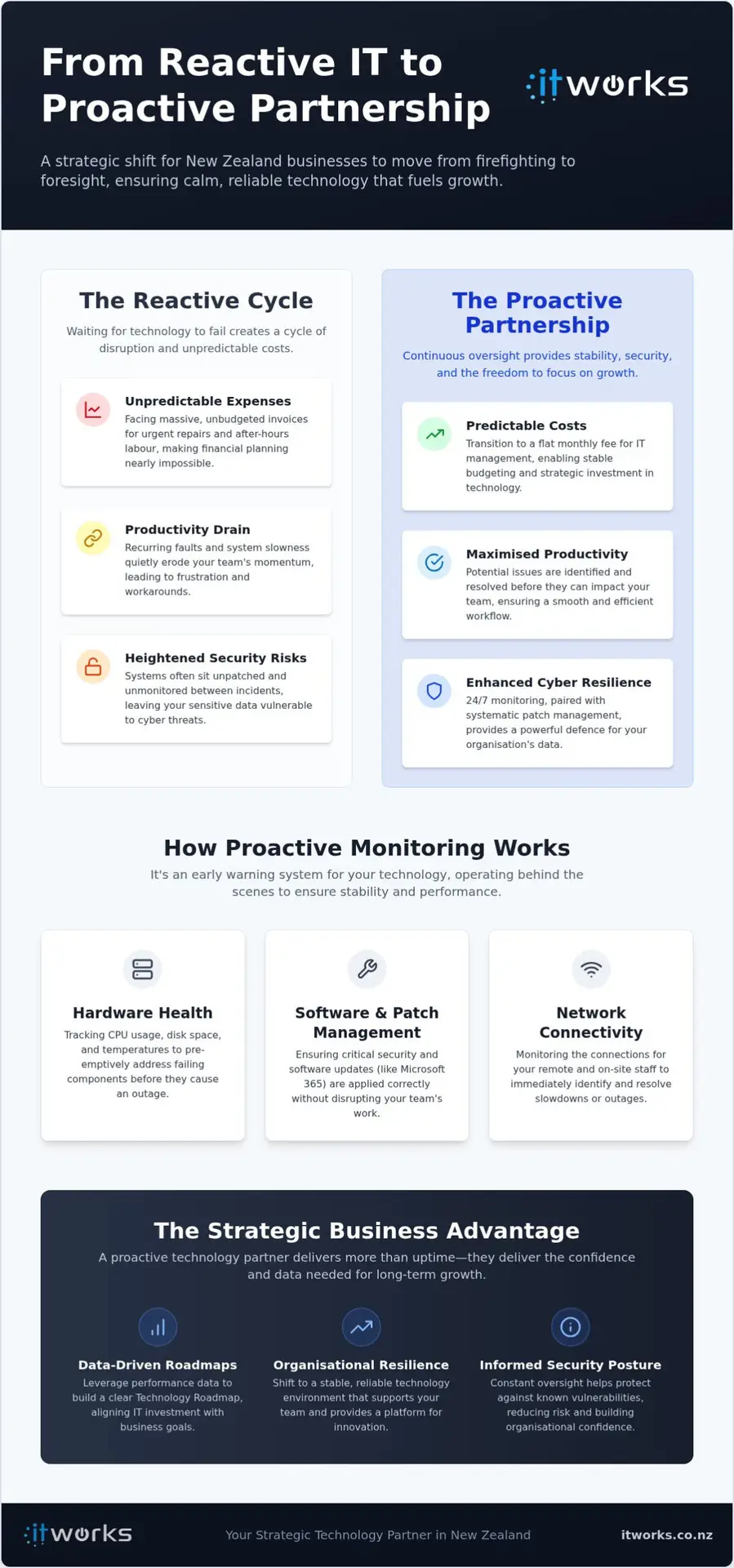
Managing IT through a “fire extinguisher” approach creates a constant state of high-alert stress. You wait for a system to fail, scramble to find a fix, and then wait for the next alarm to sound. This cycle prevents any real progress because your resources are entirely consumed by the present moment. For many New Zealand organisations, the true cost of this reactive model isn’t just the repair bill. It’s the missed opportunities for growth and the constant drain on leadership energy.
Budgeting becomes nearly impossible when you’re reliant on emergency repairs. You might face a month of stability followed by a massive, unbudgeted invoice for urgent hardware replacements or after-hours labour. This financial volatility makes it difficult to invest in the strategic technology that actually moves your business forward. When you’re stuck in this loop, you’re essentially accumulating technical debt. You apply quick patches to keep things running, but you never address the underlying architectural issues. This is where professional Network monitoring becomes essential. Without it, you’re simply treating symptoms while the root causes continue to fester.
The Productivity Drain of Recurring Faults
Total outages are obvious, but “micro-downtime” is often more damaging over time. A slow network that takes ten seconds longer to load a file, or an application that crashes once a day, quietly erodes your team’s momentum. Staff quickly become disillusioned when their tools feel like obstacles rather than enablers. They stop looking for ways to innovate and instead settle into a rhythm of workarounds. This psychological shift is hard to reverse and directly impacts your bottom line. Fixing a symptom might get a staff member back to work for an hour, but it doesn’t resolve the underlying instability that caused the glitch in the first place.
Security Risks in a Reactive Environment
A reactive environment is a playground for modern cyber threats. If your IT support only engages when something breaks, your systems likely sit unpatched and vulnerable during the quiet periods in between. Relying on network monitoring services nz providers helps bridge this gap by ensuring oversight is constant rather than occasional. In the first quarter of 2026, the NCSC recorded 1,164 incidents in New Zealand, many of which targeted known vulnerabilities that a proactive system would have identified. Security isn’t a one-off project; it’s a continuous state of oversight that ensures your data remains protected even when everything seems to be running smoothly.
Defining Proactive IT Monitoring: More Than Just Alerts
Proactive IT monitoring is the continuous oversight of technology systems to detect and resolve potential issues before they result in operational downtime. It functions as a sophisticated early warning system, identifying subtle shifts in performance that usually precede a major failure. By choosing specialised network monitoring services nz businesses gain a background process that operates 24/7, ensuring that visibility doesn’t stop when your office lights go out. Unlike reactive support, which only activates after a crisis, this model provides a steady stream of data about your infrastructure’s health.
It’s vital to distinguish between monitoring and management. Monitoring is the act of seeing the problem, while management is the strategic organisation of the fix. Seeing that a server is running hot is the first step, but having a partner who can remotely adjust workloads or schedule a part replacement before the hardware fails is what creates true resilience. This level of oversight is a cornerstone of effective business continuity planning, moving your organisation away from high-stress emergencies toward a state of calm reliability.
The Core Components of a Monitoring Service
- Hardware health: We track CPU usage, disk space availability, and internal temperatures. If a drive shows signs of mechanical fatigue, it’s flagged for replacement before it crashes.
- Software and Patch Management: Keeping Microsoft 365 and security software updated is a non-negotiable task. Monitoring ensures these updates are applied correctly without disrupting your team’s workday.
- Network Connectivity: We monitor the “pipes” that connect your remote and on-site staff. If a connection drops or slows down, we know immediately, often before your staff even notice a lag.
Automated Maintenance and Self-Healing
Modern monitoring tools go beyond simple observation by incorporating “self-healing” capabilities. If a specific background service fails or an application hangs, automated scripts can restart the process instantly without human intervention. This immediate response reduces the need for disruptive on-site visits and keeps your systems lean and fast. It’s a methodical way to handle routine maintenance, ensuring your technology environment remains stable while your team focuses on growth. If you want to see how these systems could work for you, discuss your technology strategy with a partner who understands the local New Zealand context.
The Strategic Business Case for Continuous System Oversight
Continuous system oversight is more than a safety net; it’s a strategic asset that allows leadership teams to plan with certainty. When you move away from the chaos of reactive repairs, you gain access to a wealth of performance data that directly informs your Technology Roadmap. Instead of guessing when a server might need replacing or whether your cloud infrastructure is over-provisioned, you have hard evidence to guide your future investments. This transition replaces the lumpy, unpredictable costs of emergency call-outs with a flat, manageable monthly fee. For many New Zealand organisations, this shift alone provides the financial breathing room needed to focus on scaling operations without the fear of a sudden technical bottleneck.
Confidence is a quiet but powerful driver of business success. Knowing that local experts are watching the perimeter of your network allows you to dedicate your full attention to client service and internal innovation. By utilising network monitoring services nz businesses can rely on, you ensure that technology remains a silent, efficient partner. This oversight doesn’t just keep the lights on; it identifies the optimal time to upgrade systems, ensuring you never over-invest in redundant hardware or stay tethered to legacy tools that hinder your growth.
Data-Driven Decision Making
Monitoring reports provide a clear view of your infrastructure’s true performance. You can identify which devices are reaching their end-of-life based on actual usage patterns rather than arbitrary industry lifecycles. This moves your procurement strategy from the vague feeling of “we think we need this” to the clarity of “we know we need this”. Budgeting with certainty becomes the norm because your decisions are backed by real-world data, ensuring every dollar spent on technology is a purposeful investment in your organisation’s future.
Enhancing Organisational Resilience
A proactive approach is a fundamental component of a robust Backup and Disaster Recovery strategy. By spotting failures instantly, we significantly reduce your Recovery Time Objective (RTO). You no longer lose hours simply discovering that a system has gone offline. Instead, the response begins the moment a deviation is detected. This speed builds a culture where technology is viewed as a reliable foundation, removing the underlying stress that often accompanies technical growth and allowing your team to scale with confidence.
Five Steps to Transitioning Your Organisation to Proactive Management
Transitioning from a reactive “break-fix” model to a managed environment is a deliberate process. It requires more than just installing software; it’s about shifting your organisational mindset and aligning your technical infrastructure with your long-term business objectives. By following a structured pathway, you can ensure that your network monitoring services nz investment delivers measurable value from day one.
- Step 1: The Technology Audit. We begin by identifying every asset, from on-site servers to remote laptops, and uncovering hidden vulnerabilities that could compromise your operations.
- Step 2: Defining Success Metrics. We establish clear uptime targets, security baselines, and response times. These metrics ensure that our technical priorities remain perfectly aligned with your commercial goals.
- Step 3: Deploying the Monitoring Layer. Lightweight agents are installed across all endpoints. These tools provide constant oversight without slowing down your team’s devices or disrupting their workflow.
- Step 4: Establishing a Response Framework. We define clear accountability for every alert. This prevents the “who’s on first” confusion during a glitch, ensuring that the right expert acts immediately.
- Step 5: Regular Strategic Reviews. We use the collected performance data to refine your Technology Roadmap. Quarterly consultations ensure your IT strategy evolves alongside your business.
The Importance of the Initial Audit
A comprehensive audit is the foundation of any resilient system. You simply cannot monitor or protect what you haven’t documented or accounted for. This phase allows us to clear out “shadow IT” and legacy systems that often create unnecessary risk for the business. These are the forgotten applications or old hardware that don’t receive updates but remain connected to your network. By identifying every piece of hardware and software currently in use, we set a clean baseline for future growth. This clarity is essential for effective Managed IT Support, ensuring that your technology environment is visible, secure, and ready to scale.
Aligning Monitoring with Business Goals
Your technology should mirror your executive priorities. If your organisation relies on hybrid teams, your monitoring must prioritise secure, high-performance remote access. This creates a feedback loop where the technical helpdesk data informs the leadership team’s strategic decisions. As you look toward emerging trends like AI automation, having a proactive framework ensures you can adopt new tools safely and with proper governance. It’s about staying ahead of the curve while maintaining the stability your daily operations require. This alignment ensures that IT isn’t just a cost centre, but a strategic partner in your success.
How IT Works Delivers Resilient Monitoring and Strategic Growth
At IT Works, we believe that technology should enable your success rather than merely existing as a background utility. Our philosophy centres on outcomes. While uptime is a critical baseline, our primary goal is to ensure your infrastructure supports your long-term growth and operational stability. By providing professional network monitoring services nz organisations can trust, we act as a strategic advisor that understands the specific challenges of the local market. We don’t just watch screens; we interpret data to help you make better business decisions.
Being a New Zealand-based team means we offer a level of accountability and local context that distant service providers cannot match. When you have a question about your technology roadmap or a specific security concern, you speak with experts who understand your environment. This local presence is the foundation of our Managed IT Services, ensuring that monitoring data is always translated into actionable business advice. It moves the conversation from “is the server on?” to “how can we make this system more efficient for your staff?”
A Partnership Model, Not a Helpdesk
We view our role as an extension of your internal team. A traditional helpdesk reacts to tickets; a strategic partner anticipates needs. We blend operational excellence with forward-thinking guidance to ensure your systems remain lean, fast, and secure. This approach positions Cyber Security as a confidence-builder for your board rather than a source of anxiety. When leadership knows the perimeter is monitored and managed by a dedicated partner, they can focus on high-level strategy and innovation without the distraction of technical instability.
Next Steps for Your Organisation
The journey away from the stress of reactive repairs begins with a simple technology review. We assess your current posture, identify high-risk areas, and document your existing assets to create a clear baseline. In the first 30 days of moving to a proactive management model, you can expect a marked decrease in technical hurdles as we apply baseline optimisations and deploy our oversight layer. This transition replaces the frantic energy of “break-fix” support with a methodical, planned approach to your future. Talk to IT Works about your technology strategy to discover how a proactive approach can stabilise your operations and fuel your long-term growth.
Securing Your Organisation’s Future Through Foresight
Moving away from the high-pressure “break-fix” cycle is a fundamental step toward building a resilient business. By replacing reactive repairs with professional network monitoring services nz organisations gain the visibility needed to identify risks before they escalate into costly outages. This approach doesn’t just protect your uptime; it provides the empirical data required to develop a Strategic Technology Roadmap that supports your long-term objectives.
Since 2004, our New Zealand-based advisory team has acted as a steady guide for businesses across the country. We focus on creating technology environments that feel reliable and managed, allowing you to dedicate your full attention to growth and client service. Our commitment to delivering clear, strategic roadmaps ensures that your IT investment always remains in lockstep with your commercial priorities. Transitioning to a proactive model replaces financial unpredictability with a structured, calm approach to infrastructure management.
We look forward to helping you turn your technology into a purposeful asset that drives your organisation forward with confidence and clarity.
Frequently Asked Questions
What exactly does ‘proactive’ mean in the context of IT services?
In the context of IT services, proactive means taking action to prevent a problem before it disrupts your operations. Instead of waiting for a hardware failure or a software crash to occur, we use continuous oversight to identify the early warning signs of instability. This approach allows us to perform maintenance or replace components during scheduled windows, ensuring your team stays productive and your technology remains a reliable asset for growth.
Will proactive monitoring slow down my staff’s computers or the network?
No, modern monitoring tools are designed to be incredibly lightweight and non-intrusive. The agents we install on your endpoints consume minimal system resources, ensuring that your staff won’t notice any performance lag during their workday. In fact, by identifying and clearing out background processes or memory leaks that shouldn’t be there, proactive monitoring often leads to a smoother and faster experience for your team across the entire network.
How much does proactive IT monitoring typically cost for a New Zealand SME?
Pricing for network monitoring services nz organisations utilise is typically structured as a predictable, flat monthly fee. This model moves your technology spend from lumpy, unpredictable emergency costs to a manageable operational expense. The exact investment depends on the complexity of your infrastructure and the number of staff members being supported. We focus on providing a service that delivers long-term value by reducing the significant financial impact of unplanned downtime.
Can proactive monitoring prevent all cyberattacks and system failures?
While no system can guarantee 100% protection, proactive monitoring significantly reduces the likelihood and impact of both cyberattacks and system failures. It allows for the rapid detection of anomalies that might indicate a breach or a hardware fault. By catching these issues in their earliest stages, we can often intervene before they escalate into a major crisis, ensuring your data remains secure and your business continuity plan is effectively supported.
Do we still need a helpdesk if we have proactive monitoring in place?
Yes, proactive monitoring and a responsive helpdesk are complementary components of a complete managed service. While monitoring catches and resolves many technical hurdles behind the scenes, your staff will still occasionally need direct assistance with user-specific tasks or new software queries. At IT Works, our helpdesk team uses the data from our monitoring tools to provide faster, more informed support when your team does need to get in touch.
How does monitoring help with Microsoft 365 and cloud-based applications?
Monitoring provides visibility into how your team interacts with cloud-based tools like Microsoft 365. We track performance metrics to ensure connectivity is stable and monitor security logs to identify unauthorised access attempts. Additionally, this oversight helps with licence optimisation, ensuring you aren’t paying for subscriptions that aren’t being used. It ensures your cloud environment is configured correctly and remains secure, which is vital for supporting hybrid and remote work patterns.
What is the difference between proactive monitoring and traditional managed services?
Proactive monitoring is a core pillar of modern Managed IT Services, whereas traditional managed services were often just a rebranded version of reactive support. A truly proactive model focuses on reducing the number of support tickets by fixing root causes before they affect the user. Traditional services often wait for you to report a problem. Our approach prioritises strategic alignment and risk reduction, acting as a long-term partner rather than just a technical fix-it service.
Can proactive monitoring help our organisation meet compliance or insurance requirements?
Yes, having robust monitoring in place is increasingly becoming a requirement for cyber insurance and regulatory compliance in New Zealand. Insurers often require proof of active patch management and continuous security oversight before granting coverage. By maintaining detailed logs and ensuring your systems meet the NCSC Critical Controls, proactive monitoring provides the necessary evidence that you are taking reasonable steps to protect personal information and maintain organisational resilience.