
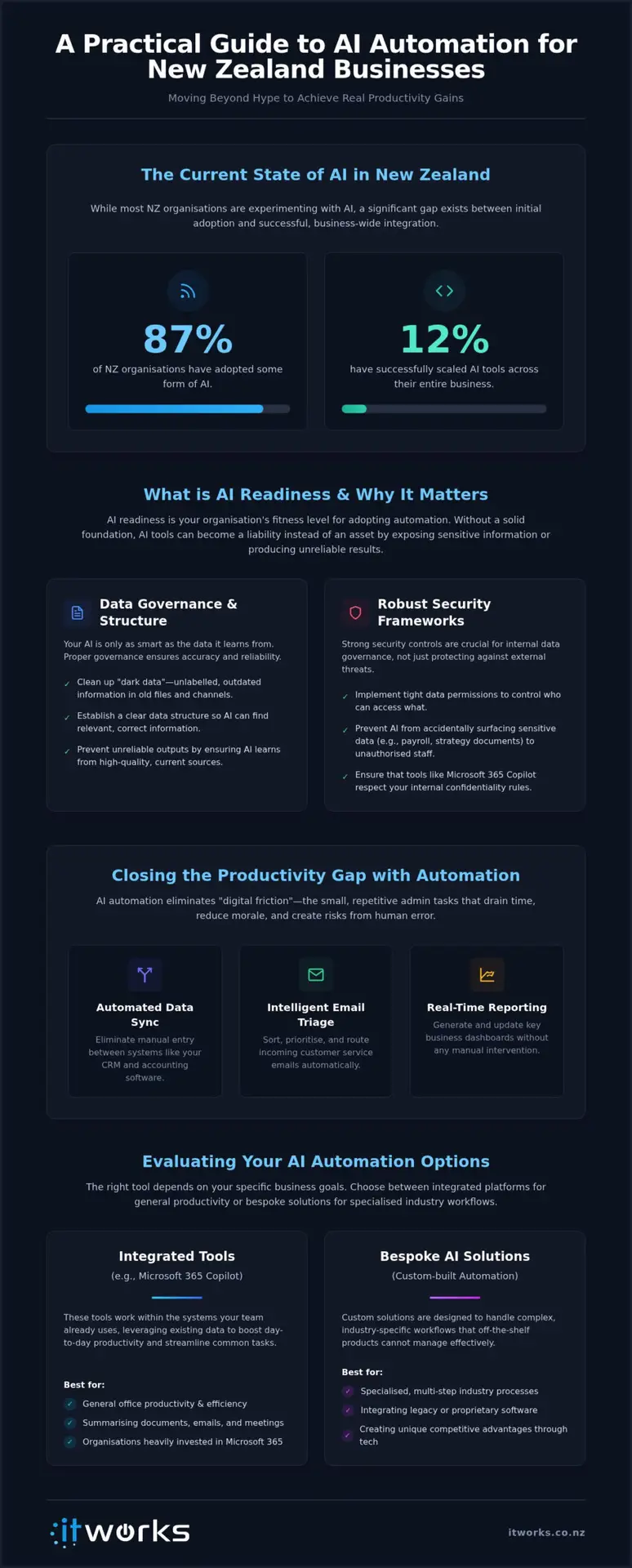
While 87% of New Zealand organisations have already adopted some form of AI, a mere 12% have successfully scaled these tools across their entire business. This gap often stems from a valid concern: how do you embrace innovation without compromising your data or overcomplicating your systems? Many leaders feel the weight of staff spending far too much time on repetitive admin, yet they hesitate to deploy AI automation solutions New Zealand teams can trust due to uncertainty around privacy and security.
We understand that you want to move beyond surface-level experimentation and achieve meaningful productivity gains. This guide provides a clear path to help you organise your data and security frameworks, ensuring your team can use tools like Microsoft 365 Copilot with absolute confidence. We will explore how to assess your current AI readiness, address the risks of unmanaged AI tools, and implement a strategic roadmap that aligns technology with your long-term business outcomes. By focusing on practical application rather than hype, you can empower your staff and secure your organisation’s competitive position in a steady, sustainable way.
Key Takeaways
- Move beyond the hype to understand how practical AI automation can be integrated into your organisation to drive real-world productivity and staff satisfaction.
- Discover why “AI readiness” is a critical first step, ensuring your data maturity and security frameworks are robust before you deploy any new technology.
- Compare the benefits of integrated tools like Microsoft 365 Copilot against bespoke AI automation solutions New Zealand businesses use for specialised industry workflows.
- Identify a structured five-step approach to building a technology roadmap that focuses on eliminating admin bottlenecks while maintaining strict data governance.
- Understand the value of a strategic partnership to manage AI enablement as a long-term asset that evolves alongside your specific business goals.
Understanding AI Automation Solutions in New Zealand
NZ organisations are no longer just watching from the sidelines. With 87% of local businesses already using some form of AI as of late 2025, the conversation has shifted from curiosity to practical application. At its core, Artificial intelligence (AI) in a business context isn’t about replacing people; it’s about refining the way work gets done. While traditional automation follows a rigid “if this, then that” rule, modern AI automation solutions New Zealand companies are now adopting involve systems that can interpret data, predict needs, and handle complex workflows. This shift allows your organisation to scale operations and increase output without the immediate need to expand your headcount. It provides a way to grow sustainably by making your existing team more effective. While a simple macro might move a file from one folder to another, an intelligent workflow can read an incoming invoice, verify it against a purchase order, and flag discrepancies for review.
The Productivity Gap in NZ Business
Many teams in Auckland and Wellington find themselves bogged down by “digital friction.” These are the small, repetitive admin tasks that consume hours every week, from manual data entry to triaging internal emails. These processes don’t just waste time; they introduce a high risk of human error that can ripple through your financial or operational reporting. By implementing smart automation, you remove these bottlenecks and create a smoother operational flow. Common areas where automation provides immediate relief include:
- Automated data synchronisation between CRM and accounting software.
- Intelligent email sorting and prioritisation for customer service teams.
- Real-time reporting dashboards that update without manual input.
The result is a noticeable lift in staff morale. When your team spends less time on drudgery and more time on high-value, strategic work, retention rates tend to improve. It turns technology into a tool for empowerment rather than a source of frustration.
As you automate and free up your staff for higher-level work, your recruitment needs may also evolve. In these instances, professional services such as WorkReferences provide candidates with employment verification, helping them transition into these new, high-value roles while giving your HR team confidence in their professional history.
Moving Beyond the Hype
As we move through 2026, the era of experimental AI is closing. Successful leaders are now focusing on integrated systems that deliver measurable outcomes. It’s easy to get distracted by flashy features, but effective AI automation solutions New Zealand leaders trust are always grounded in clear business goals. Before deploying any tool, it’s essential to identify the specific problem you’re trying to solve. Whether it’s reducing response times or improving data accuracy, the focus must remain on practical stability and long-term value. This methodical approach ensures that technology serves your strategy, rather than the other way around. By moving beyond the hype, you create a resilient framework that supports your business as it evolves without adding unnecessary complexity to your IT environment.
What is AI Readiness and Why Does It Matter?
AI readiness is essentially your organisation’s fitness level for adopting automation. It’s the measure of how mature your data is and how robust your security controls are. If you rush into AI automation solutions New Zealand businesses are currently exploring without this foundation, you risk surfacing sensitive information to the wrong people. This alignment is a key part of New Zealand’s first AI Strategy, which emphasises productivity through confident investment. Without a structured environment, an AI tool might accidentally reveal payroll details or confidential strategy documents to a junior staff member simply because they had broad access to a legacy folder. Readiness ensures that your technology is an asset rather than a liability.
For most organisations, the Microsoft 365 environment is the logical starting point. It’s where your emails, documents, and chats live. Before turning on features like Copilot, you must ensure your data permissions are tight. This isn’t just about external threats; it’s about internal data governance. If your SharePoint sites are “open to everyone” by default, your AI will assume it has permission to use all that data in its responses. You might want to talk to IT Works about your technology strategy to ensure your foundation is solid before you begin.
Data Governance and Structure
Cleaning up “dark data”, that unlabelled, forgotten information sitting in old Teams channels, is vital for accuracy. If your AI learns from outdated or incorrect files, its output will be unreliable. Establishing a logical structure for SharePoint and Teams ensures that your AI only indexes appropriate information. You also need clear policies for how staff interact with these tools to prevent accidental data leakage or misuse of automated workflows.
Security as a Foundation for AI
Security isn’t an optional extra; it’s the bedrock of any successful deployment. When choosing between public and private AI models, you’re deciding how much control you have over your intellectual property. Public models might use your queries to train their algorithms, whereas private models keep your data within your own tenant. A strong approach to cyber security for small business NZ organisations can trust provides the resilience needed to experiment safely. This includes strict identity management and MFA to ensure that only authorised users can trigger automated processes, keeping your organisational data protected and private. Equally important is ensuring your backup and disaster recovery NZ strategy is robust enough to protect the data your AI systems depend on, so that a ransomware attack or system failure doesn’t undermine your entire automation investment.
Evaluating AI Options: Copilot vs. Custom Automation
Deciding on the right path for AI automation solutions New Zealand organisations require involves a clear understanding of your specific operational needs. For many, the choice sits between leveraging integrated tools like Microsoft Copilot or investing in bespoke workflows. Off-the-shelf solutions offer the advantage of immediate deployment and familiar interfaces that your team already understands. Conversely, custom builds address niche industry requirements that standard software might miss. Each path has its place, but the decision should always be grounded in your long-term technology roadmap.
Analysing the total cost of ownership is vital. While a custom solution might seem attractive for its specificity, the long-term costs of maintenance, API updates, and security patches can add up quickly. Tools that already integrate with your existing software stack often provide a more sustainable return on investment. They inherit the security and governance frameworks you’ve already established, reducing the burden on your internal IT resources. This connected approach ensures that your data remains protected while your team gains new capabilities. Understanding how you structure these investments is equally important, reviewing your IT OpEx vs CapEx options as a New Zealand organisation can help you choose a funding model that keeps your AI spending predictable and aligned with your cash flow.
Maximising Microsoft Copilot
Copilot functions as an intelligent assistant within the apps your team uses every day. It can summarise long email threads in Outlook, draft project proposals in Word, or perform complex data visualisations in Excel. To get the most out of these features, refer to our Microsoft 365 management New Zealand guide to ensure your licensing and permissions are correctly configured. For executive teams, this means spending less time on meeting notes and more time on high-level decision-making. Project managers can use it to track milestones and identify potential risks in real-time, keeping teams aligned without manual status updates.
Specialised AI Workflows
Adopting AI automation solutions New Zealand organisations can rely on requires a methodical approach that prioritises stability over speed. A successful roadmap ensures that your investment translates into tangible business value rather than becoming a technical burden. By following a structured path, you can manage risks effectively and build internal confidence. This process begins with a clear-eyed look at your current operations before moving into technical deployment.
- Step 1: Conduct a thorough discovery. Identify the manual bottlenecks and repetitive tasks that consume your team’s time. Focus on areas where data is consistent but the processing is slow.
- Step 2: Assess and remediate gaps. Review your data security and governance. As we discussed earlier, cleaning up permissions and “dark data” is essential before any AI tool is introduced.
- Step 3: Select outcome-led tools. Choose technology based on the specific problems you need to solve. Prioritise tools that integrate naturally with your existing software to maintain a unified system.
- Step 4: Execute a pilot programme. Start with a small, high-impact team. This allows you to test the automation in a controlled environment and gather early data on its effectiveness.
- Step 5: Scale and refine. Use real-world feedback from your pilot team to adjust the workflow. Once the process is proven, you can gradually roll it out to the wider organisation.
Identifying Your High-Value Use Cases
Focusing on “quick wins” helps demonstrate immediate ROI and builds momentum for larger initiatives. You should distinguish between “nice-to-have” features and business-critical automation that solves a persistent pain point. For example, automating the initial triage of customer enquiries might be more valuable than a tool that simply summarises news articles. Every AI initiative must map back to your overall business technology strategy to ensure long-term alignment and growth.
Training and Change Management
Staff buy-in is the most critical factor in the success of any automation project. It’s vital to position AI as a productivity booster that handles the drudgery, not a tool meant to replace employees. Develop clear internal guidelines for responsible use so your team knows exactly how and when to use these new capabilities. Providing ongoing support is necessary as tools evolve, ensuring your staff feel confident and capable as the technology updates over time.
Practical AI Enablement with a Strategic Partner
Implementing AI automation solutions New Zealand organisations can depend on is rarely a one-time event. While a project-based agency might deliver a functional tool, they often lack the long-term commitment needed to ensure that tool remains secure and relevant as your business grows. A managed service approach integrates AI into your broader technology ecosystem, ensuring it evolves alongside your organisational goals. This continuity prevents the strategic drift that often occurs when technical projects are handled in isolation. By aligning your automation with your broader managed IT support services, you ensure that every new tool is supported by a robust infrastructure and a clear security framework.
The value of a local partner who understands the specific challenges of the New Zealand business landscape cannot be overstated. Whether you are operating in Wellington, Auckland, or Christchurch, having a guide who knows your regulatory environment and market conditions provides a sense of calm reliability. A structured approach to digital business transformation ensures that AI enablement is embedded within a broader modernisation strategy, rather than deployed as an isolated initiative. At IT Works, we act as a strategic ally, replacing the frantic energy of reactive technical support with a composed, deliberate presence. We focus on how technology enables your success, providing the steady guidance needed to navigate complex developments without the stress of going it alone.
Ongoing Governance and Support
AI performance and data security require constant monitoring to remain effective. As models update and new features are released, your governance policies must adapt to keep pace. We conduct regular roadmap reviews to ensure your AI automation solutions New Zealand strategy stays ahead of emerging trends while maintaining strict data integrity. This ongoing oversight provides the peace of mind that comes from knowing a locally-based support team is watching over your systems. It ensures that your automation remains a productive asset rather than a forgotten liability that could pose a security risk later.
The IT Works Approach to AI
Our methodology is built on outcomes, clear accountability, and business resilience. We intentionally avoid the hype surrounding new releases, focusing instead on practical, functional results that solve real problems for your team. This pragmatic approach ensures that every automation we implement is sustainable and adds genuine value to your operations. Our partnership model is consultative and low-pressure, designed to support your journey at a pace that suits your organisation. We believe that technology should be a quiet enabler of success, allowing you to focus on your core business while we manage the strategic complexities of your IT environment.
Securing Your Path to Intelligent Productivity
Successful automation isn’t about chasing every new trend. It’s about building a stable environment where technology serves your specific business goals. By prioritising AI readiness and data governance, you ensure that your organisation remains secure while gaining a distinct competitive advantage. Practical AI automation solutions New Zealand leaders can rely on are those grounded in strategic roadmaps and long-term resilience.
Our Wellington-based team is here to act as your steady guide. We combine deep expertise in Microsoft 365 with a focus on your unique productivity and security needs. Whether you’re in the early discovery phase or ready to scale a pilot programme, we provide the composed, strategic presence your organisation needs to grow with confidence.
Your journey toward a more efficient, AI-enabled workplace starts with a single, purposeful step. We look forward to helping you unlock the full potential of your team and your technology.
Frequently Asked Questions
How much does AI automation typically cost for an NZ organisation?
Costs vary based on the complexity of your requirements and the number of users involved. For many, the investment begins with per-user subscription fees for integrated tools. For small and medium businesses, the New Zealand government’s AI Advisory Pilot can co-fund up to 50% of expert advice costs. It’s important to view these costs as an investment in long-term productivity rather than a simple administrative overhead.
Will AI automation replace my employees?
AI is a productivity booster designed to augment your team, not replace them. By automating repetitive admin and data entry, your staff can focus on high-value tasks that require human judgement and empathy. Reports from 2025 show that 91% of NZ businesses using AI have seen improved efficiency. This shift often leads to higher job satisfaction as employees are freed from the most tedious parts of their daily workload.
Is my business data safe when using Microsoft Copilot?
Your data is safe if you use enterprise-grade tools like Microsoft 365 Copilot within a managed environment. Unlike free public AI tools, the business version keeps your data within your organisation’s tenant and doesn’t use it to train its global models. Safety depends on your internal data governance. Ensuring permissions are correctly set in SharePoint and Teams is a vital part of implementing AI automation solutions New Zealand organisations can trust.
Can AI automation work for non-profit organisations in New Zealand?
Absolutely, non-profits in Auckland and Wellington are increasingly using AI to manage donor databases and automate reporting. These tools allow smaller teams to handle complex administrative tasks without needing to increase their headcount. By reducing the time spent on manual data entry, non-profit leaders can direct more of their energy and funding toward their core mission. It’s an effective way to improve organisational resilience in a sector with tight resource constraints. A structured IT strategy for non-profits in NZ ensures that AI adoption sits within a broader technology roadmap, protecting donor data and enabling long-term operational resilience.
What is the first step my business should take toward AI adoption?
The first step is an AI Readiness assessment to evaluate your data maturity and security. You need to understand where your data lives and who has access to it before introducing automation. This discovery phase identifies the specific manual bottlenecks where AI can provide the most immediate value. Starting with a clear roadmap prevents technical complications and ensures that your first pilot project delivers a measurable return on investment for the organisation.
How long does it take to see a return on investment from AI?
ROI timing depends on the specific use cases you choose to automate first. Many organisations see productivity gains within three months by using AI for meeting summaries and document drafting. Larger financial returns from complex process automation often take six to twelve months to fully materialise. The key is to start with high-impact tasks that demonstrate immediate value to your team, building momentum for broader adoption across the business later.
Do we need to hire a specialised AI developer to get started?
You don’t typically need a specialised developer to start using AI automation solutions New Zealand businesses are adopting. Most modern tools are designed to integrate directly with your existing software stack, such as Microsoft 365. A strategic technology partner can help you configure these tools and manage the data governance without the need for bespoke coding. This approach is more sustainable and cost-effective for most organisations than hiring internal development talent.
What industries in NZ benefit most from AI automation solutions?
Professional services, finance, and manufacturing see some of the highest gains from automation. Law firms use AI for rapid contract review, while finance teams automate invoice processing and reconciliation. In manufacturing, AI helps with predictive maintenance and supply chain coordination. Any industry that relies on heavy data processing or repetitive administrative workflows will find significant opportunities to improve their efficiency and reduce human error through a structured approach to automation.