
According to the 2026 Kordia New Zealand Business Cyber Security Report, 61% of local organisations face major operational disruption following a cyber breach. This statistic is a sobering reminder that simply having a backup stored somewhere is no longer enough to guarantee your doors stay open. Many leaders find themselves caught in a cycle of uncertainty, wondering if their current technical setup could truly survive a significant event or if they are just one incident away from a prolonged shutdown. Understanding the nuances of business continuity vs disaster recovery nz is the first step toward replacing that anxiety with a sense of calm, strategic control.
We understand that technical terminology can often feel like a barrier to effective planning. You likely already recognise that resilience is vital, yet knowing where disaster recovery ends and business continuity begins remains a common challenge for many executive teams. This guide provides a clear framework to help you distinguish between these two critical functions, ensuring your organisation remains operational through any disruption. We will outline a logical path from technical recovery to broad organisational resilience, giving you the confidence that your team can maintain productivity and protect your reputation when it matters most.
Key Takeaways
- Recognise why traditional backups aren’t enough to prevent operational failure and how a proactive resilience strategy protects your brand’s reputation.
- Clarify the specific differences between business continuity vs disaster recovery nz to ensure both your people and your systems are ready for any event.
- Master the use of Recovery Time Objectives (RTO) and Recovery Point Objectives (RPO) to set realistic expectations for your organisation’s return to work.
- Gain a clear framework for conducting a Business Impact Analysis that identifies which functions are truly critical to your daily operations.
- Learn how partnering with a local, strategic advisor can replace the stress of technical management with a sense of calm, reliable stability.
Beyond the Backup: Why NZ Organisations Need a Resilience Strategy
Many New Zealand business owners feel a sense of security simply because they have a backup drive or cloud storage. However, having data saved is only one piece of the puzzle. True resilience is about the ability to keep working when things go wrong. This is where the distinction in business continuity vs disaster recovery nz becomes vital for long-term stability. It’s the difference between having a spare tyre in the boot and knowing how to change it while parked on a busy motorway. Without a plan to use those backups, they’re just dormant files taking up space.
A reactive “break-fix” approach treats IT as a utility that only matters when it’s broken. We view technology as a strategic asset that fuels growth and provides a competitive edge. By moving toward a proactive stance, you shift from frantic crisis management to a position of confident leadership. Business continuity planning allows an organisation to align its technical recovery with its broader commercial goals, ensuring that every piece of software and hardware serves a purpose in your wider success. This alignment turns technology into a foundation for stability rather than a source of stress.
The High Cost of Operational Silence
Downtime isn’t just a technical glitch; it’s a financial and reputational drain. Even a few hours of system silence can stall staff productivity and erode the hard-earned trust of your clients. Operational resilience is the ability to absorb shocks and keep moving. In a period where cyber security incidents are rising, we must move away from asking “if” a disruption will occur and focus on “when” it happens. The 2026 Kordia New Zealand Business Cyber Security Report found that 44% of medium-to-large local businesses were victims of a cyber-attack in the past year. Preparing for that moment ensures your organisation remains a steady, reliable presence in the market, regardless of external pressures.
Why Traditional Backups Often Fall Short
There’s a significant difference between simple data storage and a functional recovery system. A backup is merely a copy of information; it doesn’t guarantee you can actually use that information quickly after a crash. Traditional backups can be corrupted, incomplete, or out-of-date, especially during a sophisticated ransomware event. Leaders should prioritise the “time to recover” over the mere “data saved.” If your backup takes three days to restore, your business is effectively closed for that duration. True resilience means knowing exactly how long it takes to get back to full speed, giving you the certainty required to lead through a crisis without second-guessing your infrastructure.
Business Continuity vs Disaster Recovery NZ: Defining the Roles
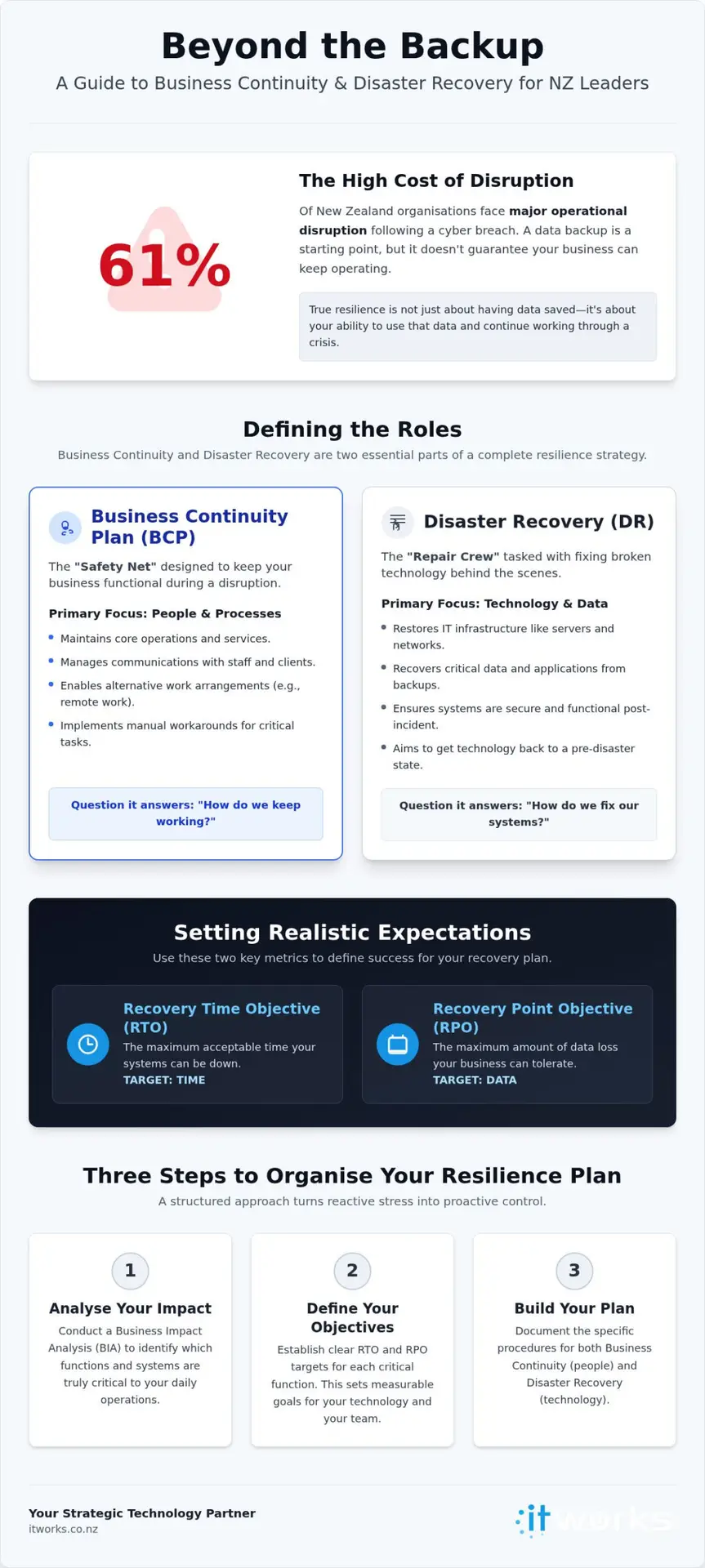
To understand the full scope of business continuity vs disaster recovery nz, it’s helpful to view them as two distinct but complementary teams. Business Continuity is your safety net, designed to keep your organisation functional while the ground is shifting. Disaster Recovery is your repair crew, tasked with fixing the broken machinery behind the scenes. While many New Zealand firms focus heavily on natural disasters like earthquakes, modern resilience must also account for the silent disruption of a cyber-attack that locks your systems while your staff are still at their desks. Both roles are essential for a complete business continuity vs disaster recovery nz strategy.
What is Business Continuity Planning (BCP)?
Business Continuity focuses on the “how” of keeping your organisation open, even if your primary office or systems are unavailable. It’s a broad strategy that prioritises people, processes, and alternative work arrangements. BCP ensures that your team knows exactly what to do when a disruption occurs, whether that means shifting to remote work or using manual workarounds for critical tasks.
In the context of a cyber incident, BCP might involve:
- Activating communication protocols to keep clients and stakeholders informed.
- Redirecting staff to secondary locations or established home offices.
- Implementing non-digital processes to maintain essential services.
- Ensuring key decision-makers have the authority to act without delay.
The goal is simple: to keep the business moving so that your customers never experience a total loss of service. It’s about the business remaining “open” even if the physical or digital office is effectively closed.
What is Disaster Recovery (DR)?
Disaster Recovery is a more technical discipline. It focuses specifically on restoring your servers, networks, cloud infrastructure, and data. If BCP is about the business staying open, DR is about getting the lights back on. This process involves the precise technical steps required to bring your IT systems back into a functional state after a crash or breach.
Effective DR planning involves setting clear priorities for which systems need to come online first. You can explore more about these technical requirements in our backup and disaster recovery NZ guide. Without a robust DR plan, even the best business continuity strategy will eventually falter as manual workarounds become unsustainable over time.
When these two elements are aligned, your organisation gains a level of stability that allows for growth and innovation. If you’re unsure where your current plan sits on this spectrum, you can discuss your technology strategy with our team to ensure your safety net and repair crew are ready to work in unison.
The Strategic Split: Comparing Continuity and Recovery Objectives
Understanding the strategic split in business continuity vs disaster recovery nz is about more than just semantics. It’s about ensuring your organisation can survive a blow while simultaneously rebuilding its foundation. While disaster recovery is technically a subset of business continuity, treating them as identical creates a dangerous gap in your resilience. Business continuity focuses on the survival of the organisation as a whole, whereas disaster recovery focuses on the restoration of the technical systems that support it. A common misconception for smaller NZ firms is that a simple backup covers both. In reality, having your data saved won’t help if your staff don’t know how to process orders manually or communicate with clients during an outage.
Both disciplines require individual attention to be effective. If you only focus on recovery, you may find your technical systems are restored only to discover your client base has moved on because you couldn’t serve them during the downtime. Conversely, a continuity plan without a recovery foundation is unsustainable; manual workarounds eventually collapse under the weight of modern operational demands. Balancing these two ensures that your organisation remains both functional in the short term and stable in the long term.
Scope and Responsibility
Business continuity takes a “whole of business” approach. It’s not just an IT issue; it’s a leadership priority. General Managers and Managing Directors should lead the continuity initiative, as they understand the critical processes that keep the lights on. Conversely, disaster recovery is IT-centric. It’s the domain of your technical team or managed service provider. Clear accountability ensures that when a crisis hits, the leadership is focused on staff and client management while the IT partner is focused on server restoration. This division of labour prevents the frantic overlap that often leads to mistakes during high-pressure situations.
Timeline: During vs After the Event
The timing of these two strategies is a critical differentiator. Business continuity planning is active during the crisis. It provides the immediate workarounds needed to maintain service levels while the primary systems are down. Disaster recovery often takes centre stage once the initial shock has passed, focusing on the methodical rebuild of your digital infrastructure. This timeline is where a robust cyber security for small business NZ strategy proves its worth. It integrates with your continuity plan to reduce the initial impact and streamlines the recovery phase by ensuring your backups are clean and ready for restoration. By aligning these timelines, you ensure your business continuity vs disaster recovery nz efforts work in harmony rather than in isolation.
Five Steps to Organise Your Organisation’s Resilience Plan
Building a resilient organisation doesn’t happen by accident. It requires a methodical approach that bridges the gap between executive vision and technical execution. By following a structured path, you can ensure your business continuity vs disaster recovery nz strategy is more than just a document on a shelf; it becomes a living part of your operational culture. This process ensures that when a disruption hits, your team isn’t guessing their next move.
- Step 1: Conduct a Business Impact Analysis (BIA). This foundational step identifies which functions are truly critical to your survival. By understanding the financial and operational cost of losing a specific service, you can make informed decisions about where to invest in your business continuity vs disaster recovery nz framework.
- Step 2: Set your RTO and RPO. These metrics define your tolerance for downtime and data loss, providing clear targets for your technical team to meet.
- Step 3: Document clear procedures. Your staff need to know exactly who to call and what manual steps to take while the IT team works on recovery. Actionable, plain-language instructions are vital during a crisis.
- Step 4: Implement the necessary technology. This might involve cloud-based backups that are geographically separated from your main office or redundant network connections to prevent a single point of failure. Modern tools allow for near-instant failover, reducing the pressure on your staff.
- Step 5: Test, review, and update. A plan is only as good as its last successful drill. Regular reviews ensure your strategy evolves alongside your organisation and the shifting threat environment.
Understanding RTO and RPO
Defining your Recovery Time Objective (RTO) and Recovery Point Objective (RPO) is essential for any modern organisation. RTO asks: how quickly do you need to be back up? RPO asks: how much data can you afford to lose? These metrics are the heartbeat of any managed IT support services agreement. They provide the technical benchmarks needed to design a system that meets your specific business requirements, replacing vague promises with concrete recovery goals.
Testing: The Only Way to Know It Works
An untested plan is just a piece of paper. You don’t want to find out your recovery process fails during an actual cyber incident or server crash. We recommend regular “fire drills” for both your IT systems and your operational workflows. This ensures everyone knows their role and the technology performs as expected under pressure. It’s about building a culture of continuous improvement rather than a “set and forget” mentality. When you test regularly, you gain the confidence that your organisation can survive a major disruption without losing its stride.
Partnering for Stability: Practical Resilience with IT Works
Achieving true organisational resilience requires more than just technical tools; it requires a partnership built on shared goals and local expertise. At IT Works, we act as a strategic ally for organisations across New Zealand, moving beyond the role of a service provider to become a trusted advisor. Our local, NZ-based team understands the unique geographical and economic factors that influence your operations, from the specific supply chain considerations of an island nation to the regulatory requirements of local bodies. Whether it is managing the complexities of business continuity vs disaster recovery nz or ensuring your network is secure against global threats, we provide a steady hand in an often unpredictable environment.
We believe technology should be a driver for productivity and growth, not just a cost centre that drains your resources. By blending high-level strategic roadmapping with day-to-day operational support, we help you build a system that is as robust as it is efficient. This dual focus ensures that your infrastructure doesn’t just work; it works for you, providing the stability needed to innovate and scale with confidence. When your technical foundation is secure, your leadership team can focus on what truly matters: growing the organisation and serving your customers.
From Reactive Fixes to Strategic Roadmaps
The shift from reactive fixes to strategic roadmaps is where the typical stress of technical management is replaced by a sense of calm reliability. Unlike the frantic energy of a “break-fix” model, our proactive approach anticipates challenges before they become crises. A well-constructed technology roadmap ensures that your resilience measures scale alongside your growth. It provides a clear vision for the future, allowing you to treat technology as a partner in your success rather than a recurring problem to be solved. This long-term perspective is vital for maintaining a competitive edge in any industry.
Your Next Steps Toward Resilience
Your journey toward a more resilient future begins with a clear understanding of your current position. We suggest a preliminary review of your existing backup and continuity procedures to identify any gaps that could leave you vulnerable to downtime. A layered approach to cybersecurity is essential here, as it builds the organisational confidence required to face any disruption. By aligning your people, processes, and technology within a business continuity vs disaster recovery nz framework, you create a foundation that is capable of withstanding the unexpected and thriving in its aftermath.
Building a Resilient Future for Your Organisation
Navigating the complexities of business continuity vs disaster recovery nz is a journey from reactive uncertainty to proactive stability. True resilience is achieved when your people know their manual workarounds and your IT team has a verified restoration process ready to go. This dual approach ensures your organisation remains a reliable presence for your clients, even during the most challenging disruptions. It moves your technology from a source of potential failure to a foundation for consistent performance.
As a strategic partner for New Zealand organisations with 10 to 250+ staff, we focus on business outcomes rather than just technical fixes. Our local team provides the accountability and strategic roadmapping needed to turn your infrastructure into a driver for growth. We help you build a system that doesn’t just store data but actively protects your productivity and reputation. By aligning your recovery goals with your commercial vision, you create an environment where success is sustainable.
Taking these proactive steps today creates the organisational confidence required to grow and innovate without the constant fear of disruption. We look forward to helping you build a more secure and steady future.
Frequently Asked Questions
What is the main difference between business continuity and disaster recovery?
Business continuity focuses on keeping the entire organisation operational during a crisis, while disaster recovery is the specific technical process of restoring IT systems and data. You can think of continuity as your strategy for survival and recovery as the repair of your digital foundation. Both are required for a complete business continuity vs disaster recovery nz strategy. This ensures that while your systems are being fixed, your team has the manual processes needed to continue serving your clients.
Do small NZ businesses really need a formal business continuity plan?
Every organisation in New Zealand needs a plan because disruptions don’t discriminate based on company size. Statistics from the 2026 Kordia New Zealand Business Cyber Security Report show that 61% of businesses face major operational disruption after a cyber incident. A formal plan provides a clear roadmap for your staff, reducing panic and ensuring you can protect your reputation. Without one, you risk a prolonged shutdown that could lead to lost revenue and a permanent loss of client trust.
How often should we test our disaster recovery procedures?
We recommend testing your procedures at least once a year or whenever you make significant changes to your IT infrastructure. An untested plan is just a theory; regular “fire drills” ensure your backups actually work and your staff remember their roles. This proactive approach identifies gaps in your resilience before a real crisis occurs. It builds organisational confidence by proving that your recovery systems can perform under pressure when your productivity and reputation are on the line.
What are Recovery Time Objectives (RTO) and Recovery Point Objectives (RPO)?
Recovery Time Objective (RTO) defines how quickly you need to be back up and running after a failure. Recovery Point Objective (RPO) determines the maximum amount of data loss your organisation can tolerate. These metrics are the heartbeat of your resilience strategy. They allow you to align your technical investments with your business needs, ensuring you aren’t paying for instant recovery where it isn’t required or risking too much data in critical areas of your operation.
Can cloud services replace the need for a disaster recovery plan?
Cloud services provide excellent tools for resilience, but they don’t replace the need for a documented disaster recovery plan. While the cloud offers high availability, you still need a strategy for how to access that data if your primary connection fails or if files are accidentally deleted. A plan ensures you have clear accountability and defined processes for restoration. It moves you from simply having data stored to having a functional, predictable recovery system that supports growth.
How does cybersecurity link to business continuity planning?
Cybersecurity is a critical component of business continuity vs disaster recovery nz because cyber-attacks are now a leading cause of operational halts. A layered security strategy reduces the risk of a breach, while your continuity plan ensures you can respond effectively if one occurs. This integration builds organisational confidence by providing a complete shield. It ensures your business remains productive and secure, protecting your long-term value from the rising threat of sophisticated and often automated digital incidents.
What should be the first step in creating a resilience plan for my organisation?
The first step is conducting a Business Impact Analysis (BIA) to identify your most critical functions and the cost of their downtime. This analysis provides the data needed to prioritise your recovery efforts and allocate your budget effectively. It moves the conversation from vague technical concerns to specific business outcomes. Once you understand which processes are vital for survival, you can begin documenting the procedures and implementing the technology required to protect them from any potential disruption.