
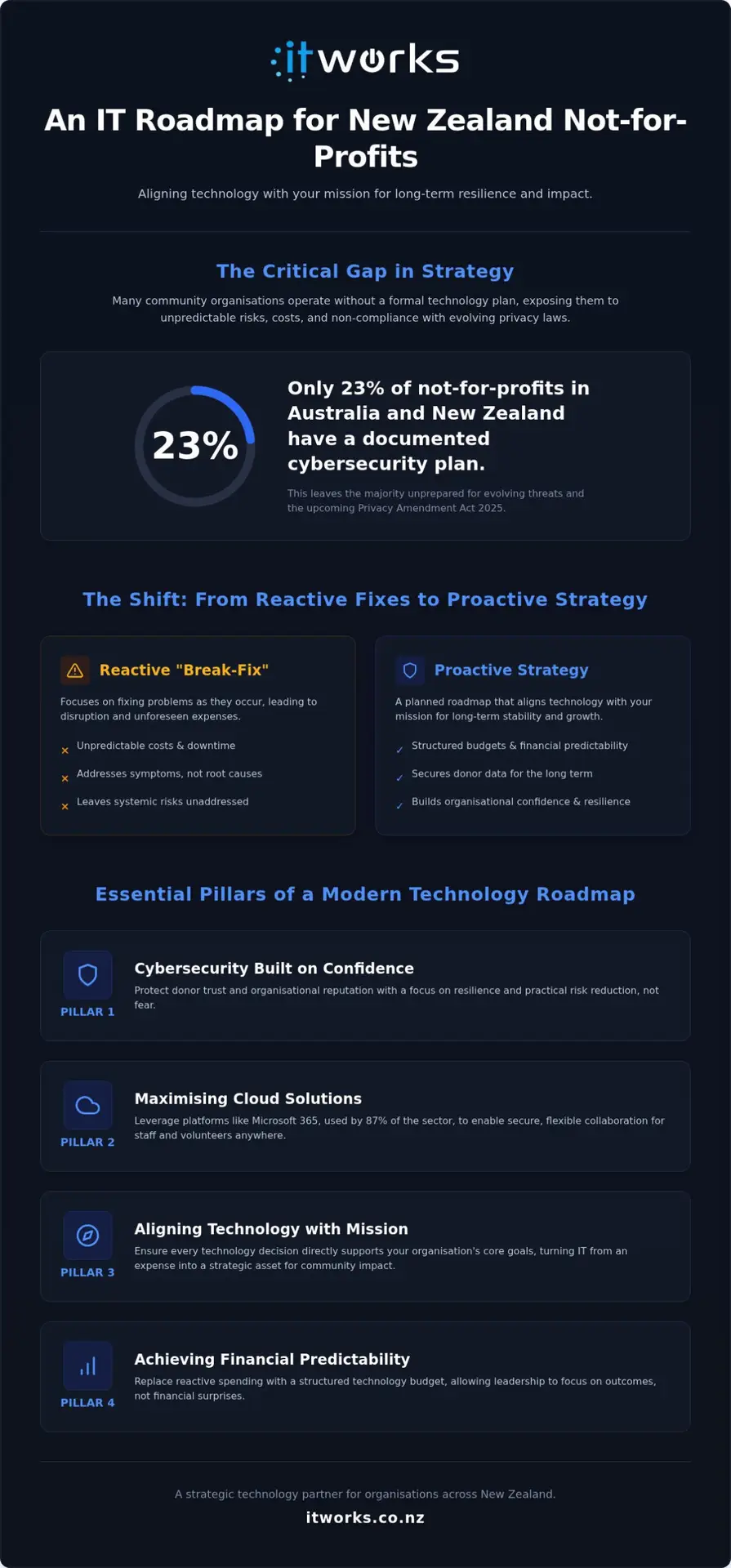
Only 23% of not-for-profits in Australia and New Zealand have a documented cybersecurity plan. For many community organisations, technology often feels like a series of reactive fixes rather than a cohesive plan. You likely started your mission to support your community, not to spend your evenings worrying about unpredictable costs or whether donor data is safe. With the Privacy Amendment Act 2025 coming into force on 1 May 2026, the need for a structured approach to data has never been more practical or necessary.
Developing a clear it strategy for non-profits nz allows you to move away from the stress of technical management and towards a sense of calm reliability. In this guide, you’ll learn how to align your technology with your mission to protect donor data, empower your volunteers, and ensure long-term operational resilience. We’ll explore how a structured technology roadmap helps you achieve predictable monthly spending and gives your team the confidence to work effectively from anywhere, whether they are based in Wellington, Auckland, or Christchurch.
Key Takeaways
- Shift from reactive technical troubleshooting to a proactive it strategy for non-profits nz that ensures every technical decision supports your mission.
- Understand how a Technology Roadmap replaces unpredictable “break-fix” costs with a structured budget, allowing for better long-term financial planning.
- Discover how modern cloud infrastructure enables your staff and volunteers to collaborate securely from any location while protecting sensitive donor data.
- Learn to build organisational confidence through robust cybersecurity governance that focuses on resilience and practical risk reduction.
- Gain a clear path for integrating New Zealand’s evolving privacy requirements into your operations to maintain trust and compliance.
What is IT Strategy for Non-profits in New Zealand?
An IT strategy isn’t a complex technical manual stored on a dusty shelf. It’s a living roadmap that ensures every dollar you spend on technology directly supports your charitable goals. For many organisations, an it strategy for non-profits nz provides the bridge between daily operations and long-term community impact. It moves technology from the “unforeseen expense” column into a category of strategic assets that drive efficiency and protect your reputation.
A well-crafted Technology strategy serves as a guide for decision-making. It ensures you aren’t just buying the latest gadgets, but investing in tools that help your staff work smarter. This outcome-focused approach means your technology is measured by how well it empowers your mission, rather than just how many tickets your helpdesk closes. When your systems are aligned with your purpose, you can focus on what matters most: serving your community.
The Difference Between Tech Support and IT Strategy
Reactive support is often called “break-fix” for a reason. It focuses on the immediate problem, like a crashed server or a faulty printer. While these fixes are necessary, they don’t address systemic risks like cybersecurity vulnerabilities or inefficient data silos. Strategy, however, is proactive. It looks ahead to secure donor data and plan for future growth. It provides clear accountability, ensuring you have an advisor who understands the “why” behind your technology. This shift allows your leadership team to move away from the stress of constant technical fires and towards a state of calm reliability.
Why Strategy Matters for NZ Charities in 2026
Donor expectations have changed. Supporters now expect the same seamless digital experiences from charities that they get from their banks or favourite retailers. They want to know their personal information is handled with care, especially with updated privacy regulations on the horizon. Building this trust requires a resilient foundation. In cities like Wellington, Auckland, and Christchurch, local operational challenges mean your team needs to be able to work from anywhere at a moment’s notice.
Establishing high-quality managed IT support services is the first step toward this resilience. It allows your leadership team to focus on community outcomes while knowing the underlying systems are stable and secure. This stability is the core of a successful it strategy for non-profits nz, turning technical management into a driver of organisational confidence rather than a source of anxiety. By planning for the future, you ensure your organisation remains functional and sustainable in an increasingly digital world.
Essential Pillars of a Modern Technology Roadmap
A successful it strategy for non-profits nz isn’t built on software discounts alone. It requires a balanced approach across four core areas that ensure your mission remains uninterrupted. While many organisations start with procurement, the most resilient ones focus on governance and long-term stability first. This structured approach replaces the stress of reactive fixes with a clear path forward.
Cybersecurity Built on Risk Reduction, Not Fear
Research shows that only 23% of not-for-profits in Australia and New Zealand have a documented cybersecurity plan. We believe security should build confidence rather than anxiety. By adopting the same cyber security for small business NZ principles used by leading commercial firms, you protect your donors’ trust. Layered security, including Multi-Factor Authentication (MFA) and robust identity management, ensures that even as threats evolve, your data remains secure. This is particularly vital as we prepare for the Privacy Amendment Act 2025, which introduces stricter notification requirements for personal information.
Maximising Microsoft 365 and Cloud Solutions
With 87% of the sector already relying on cloud platforms for daily operations, the focus shifts to how you organise Microsoft 365 management New Zealand organisations need. It’s not enough to just have the licenses; you must structure SharePoint and Teams so that staff and volunteers can collaborate seamlessly. Modernising legacy systems via cloud migration reduces the physical burden on your office and improves operational resilience. This allows your team in Wellington, Auckland, or Christchurch to work with the same efficiency regardless of their physical location.
Practical AI and Copilot Readiness
When looking at AI automation solutions New Zealand non-profits can use, the goal is practical productivity. AI shouldn’t be about replacing your passionate staff. It’s about removing the administrative “noise” that slows them down. Whether it’s using Copilot to summarise board meetings or automating donor receipts, responsible governance must come first. You can discuss your technology priorities with the IT Works team to ensure your it strategy for non-profits nz includes these productivity gains safely.
Business Continuity and Mission Protection
Your roadmap must include a clear plan for business continuity. Protecting your mission against data loss or sudden disruption is now a baseline expectation for modern donors. It ensures that whether you’re facing a technical failure or a regional emergency, your services remain available to those who need them most. A resilient backup and disaster recovery plan provides the final layer of your strategic foundation, ensuring long-term sustainability for your organisation.
Comparing IT Support Models for NZ Organisations
Selecting the right support model is a critical pillar of any it strategy for non-profits nz. The way you choose to manage your technology determines whether your organisation operates with calm reliability or remains trapped in a cycle of technical disruptions. While there are several paths to take, the goal is always to ensure your systems empower your team rather than slowing them down.
- Managed IT Services: This model offers a proactive approach where your partner monitors systems to prevent issues before they occur. It provides a predictable monthly spend, making it easier to manage tight non-profit budgets.
- In-house IT: Hiring internal staff can work for very large organisations. However, for most mid-sized NZ charities, it’s difficult for one or two people to maintain the broad expertise required for modern cybersecurity and cloud management.
- The Strategic Blend: The most effective organisations use a partner that provides both high-level strategy and reliable operational helpdesk support. This ensures your long-term goals are always supported by stable day-to-day systems.
The High Cost of Reactive Break-Fix IT
Choosing a “budget” or reactive support model often leads to hidden costs that far outweigh the initial savings. When you only pay for IT when something breaks, your provider has no incentive to prevent the next failure. This approach creates technical debt, where outdated systems are patched together rather than modernised. Over time, recurring issues and unexpected downtime drain your resources and frustrate your staff. This constant friction can significantly damage staff morale. Passionate team members feel held back by the very tools meant to help them. A sustainable it strategy for non-profits nz avoids these pitfalls by prioritising stability and long-term value over the cheapest hourly rate.
Why a Long-Term Partnership Outperforms Product Reselling
A strategic ally does more than just sell you software licences or hardware. They take the time to understand the unique challenges of the New Zealand non-profit landscape. This partnership focuses on business outcomes, ensuring that every technical investment actually moves your mission forward. Having local expertise in centres like Wellington, Auckland, and Christchurch adds a layer of trust and accessibility that distant providers cannot match. Your partner should act as a steady guide, helping you navigate complex decisions with a focus on practical results rather than technical hype. This collaborative approach ensures your technology remains a functional tool for community impact rather than a source of management stress.
Navigating Unique Strategy Challenges in the Third Sector
The non-profit sector operates under a different set of pressures than the commercial world. Every dollar spent on technology is often viewed through the lens of mission delivery. This means your it strategy for non-profits nz must be exceptionally efficient, ensuring that back-office stability never comes at the expense of front-line services. Balancing these priorities requires a shift in how technology is perceived; it isn’t just a cost, but a tool for sustainable growth.
Securing the Volunteer Workforce
Managing a multi-generational team of volunteers presents a unique security challenge. You need to protect sensitive donor information while ensuring that non-technical users don’t find the systems too difficult to use. A successful it strategy for non-profits nz implements simple, secure login processes that protect data without hindering productivity. By using role-based access, you can ensure volunteers only see what they need to see and nothing more. Security awareness training also plays a vital role here. It builds organisational confidence by teaching your team how to recognise risks, turning your volunteer base into your first line of defence rather than a vulnerability.
Meeting Privacy and Donor Trust Requirements
Donor trust is the lifeblood of any charitable organisation. With the Privacy Amendment Act 2025 coming into force on 1 May 2026, New Zealand organisations face stricter rules regarding how they collect and notify individuals about their data. Specifically, Information Privacy Principle 3A requires you to be transparent when collecting personal information from third parties. Your technology roadmap must account for these changes, ensuring your CRM and donor databases are compliant. This proactive governance protects your reputation and ensures you maintain your “adequacy status” for international data sharing, which is vital for organisations operating across borders.
Budgeting for Technology: From Capex to Opex
Traditional IT models often rely on large, unpredictable capital expenses. For a charity, a sudden server failure can be a financial disaster. Moving towards an operational expense (Opex) model through managed services turns these lumpy costs into predictable monthly fees. This shift allows for much better long-term planning and donor transparency. Strategic procurement services also ensure you get the best value from your hardware spend. By planning for hardware lifecycles well in advance, you avoid emergency “fire-drill” spending. This methodical approach ensures your technology remains a stable foundation for your mission rather than a source of financial stress.
Partnering with IT Works for a Resilient Future
Choosing a partner for your it strategy for non-profits nz is one of the most significant decisions your leadership team will make. It’s a choice between continuing with the stress of reactive technical management or moving towards a state of calm reliability. We act as your strategic technology partner, ensuring your infrastructure is an invisible, reliable engine for your organisation’s success. Our team doesn’t just manage servers; we provide the guidance needed to ensure your technology enables better community outcomes.
The journey to stability begins with a custom Technology Roadmap. This isn’t a generic template or a list of software to buy. It’s a structured plan that aligns your technical investments with your specific mission goals. We combine high-level advisory with proactive helpdesk support, ensuring that while we’re planning for your future, your staff are supported today. This dual focus allows you to concentrate on your mission while we handle the complexities of your technology infrastructure.
A Local Team Committed to NZ Non-profits
Based in Wellington, our team serves organisations right across New Zealand. We understand the local context, from the unique requirements of the Privacy Amendment Act 2025 to the practicalities of coordinating teams in Wellington, Auckland, and Christchurch. We’re a local team that values long-term partnerships over one-off transactions. This commitment is reflected in our approach to communication; we prioritise plain language over technical jargon.
We believe that technology should be accessible and human. You’ll work with experienced advisors who understand the human side of technical challenges. Whether you’re managing a small team or a large volunteer workforce, we provide the steady guidance needed to keep your operations running smoothly. Starting the conversation about your organisation’s technology strategy is the first step toward building a more resilient future.
Next Steps: Building Your Roadmap
Starting the process is straightforward. During an initial technology strategy consultation, we’ll discuss your current challenges, your operational goals, and the specific needs of your staff and volunteers. We’ll look at your existing systems and identify where improvements can lead to better productivity or stronger cybersecurity. This isn’t about making radical changes overnight, but about creating a logical progression toward a more stable environment.
The outcome of this partnership is a shift from technology being a source of anxiety to a source of organisational confidence. You’ll gain predictable monthly spending, robust data protection, and a team that can work effectively from anywhere. Talk to IT Works about your technology strategy today to see how we can help your organisation thrive.
Empowering Your Mission Through Strategic Stability
Transitioning from reactive technical management to a proactive it strategy for non-profits nz provides the stability your organisation needs to thrive. By aligning your technology with your core mission, you ensure that every technical decision supports community outcomes rather than creating administrative friction. This approach replaces the stress of unpredictable costs with the calm reliability of a structured technology roadmap. It’s about building a foundation that protects donor trust while enabling your staff to work with confidence.
Since 2004, IT Works has served as a specialist in the NZ non-profit sector. We’ve helped organisations across the nation move away from the frantic energy of reactive support towards a more sustainable model. Our outcome-focused approach ensures your sensitive data is secure and your team is empowered to work effectively from any location. We provide the steady guidance needed to navigate technical challenges while you focus on making a meaningful difference in your community.
Talk to IT Works about your technology strategy
Building a resilient future for your organisation starts with a single conversation about your long-term goals. We look forward to acting as your strategic ally and helping you achieve lasting operational success.
Frequently Asked Questions
Does our non-profit really need a formal IT strategy?
Yes, a formal strategy is essential for any organisation that relies on technology to deliver its services. Without one, you risk falling into a cycle of reactive repairs that drain your budget and frustrate your team. An it strategy for non-profits nz ensures your technical investments are purposeful. This helps you avoid technical debt while ensuring every dollar spent directly supports your community outcomes and long-term sustainability.
How can we secure donor data without a massive cybersecurity budget?
You don’t need a massive budget to achieve robust security. Focus on foundational steps like Multi-Factor Authentication (MFA) and strong identity management. These simple measures are highly effective at preventing unauthorised access. Additionally, staying informed about New Zealand’s Privacy Act requirements, such as the new notification rules starting in May 2026, helps you build a culture of data protection. Layered security ensures you protect donor trust through practical risk reduction.
What are the benefits of Microsoft 365 for NZ charities?
Microsoft 365 provides a unified platform for collaboration through Teams and SharePoint. For NZ charities, the primary benefit is the ability for staff and volunteers to work together seamlessly from any location, whether they’re in Auckland or Christchurch. Many non-profits also qualify for significant discounts or grants from Microsoft. This makes it a cost-effective way to modernise your operations and ensure your team has access to professional, secure productivity tools.
How do we manage IT access for volunteers who use their own devices?
Managing a “Bring Your Own Device” environment requires a clear policy and role-based access controls. You can implement secure login processes that allow volunteers to access only the specific information they need for their roles. This protects sensitive donor data while still allowing for a flexible workforce. Combined with basic security awareness training, this approach ensures that volunteers can contribute effectively using their own devices without introducing unnecessary risks to your organisation’s network.
What is the difference between a managed service provider and a break-fix shop?
A managed service provider acts as a strategic partner, focusing on preventing issues before they occur and aligning technology with your goals. In contrast, a “break-fix” shop is reactive, only getting involved when something has already failed. While break-fix might seem cheaper initially, it often leads to higher long-term costs and downtime. A managed partner provides a predictable monthly spend and a long-term roadmap, ensuring your systems remain functional and resilient.
Can IT strategy help us apply for technology-related grants in NZ?
Yes, a clear technology roadmap demonstrates to grant providers that your organisation has strong governance and a well-thought-out plan. For example, when applying for science and technology grants like those from the Earle Creativity and Development Trust, having a documented strategy shows you’ll use the funding effectively. It provides the evidence of sustainability and impact that many NZ funding bodies look for when evaluating applications for technology-related projects or infrastructure upgrades.
How often should we review our technology roadmap?
We recommend reviewing your technology roadmap at least once a year, or whenever there’s a significant shift in your organisation’s goals. Technology and regulatory environments move quickly, as seen with the upcoming changes to New Zealand privacy laws. Regular reviews ensure your it strategy for non-profits nz remains relevant and that you’re taking advantage of new efficiencies. This methodical approach keeps your technology aligned with your mission and prevents your systems from becoming outdated.
Does IT Works provide support to non-profits outside of Wellington?
Yes, while we are based in Wellington, we provide strategic technology support to organisations throughout New Zealand. Our team uses modern remote management tools to support staff and volunteers in Auckland, Christchurch, and regional centres. We pride ourselves on being a local partner that understands the specific needs of the NZ non-profit sector. Distance is not a barrier to receiving high-quality, proactive management that helps your organisation move from technical stress to calm reliability.