Most New Zealand business owners view a laptop as a simple asset, yet the moment it’s unboxed, it begins a silent race against obsolescence and security risks. You likely feel the weight of rapidly outdated technology and the frustration of unexpected capital expenditure spikes when a fleet needs replacing. It’s a common challenge to balance high staff productivity with a predictable budget, especially when you’re trying to maintain a strong security posture and prepare for AI integration.
Choosing between IT hardware leasing vs buying NZ is no longer just a task for the accounts department; it’s a strategic decision that affects your organisation’s agility. This guide provides the clarity you need to make an informed choice that supports your long-term goals. We’ll examine the practical impacts of the 2025 Investment Boost, which allows a one-off 20% upfront deduction for new purchases, alongside the cash flow benefits of operating leases. We’ll also look at how your procurement model affects your ability to scale without financial strain, providing a clear path toward a more resilient and productive technology ecosystem.
Key Takeaways
- Understand why hardware procurement is a strategic pillar for productivity and security rather than a simple line item in your budget.
- Evaluate the financial impact of ownership, including how to utilise the 2025 Investment Boost and IRD depreciation rates to manage your capital expenditure.
- Discover how the choice between IT hardware leasing vs buying NZ affects your organisation’s agility and your ability to maintain a modern, secure fleet.
- Learn a practical framework for auditing your current technology and aligning your hardware needs with a three-year technology roadmap.
- Explore the benefits of a managed procurement partnership that simplifies the hardware lifecycle and ensures your team remains ready for future AI developments.
Understanding Hardware Procurement NZ: Why the Model Matters
Hardware procurement is the deliberate process of selecting and acquiring the physical tools your team needs to function, from high-performance laptops to robust servers and networking gear. It’s often viewed as a simple expense, but viewing it as a strategic pillar is essential for understanding equipment procurement models and their impact on your bottom line. Whether you choose to own or lease, the decision directly shapes your organisation’s resilience and its ability to respond to market shifts.
When evaluating IT hardware leasing vs buying NZ, it’s helpful to see technology as a strategic asset that enables growth rather than a sunk cost to be minimised. You aren’t just comparing interest rates or depreciation schedules; you’re deciding how quickly your business can adapt. Old gear creates bottlenecks that slow down your best people and leave your systems open to vulnerabilities.
The Role of Hardware in Modern NZ Organisations
The equipment your staff use every day is the primary interface for their work. When that gear is slow or unreliable, it leads to genuine frustration and a measurable drop in output. There is also a critical link between having modern hardware and maintaining cyber security for small business NZ. Older devices often lack the firmware protections and processing power required for modern security protocols, making them easier targets. While “making do” with five-year-old laptops might seem like a saving, the hidden costs of downtime and security risks usually outweigh the price of a refresh.
Hardware and AI Readiness
As we move through 2026, the technical requirements for business tools are changing. Practical AI applications, like Microsoft Copilot, require more than just a fast internet connection. They demand local processing power. Modern procurement must now account for NPUs (Neural Processing Units) that handle AI tasks without slowing down the rest of the system. If your hardware lacks these capabilities, your team won’t be able to utilise the latest productivity tools effectively. A well-constructed technology roadmap ensures your hardware specs aren’t just sufficient for today, but are ready for the software demands of tomorrow.
Buying IT Hardware: Ownership, Assets, and Long-term Costs
Purchasing your equipment outright is the traditional approach to procurement. The primary appeal lies in full ownership; once the invoice is settled, the asset belongs to your organisation. You don’t have to worry about monthly interest charges or ongoing lease payments for that specific unit. For businesses with a strong cash position, this can feel like a clean, simple way to manage the balance sheet. However, when weighing up IT hardware leasing vs buying NZ, it’s vital to look beyond the initial price tag at the total cost of ownership.
Financial Implications of Capital Expenditure (CapEx)
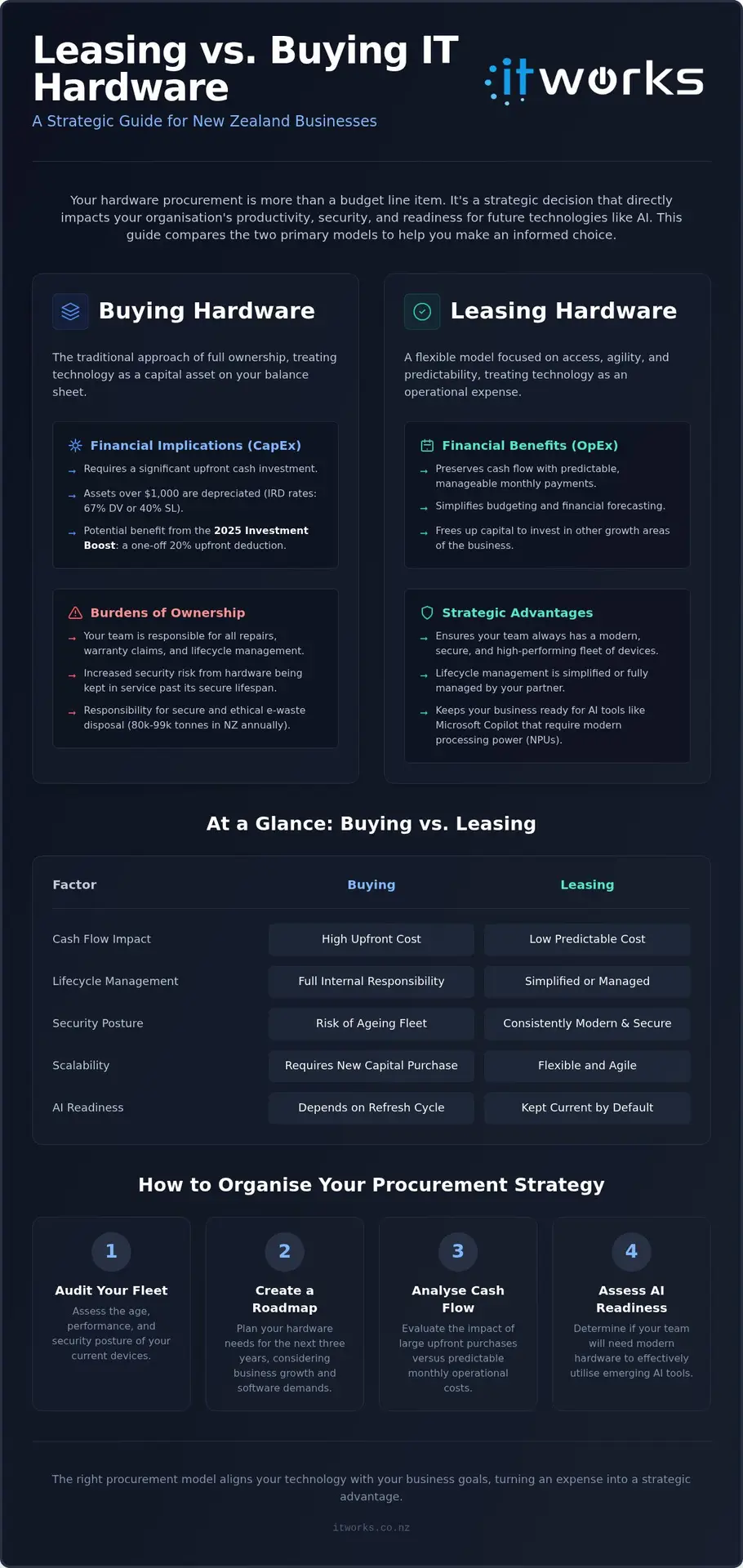
Buying IT gear involves a significant upfront hit to your cash flow. In New Zealand, the tax treatment of these assets is quite specific. Business assets costing $1,000 or less can be fully expensed in the year of purchase. For most laptops and servers, which exceed this threshold, you must use depreciation. The IRD prescribes a rate of 67% for Diminishing Value or 40% for Straight Line.
A recent development is the “Investment Boost” tax incentive. For new assets purchased and used from 22 May 2025, you can claim a one-off 20% upfront deduction. While this makes buying more attractive, it still ties up capital in assets that lose value quickly. You might find it more effective to discuss your technology strategy with a partner who can help you balance these tax benefits against your broader growth goals.
The Burden of Lifecycle Management
Ownership brings a range of “hidden” costs that often go unbudgeted. When you own the gear, your team is responsible for managing every repair, warranty claim, and software update. There’s also the logistical challenge of storage and disposal. New Zealand generates between 80,000 and 99,000 tonnes of electronic waste each year. With new Extended Producer Responsibility regulations expected to be finalised in 2026, the burden of ethical and secure disposal will fall more heavily on business owners.
Owned hardware often stays in use far past its secure lifespan simply because it “still works.” This creates security vulnerabilities that modern operating systems can’t always patch. While it’s often wise to buy lower-risk items like monitors and peripherals outright, mission-critical devices like laptops and servers require a more agile approach to ensure they remain secure and productive. When hardware issues arise that remote diagnostics can’t resolve, having access to on-site IT support Wellington organisations can rely on becomes essential for minimising downtime.
Leasing IT Hardware: Agility, Security, and Predictability
Leasing transforms technology from a lumpy capital expense into a predictable operational cost. While buying focuses on the physical asset, leasing prioritises the service that asset provides to your team. When evaluating IT hardware leasing vs buying NZ, many organisations find that the agility gained through a lease model outweighs the perceived benefit of ownership. It’s about outcomes, not just hardware. This approach allows you to treat your fleet as a revolving resource that is always fit for purpose.
Operational Expenditure (OpEx) and Cash Flow
The primary financial shift with leasing is the move to an Operating Expenditure (OpEx) model. Instead of a single large payment that drains your cash reserves, you pay a manageable monthly fee. This smoothing of costs makes budgeting simple and transparent. It frees up your capital for growth focused projects, such as market expansion or product development, rather than tying it up in depreciating laptops. You receive one monthly bill that covers the hardware, often bundled with your managed IT support services, creating a streamlined administrative experience.
Security and Performance Benefits
Leasing naturally enforces a healthy refresh cycle. By setting a term of three or four years, you ensure that no staff member is struggling with an outdated machine. This approach significantly reduces security risks, as modern hardware is designed to support the latest encryption and authentication features. It also simplifies your Microsoft 365 management New Zealand experience. When your entire fleet is standardised and under warranty, deploying updates and managing cloud identities becomes a far more stable process.
There is a common misconception that leasing is always the more expensive path. However, when you look at the total cost of ownership, the numbers often tell a different story. Leasing eliminates the hidden costs of ownership, such as secure data destruction, e-waste compliance, and the time your internal team spends managing out of warranty repairs. For most organisations, the value of having a reliable, secure, and fully supported fleet far exceeds the interest costs associated with a lease agreement.
How to Organise Your Procurement Strategy: A Selection Framework
Building a procurement strategy requires moving away from reactive purchasing. Instead of buying a laptop simply because another one has failed, you should look at your fleet as a connected system that drives your business forward. When weighing up IT hardware leasing vs buying NZ, a structured framework helps remove the guesswork and ensures your technology supports your specific organisational objectives.
Step 1 involves a thorough audit of your current hardware to identify which devices are causing performance bottlenecks or posing security risks. Step 2 requires you to align these findings with your long-term vision, perhaps using an it strategy for non-profits nz as a template for your own technology roadmap. This ensures you aren’t just buying gear, but investing in tools that help you reach your three-year goals.
Calculating Total Cost of Ownership (TCO)
Many managers focus solely on the initial invoice, but the sticker price is only the beginning of the story. Total cost of ownership (TCO) is the sum of all direct and indirect costs associated with an asset over its entire life. You must factor in the time spent on setup, the cost of ongoing support, and the eventual expense of secure disposal. Perhaps most importantly, you should consider the cost of staff downtime. A slow machine that wastes ten minutes of an employee’s day can cost thousands in lost productivity over a 36-month period.
Step 3 is to compare the TCO for both models over a three-year window. To ensure the most efficient results during this phase, RightCostIQ provides professional RFP management and negotiation assistance to optimise procurement outcomes for your organisation. Step 4 is the final check: consult with your technology partner to ensure the specifications of the hardware you choose are capable of running your mission-critical software without compromise.
Your choice often depends on your specific operational needs. Leasing is usually the preferred option for rapidly scaling teams or organisations with high-security requirements that demand regular refreshes. Conversely, buying might suit long-term infrastructure with slow innovation cycles where the hardware doesn’t need to be updated frequently. Regardless of the model, your hardware choices must also support AI automation solutions New Zealand, ensuring your processors can handle the local compute needs of modern productivity tools.
Beyond the Purchase: Managed Procurement with IT Works
Procurement often feels like a siloed financial transaction, where you speak to a bank about a loan or a vendor about a price. However, those parties don’t understand your security posture or your long-term technology goals. At IT Works, we act as a strategic procurement partner rather than a simple reseller. We bridge the gap between financial decisions and operational reality, ensuring the choice between IT hardware leasing vs buying NZ is settled based on what actually drives your organisation forward.
This integrated approach is a core element of our Managed IT Services Wellington. By having a local NZ-based team manage the entire hardware lifecycle, you gain a partner who is deeply invested in your daily productivity. We aren’t here to push a specific brand or meet a sales quota. Instead, we prioritise the business outcomes that matter most to you, such as high staff morale, robust security, and the ability to scale without technical friction.
The IT Works Approach to Technology Strategy
We start by building a practical technology roadmap that includes scheduled hardware refreshes. This methodical planning removes the sudden stress of a fleet replacement and keeps your budget predictable. Every piece of equipment we procure is configured for security and productivity from day one, meaning your team can get straight to work without the usual setup headaches. We provide clear accountability for every device we manage. If a machine isn’t performing as it should, it’s our priority to resolve the issue, acting as your steady guide through any technical challenge.
Next Steps for Your Organisation
Moving toward a proactive hardware plan starts with a simple conversation about your current challenges. We help you identify where aging gear is creating bottlenecks or leaving your systems open to vulnerabilities. This is particularly important for organisations with 10 to 250 staff, where the complexity of managing hardware lifecycles can quickly become overwhelming. Whether you are looking to improve your Microsoft 365 experience or ensuring your fleet is ready for local AI processing, our team is here to provide pragmatic, results-focused advice. Organisations across the capital can also explore how IT services in the Wellington region can move them beyond reactive repairs and toward a more secure, modern, and productive future. Talk to IT Works about your technology strategy to move beyond the cycle of reactive repairs and toward a more secure, modern, and productive future.
Building a Resilient Technology Foundation
The choice between IT hardware leasing vs buying NZ ultimately depends on how you want your organisation to grow. While buying gear provides ownership and specific tax benefits, leasing offers the agility and predictable budgeting required for modern security and AI readiness. Your hardware shouldn’t be an afterthought. It’s the engine that drives your staff productivity and protects your business data.
By moving away from reactive repairs and adopting a security-first procurement model, you ensure your team always has access to reliable, high-performance tools. Our NZ-based team of strategic advisors specialises in helping organisations with 10 to 250 staff navigate these complex decisions. We ensure every device aligns with a long-term technology roadmap that supports your specific business goals and operational needs.
Talk to IT Works about your technology strategy
A proactive approach to fleet management transforms technology from a source of stress into a competitive advantage. We’re ready to help you build a more secure and productive future for your organisation.
Frequently Asked Questions
Is it cheaper to lease or buy IT hardware in New Zealand?
Whether it’s cheaper to lease or buy depends on your total cost of ownership over a three or four-year period. Buying often has a lower sticker price and avoids interest, which appeals to cash-rich firms. However, leasing frequently reduces indirect costs like staff downtime and secure disposal fees. When you account for the productivity gains of a modern fleet, the financial gap narrows significantly. Most organisations find leasing provides better long-term value by keeping teams efficient.
What are the tax benefits of leasing business equipment in NZ?
Leasing business equipment provides significant tax advantages by shifting hardware from a capital asset to an operating expense. Your lease payments are generally fully tax-deductible in the financial year they are incurred. Unlike buying, where you must manage complex depreciation schedules or the 20% Investment Boost, leasing simplifies your accounting. You also claim GST on each periodic payment rather than waiting for a large upfront refund, which helps maintain a steady and predictable cash flow.
How often should a New Zealand business refresh its IT hardware?
A three to four-year refresh cycle is the standard for most New Zealand organisations. Beyond this point, hardware performance typically declines, leading to increased staff frustration and lost productivity. More importantly, older devices often lack the firmware protections required to defend against modern security threats. By refreshing every three years, you ensure your fleet remains under warranty and is capable of handling resource-heavy applications like AI automation and advanced data processing tools.
Can I lease hardware if I am a small organisation with only 10 staff?
Yes, organisations with as few as 10 staff can certainly benefit from leasing. In fact, smaller teams often find this model more attractive because it removes the need for large, lumpy capital outlays. It allows a business of 10 people to access the same high-quality, secure gear used by much larger firms. This approach supports your growth by making technology costs predictable and ensuring your team isn’t held back by aging or unreliable equipment.
What happens to leased hardware at the end of the term?
At the end of a lease term, you typically have three choices: return the equipment and refresh with new gear, purchase the assets at fair market value, or extend the lease. Most organisations choose to return and refresh, as this ensures their team always has modern, secure devices. Returning the gear also shifts the responsibility for secure data wiping and ethical e-waste disposal to the leasing provider, which simplifies your internal compliance requirements.
Does leasing hardware include technical support and maintenance?
While a standalone lease covers the hardware itself, most strategic partners bundle it with managed IT support services. This means your technical support, maintenance, and security monitoring are all included in a single monthly fee. This integrated approach ensures that if a leased device fails, it’s repaired or replaced quickly without extra costs. It provides a complete ecosystem where both the physical asset and the software running on it are fully supported.
How does hardware choice affect my cybersecurity insurance in NZ?
Your choice between IT hardware leasing vs buying NZ can directly impact your cybersecurity insurance eligibility. Insurers increasingly look for evidence of proactive lifecycle management and up-to-date hardware. Devices older than five years are often seen as high-risk because they may not support modern encryption or multi-factor authentication. Maintaining a modern, leased fleet demonstrates a commitment to risk reduction, which can help you secure better coverage terms and lower premiums for your organisation.
Is it possible to have a hybrid model of both leased and owned hardware?
It’s very common to use a hybrid model that combines both leasing and buying. You might choose to lease high-value, fast-moving assets like laptops and servers to ensure they are always modern and secure. Conversely, buying lower-risk items like monitors, keyboards, and office furniture often makes more sense as these items have much longer lifespans. A strategic partner can help you identify which assets belong in each category to optimise your technology budget.