
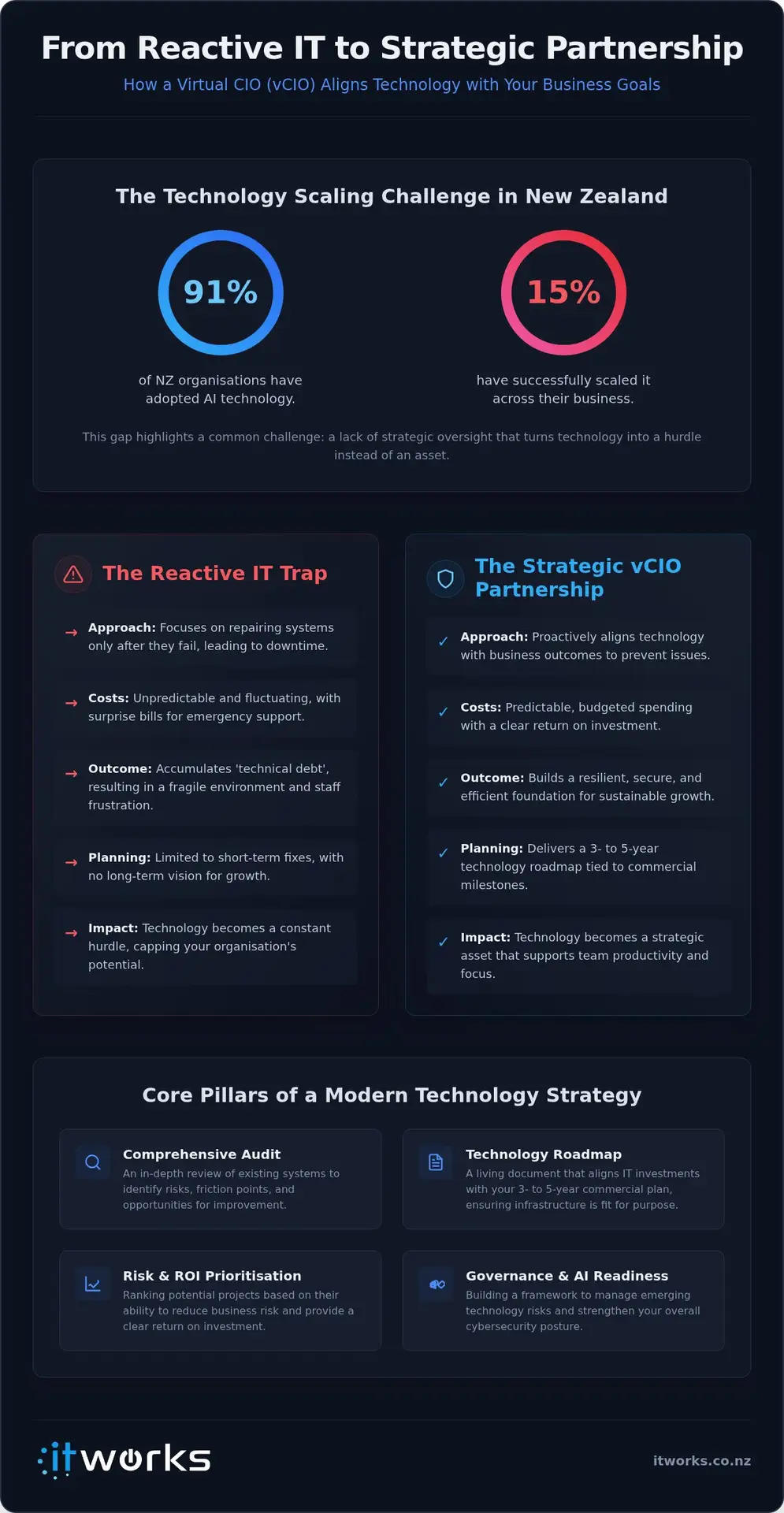
Did you know that while 91% of New Zealand organisations have adopted AI in 2026, only 15% have successfully scaled it across their entire business? This gap often stems from a lack of strategic oversight, leaving many business owners feeling like they’re constantly chasing technology rather than leading it. You probably recognise the cycle of runaway costs, reactive IT support that only fixes things once they break, and a nagging worry that your cybersecurity isn’t quite where it needs to be. It’s exhausting to manage, especially when you’d rather focus on your core commercial mission.
By integrating virtual cio services nz into your leadership team, you can replace that technical friction with a sense of calm reliability. We’ll show you how a strategic partner aligns your technology spend with your commercial goals, providing a predictable budget and a clear technology roadmap for the next three to five years. This article outlines the practical steps to secure your organisation against emerging threats while ensuring your team has the tools to stay productive, focused, and ready for sustainable growth.
Key Takeaways
- Learn how a fractional technology executive aligns your IT infrastructure with your commercial objectives to drive sustainable growth.
- Understand the role of a multi-year technology roadmap in creating predictable budgets and moving away from reactive, fire-fighting support.
- Discover why the ongoing accountability found in virtual cio services nz provides more stability than traditional project-based IT consulting.
- Gain practical guidance on building a governance framework that manages AI risks and strengthens your cybersecurity posture without the stress.
- Explore how a long-term strategic partnership ensures your technology remains an asset that supports your team’s productivity and focus.
Understanding the vCIO: Moving Beyond Reactive IT Support
Many Kiwi organisations reach a stage where their technology feels like a hurdle rather than a springboard. Traditional IT support is often “break-fix” in nature, meaning your provider only hears from you when something goes wrong. A Virtual CIO (vCIO) changes this dynamic entirely. Instead of a technician who simply repairs a broken laptop, a vCIO is a fractional executive who brings the high-level strategy of a Chief Information Officer (CIO) to your leadership team. This model allows you to access senior expertise without the overhead of a full-time executive salary.
The tipping point for this shift usually arrives when your organisation grows beyond 20 staff. At this size, technology decisions start to have a direct impact on your bottom line. If your IT team is constantly putting out fires, they aren’t planning for your next three years of growth. Professional virtual cio services nz ensure that your technology is treated as a strategic asset, helping you avoid the “accidental” IT environment that many businesses fall into through years of unplanned purchases.
What a Virtual CIO Actually Does
A vCIO shifts the focus from managing “boxes and wires” to managing business outcomes. They look at how your systems can improve staff productivity and reduce operational risk. This involves creating a structured roadmap that aligns your technical spend with your commercial milestones. The vCIO acts as a bridge between the boardroom and the server room, translating complex technical risks into clear business decisions for the executive team.
This role prioritises long-term stability over quick fixes. By looking at the big picture, a vCIO ensures that every dollar spent on technology is an investment in your future efficiency rather than just another expense to keep the lights on.
The Problem with Reactive IT Management
Relying on reactive support creates a hidden burden known as technical debt. This happens when short-term fixes are prioritised over long-term stability, leading to a fragile environment that’s prone to outages. It’s a cycle that results in unpredictable costs and significant staff frustration. When your technology is stagnant, your organisation’s growth is effectively capped. Common symptoms of this reactive trap include:
- IT costs that fluctuate wildly from month to month with no clear ROI.
- A “revolving door” of technical issues that never seem to stay fixed.
- An IT team that’s too busy with daily tickets to help with business-wide initiatives.
Moving to a strategic model replaces that frantic energy with a composed, methodical approach. It provides business owners with the confidence that their systems are not just working, but are actively supporting the company’s long-term goals.
The Core Pillars of a Modern Technology Strategy
A successful business strategy doesn’t exist in a vacuum; it requires a robust technical foundation to succeed. For many Kiwi organisations, the “Technology Roadmap” serves as this foundation. It isn’t a static report that sits in a drawer but a living document that evolves alongside your commercial milestones. When you align your IT investments with your business goals, you ensure that every dollar spent contributes to higher productivity and reduced risk.
This alignment allows leadership teams to move from a defensive posture to an offensive one. Instead of wondering if your systems can handle a new contract or an increase in staff, you have the data to know they can. By engaging virtual cio services nz, you ensure that technology supports a “fair go” for your team, providing them with reliable tools that eliminate daily frustrations and let them focus on their best work.
Building a Practical Technology Roadmap
The process begins with a comprehensive audit of your existing systems. We look at what’s working, what’s causing friction, and where the gaps lie between your current setup and your three-year growth plan. Prioritisation is key. We rank potential projects based on their ability to reduce risk and provide a clear return on investment. This isn’t about buying the newest gadgets; it’s about making sure your infrastructure is fit for purpose.
A significant part of this modernisation involves Microsoft 365 management New Zealand organisations can use to streamline collaboration. By optimising these tools, you give your team the ability to work securely from anywhere. This strategic alignment ensures that your staff aren’t fighting with slow software but are instead supported by a system that facilitates growth.
Predictable Budgeting and Resource Allocation
One of the greatest benefits of a strategic partnership is the elimination of “bill shock.” We move away from the stress of unexpected hardware failures by implementing planned lifecycle management. This means you know exactly when a server or fleet of laptops needs replacing years in advance, allowing for much smoother cash flow management.
Modern environments are also shifting from heavy upfront capital expenditure (CapEx) to more manageable operational expenditure (OpEx) through cloud-first solutions. This shift allows for more fluid resource allocation. When evaluating new software, we use a framework that measures ROI not just in dollars saved, but in hours of staff time recovered and risks mitigated. If you’re ready to move away from reactive spending, you might want to talk to IT Works about your technology strategy to see how we can bring more predictability to your business.
Virtual CIO vs. Traditional IT Consulting: Choosing Your Path
Choosing between an IT consultant and a vCIO often comes down to the duration and depth of the relationship you require. Many organisations hire a consultant for a specific project, such as a cloud migration or a security audit. Once the project concludes, the consultant moves on, leaving your team to manage the long-term results. In contrast, virtual cio services nz represent a permanent seat at your leadership table. This role isn’t about one-off interventions; it’s about an enduring partnership where the advisor’s success is directly tied to your organisation’s performance.
A vCIO operates as a core component of your managed IT support services ecosystem. This integration ensures that strategic advice is never disconnected from daily operations. While a consultant might suggest a complex new system and leave before the “bugs” are ironed out, a vCIO stays to ensure the technology actually delivers the promised business outcomes. They understand your internal culture, your staff’s pain points, and your long-term vision, allowing them to provide guidance that’s both practical and personalised.
The Accountability Factor
The primary difference lies in accountability. Most consultants are paid for their time and their reports, but they don’t always have “skin in the game” when it comes to the long-term consequences of their advice. A vCIO owns the outcomes. If a strategic decision doesn’t yield the expected productivity gains, the vCIO is there to course-correct and refine the approach. This sustained commitment is what builds trust and replaces technical stress with calm reliability.
This ongoing presence is particularly valuable for vendor management. Instead of you having to negotiate with multiple software providers or hardware vendors, the vCIO acts as your advocate. They hold third parties to account, ensuring service level agreements are met and that you aren’t overpaying for redundant features. It replaces the “hit and run” nature of traditional projects with a steady, reliable rhythm of improvement that supports your commercial goals.
Finding the Right Fit for Your Organisation
Selecting a partner requires more than just checking technical credentials. You need someone who understands the local context, from NZ-specific regulatory requirements to the unique cultural values of Kiwi businesses. When evaluating a provider, ask how they handle long-term roadmapping and how they measure the success of their strategic guidance. It’s about finding a guide who is as invested in your journey as you are.
Local, NZ-based expertise is critical for ensuring your technology remains compliant and aligned with your team’s way of working. For a deeper dive into the selection process, you can read our guide on how to choose managed IT provider NZ. Finding a partner who acts as an extension of your executive team, rather than a distant service provider, is the key to turning technology into a genuine competitive advantage.
Preparing for the Future: Governance, Security, and AI Readiness
As we look toward the 2026 to 2030 horizon, the regulatory environment for Kiwi organisations is shifting significantly. The New Zealand Government’s latest cybersecurity strategy indicates a move toward mandatory security requirements and formalised incident reporting. This change shouldn’t be a source of anxiety for business owners. Instead, it’s an opportunity to build a more resilient foundation. By utilising virtual cio services nz, your organisation can establish a governance framework that balances these new obligations with your operational needs. A vCIO acts as a steady guide in the boardroom, translating these technical shifts into clear, actionable governance policies.
Non-Fear-Based Cybersecurity Governance
Cybersecurity is often discussed using “doom and gloom” language, but we prefer to view it as an enabler of organisational confidence. A layered security approach focuses on risk reduction and resilience. Your vCIO works to ensure that protection doesn’t come at the cost of staff productivity. We focus on practical measures like identity management and encryption that allow your team to work securely from anywhere without unnecessary barriers.
This strategic oversight is essential for meeting the proposed standards in the Cyber Security and Resilience Bill. For deeper reading on protecting your operations, our pillar on cyber security for small business NZ provides further guidance on building a robust defence. Beyond prevention, we also prioritise continuity through backup and disaster recovery NZ solutions, ensuring that your data remains available even if the unexpected occurs.
Practical AI Enablement and Ethics
AI adoption in New Zealand has reached 91% in 2026, yet only 15% of businesses are successfully scaling these tools organisation-wide. This gap exists because many teams adopt the technology before they have the right data governance in place. Integrating virtual cio services nz into your leadership ensures that these AI initiatives are grounded in practical business outcomes rather than hype. We help you bridge the gap by identifying real-world use cases where AI can actually save time and reduce manual effort, such as ensuring your data is clean before rolling out Microsoft Copilot.
Instead of viewing AI as a replacement for staff, we position AI automation solutions New Zealand professionals can use to empower their teams. This approach focuses on productivity and responsible use, helping your people shed repetitive tasks and focus on higher-value work. By establishing clear policies now, you ensure your organisation stays ahead of the curve while managing the inherent risks of “shadow AI.”
Partnering with IT Works for Strategic Growth
Finding the right partner to lead your technology strategy is the final, most critical step in moving away from technical stress. For many Kiwi organisations, IT Works Limited acts as that strategic ally, bridging the gap between daily operations and long-term commercial vision. Our virtual cio services nz are designed for businesses that have outgrown basic support and require a steady, expert hand to guide their investment decisions. We bring a composed and methodical approach to every engagement, ensuring that your systems are always aligned with where you want the business to be in three years.
Since our founding in 2004, we’ve remained a locally-grounded team that understands the unique nuances of the New Zealand business environment. We know the challenges of scaling a team in this market and the importance of maintaining a “fair go” culture through reliable, high-performing tools. Our focus is on replacing the frantic energy of reactive support with a sense of calm reliability, allowing you to focus on your core mission while we manage the technical complexities.
The IT Works Partnership Model
Our philosophy is built on being an extension of your executive team rather than a distant service provider. We operate with an outcome-focused, not product-led, mindset. This means we never recommend a solution simply because it’s the latest trend; we recommend it because it solves a specific business challenge or unlocks a new level of productivity. By maintaining this focus, we ensure that your technology budget is used effectively to build resilience and support your staff.
Accountability is a core pillar of how we work. We believe in transparent processes and clear communication, replacing technical jargon with plain language that makes sense in a boardroom. We don’t just provide advice; we own the results of our recommendations. This long-term partnership model ensures that as your business evolves, your technology evolves with it, preventing the accumulation of technical debt and ensuring your infrastructure remains a strategic asset.
Next Steps for Your Technology Strategy
The journey toward a more stable and strategic technology environment begins with a simple, low-pressure conversation. We start by identifying your immediate business challenges and your goals for the coming years. This initial discovery helps us understand where your current systems might be hindering your progress and where there are opportunities to improve efficiency or security. It’s about building a foundation that supports your team and protects your reputation.
The ultimate goal is to create a technology ecosystem that supports growth and provides you with the confidence to innovate. When your infrastructure is managed with a clear roadmap and predictable budgeting, you’re free to lead with clarity. If you’re ready to move beyond reactive fire-fighting and start planning for a more secure and productive future, we invite you to talk to IT Works about your technology strategy.
Building Your Strategic Technology Foundation
Shifting your focus from reactive fire-fighting to proactive roadmapping is the most effective way to unlock true productivity. A structured multi-year plan ensures your IT budget serves as a direct investment in your commercial growth rather than a source of recurring stress. By choosing virtual cio services nz, you gain a dedicated partner who owns the outcomes and integrates deeply with your executive leadership team.
Since 2004, our 100% New Zealand-based team has provided the perfect blend of high-level strategic guidance and practical operational expertise. We’re committed to building organisational confidence through resilient cybersecurity and responsible AI governance. It’s about ensuring your technology supports your people and your long-term vision without the typical management headaches.
You don’t have to manage these technical complexities alone. With a steady guide by your side, your technology becomes a powerful engine for your organisation’s success and sustainable future.
Frequently Asked Questions
What is the difference between a Virtual CIO and an IT Manager?
A vCIO is a strategic, fractional executive, while an IT Manager is typically a full-time operational role. The vCIO focuses on board-level alignment and the long-term roadmap. In contrast, an IT Manager handles day-to-day infrastructure and staff support. A vCIO provides the bridge between your commercial goals and technical execution, often overseeing tactical work to ensure it matches your three-year growth plan and risk management priorities.
How much does a Virtual CIO service cost in New Zealand?
Fees for virtual cio services nz are usually structured as a recurring monthly subscription based on the complexity of your environment. This fractional model is more cost-effective than hiring a full-time C-suite executive, allowing organisations to access senior leadership expertise on a scale that fits their current budget. It provides your leadership team with predictable technology management and strategic advisory without the significant overhead and long-term commitment of a permanent salary.
Does our business need to be a certain size to benefit from a vCIO?
Growing organisations with 10 to 250 staff often see the greatest benefit from fractional leadership. At this scale, technology decisions have a direct impact on productivity and risk, making a structured roadmap essential. Smaller teams find that this governance helps them scale securely, while larger organisations use a vCIO to bring high-level accountability to their existing technical departments. It ensures that technology remains an asset that supports your organisation’s sustainable growth.
Can a Virtual CIO work alongside our existing in-house IT person?
A vCIO often acts as a strategic mentor and escalation point for your in-house IT staff. This partnership allows your internal person to focus on daily user support while the vCIO handles high-level budgeting, vendor management, and long-term planning. It provides your team with extra capacity and specialist input on complex projects. This ensures their tactical work remains perfectly aligned with your organisation’s overarching commercial milestones and strategic goals.
How often does a Virtual CIO meet with our executive team?
The frequency depends on your specific needs, but most organisations benefit from monthly or quarterly strategic reviews. These sessions focus on tracking progress against your technology roadmap, reviewing your security posture, and adjusting the budget for upcoming projects. Between these formal meetings, your vCIO remains available for high-level advisory work. This ensures that technical strategy is integrated into your executive team’s regular decision-making processes, providing a sense of calm reliability for the leadership team.
Will a vCIO help us with cybersecurity and compliance?
A vCIO establishes a robust governance framework that focuses on risk reduction and organisational resilience. They move beyond basic software installs to build layered security that protects your data and reputation. This includes managing incident response planning and ensuring your systems meet emerging regulatory standards. By providing strategic oversight, the vCIO gives your leadership team the confidence that cybersecurity is being managed as a core business issue rather than just a technical risk.
What is the first step in creating a technology roadmap?
The process starts with a comprehensive audit of your current systems against your future commercial goals. This discovery phase identifies technical friction, security gaps, and areas where technology isn’t supporting your team’s productivity. Once we understand your objectives, we can prioritise investments based on risk and return. This ensures your technology roadmap is a strategic document that guides your spend for the next three to five years, replacing reactive fixes with planned growth.
How does a vCIO help with AI adoption and governance?
A vCIO guides your organisation through safe AI adoption by identifying real-world use cases that empower your staff. The focus remains on productivity and responsible governance, ensuring you have the right data policies in place before rolling out new tools. By establishing clear frameworks, the vCIO helps you avoid “shadow AI” risks while ensuring your team can use automation to shed repetitive tasks. This keeps your organisation ahead of trends while managing inherent risks.