Boards don’t reject technology budgets because the systems are flawed; they reject them because the commercial return remains invisible. If you’ve ever sat across a boardroom table watching directors scrutinise routine software licensing and infrastructure upgrades as pure overhead, you know the frustration. Mastering how to present an IT budget to the board isn’t about defending technical line items or resorting to alarmist cybersecurity warnings. It’s about speaking the language of governance, operational resilience, and sustainable commercial growth.
You already know your organisation requires dependable systems to protect daily productivity, but bridging the divide between technical needs and director priorities can feel daunting. This guide shows you how to translate complex technology costs into strategic business value to secure full board approval. You’ll discover practical frameworks to structure executive proposals, balance operational maintenance with forward-looking initiatives, and earn the confidence required to position technology as a true enabler of organisational success.
Key Takeaways
- Shift the conversation from technical specifications to commercial outcomes, ensuring directors evaluate technology spend through governance, productivity, and clear returns.
- Frame cyber security and operational risk around business resilience rather than alarmist messaging to build lasting executive confidence.
- Categorise expenditure using the Run, Grow, and Transform framework to clearly separate essential operational running costs from strategic growth initiatives.
- Master how to present an IT budget to the board using a structured five-step approach that secures executive consensus well before the formal meeting.
- Discover how collaborating with an external technology partner can validate your planning assumptions and help you build a compelling, boardroom-ready roadmap.
Why IT Budget Presentations Fail in the Boardroom
Most technology budget submissions fail before the presentation even reaches the midpoint. IT managers often arrive armed with dense spreadsheets containing server specifications, backup storage quotas, and complex software renewal line items. Non-executive directors, however, do not view an organisation through technical infrastructure. They operate within the principles of corporate governance of information technology, focusing strictly on fiduciary duties, enterprise risk, and sustainable commercial returns.
When leadership teams fail to grasp how to present an IT budget to the board, an uncomfortable disconnect occurs. The board encounters unfamiliar technical terminology, struggles to identify the direct business benefit, and defaults to treating the entire request as an inflated cost centre. That misunderstanding triggers arbitrary, across-the-board budget reductions that leave critical operational systems vulnerable.
The Language Barrier Between IT and Governance
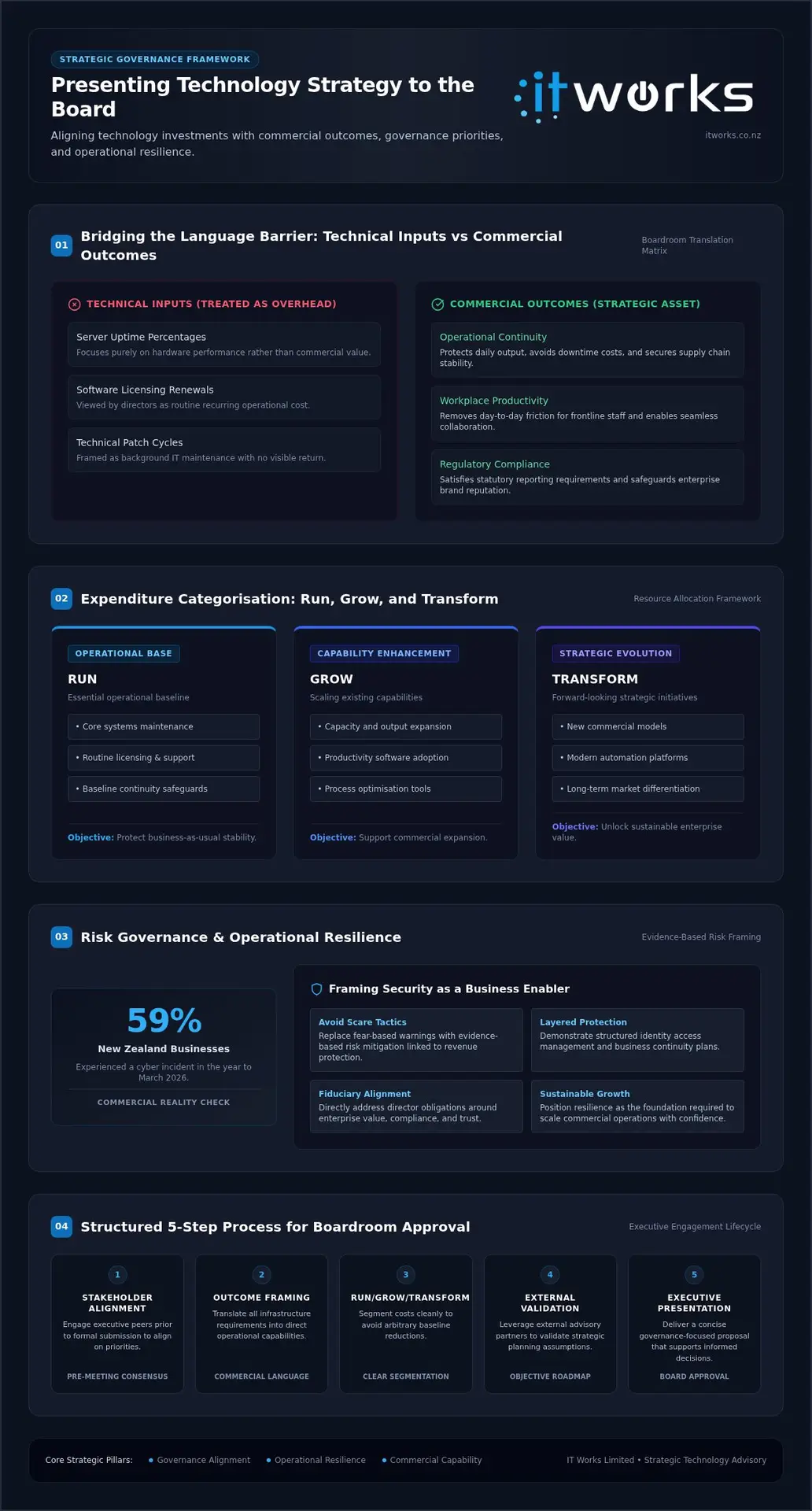
Bridging this divide requires translating technical specifications into clear commercial impacts. Board directors don’t require updates on hardware architecture; they want to know how that investment ensures business continuity, protects customer data, and improves staff productivity.
To communicate effectively with the executive table, anchor your narrative around practical commercial outcomes:
- Operational continuity: Replace discussions about server uptime percentages with the cost of downtime avoided and supply chain stability preserved.
- Workplace productivity: Position collaboration platforms and managed it support services as proactive tools that eliminate day-to-day friction for frontline staff.
- Regulatory compliance: Frame software patch cycles and security audits as vital safeguards that satisfy statutory reporting requirements and protect brand reputation.
Treating Technology as an Overhead Instead of an Asset
A persistent challenge in understanding how to present an IT budget to the board is overcoming the perception that computing systems are merely expensive utilities. When technology is framed solely around “keeping the lights on”, directors inevitably look for ways to cut baseline expenditure. This short-term mindset generates technical debt, compounding operational drag and heightening security exposures across the entire business.
Strategic technology leaders reframe this dialogue. By linking capital outlays directly to core business initiatives, you transform technology into a commercial capability. Modern digital systems are assets that scale operations, unlock customer value, and provide the operational stability your organisation needs to grow with confidence.
Framing Your IT Budget Around Commercial Risk and Resilience
Company directors carry strict fiduciary duties to protect enterprise value, ensure regulatory compliance, and uphold market trust. They don’t evaluate risk through technical vulnerability scores or abstract threats. Instead, research published by Harvard Law School indicates that what boards need to see is how specific investments systematically protect revenue streams and support strategic continuity.
When considering how to present an IT budget to the board, your primary goal is to frame risk management around operational resilience rather than worst-case anxiety. This approach builds governance confidence, allowing directors to make balanced, evidence-based funding choices without feeling pressured by technical speculation.
Communicating Cyber Risk Without Fear-Based Tactics
Relying on dramatic headlines or fear tactics rarely works at the executive table. Experienced directors recognise scare tactics quickly and often respond by pushing back on proposed figures. With 59% of New Zealand businesses experiencing a cyber incident in the year to March 2026, technology leaders must present risk calmly and constructively.
Applying proven principles of cyber security for small business NZ leaders rely on means presenting security as an operational enabler. Focus on layered defences that protect daily output:
- Identity access management: Ensures sensitive financial and client files remain accessible only to verified team members.
- Managed endpoint controls: Detects and isolates anomalies early, preventing isolated device issues from disrupting wider business networks.
- Security awareness education: Equips employees with practical knowledge to recognise social engineering, turning staff into an active defensive line.
Safeguarding Business Continuity and Disaster Recovery
Unplanned downtime quickly erodes commercial margins. Hardware faults, natural disruptions, and system corruptions halt operations, interrupt client commitments, and damage commercial reputations. Understanding how to present an IT budget to the board means translating technical backup specifications into precise commercial metrics: Recovery Time Objectives (RTO) and Recovery Point Objectives (RPO).
By implementing robust backup and disaster recovery NZ frameworks, you show leadership exactly how business functions resume following an outage. Clear recovery windows clarify the value of recurring operational investments, illustrating how rapid restoration minimises unrecoverable wage costs and client attrition. To assess your organisation’s current posture, you can discuss your cybersecurity priorities with our team to ensure your roadmap aligns with governance expectations.
Categorising Your IT Spend: Run, Grow, and Transform
Lumping every software licence, hardware upgrade, and consulting fee into a single operational ledger confuses non-executive directors. When an executive team reviews an undifferentiated pool of expenses, their default reaction is cost containment. A core principle of how to present an IT budget to the board is separating necessary baseline operations from value-generating initiatives using the Run, Grow, and Transform framework.
This strategic portfolio approach gives directors absolute transparency over where commercial capital goes. Typically, organisations allocate 60 to 75 percent of their total technology budget to “Run”, leaving the remainder balanced between “Grow” and “Transform”. By defining these transparent boundaries, you demonstrate rigorous financial governance and protect essential operational funding from arbitrary trimming.
Run: Defending Essential Operations and Maintenance
The “Run” category encompasses baseline operational continuity: network monitoring, helpdesk support, hardware refreshes, and software renewals. Demonstrating proactive discipline here establishes immediate credibility. For instance, structured Microsoft 365 management New Zealand organisations use eliminates unused accounts, consolidates redundant licensing tiers, and guarantees configuration security.
Clearly explain the compounding business impact of neglecting this operational foundation. Deferring scheduled lifecycle replacements or cutting baseline support introduces severe technical debt, increasing system instability and reducing everyday staff productivity.
Grow: Scaling Capabilities and Operational Efficiency
Spending in the “Grow” category funds projects that expand operational capability and improve workflow efficiency across business units. These initiatives help teams accomplish more without requiring matching increases in headcount.
- System integration: Connecting line-of-business platforms to eliminate manual data entry between finance, sales, and operations.
- Cloud modernisation: Migrating legacy servers to resilient cloud environments, enabling seamless collaboration for hybrid teams.
- Process workflow enhancements: Upgrading core platforms to decrease order processing times and enhance client response rates.
Transform: Enabling Innovation and Practical AI
The “Transform” category looks ahead, piloting new capabilities that create enduring operational advantages. With 66% of New Zealand businesses currently managing active AI projects, leadership teams want to understand how emerging capabilities fit into their broader commercial strategy.
When mastering how to present an IT budget to the board, frame transformational expenditure around safe adoption and measured productivity rather than speculative hype. Introducing practical AI automation solutions New Zealand businesses deploy to handle repetitive administrative tasks delivers tangible time savings while maintaining strict data governance.
How to Present an IT Budget to the Board: A 5-Step Process
Securing board approval for technology expenditure requires a methodical approach that starts weeks before the meeting takes place. When deciding how to present an IT budget to the board, treating the boardroom session as the starting point of negotiation is a mistake. The meeting itself should simply be the formal confirmation of consensus already established across the executive leadership group.
Following a structured five-step progression ensures your proposals reflect wider business objectives, pre-empts director scrutiny, and builds lasting executive confidence.
Step 1 & 2: Stakeholder Pre-Alignment and Executive Summaries
Begin by scheduling one-on-one working sessions with key executive peers. Sit down with the Chief Financial Officer early to validate depreciation schedules, cash-flow impacts, and operational expense thresholds, demonstrating rigorous cost governance by using platforms like LicenseIQ to identify and recover wasted software spend can quickly win finance backing. Consult operational general managers to ensure proposed system adjustments address real departmental bottlenecks.
Condense the entire submission into a crisp, single-page executive summary. Boards review dozens of briefing papers, so place your investment totals, risk mitigations, and expected commercial benefits on the opening page. Explicitly identify essential trade-offs so directors see the practical outcomes of each funding level.
Step 3 & 4: Visual Storytelling and Strategic Roadmapping
Replace dense spreadsheets and technical architectural diagrams with clean visual roadmaps. Use timeline charts to illustrate how scheduled projects support corporate milestones over a multi-year horizon.
- Map project sequencing: Clearly display technical prerequisites to explain why foundational infrastructure updates must precede customer-facing software rollouts.
- Highlight governance milestones: Pinpoint formal review gates where progress and expenditure are verified before subsequent project phases commence.
- Visualise capital allocation: Graph the budget across the Run, Grow, and Transform tiers to reinforce prudent financial governance.
Step 5: Anticipating Director Objections and Delivering Clear Follow-Up
Mastering how to present an IT budget to the board involves preparing for rigorous interrogation. Anticipate tough commercial questions regarding deferred upgrades, software subscription increases, or regulatory deadlines. Prepare scenario models showing the operational costs and productivity impacts if specific initiatives are delayed.
Immediately after the meeting, distribute a concise summary confirming approved figures, assigned governance oversight, and upcoming reporting intervals. Documenting these decisions swiftly preserves momentum and cements your position as a trusted commercial leader.
Partnering for Success: Developing a Board-Ready IT Strategy
Internal technology teams are frequently consumed by daily user support, maintenance tasks, and urgent network issues. Finding the time and objective space to step back, model financial projections, and build an executive-grade business case remains a significant hurdle. When refining how to present an IT budget to the board, collaborating with an external technology partner provides the clarity and strategic validation needed to convert technical line items into director confidence.
Independent technology advisors bring broad commercial perspective to your planning process. By stress-testing financial models and assessing project timelines, a partner helps you eliminate hidden risks and confirm cost predictability. For example, managed service providers like Torch Services highlight how consolidating multi-vendor agreements into structured billing frameworks gives executives clearer visibility over ongoing commitments. Directors place immense value on external validation, knowing your recommendations are grounded in proven industry benchmarks.
The Role of Strategic Technology Roadmaps in Governance
A multi-year technology roadmap bridges the divide between day-to-day operations and high-level corporate governance. Instead of presenting reactive, disconnected capital requests each year, an integrated roadmap maps initiatives over a rolling 24 to 36-month horizon, tying every expenditure directly to organisational goals.
This structured governance model proves effective across all sectors. Specialised planning models, such as tailored IT strategy for NZ not-for-profits, demonstrate how organisations with disciplined capital constraints successfully establish predictable technology pipelines. Providing directors with visibility over upcoming lifecycle replacements, cloud enhancements, and cyber controls replaces unexpected funding requests with dependable, transparent oversight.
How IT Works Supports Strategic Technology Planning
Founded in 2004, IT Works operates as an outcome-focused technology partner and trusted advisor for organisations nationally. We combine strategic roadmaps with reliable day-to-day managed IT services, acting as a collaborative co-pilot for leadership teams. Our role is to ensure your technology systems actively support productivity, risk management, and commercial performance.
Mastering how to present an IT budget to the board becomes straightforward when your proposals are backed by pragmatic planning and sound financial governance. Our team helps you design defensible budget structures, balance operational risk, and articulate clear business outcomes that directors appreciate. Talk to IT Works about your technology strategy to build a clear, boardroom-ready plan that earns executive buy-in.
Securing Boardroom Confidence for Your Technology Vision
Securing executive approval becomes straightforward when technology is framed as an operational enabler rather than an overhead expense. Segmenting your spend through the Run, Grow, and Transform framework establishes financial transparency, while positioning risk around continuity protects essential systems from arbitrary cuts. Mastering how to present an IT budget to the board transforms what was once a stressful negotiation into a collaborative partnership focused on sustainable commercial growth.
Founded in 2004, IT Works delivers outcome-focused technology and cybersecurity advisory across the country. By combining dependable managed IT support with multi-year strategic roadmaps, our national team helps executive leaders validate their planning, strengthen governance, and protect business value.
With a balanced, business-led proposal in place, you can approach your next director meeting with absolute confidence in your commercial direction.
Frequently Asked Questions
How many slides should be included in an IT budget presentation to the board?
Aim for 8 to 12 core slides, supported by an appendix for detailed technical data. Directors value clarity and high-level strategy over operational minutiae. Structure the deck around executive priorities: a one-page summary, strategic alignment, the Run, Grow, and Transform allocation breakdown, critical risk mitigations, and explicit decision points. Keep the primary narrative focused on business outcomes, reserving detailed supplier contracts and technical architecture diagrams for supplementary slides if questions arise during discussion.
How do I explain necessary cybersecurity investments to directors who want to cut costs?
Frame cybersecurity as an operational resilience control that protects revenue and balance sheet integrity rather than an IT insurance policy. When evaluating how to present an IT budget to the board, avoid fear-based rhetoric or speculative threat scenarios. Instead, link security controls directly to business continuity, statutory compliance obligations, and customer trust. Presenting layered defences such as managed identity access and automated endpoint isolation demonstrates sensible risk containment that safeguards commercial momentum without excessive overhead.
What is the best way to handle requests for an immediate across-the-board budget cut?
Avoid defending individual cost items defensively and present predefined trade-off scenarios instead. Show the board exactly what operational capability or risk threshold shifts if funding drops by a given percentage. Use the Run, Grow, and Transform framework to explain that cutting essential baseline maintenance increases system vulnerability and downtime risk. Forcing a collaborative trade-off discussion empowers directors to decide which growth projects or service levels they are willing to postpone.
How should operational technology costs be differentiated from capital investments?
Distinguish recurring operational expenses that maintain daily productivity from capital expenditures that build lasting capabilities. Cloud platforms, software licensing, and managed support fit cleanly under operating costs because they deliver steady operational value. In contrast, major infrastructure upgrades or system replacements represent capital investments that depreciate over time. Aligning this distinction with your finance team’s reporting standards ensures directors assess cash flow and asset value accurately.
How far in advance should I prepare an annual IT budget presentation for executive review?
Begin preparing your technology budget at least eight to twelve weeks before the scheduled board meeting. A successful submission requires meaningful consultation across the organisation. Starting early allows you to align priorities with finance, review vendor contracts, and validate operational roadmaps with department heads. Understanding how to present an IT budget to the board means securing stakeholder consensus well in advance, ensuring the formal presentation proceeds smoothly without unexpected pushback or unvetted figures.
What key metrics do board members care about most during a technology funding review?
Board members focus primarily on business continuity metrics, project return on investment, and capital efficiency ratios. Highlight Recovery Time Objectives to prove resilience against operational disruptions, alongside measurable productivity gains generated by workflow automation. Additionally, show the proportion of spend allocated across operational maintenance versus strategic growth. Presenting these commercial indicators reassures directors that capital is deployed responsibly to protect shareholder value and enable sustainable organisational performance.