
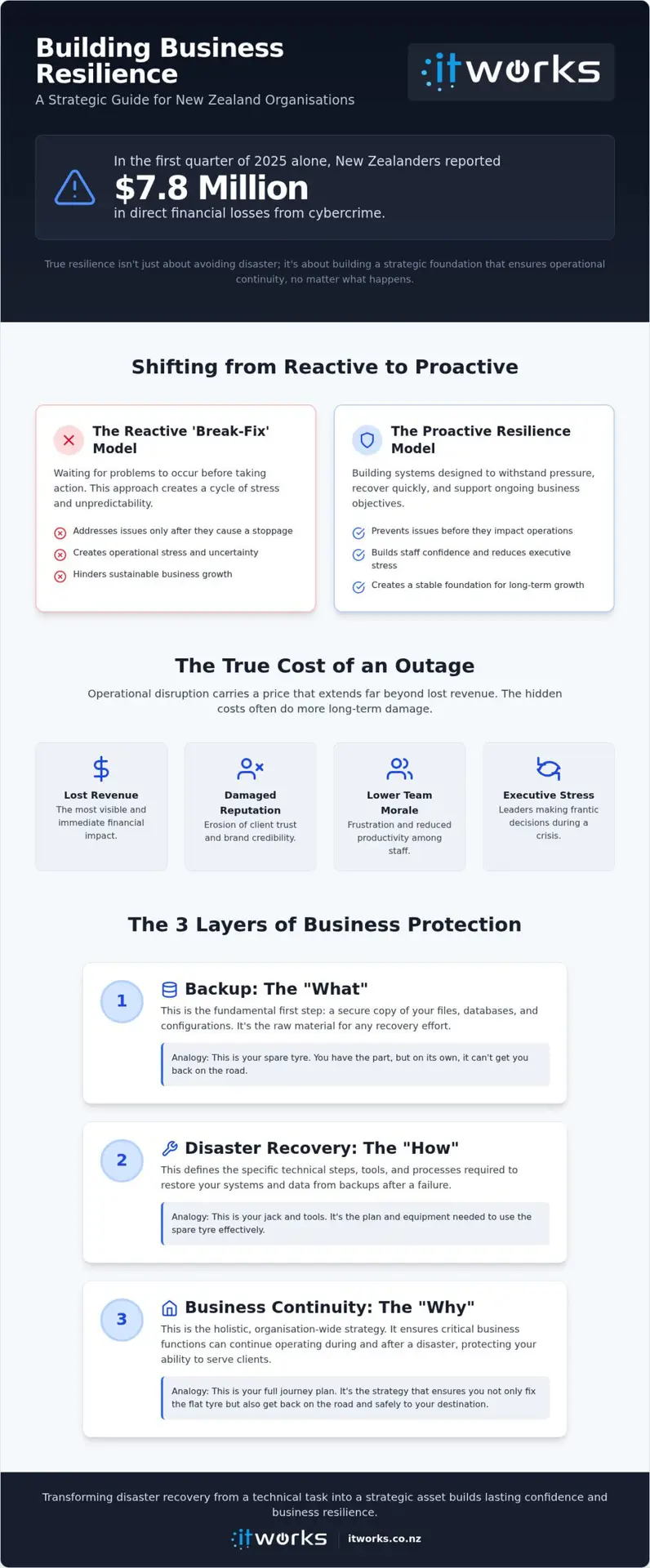
Did you know that New Zealanders reported $7.8 million in direct financial losses from cybercrime in just the first quarter of 2025? For many local leaders, the fear of a sudden system failure isn’t just about technical glitches; it’s about the threat of downtime and the pressure to meet increasingly strict insurance requirements. When you’re evaluating disaster recovery services Wellington organisations can trust, you likely understand that your data is vital, yet you might feel unsure about the practical difference between a simple backup and a comprehensive recovery strategy.
We agree that technology should be a source of stability, not a constant cause for concern. This article will show you how to transform technical disaster recovery into a strategic business asset that ensures operational continuity regardless of external events. We’ll provide a clear, jargon-free roadmap to help you build genuine resilience, replacing the stress of risk management with the confidence that comes from a well-structured technology strategy. By shifting focus from reactive support to long-term growth, you can ensure your organisation remains robust and prepared for any situation.
Key Takeaways
- Learn why building business resilience is a strategic foundation that supports staff confidence and long-term organisational growth.
- Understand the vital differences between backups, disaster recovery, and business continuity to ensure your protective layers are correctly aligned.
- Discover how to set recovery standards based on your specific business requirements rather than being limited by technical constraints.
- Follow a practical roadmap for disaster recovery services Wellington organisations can use to transition from reactive support to proactive resilience.
- See how a long-term partnership with a local New Zealand-based team provides the strategic guidance needed to manage risk with total confidence.
Redefining Disaster Recovery: Why Resilience Matters for NZ Organisations
For many organisations in New Zealand, disaster recovery is often viewed as a technical insurance policy tucked away in a server room. However, viewing it solely as a backup plan misses the bigger picture. True resilience is a core component of a modern technology strategy. It’s about ensuring that your team can keep working, your clients remain served, and your growth remains steady regardless of external events. When you prioritise resilience, you support day-to-day productivity and build immense staff confidence. People work better when they know their tools are reliable and their data is secure. When technology is treated as a strategic asset, it becomes a foundation for scaling rather than a source of potential failure.
Moving Beyond Reactive Tech Support
Many businesses still operate under a break-fix mentality, where technical issues are only addressed once they cause a stoppage. This reactive approach creates a cycle of stress and unpredictability that can hinder sustainable growth. Proactive resilience is different. It involves building systems that are designed to withstand pressure and recover quickly. This is where managed IT support services provide the essential groundwork. By establishing these foundations, you ensure that disaster recovery services Wellington providers can implement a strategy that is integrated with your daily operations. Waiting for a major disruption to occur before acting is a risk that can be easily avoided with the right roadmap. A resilient organisation doesn’t just survive an outage; it maintains its momentum.
The True Cost of Operational Disruption
Operational disruption carries a price tag that extends far beyond the initial outage. While lost revenue is the most visible metric, the hidden costs often do more long-term damage. Consider the impact on your team’s morale when they’re unable to perform their roles, or the reputational risk when clients can’t reach you. When you invest in the disaster recovery services Wellington organisations rely on, you’re actually investing in your team’s peace of mind. Effective recovery planning significantly reduces executive stress and improves overall governance. It ensures that leaders aren’t making frantic decisions during a crisis; instead, they’re following a pre-validated process. This level of preparedness is closely linked to robust cyber security for small business NZ, as preventing data-loss events is always more efficient than attempting to fix them after the fact. A structured Disaster recovery plan serves as a guide, ensuring that every member of the organisation understands their role in maintaining continuity and protecting the integrity of your business data.
Beyond Simple Backups: Understanding the Layers of Business Continuity
Many local business owners believe that having a daily backup means their organisation is fully protected. While data copies are essential, they are only one part of a much larger picture. Relying on a backup alone is like having a spare tyre but no jack; you have the part, but no way to get back on the road. This is why effective disaster recovery services Wellington organisations implement focus on backup and disaster recovery NZ as a connected system. Disaster Recovery is the process of restoring technical infrastructure after a major disruption. Without a plan for that restoration, your data remains inaccessible exactly when you need it most.
Backup vs Disaster Recovery vs Business Continuity
To build a resilient organisation, it helps to distinguish between these three fundamental layers. They work together to ensure you aren’t just protecting data, but protecting your ability to function.
- Backup: This is the “what”. It’s the secure copy of your files, databases, and configurations stored safely away from your primary systems.
- Disaster Recovery: This is the “how”. It defines the specific technical steps and tools required to bring your systems back online after a failure.
- Business Continuity: This is the “why”. It’s the overarching business continuity plan that ensures your entire organisation can continue to function, covering everything from staff communication to alternative workspaces.
The Role of Cloud Solutions in Modern Recovery
Traditional on-site servers often present a bottleneck during a crisis. If the physical hardware is damaged or the office is inaccessible, recovery can take days or even weeks. Cloud infrastructure changes this by allowing for near-instant restoration in a virtual environment. When looking for the right disaster recovery services Wellington provides, focusing on the cloud’s ability to replicate environments is key. For organisations using decentralised work models, Microsoft 365 management New Zealand ensures that teams can continue collaborating from any location, even if the main office is offline.
It’s also important to remember that SaaS data itself needs protection. Cloud-to-cloud backup acts as a safety net for your productivity tools, ensuring that your emails and shared documents are just as resilient as your core servers. If you’re unsure how these layers fit together in your current setup, you can discuss your technology strategy with our team to find a balance that works for your specific needs.
Setting Your Standards: Calculating Recovery Time and Point Objectives
When designing a strategy for disaster recovery services Wellington organisations can rely on, the focus must shift from technical possibilities to business realities. Two primary metrics serve as the foundation for this measurement: Recovery Time Objective (RTO) and Recovery Point Objective (RPO). These shouldn’t be arbitrary numbers set by an IT department; they should be strategic decisions made by leadership based on operational needs. At IT Works, we prioritise practical, outcome-based standards that ensure your technology supports your business goals without unnecessary complexity or cost.
Defining RTO (Recovery Time Objective)
RTO represents the maximum tolerable duration of downtime after a disruption. It essentially answers the question: “How quickly do we need to be back up and running?” Different business functions often require different RTOs. For instance, your customer-facing booking system might need to be restored within an hour, while your internal archived files could potentially wait for a day. Ask yourself: “How long can your team go without access to email or files before it gets pear-shaped?” By categorising your systems by their impact on operations, you can allocate resources more effectively, ensuring your most critical tools receive the fastest response.
Defining RPO (Recovery Point Objective)
While RTO focuses on time, RPO focuses on data. It defines the maximum amount of data loss your organisation can tolerate, measured in time. If your RPO is four hours, it means you’re prepared to lose up to four hours of work if a system fails. Setting a very low RPO requires more frequent backups, which in turn demands more storage and bandwidth. When determining this target, consider your data entry volume. A professional services firm entering complex data all day might need a very short RPO, whereas a business that only updates its records once a day could afford a longer window.
Achieving near-zero RTO and RPO is technically possible, but it often comes with a significant price tag. The key is finding a balance that protects your organisation without over-investing in unnecessary speed. By working with a partner who understands disaster recovery services Wellington businesses actually need, you can create a tiered strategy. This ensures that your mission-critical operations are protected by rapid recovery protocols, while less vital systems are managed with a more cost-effective approach. This strategic alignment ensures your investment is always focused on where it provides the most value.
Designing a Practical Disaster Recovery Roadmap for Your Team
Resilience isn’t an accident. It’s the result of a deliberate, step-by-step process that moves your organisation away from high-stress reactive fixes. A roadmap shouldn’t be a static document gathering dust on a shelf; instead, it serves as a living guide that evolves alongside your business. When you engage with the disaster recovery services Wellington organisations rely on, you gain more than technical tools. You gain a strategic framework that turns uncertainty into operational confidence. This layered approach ensures every risk is identified and mitigated before it can impact your bottom line.
Identifying Critical Business Functions
The first phase of any roadmap involves looking under the hood of your current operations. You can’t protect what you haven’t mapped. This process requires a clear-eyed look at how work actually gets done on a daily basis.
- Step 1: Audit your landscape. Identify where your data actually lives. Is it in local folders, cloud silos, or a mix of both? Auditing your existing data silos is the only way to ensure nothing is left behind.
- Step 2: Rank by importance. Not every system is equal. Determine which applications are vital for the first hour of recovery and which can wait until the next day.
- Step 3: Map dependencies. Technology is interconnected. For example, if your internet connection fails, can your team still access files on SharePoint? Understanding these links prevents surprises during a crisis.
Testing and Refining Your Response Plan
An untested plan is essentially just a list of good intentions. Real resilience comes from practice and validation. Regular tabletop exercises or simulated failovers allow your team to walk through their roles in a low-pressure environment. These sessions often reveal small gaps that could become major hurdles during an actual event. As your business scales or adopts new tools like AI automation solutions New Zealand organisations are now using, your roadmap must be updated to reflect these changes. By treating your recovery plan as a work in progress, you ensure it remains functional when you need it most.
A strategic technology partner acts as a steady guide through this process, providing the expertise needed to keep your plan current. We help you move from a reactive state to a resilient position, ensuring your disaster recovery services Wellington strategy remains relevant. By focusing on practical outcomes, we ensure your roadmap is functional in the real world.
Partnering for Confidence: The IT Works Approach to Disaster Recovery
Choosing a partner for your resilience strategy is about more than just checking technical boxes. It’s about finding a team that understands the weight of your operational responsibilities. At IT Works, we combine long-term strategic advisory with reliable day-to-day support. This dual focus ensures that your disaster recovery services Wellington strategy is never just a document on a shelf. Instead, it’s a living part of your business that provides genuine peace of mind. We prioritise clear accountability and transparent processes, acting as a steady guide so you can focus on leading your organisation with total confidence.
Strategic Advisory Meets Operational Excellence
We believe that resilience should be woven into the fabric of your organisation. Our model integrates recovery planning directly into your broader managed IT services Wellington plan. This ensures that every technical decision we make supports your overarching business goals. We don’t focus on selling specific products or vendor solutions. Our outcome-focused model prioritises what actually works for your team. Whether you’re based in Wellington or operating across New Zealand, our approach remains the same: we provide practical, functional results that protect your productivity. By aligning your recovery standards with your actual business needs, we help you grow securely without unnecessary technical overhead.
Building a Long-Term Technology Partnership
A successful technology strategy requires a partner who truly knows your business. We act as an extension of your own team, taking the time to understand your unique goals and challenges. This local connection is vital. All our support and advisory work is performed by our New Zealand-based team. We don’t use outsourced helpdesks, ensuring you always speak with an expert who understands your context. As your organisation scales, our regular technology roadmaps keep your resilience plan relevant. These roadmaps help you adopt new tools responsibly and ensure your protective layers remain robust as your requirements change. We’re here to replace the typical stress of technical management with a sense of calm reliability, helping you build a stable foundation for the future.
If you’re ready to move away from reactive support and toward a more resilient future, we’re here to help. Talk to IT Works about your technology strategy or discuss your cybersecurity priorities with our team to see how we can support your journey.
Building a Resilient Future for Your Organisation
Transforming your technical infrastructure into a strategic asset is the first step toward long-term stability. By understanding the distinct layers of business continuity and setting clear, outcome-based recovery standards, you move far beyond the limitations of simple backups. This structured approach ensures that your team remains productive and your data remains protected; even during unexpected disruptions. Effective disaster recovery services Wellington leaders trust focus on this proactive risk management to build genuine organisational confidence.
Since 2004, our NZ-based team of experts has helped local organisations navigate these complexities with a focus on strategic alignment rather than reactive support. We act as a steady guide, ensuring your technology roadmap evolves alongside your business goals. You don’t have to manage these risks alone.
With a practical roadmap and a steady partner by your side, you can focus on scaling your business with the certainty that your operations are built to last.
Frequently Asked Questions
What is the difference between backup and disaster recovery?
Backup is essentially a copy of your data, while disaster recovery is the entire process and infrastructure required to restore your operations after a failure. Think of a backup as the spare parts and disaster recovery as the mechanic and tools needed to get the car back on the road. Without a recovery plan, your data might be safe, but your team remains unable to work until the systems are rebuilt.
How much do disaster recovery services cost for NZ businesses?
The investment for these services varies significantly based on your specific Recovery Time Objectives and the complexity of your infrastructure. Rather than a fixed price, costs are determined by the speed at which you need to be back online and the volume of data you manage. A strategic technology partner will help you balance these requirements to ensure your investment aligns with your actual business risk and operational needs.
Does my small business really need a disaster recovery plan?
Every organisation, regardless of size, relies on digital tools to function and serve customers. Small businesses often face higher relative risks from downtime because they lack the deep financial reserves of larger corporations. Implementing disaster recovery services Wellington organisations trust ensures that a single event doesn’t stall your growth. Resilience isn’t just for enterprises; it’s a fundamental requirement for any business that values its reputation and operational continuity.
How often should we test our disaster recovery response?
You should test your response plan at least once a year, though quarterly reviews are better for growing organisations. Testing ensures that your roadmap remains relevant as you adopt new software or change your internal processes. Regular tabletop exercises allow your leadership team to walk through their roles without the pressure of a real crisis. If you make significant changes to your network, a re-test should be performed immediately.
Can disaster recovery services help with ransomware attacks?
Modern recovery strategies are a vital defence against ransomware because they allow you to restore your systems to a clean state from before the infection occurred. While cybersecurity tools focus on prevention, disaster recovery focuses on resilience and your ability to bounce back. Having a verified recovery point ensures that you don’t have to choose between losing your data or dealing with the stress of an active extortion attempt.
What is a “warm site” vs a “cold site” in recovery planning?
A cold site is a physical space with power and cooling but no pre-installed hardware, requiring days to set up during a crisis. In contrast, a warm site has pre-configured equipment and partial data backups ready to go. Most modern businesses now favour cloud-based recovery, which acts like a hot site by allowing almost instant failover to a virtual environment without the high cost of maintaining a second physical office.
Who should be involved in creating our disaster recovery roadmap?
Creating a roadmap requires input from both your executive leadership and your department heads. Managing directors provide the strategic vision and budget, while department leaders identify which specific functions are most critical for their daily workflows. Your technology partner then translates these business needs into a technical framework. This collaborative approach ensures the final plan supports the whole organisation rather than just being a checklist for the IT team.
How does cloud migration impact our disaster recovery strategy?
Moving to the cloud significantly strengthens your resilience by removing the dependency on physical hardware located in a single office. It allows your team to access vital applications and data from any location with an internet connection, which is essential during a local disruption. Cloud-based disaster recovery services Wellington providers offer more flexibility and faster restoration times than traditional on-site models, making it easier to scale your protection as your business grows.