
Did you know that nearly three-quarters of all cybersecurity breaches involve a human element, such as a simple error or a well-disguised phishing attempt? For many New Zealand business owners, this statistic highlights the urgent need for better cybersecurity awareness, yet it often feels more like a burden than a benchmark. It’s easy to feel overwhelmed by complex jargon and the constant pressure to protect sensitive data while keeping your team productive. You likely worry that one wrong click could lead to a significant disruption, making security feel like a source of stress rather than stability.
We believe that building a resilient culture should be based on a foundation of confidence, not fear. This article will show you how to transform your staff into a proactive line of defence by prioritising clear communication and practical habits. We’ll move past old-fashioned compliance to provide a strategic roadmap for your organisation. You’ll learn how to foster a security-conscious team that feels empowered to protect your business, ensuring your technology serves as a secure platform for long-term growth.
Key Takeaways
- Learn why effective cybersecurity awareness is a shared organisational responsibility that extends far beyond technical firewalls.
- Understand how social engineering targets human psychology and why technical controls alone aren’t enough to stop modern threats.
- Discover how to replace fear-based messaging with education that builds staff confidence and encourages proactive reporting.
- Gain a practical roadmap for developing a continuous learning programme that moves beyond annual tick-box training.
- Learn how a strategic partnership provides the local context and ongoing support needed to maintain a resilient security posture.
Moving Beyond the Tick-Box: Why Awareness is Your Best Defence
For many organisations across New Zealand, cybersecurity is often viewed as a technical barrier, something managed by firewalls and software updates. While these tools are essential, they can’t protect against every threat, especially those that target human psychology. True resilience comes when cybersecurity awareness is treated as a shared responsibility across the entire team. It’s about moving away from the idea that security is solely an IT task and recognising it as a core part of your organisational culture.
In New Zealand, we often pride ourselves on a “she’ll be right” attitude. While this serves us well in many areas, it can create significant gaps in our digital defences. Relying on luck or assuming your business is too small to be a target often leads to avoidable risks. Following the NCSC Minimum Cyber Security Standards, which are now the benchmark for private sector organisations, helps bridge these gaps. By integrating awareness into your daily operations, you build a foundation for long-term growth and business success.
The Real Impact of Security Awareness
A security-conscious culture does more than just stop breaches; it actively reduces operational downtime. When your staff feel confident in their ability to spot a lure, they become a proactive layer of protection. This confidence is a clear competitive advantage. It demonstrates to your clients and donors that you take their data seriously, which is vital for maintaining long-term trust. Under the Privacy Act 2020, being prepared also means your team can identify and report potential issues before they escalate into serious harm, ensuring you meet your regulatory duties with ease.
Why Traditional Training Often Fails
Many businesses still rely on once-a-year sessions that leave staff feeling bored and disconnected. These events often focus on technical jargon that feels alien to non-technical professionals. When security awareness is treated as a tick-box exercise, the information rarely sticks. To be effective, training needs to be practical, relatable, and delivered in small, manageable pieces. It shouldn’t feel like a chore; it should feel like a valuable skill that helps employees protect both the organisation and their own personal information. This ongoing approach ensures that cybersecurity awareness remains a top priority rather than a forgotten annual event.
Unpacking the Human Element: Why Technical Controls Aren’t Enough
Technical controls like firewalls and antivirus software are essential components of your infrastructure, yet they possess a significant blind spot: the person behind the screen. Modern cybercriminals have largely shifted their focus from hunting for software bugs to identifying people they can influence through psychological triggers. This shift is why cybersecurity awareness is no longer just an optional extra; it’s the critical first layer of a layered security strategy. It provides a vital human sanity check that automated systems simply cannot replicate.
While software can block known malicious files, it struggles to interpret the context of a conversation or the intent of an email. Attackers exploit this by creating scenarios that demand urgent action, bypassing technical filters by targeting the user directly. By building a culture where every team member understands their role in the security chain, you create a more resilient organisation that can adapt to threats that technical tools might miss.
Spotting Social Engineering in the Wild
Social engineering is the tactical manipulation of human trust. Attackers exploit our natural tendency to be helpful or our fear of authority to gain access to sensitive systems. Phishing has evolved significantly, moving past the era of obvious spelling mistakes and generic greetings. Today, attackers use sophisticated tools to craft flawless, highly personalised messages that are difficult to distinguish from legitimate internal communications.
Business Email Compromise (BEC) is a prime example of this evolution. A finance officer might receive a perfectly timed, urgent request to update a supplier’s bank account details, appearing to come directly from a senior executive. The NCSC reported that in the first quarter of 2025, scams and fraud resulted in NZ$6.5 million in reported losses, with a significant portion attributed to these unauthorised money transfers. For a more structured lifecycle approach to these challenges, the NIST guidance on cybersecurity learning programs offers a comprehensive blueprint for organisations looking to move beyond simple compliance.
The Role of Identity and Access
Multi-Factor Authentication (MFA) is a non-negotiable defence for any New Zealand organisation. It adds a necessary barrier that stops most credential-based attacks in their tracks. However, its effectiveness relies heavily on staff awareness. Without an understanding of the risks, employees can fall victim to “MFA fatigue,” where they accidentally approve a fraudulent login attempt after being bombarded with notifications.
Encouraging a healthy level of professional scepticism is key to preventing these errors. When your team knows to pause and verify an unexpected prompt, they become an active part of your defence system rather than a passive user. This mindset ensures that technology like MFA acts as a partner to human judgement, not a replacement for it. To ensure your team is prepared for these evolving tactics, you can discuss your cybersecurity priorities with our team at IT Works.
Strategy vs. Scare Tactics: What Makes Training Effective?
Traditional cybersecurity messaging often relies on fear to drive action. While the threats facing New Zealand businesses are genuine, “doom-and-gloom” tactics usually lead to staff disengagement. When employees feel overwhelmed or threatened by the technology they use, they’re more likely to ignore warnings or, worse, hide mistakes when they occur. At IT Works, we believe in a different approach. We focus on building confidence through clear, practical education that empowers your team to act as a resilient line of defence.
Effective cybersecurity awareness initiatives move beyond simple checklists to focus on genuine behavioural change. The NIST SP 800-50 guidelines on building a cybersecurity learning program provide an excellent framework for this, emphasising that education should be an ongoing lifecycle rather than a one-off event. By prioritising a supportive environment, you ensure that security becomes a natural part of your organisation’s daily rhythm rather than a source of stress.
Fostering a Culture of Confidence
A resilient culture is built on trust and open communication. It’s vital to encourage a “no-blame” approach where staff feel safe reporting suspicious activity, even if they’ve accidentally clicked a link. Rapid reporting is essential for limiting the impact of an incident. In the 2024/25 period, the NCSC recorded 5,995 cybersecurity incidents across New Zealand. Reducing the time an attacker spends in your system starts with a team that isn’t afraid to speak up. Positive reinforcement and making security a regular, jargon-free conversation will always yield better results than punitive measures.
Aligning Awareness with Business Outcomes
Security should never be a hurdle to productivity. When your team understands the “why” behind security protocols, they’re more likely to follow them without feeling slowed down. This alignment leads to direct business benefits, such as a reduced risk of financial loss. With reported losses reaching NZ$26.9 million in the last reporting year, the financial case for a security-conscious workforce is clear. Beyond the balance sheet, a well-trained team ensures operational efficiency by reducing the frequency of IT disruptions. This resilience allows your organisation to focus on its core goals, knowing that your people and your data are well-protected.
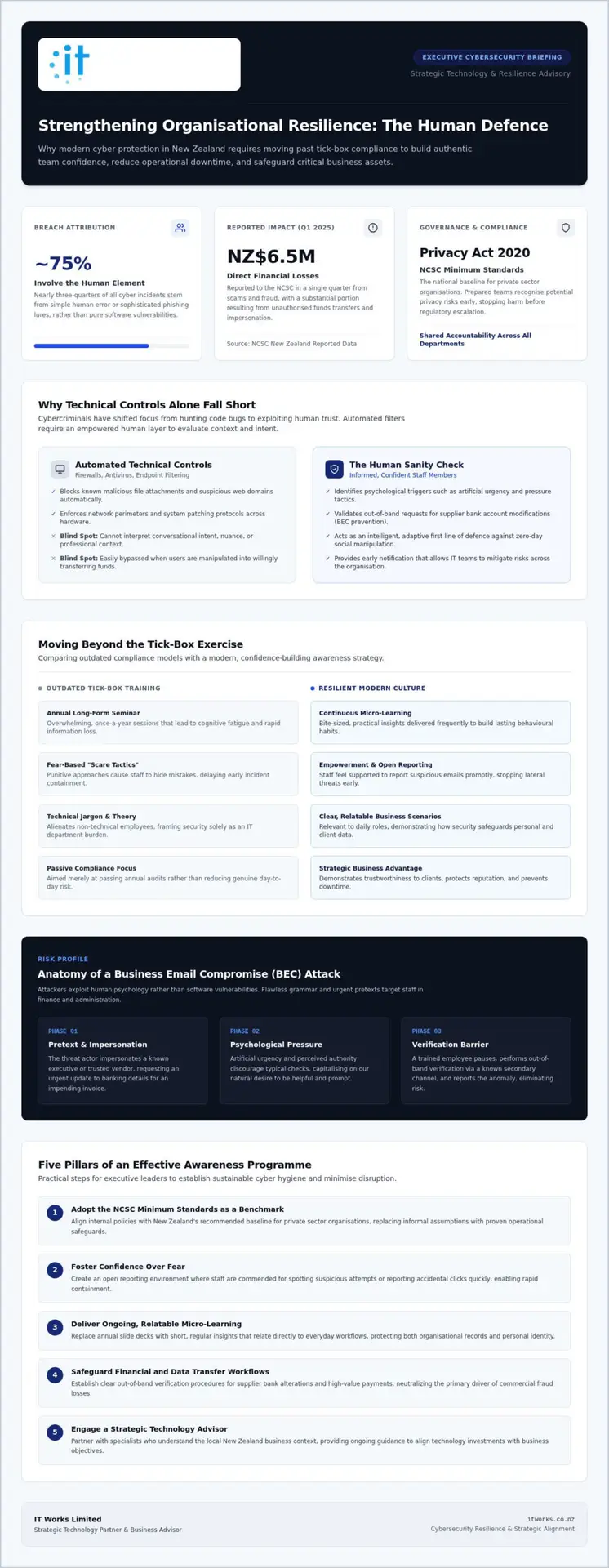
Five Practical Steps to Organise Your Awareness Programme
Building a cybersecurity awareness programme that actually works requires a move away from generic automation and toward a structured, human-centric approach. It’s about creating a sustainable system that evolves alongside your business rather than a one-off event that’s quickly forgotten. By following a logical progression, you can ensure your efforts lead to genuine behavioural change across your organisation.
Assessing Your Current Risk Profile
The first step is to understand where your specific vulnerabilities lie. Not all staff groups face the same risks; for instance, your finance team might be targeted with sophisticated invoice fraud, while your executive team faces highly personalised impersonation attempts designed to bypass standard protocols. Identifying these high-risk groups allows you to tailor your education to the threats they’re most likely to encounter in their specific roles. You should also evaluate how you currently manage sensitive data and user identities. For more on this, our guide on Cyber Security for Small Business NZ provides a deeper look at building resilience from the ground up.
Implementing Continuous Learning
Consistency is more effective than intensity. Instead of long, infrequent training sessions, use bite-sized modules that take only a few minutes to complete. If you need an efficient way to turn static policies into interactive modules, explore Pay-per-assignment e-learning platform tools that make training creation seamless. This approach prevents information overload and keeps security at the front of everyone’s mind. You can keep the conversation fresh by sharing fortnightly security tips or discussing near misses in team meetings. Encouraging staff to share their experiences creates a peer-to-peer learning environment that feels supportive rather than instructional. This openness helps demystify security and makes it a natural part of your daily operations.
To keep your programme on track, consider these five actionable steps:
- Establish a baseline: Use an initial assessment to understand your team’s current knowledge and identify specific gaps.
- Schedule regular updates: Move to a continuous learning model with short, monthly focus areas rather than annual marathons.
- Use New Zealand contexts: Relate training to local events or common scams targeting Kiwi businesses to make the content feel relevant and immediate.
- Measure through simulation: Use benign phishing simulations to track improvement in reporting speeds and click rates over time.
- Refine your approach: Review your progress every six months and adjust your content based on new risks or direct staff feedback.
By treating cybersecurity awareness as an ongoing journey, you move beyond simple compliance and start building a culture of true resilience. This structured approach ensures that your team remains your strongest asset in protecting your organisation’s future.
Strengthening Your Security Posture with a Strategic Technology Partner
For organisations operating across New Zealand, the value of a local strategic partner lies in a shared understanding of the specific business environment. A partner who understands the unique pressures facing Kiwi teams can provide guidance that feels relevant and grounded. This national presence allows for a more meaningful implementation of cybersecurity awareness, as the advice is tailored to the real-world experiences of your staff rather than generic global templates. Moving away from a reactive “break-fix” model ensures that your technology remains a stable foundation for growth rather than a source of constant fire-fighting.
A proactive partnership focuses on long-term outcomes rather than just resolving immediate technical hurdles. By acting as a strategic advisor, a partner helps you anticipate risks before they impact your operations. This approach replaces the frantic energy of traditional support with a composed, methodical strategy. It ensures that every technical decision aligns with your broader business goals, creating a connected system where security and productivity work in harmony.
The IT Works Approach to Cyber Resilience
Our philosophy centres on providing practical, layered security that protects your organisation without the burden of dense technical jargon. We aim to act as a seamless extension of your team, providing the strategic oversight typically associated with an internal IT department. This relationship allows us to deeply understand your workflows and the specific pressures your staff face. To see how this model differs from traditional reactive services, you can explore our Guide to Managed IT Support, which outlines the benefits of a partnership focused on business success.
Building Your Technology Roadmap
A well-defined technology roadmap is essential for planning future growth while maintaining a secure environment. This roadmap serves as a strategic guide, helping you prioritise investments that offer the most significant value to your organisation. It allows for the safe integration of new developments, such as AI and automation, into your existing workflows without compromising your security posture. By focusing on responsible governance and practical applications, you can leverage these tools to enhance productivity while keeping your data protected.
A strategic partner ensures that your cybersecurity awareness initiatives are not isolated events but are integrated into this larger technology plan. This ensures that as your business evolves, your team’s skills and your technical defences evolve alongside it. This steady, reassuring pace of development builds organisational confidence, knowing that your technology strategy is both functional and sustainable in the real world. Talk to IT Works about your technology strategy for the year ahead and learn how a proactive partnership can lead to better business outcomes.
Empowering Your Organisation for Future Success
Creating a resilient organisation starts with recognising that technology is an enabler of business success, not just a set of tools to be managed. By shifting from a tick-box compliance mindset to a genuine culture of cybersecurity awareness, you empower your staff to act with confidence and clarity. This human-centric approach, combined with robust technical layers, ensures that your business can navigate risks while remaining focused on growth and productivity.
Since 2004, our New Zealand-based team has helped organisations move away from reactive support toward a proactive, outcome-focused model. We are committed to acting as a strategic ally, providing the guidance and stability you need to build a truly secure environment. Together, we can transform security from a source of anxiety into a foundation for long-term organisational resilience.
Your team is ready to become your strongest line of defence, and we are here to guide you every step of the way.
Frequently Asked Questions
What is cybersecurity awareness and why does it matter for my business?
Cybersecurity awareness is the combination of knowledge, attitudes, and behaviours that your team members have regarding digital security. It matters because technical defences alone cannot stop every threat, especially those that target human psychology. When your staff understand how to recognise and report suspicious activity, they become a proactive line of defence. This shared responsibility reduces the risk of data breaches and builds organisational confidence in your technology systems.
How often should we run cybersecurity training for our staff?
Effective cybersecurity awareness shouldn’t be a one-off annual event. Instead, you should move toward a continuous learning model that keeps security at the front of your team’s mind. We recommend using bite-sized training modules delivered monthly, supplemented by fortnightly security tips or discussions about recent local threats. This regular rhythm ensures that habits stay fresh and your team remains resilient as new social engineering tactics emerge throughout the year.
Is cybersecurity awareness training expensive for smaller organisations?
The cost of a structured programme is a manageable investment that is far lower than the potential impact of a data breach. For smaller New Zealand organisations, we focus on providing scalable solutions that deliver high value without the need for a massive budget. By prioritising a strategic technology roadmap, you can integrate education into your existing managed services. This proactive approach leads to better business outcomes and protects your long-term financial stability.
What are the most common social engineering attacks in New Zealand?
Phishing and Business Email Compromise (BEC) remain the most frequent threats facing local organisations. According to NCSC data, scams and fraud accounted for NZ$6.5 million in reported losses in the first quarter of 2025 alone. Attackers often impersonate senior executives or trusted suppliers to request urgent bank account changes or unauthorised money transfers. Training your team to use out-of-band verification for any financial request is a vital step in preventing these losses.
How can I get my senior leadership team to buy into security training?
Frame security as a strategic business enabler rather than a technical hurdle or a cost centre. Explain how a security-conscious culture protects client trust, ensures business continuity, and supports scalable growth. When leadership understands that cybersecurity awareness reduces operational downtime and financial risk, it becomes easier to align these goals with your broader technology strategy. Highlighting the legal duties under the Privacy Act 2020 can also help emphasize the importance of proactive risk management.
Can cybersecurity awareness really prevent a ransomware attack?
Yes, because most ransomware incidents begin with a human error, such as clicking a malicious link or downloading a compromised attachment. By teaching your staff to identify the early signs of a lure, you can stop an attack before it gains a foothold in your network. While technical controls like backups and endpoint monitoring are essential, an educated workforce provides the critical sanity check that prevents the initial entry point for attackers.
What is the difference between security training and a security culture?
Security training refers to the specific educational activities your staff complete, such as watching a module or attending a workshop. A security culture is the ongoing mindset where security is naturally integrated into every business decision and daily habit. While training provides the necessary knowledge, culture ensures that staff feel confident and supported when they report a “near miss.” A strong culture moves your organisation from a tick-box exercise to a state of true resilience.
Do we need a cybersecurity awareness programme if we have good antivirus software?
Absolutely, because software cannot interpret the context of a conversation or the intent behind a fraudulent request. Antivirus tools are excellent at blocking known malicious files, but they struggle to stop social engineering or credential theft where no “virus” is actually present. Your staff are the only ones who can verify if a request from a colleague or supplier feels legitimate. Combining technical tools with human judgement creates the most effective layered defence for your organisation.