
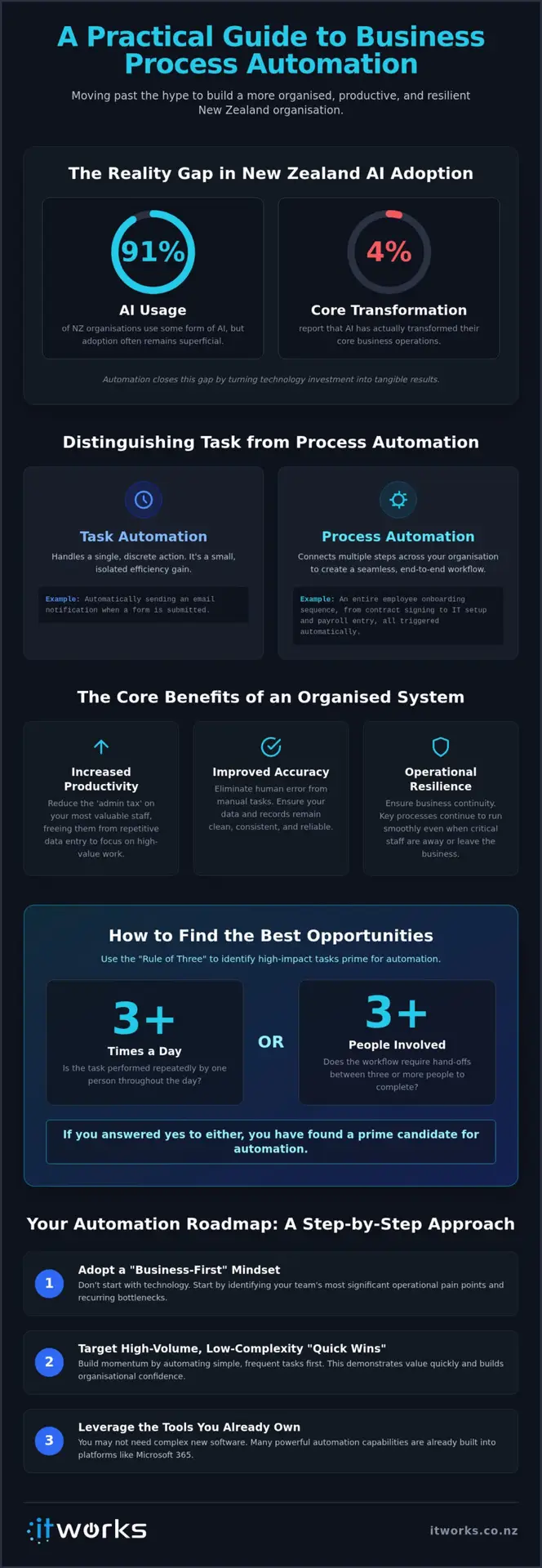
While 91% of New Zealand organisations used some form of AI in 2026, a mere 4% report that these tools have actually transformed their core operations. It’s a striking gap that highlights a common frustration for many local leaders. You’ve likely seen your staff spend hours on manual data entry or repetitive admin, even as you invest in new software. It feels like you’re running to stand still, worried that competitors might be moving faster while your own processes remain inconsistent and prone to human error.
We understand that technology should be a quiet engine for growth, not a source of constant friction. This guide to business process automation nz will help you move past the hype to find a clearer, more organised way of working. We’ll show you how to automate those draining repetitive tasks to improve staff morale and gain better visibility into your performance. By the end, you’ll have a practical framework to align your technology roadmap with your actual business goals, ensuring your investments deliver a measurable impact on your bottom line.
Key Takeaways
- Learn how to distinguish between simple task automation and full process automation to identify the highest impact opportunities within your operations.
- Apply the “Rule of Three” to pinpoint repetitive admin tasks that are prime candidates for automation, freeing your staff for more meaningful work.
- Discover how to leverage the tools you already own, such as Microsoft 365, to implement business process automation nz without needing complex new software.
- Develop a structured technology roadmap that balances immediate operational fixes with long-term strategic growth and sustainable productivity.
- Understand the value of a proactive technology partnership in maintaining a secure, organised system that evolves alongside your business.
What is Business Process Automation and Why Does it Matter for NZ Firms?
At its simplest, Business process automation (BPA) involves using technology to execute recurring tasks or workflows where manual effort can be replaced. For many New Zealand organisations, this isn’t about replacing people with robots; it’s about organising your technology so your team can focus on work that actually requires a human touch. While task automation might handle a single action, like an email notification, true business process automation nz looks at the bigger picture. It connects multiple steps across your organisation to create a seamless, hands-off workflow.
This approach represents a fundamental shift in how we view IT. Instead of a reactive “break-fix” mindset where you only call for help when something stops working, automation creates a proactive and organised system. It’s a core component of modern business strategy, often sitting alongside a comprehensive Guide to Managed IT Support for New Zealand Organisations. When your underlying technology is managed strategically, automation becomes the engine that drives your daily operations forward without constant manual intervention.
The Core Benefits of Organising Your Technology
Implementing structured automation provides several tangible advantages for growing firms:
- Increased Productivity: You can significantly reduce the “admin tax” that bogs down your most valuable staff members. When software handles the heavy lifting of data movement, your team regains hours every week.
- Improved Accuracy: Human error is an inevitable part of manual data entry and repetitive filing. Automation eliminates these mistakes, ensuring your records remain clean and reliable.
- Operational Resilience: If a key staff member is away or leaves the business, your processes shouldn’t grind to a halt. Automated workflows ensure consistency and keep the wheels turning regardless of who is in the office.
Common Signs Your Organisation is Ready for Automation
Identifying the right time to start can be difficult. Look for these indicators within your current operations:
- Recurring bottlenecks: If approvals, employee onboarding, or monthly financial reporting consistently stall at the same points, your process needs better structure.
- High volume of “busy work”: Listen to your staff. If they complain about spending more time on admin than their core roles, you’re losing money on inefficient tasks.
- Manual data silos: Entering the same information into multiple systems is a clear sign that your technology isn’t talking to itself. You can bridge these gaps by implementing business process automation nz to sync data automatically.
Identifying High-Impact Automation Opportunities in Your Business
The most successful implementations of business process automation nz don’t start with a piece of software; they start with a business problem. We recommend a “Business-First” approach, where you look for existing pain points rather than chasing the latest technical features. Instead of asking what a tool can do, ask where your team feels the most friction. By identifying these manual bottlenecks first, you ensure that any technology investment directly supports your operational goals and delivers a clear return on investment.
A simple yet effective framework for this is the “Rule of Three.” If a specific task is performed more than three times a day, or if it involves more than three people to complete, it’s a prime candidate for automation. When you’re starting out, it’s wise to focus on high-volume, low-complexity tasks. These “quick wins” help build organisational confidence and demonstrate the value of structured workflows without the risk of a massive, multi-year project. For a deeper look at how this fits into a broader plan, our AI automation solutions New Zealand guide provides a strategic framework for mapping these workflows.
Finance and Administration Workflows
Finance departments are often the first to benefit from better organisation. Manual invoice processing and expense approvals frequently lead to delays in month-end reporting and unnecessary stress for the accounts team. By automating these steps, you can ensure that data flows directly into your ledger with minimal manual entry. Other high-impact areas include:
- Bank Reconciliation: Using technology to automatically match transactions, reducing the time spent on manual line-item checks.
- Accounts Management: Streamlining accounts payable and receivable to maintain a healthy cash flow with automated reminders.
- Procurement: Simplifying how you order hardware or manage software licences to ensure every purchase follows a standard approval path.
- Payroll and Tax Compliance: Eliminating manual paperwork in enterprise systems, such as implementing PeopleSoft W4 automation for employee withholding forms, drastically reduces processing delays and compliance errors.
Human Resources and Staff Onboarding
Your people are your most valuable asset, yet they’re often bogged down by administrative checklists. Standardising the onboarding process ensures that every new hire has the correct system access, hardware, and safety briefings from their first hour on the job. This doesn’t just save time; it improves the employee experience and protects your business from compliance risks. Automation can also manage leave requests and performance review cycles, ensuring these vital tasks don’t slip through the cracks. You can talk to IT Works about your technology strategy to identify which of these areas will offer the quickest return for your organisation’s specific needs.
Effective internal communication is another area where automation shines. Rather than relying on manual emails, you can automate all-staff updates and policy acknowledgements. This ensures that everyone stays informed and that you have a clear record of who has seen and accepted important company information.
Practical AI and Automation Tools: Moving Beyond the Hype
While the conversation around Artificial Intelligence often feels saturated with hype, practical business process automation nz is grounded in tools that deliver measurable value. Most New Zealand organisations don’t need to reinvent their entire technology stack to see results. Instead, the focus should be on responsible governance and identifying specific applications that support your team rather than attempting to replace them. With 91% of local organisations already using some form of AI as of 2026, the real challenge has shifted from simple adoption to effective, strategic implementation.
The goal is to bridge the “productivity gap” where many firms use tools in a limited capacity but struggle to redesign core processes. By focusing on practical utility, you can ensure your technology works for you, providing a sense of calm reliability rather than technical stress. This starts with looking at the software your team uses every day and finding the hidden efficiencies within those systems.
Leveraging the Microsoft 365 Ecosystem
Many of the capabilities you need are likely already sitting within your existing subscriptions. Our Microsoft 365 Management New Zealand guide explores how to optimise these environments to ensure you aren’t paying for features you don’t use. Within this ecosystem, Power Automate stands out as a primary tool for connecting disparate apps to handle repetitive file transfers and notifications automatically. It allows data to flow seamlessly between your email, spreadsheets, and project management tools without manual intervention.
Using SharePoint and Teams to house structured data creates a foundation where these automated workflows can truly thrive. When your information is organised and accessible, automation can improve collaboration across the entire business. It’s also worth conducting a regular audit of your licences; ensuring your team has the right access levels means you can unlock advanced automation features without overspending on unnecessary “premium” tiers.
AI Readiness and Copilot for Business
The introduction of Microsoft Copilot has provided NZ teams with a powerful way to enhance daily productivity. From generating instant meeting summaries to creating initial drafts of complex reports, these tools act as a sophisticated assistant for your staff. However, enabling AI requires a “security-first” mindset. Before rolling out these tools, it’s vital to assess your internal data permissions. Because AI can access any information a user has permission to see, you must ensure sensitive financial or HR data is correctly siloed and protected.
A clear technology roadmap is essential for guiding this adoption safely. This roadmap should identify high-value use cases specific to your organisation, ensuring that your move toward automation is both purposeful and secure. By focusing on these practical applications, you build a resilient system that empowers your people to do their best work while the technology handles the routine admin.
Planning Your Automation Roadmap: A Step-by-Step Approach
Building a roadmap for business process automation nz requires a shift in perspective. It’s a journey of continuous improvement, not a one-time technical fix. Success depends on a blend of strategic vision and operational reality. This approach ensures every automated workflow solves a real business problem instead of just adding layers of complexity. When you’re setting a budget, look past the initial setup costs. Focus instead on long-term productivity gains and the value of reduced operational risk. If you’re in the charitable sector, our guide on IT Strategy for NZ Not-for-profits offers a tailored look at building these roadmaps within specific funding constraints.
Step 1: Process Mapping and Audit
Begin by documenting your current “as-is” processes. You have to see where the friction actually lives before you can remove it. One vital rule is to never automate a broken process. If it doesn’t work manually, automation will only make it fail faster and more consistently. Consult with your team to uncover their daily work-arounds. They usually have the best insights into which tasks are truly draining their energy and where data silos are causing the most frustration.
Step 2: Prioritisation and Pilot Projects
Once you have a list of candidates, prioritisation is the next step. Pick a “quick win” for your pilot project. This demonstrates the practical value of business process automation nz to the wider team and builds much-needed momentum. Evaluate potential projects by weighing the expected ROI and risk reduction against how easy they are to implement. Set clear KPIs from the start. You need to know if the pilot actually delivered on its promise before you scale the solution across the organisation.
Step 3: Security and Resilience Planning
Security must be woven into the fabric of every automated workflow. You don’t want to inadvertently create data leaks or fresh vulnerabilities by connecting systems without proper oversight. Every automated process should be incorporated into your Backup and Disaster Recovery NZ plans to maintain organisational resilience. Finally, establish clear governance. Decide who has the authority to create or modify these processes. This keeps your technology ecosystem clean, secure, and organised.
Building Resilience Through Strategic Technology Partnerships
Technology should be a quiet enabler of your success, not a constant source of technical debt or distraction. While many firms start their business process automation nz journey by looking for a specific tool, the long-term results depend on the strategy behind those tools. This is where the difference between a reactive “break-fix” provider and a strategic technology partner becomes clear. A reactive provider waits for things to stop working before they step in. A partner acts as an extension of your team, anticipating bottlenecks and ensuring your systems are organised to support sustainable growth.
Working with a local, NZ-based team provides a level of cultural alignment and trust that distant service providers cannot match. It means your advisor understands the specific market conditions and regulatory requirements facing New Zealand organisations. At IT Works, we focus on this long-term alignment, moving away from the frantic energy of traditional support toward a composed, strategic presence. We believe that technology should enable business success, providing a stable foundation for your team to do their best work.
The Value of a Proactive Technology Roadmap
Moving from “fighting fires” to planning for future scalability is a hallmark of a mature organisation. A proactive technology roadmap provides a clear path forward, ensuring that your investments in automation remain aligned with your evolving business goals. We conduct regular strategic reviews to assess the performance of your automated workflows, making adjustments as your team grows or your processes change. This ensures your technology never becomes a bottleneck to your ambition.
This methodical approach creates predictable technology management. It replaces the stress of unexpected IT issues with a sense of calm reliability. For business owners and General Managers, this means you can focus on high-level strategy while knowing that the operational day-to-day is being handled by experts who understand your vision. By planning for growth rather than just reacting to problems, you create a more resilient and scalable business.
Layered Security and Automation Confidence
A strategic partner builds confidence through risk reduction rather than fear-based tactics. As you implement business process automation nz, your security posture must evolve to protect these new workflows. We integrate vulnerability management and incident response directly into your automated systems, ensuring that efficiency never comes at the cost of safety. This layered approach protects your data without getting in the way of productivity.
Building a culture of security awareness is just as important as the technical safeguards. When your staff understand how to use automated tools responsibly, they become a vital part of your organisation’s resilience. This ensures that your modern ways of working are supported by a foundation of practical stability, giving you the confidence to innovate without hesitation. Ultimately, a strategic partnership is about more than just fixing computers; it is about providing the guidance and support you need to thrive.
Empowering Your Team Through Strategic Automation
Transitioning toward an organised, automated workflow is one of the most effective ways to give your organisation confidence in its future. By removing the “admin tax” that bogs down your most valuable people, you create space for the high-value work that actually drives growth. Success in business process automation nz doesn’t require a total technical overhaul; it starts with a clear roadmap and a focus on the tools your team already uses every day.
With over 20 years of experience in strategic IT, our 100% New Zealand-based team is here to act as your long-term partner. We take an outcome-focused approach to AI and automation, ensuring your technology roadmap aligns perfectly with your business goals. Replacing technical stress with a sense of calm reliability is possible when you have the right guide by your side to help you navigate these developments safely.
Talk to IT Works about your technology strategy
We look forward to helping you build a more resilient and productive organisation through purposeful technology management and strategic partnership.
Frequently Asked Questions
What is the difference between business process automation and RPA?
Business process automation (BPA) is a broad strategy used to manage entire end to end workflows within an organisation. Robotic Process Automation (RPA) is a specific technology under that umbrella that uses software “bots” to mimic human interactions with digital systems. While RPA handles repetitive clicks and data entry, BPA focuses on connecting systems and streamlining the entire process for better visibility. Most NZ firms benefit from a combined approach that aligns with their long term technology roadmap.
Will business process automation replace my employees?
No, automation is designed to empower your team rather than replace them. The goal of business process automation nz is to remove the “admin tax” that bogs down your most valuable staff members. By handling repetitive filing or data entry, technology allows your people to focus on high value tasks that require a human touch. This shift often leads to improved staff morale as employees feel more productive and less overwhelmed by routine paperwork.
How much does it cost to implement business process automation in NZ?
The cost of implementation varies depending on the complexity of your workflows and the tools you choose. Many organisations start by leveraging their existing Microsoft 365 subscriptions, which keeps initial investment low. For larger projects, the New Zealand government’s AI Advisory Pilot Programme provides 50% co-funding for advisory services, capped at $15,000 per business. It’s best to focus on the long term ROI and productivity gains rather than just the upfront implementation fee.
Is my business too small for automation?
Size is rarely a barrier to seeing the benefits of automation. While we typically work with organisations of 10 to 250+ staff, any business with recurring manual tasks can gain significant efficiencies. Even small teams find that automating a single process, such as invoice approvals or staff onboarding, can save hours of work every week. Automation provides a scalable foundation that allows your business to grow without needing to hire additional admin staff for every new client.
How do I know which processes to automate first?
You should prioritise high volume, low complexity tasks that follow a predictable set of rules. We recommend applying the “Rule of Three” mentioned earlier in this guide. If a task is done three times a day or involves three different people, it’s a prime candidate for a pilot project. Identifying these “quick wins” helps build organisational confidence and demonstrates clear value to your executive team before you move on to more complex, cross departmental workflows.
Can automation improve my business’s cybersecurity posture?
Yes, automation significantly improves your security by reducing the risk of human error. Manual processes often lead to inconsistent data handling or missed security steps during tasks like user offboarding. Automated workflows ensure that every action follows your defined security protocols every time. By integrating vulnerability management into your automated systems, a strategic partner can help you build a more resilient environment that protects sensitive information without hindering your team’s daily productivity.
Do I need special software to start automating tasks?
Most NZ organisations don’t need to purchase expensive new software to begin their automation journey. You likely already have powerful tools like Power Automate and SharePoint within your Microsoft 365 ecosystem. These applications are designed to connect the software you use every day, allowing data to flow seamlessly between your email, spreadsheets, and databases. The key is ensuring your environment is correctly managed and that your team has the right training to use these existing features effectively.
How long does it take to see a return on investment from automation?
The timeframe for seeing a return on investment depends on the scope of the project, but “quick wins” often deliver results within weeks. Simple automations, like matching transactions for bank reconciliation, provide immediate time savings for your finance team. More complex strategic shifts may take several months to show their full impact on your bottom line. By setting clear KPIs at the start of your technology roadmap, you can track these productivity gains and justify further investment in your digital systems.