
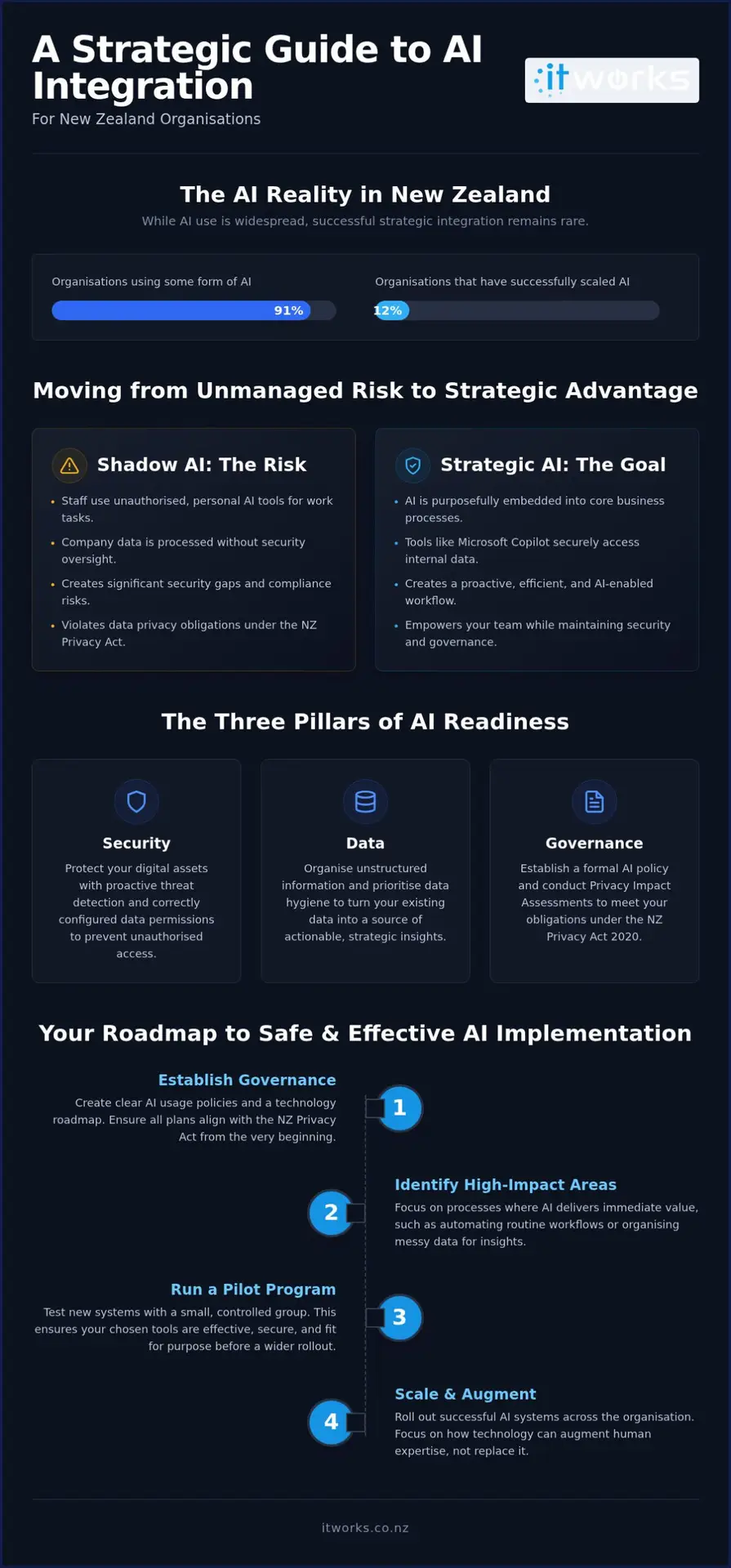
Did you know that 91% of New Zealand organisations are already using some form of AI, yet only 12% have successfully scaled it across their entire business? While the adoption rate is high, many leaders feel stuck in an exploratory phase, unsure how to approach ai integration for business nz. You likely recognise the potential for growth, but you’re also managing the very real risks of data privacy and the NZ Privacy Act. It’s unsettling to think staff might be using unauthorised “shadow AI” tools, creating security gaps your current policies aren’t equipped to handle.
We believe technology should enable your success, not add to your stress. This guide provides a clear roadmap for adopting these tools safely, showing you how to build a secure foundation that protects your sensitive data. You’ll discover how to move past the hype and implement practical applications that drive measurable productivity. We will explore the essential steps for responsible governance, from conducting Privacy Impact Assessments to establishing a technology roadmap that aligns with your goals. By the end, you’ll have the confidence to lead your organisation into a more efficient, AI-enabled future.
Key Takeaways
- Learn to distinguish between simple off-the-shelf tools and a purposeful strategy for ai integration for business nz that embeds intelligence into your unique workflows.
- Identify high-impact areas where machine learning delivers immediate value, such as streamlining customer service and organising messy data into actionable insights.
- Understand how to meet your obligations under the NZ Privacy Act 2020 by prioritising security and data hygiene as the foundation of your adoption process.
- Follow a clear implementation roadmap that uses small pilot groups to ensure your new systems are both effective and secure before a wider rollout.
- Move beyond the noise of technical hype to focus on practical, measurable productivity gains that support your long-term business objectives.
What Does AI Integration for Business NZ Really Mean?
AI integration is often misunderstood as simply using a chatbot to write an email or summarise a meeting. In reality, ai integration for business nz involves the purposeful embedding of machine learning into your core organisational processes. It’s the functional difference between an employee using a standalone tool like ChatGPT and your entire team using an integrated system like Microsoft Copilot that securely interacts with your internal files. This shift represents a move from reactive IT management to a proactive, AI-enabled way of working where technology supports every department.
New Zealand organisations are rapidly moving past the stage of simple curiosity. Leaders across the country are now looking for ways to create a more connected system where technology anticipates needs rather than just responding to commands. By adopting Industrial artificial intelligence principles, local firms can turn stagnant data into a flow of actionable insights. This strategic adoption allows businesses to move away from the stress of manual data entry and toward a model focused on high-level strategy and growth.
Moving Beyond the Hype to Practical Utility
Many NZ businesses currently face the risk of “shadow AI,” where staff use personal accounts to process company information without oversight. Legitimising this use through a formal policy ensures security while capturing the benefits of these tools. For organisations exploring dedicated internal infrastructure to keep sensitive workflows secure, check out REAS 睿思智慧 to see how private enterprise AI hubs can prevent unauthorised data exposure. It’s also vital to distinguish between generative AI, which creates new content, and predictive analytics, which forecasts trends based on your historical data. When you focus on practical utility, the goals become clear: saving valuable time, reducing manual errors, and making more informed decisions based on facts rather than intuition.
AI as a Strategic Partner, Not a Replacement
A common concern is that these developments might replace staff, but the most successful implementations show that AI actually augments human expertise. It handles the repetitive, data-heavy tasks that often lead to burnout, allowing your team to focus on high-value strategy and relationship building. This approach supports long-term growth and builds organisational resilience against market shifts. By empowering your people with better tools, you create a more engaged and capable workforce. AI integration is a strategic business asset that empowers New Zealand firms to enhance operational efficiency while maintaining human-led oversight.
Practical Use Cases: Where AI Delivers Value for NZ Organisations
For many organisations, the real value of ai integration for business nz lies in its ability to turn fragmented information into a cohesive operational asset. In departments like finance and customer service, AI tools can sift through years of unstructured data to identify patterns that a human eye might miss. This isn’t just about speed; it’s about accuracy and foresight. By organising messy data into actionable insights, your leadership team can make decisions based on real-time trends rather than historical guesswork.
Beyond administrative tasks, AI plays a critical role in protecting your digital perimeter. By using machine learning for proactive threat detection, your systems can identify and isolate unusual behaviour before it escalates into a breach. This creates a more resilient environment, allowing your team to work with confidence. This sense of security is essential for fostering a culture where staff feel comfortable exploring new ways to use technology to improve their daily output.
Maximising Productivity with Microsoft Copilot
Microsoft Copilot is often the first step for Kiwi firms already using the M365 ecosystem. It functions as an intelligent assistant that lives within your familiar apps, helping to summarise long Teams meetings or draft initial report outlines based on existing spreadsheets. Managing a cluttered inbox becomes significantly easier when AI can triage messages based on priority and draft suggested responses that match your professional tone. However, achieving these gains requires “Copilot readiness.” This means ensuring your data permissions are correctly configured so the AI doesn’t inadvertently surface sensitive payroll information to the wrong staff members.
Automating Routine Workflows with AI
Routine tasks that previously consumed hours of manual labour can now be handled through intelligent automation. For example, AI-driven document processing can extract data from invoices and enter it directly into your accounting software. Implementing a structured approach to ai integration for business nz allows you to automate these workflows with precision, reducing operational friction and freeing up your staff for more meaningful work. This technology is particularly beneficial for the charitable sector, where AI can help non-profits manage complex donor data and improve engagement without increasing overheads.
The NZ Government AI Support for Businesses initiative highlights how much potential there is for local organisations to thrive with the right guidance. If you’re unsure where to start, you can discuss your technology strategy with our team to identify the highest-value opportunities for your specific business.
The Three Pillars of AI Readiness: Security, Data, and Governance
Successful ai integration for business nz isn’t just about choosing the right software. It’s about building a foundation that ensures your technology is safe, reliable, and compliant. We see many organisations rush into adoption, only to realise their underlying structures aren’t ready for the increased visibility that AI brings. To avoid these pitfalls, you must focus on three core pillars: security, data hygiene, and governance.
A clear governance framework is essential to balance innovation with safety. This involves aligning your usage with the New Zealand Privacy Act 2020 and following the principles outlined in New Zealand’s National AI Strategy. By setting clear rules for how tools are procured and used, you protect your organisation from regulatory risks while giving your team the confidence to experiment within safe boundaries.
Cybersecurity and Data Privacy in an AI World
Security is the non-negotiable first step. One of the biggest concerns for local leaders is ensuring that sensitive business data doesn’t end up in public AI training models. When you use consumer-grade tools, you often inadvertently grant permission for your data to be used by the vendor. A professional integration prioritises layered security, protecting both your endpoints and user identities before any AI features are enabled. This proactive approach builds organisational resilience. For a deeper look at protecting your perimeter, see our guide on Cyber Security for Small Business NZ: Building Resilience and Confidence.
Organising Your Data for AI Success
The “Garbage In, Garbage Out” rule is more relevant now than ever. If your internal data is poorly organised, your AI outputs will be inaccurate or irrelevant. This is where SharePoint and clean file structures become critical. AI tools work by scanning your existing environment; if your permissions are messy, the system might inadvertently surface sensitive information to staff who shouldn’t see it. Our team helps you clean up these digital environments by identifying sensitive data and implementing strict access controls. This ensures your ai integration for business nz delivers precise results without compromising internal confidentiality. A well-structured data environment is the secret to making AI a truly effective partner in your daily operations.
How to Implement AI Safely and Effectively
Successful ai integration for business nz is a deliberate process that requires more than just a software subscription. Safety is the priority. It starts with a clear understanding of your current environment and a structured plan for the future. By following a methodical path, you ensure that new tools enhance your productivity without introducing hidden vulnerabilities.
Start with a Technology Roadmap to align machine learning capabilities with your specific business goals. This approach prevents “shiny object syndrome,” where businesses buy tools because they’re popular rather than because they’re useful. Instead of chasing every new feature, a roadmap allows you to integrate technology into your 3-year strategic plan at a pace that suits your team’s capacity and ensures you aren’t just reacting to trends.
Identifying a pilot group is a practical way to test these tools before a full-scale rollout. Choose a small team of “early adopters” to use the tools in their daily workflows. This trial phase allows you to uncover potential issues with data permissions or user experience in a controlled setting. Their insights are vital for refining your approach and ensuring the wider staff feel supported when it’s their turn to adopt the technology.
Creating an AI Usage Policy for Your Team
Every New Zealand business needs a clear policy that defines what AI can and cannot do within the organisation. This document should outline approved tools and set strict boundaries regarding the use of sensitive client or financial information. By balancing staff autonomy with organisational risk management, you foster a culture of “responsible AI” use. Transparency and accountability are key; your team should feel empowered to use these tools, provided they understand the security framework that protects the company.
The Value of a Technology Roadmap
This strategic approach turns a complex technical shift into a series of manageable operational steps. It ensures that your data hygiene and security layers are robust before you add advanced automation features. Building a well-defined roadmap creates confidence among your leadership team, as every technical investment is directly linked to a measurable business outcome. It replaces the stress of reactive IT management with a composed and forward-thinking strategy.
Training your staff is the final piece of the puzzle. Teaching your team the basics of “prompt engineering” helps them get the best results from your ai integration for business nz project quickly. Regular monitoring and adjustment are necessary to keep the system performing at its peak. AI is an evolving technology, and your implementation should be flexible enough to adapt as new capabilities emerge.
Building a Future-Ready Organisation with IT Works
IT Works acts as the bridge between technical potential and tangible business results. We understand that for many New Zealand leaders, the challenge isn’t just knowing that AI exists, but knowing how to apply it safely within their specific operational context. Our role is to provide the strategic and operational blend needed for success, ensuring your technology investments are always grounded in practical stability. We replace the typical stress of technical management with a sense of calm reliability, allowing you to focus on your core business goals.
Having a local, New Zealand-based partner is a significant advantage for your ai integration for business nz project. Our team has been performing advisory work since 2004, and we understand the unique nuances of the local market. We are well-versed in the specific requirements of the Privacy Act 2020 and how they intersect with emerging technologies. This local expertise allows us to offer guidance that is both relevant and compliant, helping you close the gap between your current state and an AI-enabled future.
Practical AI Enablement and Support
Our approach focuses on Microsoft Copilot readiness and robust data security. We don’t simply hand over a set of tools; we work as an extension of your team to ensure long-term success. This involves the data hygiene work mentioned earlier, identifying sensitive information, and implementing the layered security necessary for a confident rollout. Our goal is to build a connected system that grows with your organisation. For a broader look at these strategies, you can explore our AI Automation Solutions New Zealand: Strategic Guide.
Next Steps for Your AI Journey
The first step toward successful ai integration for business nz is a simple, low-pressure conversation about your current environment. We help you identify where your data currently sits and where your biggest productivity bottlenecks are. From there, we help you build a practical technology roadmap that prioritises your most urgent needs while preparing you for future growth. This methodical approach ensures that every step you take is deliberate and adds value to your organisation.
Talk to IT Works about your technology strategy or discuss your priorities with our team to begin this process. We are here to help you improve productivity and security, acting as a strategic ally in your journey toward a more efficient, future-ready organisation. Book a conversation about improving your operational resilience today.
Leading Your Organisation Into an AI-Enabled Future
Integrating machine learning is no longer a matter of “if” but “how”. By focusing on the three pillars of security, data hygiene, and governance, you can move beyond the risks of shadow AI and build a foundation for sustainable growth. A well-constructed technology roadmap ensures that your investments lead to measurable productivity gains rather than wasted budget. This strategic approach replaces the stress of technical uncertainty with a clear path forward.
Our NZ-based team of experts provides the strategic and operational blend needed to make practical AI enablement a reality for your organisation. We act as your guide, helping you navigate the complexities of the Privacy Act while ensuring your data remains protected. Successfully managing ai integration for business nz requires a partner who understands the human side of technical challenges. This journey is about empowering your people to do their best work with tools that are both powerful and secure.
Talk to IT Works about your technology strategy
Taking the first step toward a more efficient future is a simple, strategic decision. We are here to help. Our team turns technical potential into real-world business success, providing the steady guidance you need to lead with confidence.
Frequently Asked Questions
Is AI integration safe for small and medium businesses in New Zealand?
Yes, ai integration for business nz is safe when built on a foundation of robust security and data governance. You must ensure your implementation aligns with the NZ Privacy Act 2020 and protects sensitive information from public training models. A layered security approach, including endpoint protection and identity management, allows small and medium organisations to adopt these tools with confidence. It’s about moving from reactive support to a proactive, strategic partnership.
Does my business need to upgrade its Microsoft 365 licence for AI?
Your current plan might need an adjustment depending on which features you want to enable. Microsoft Copilot typically requires specific business or enterprise tiers, such as Business Premium, to function effectively. We help you review your current environment to ensure your licence optimisation is aligned with your goals. This prevents wasted budget on unnecessary subscriptions while ensuring your team has the right tools to boost their daily productivity and operational efficiency.
How can AI help my team be more productive without replacing jobs?
AI is a productivity booster that handles the repetitive, data-heavy tasks that often lead to staff burnout. By automating meeting summaries, report drafting, and email triage, your team can focus on high-value strategy and relationship building. It augments their existing expertise rather than replacing it. This approach supports organisational growth and resilience, allowing your people to do more meaningful work while the technology manages the administrative burden and routine workflows.
What are the biggest risks of using ChatGPT in a business setting?
The primary risks involve data privacy and the lack of organisational oversight. When staff use personal accounts for ChatGPT, sensitive company information can inadvertently be used to train public models. This “shadow AI” creates significant security gaps and potential breaches of the NZ Privacy Act. Without a formal policy and secure integrated systems, you lose control over where your data resides and how it’s being processed by external vendors or unauthorised third parties.
Do we need an AI policy if we only use it occasionally?
Yes, a clear policy is essential regardless of how often you use these tools. It sets the ground rules for what is acceptable and ensures every staff member understands their responsibilities regarding data privacy. Even occasional use of unauthorised tools can expose your business to risk. A policy provides a framework for responsible use, balancing staff autonomy with the need to protect sensitive client, financial, and internal organisational information from accidental exposure.
How much does it cost to start integrating AI into our business?
The investment required depends on your specific goals and the complexity of your current environment. Generally, you’ll need to consider recurring software licence fees and project-based professional service fees for the initial setup and strategic consulting. Starting with a technology roadmap is the best way to manage these costs effectively. This strategic approach ensures you invest in tools that deliver measurable productivity gains without overstretching your budget on unnecessary or redundant technology features.
Can AI help with cybersecurity and threat detection?
AI significantly strengthens your security posture by providing proactive threat detection. These systems can identify and isolate unusual behaviour across your network in real-time, often before a human operator would notice a problem. This creates a more resilient digital environment and reduces the risk of data breaches. By integrating machine learning into your cybersecurity services, you build organisational confidence and ensure your business is better prepared for emerging digital threats and vulnerabilities.
What is Microsoft Copilot readiness, and why does it matter?
Copilot readiness is the strategic process of preparing your data, security, and permissions for machine learning tools. It matters because AI can only be effective if it has access to clean, well-organised data. Without this preparation, you risk “garbage in, garbage out” results or, more seriously, sensitive internal files being surfaced to unauthorised users. Proper readiness ensures your ai integration for business nz project is safe, functional, and aligned with your broader strategic goals.