Purchasing your own servers and hardware might feel like a secure investment in your company’s future, but it often becomes an anchor of technical debt that limits your agility. When weighing up the choice between IT OpEx and CapEx, New Zealand organisations frequently find themselves caught between the desire for asset ownership and the need for a predictable, scalable budget. You’re likely familiar with the frustration of lumpy IT spending, where a sudden hardware refresh or an unexpected server failure creates a massive capital outlay that disrupts your cash flow for the quarter. It’s a reactive cycle that makes long-term financial planning feel like guesswork.
This guide from IT Works will show you how to balance operational and capital expenditure to create a stable IT budget that supports sustainable growth. We’ll explore how modern cloud models and IRD depreciation rules, including the $1,000 low-value asset threshold, can help you access sophisticated technology without the burden of aging physical assets. We’ll examine how the current 5.50% Official Cash Rate influences your procurement strategy and how to build a tech stack that scales naturally with your organisation. By the end, you’ll understand how to align your technology strategy with your financial goals to ensure your IT remains an asset rather than a liability.
Key Takeaways
- Understand the strategic shift from owning depreciating hardware to subscribing to modern cloud services that offer greater operational flexibility.
- Learn how to balance it opex vs capex nz to eliminate unpredictable spending and secure a more consistent monthly cash flow.
- Identify how to use a technology roadmap to audit your current assets and systematically reduce technical debt.
- Discover how to leverage IRD low-value asset thresholds to maximise immediate deductions and simplify your IT accounting.
- Shift your focus from managing technical features to achieving business outcomes by aligning your IT budget with long-term growth.
Defining IT OpEx and CapEx for New Zealand Business Leaders
For many New Zealand organisations, the decision between it opex vs capex nz is more than just a line item on a balance sheet. It represents a choice between two distinct financial philosophies. One focuses on the long-term ownership of physical assets, while the other prioritises agility and the ability to consume technology as a service. Understanding the nuances of each is the first step toward building a more resilient and predictable technology budget.
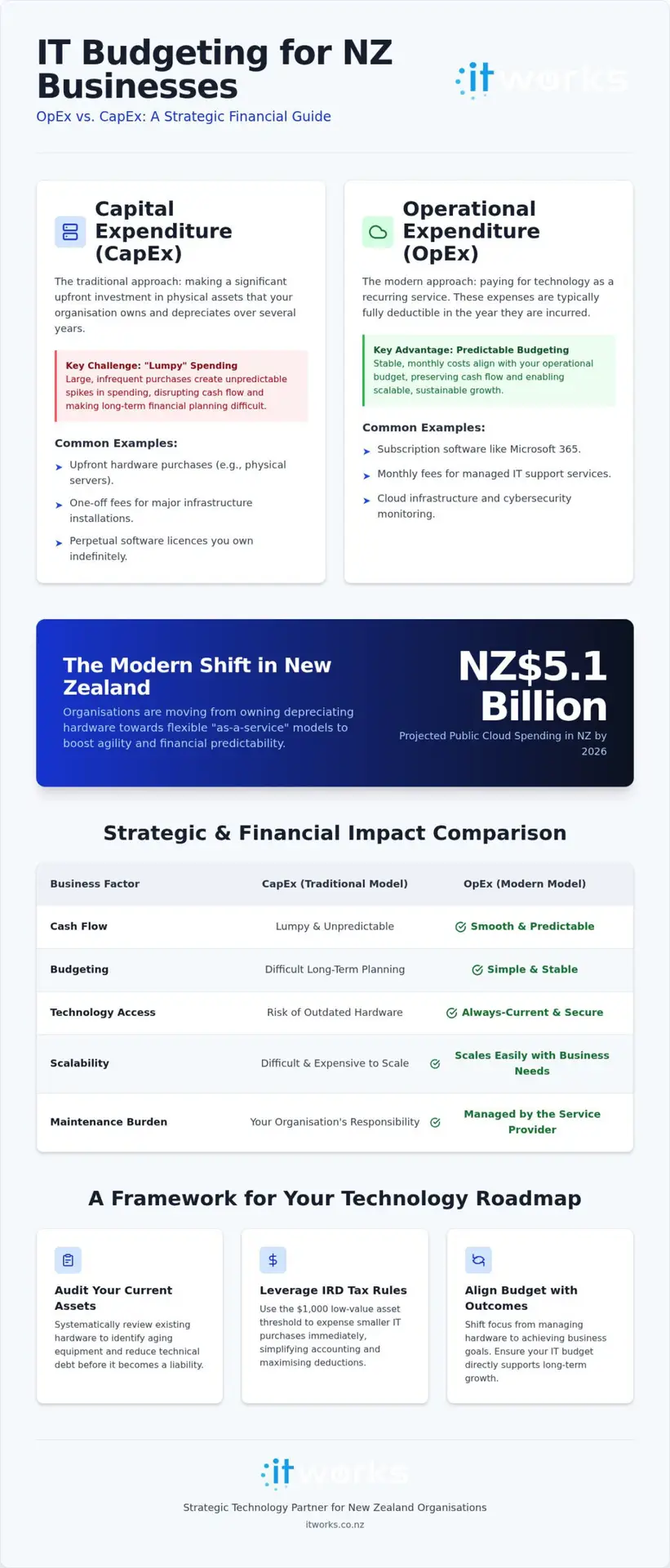
Capital expenditure (CapEx) involves the upfront investment in major physical goods that provide value over several years. These are the “big ticket” items your organisation buys once and then depreciates over time. In a traditional IT environment, this meant writing a large cheque for a server room full of hardware. Under current New Zealand tax rules, business assets costing more than $1,000 must generally be capitalised and depreciated, whereas smaller items can often be expensed immediately.
Operational expenditure (OpEx) covers the recurring costs of running your business on a daily basis. These expenses are typically fully deductible in the year they are incurred, making them a popular choice for organisations looking to preserve cash flow. Instead of owning the asset, you pay for the right to use it. This model is often associated with subscription services and ongoing support fees that keep your operations running smoothly.
Think of it like a company vehicle. Buying the car outright is a capital expense. The petrol, insurance, and regular servicing represent your operational costs. In the past, IT was heavily weighted toward the purchase. Now, the shift is toward “running the car” through subscriptions and services. This allows you to focus on where the vehicle is taking your business, rather than worrying about the mechanics under the bonnet.
The rise of “As-a-Service” models has blurred these lines. When you pay for a cloud platform, you’re essentially renting a portion of someone else’s massive capital investment. This allows your organisation to benefit from enterprise-grade technology without the enterprise-grade price tag. It transforms technology from a static asset into a dynamic tool that evolves with your needs.
Common Examples of IT CapEx
Traditional IT setups rely heavily on CapEx to build a foundation. While this model offers total control over the equipment, it also places the burden of maintenance and eventual replacement squarely on your shoulders. It often results in a “lumpy” budget where costs spike every few years.
- Upfront hardware purchases like physical servers and networking switches.
- One-off professional service fees for major infrastructure installs.
- Perpetual software licences that you own indefinitely.
Common Examples of IT OpEx
Modern organisations lean into OpEx to stay nimble and avoid the lumpy spending patterns often associated with it opex vs capex nz comparisons. These costs are predictable and scale with your headcount, ensuring your tech stack remains modern without massive capital outlays.
- Monthly fees for managed IT support services.
- Subscription-based software like Microsoft 365 or Xero.
- Cloud infrastructure costs (IaaS) and monthly cybersecurity monitoring.
The Modern Shift: Why NZ Organisations are Moving to an OpEx Model
New Zealand’s business environment is increasingly favouring the agility of operating models. With public cloud spending in the country projected to reach NZ$5.1 billion by 2026, it’s clear that the strategic debate over it opex vs capex nz has shifted in favour of the former. This transition isn’t merely about accounting preferences. It’s about realising the financial value of cloud services to ensure that technology serves as a catalyst for growth rather than a drain on capital reserves.
At the heart of this modern approach is Microsoft 365 management New Zealand organisations rely on for daily productivity. By moving these essential tools to a subscription basis, you eliminate the need for expensive, perpetual software licences that quickly become outdated. It ensures your team always has access to the latest security features and collaborative tools, effectively creating a tech stack that stays “forever young” through constant, background updates.
Scalability and Flexibility
Subscription models provide a level of responsiveness that traditional hardware ownership cannot match. If your team expands, you simply add new users to your existing plan. If you need to scale back, you’re not left with expensive, idle hardware gathering dust in a server room. This agility is a core reason why the balance of it opex vs capex nz is tilting toward operational models. It lowers the barrier to entry for advanced capabilities, allowing businesses to experiment with AI automation solutions New Zealand companies use to improve efficiency without committing to massive upfront costs.
Eliminating the ‘Hardware Refresh’ Headache
The traditional “big bang” upgrade cycle is often a source of significant stress for finance teams. Every few years, a massive capital outlay is required to replace aging servers and networking gear. By adopting an OpEx-focused strategy, you move toward incremental improvements where costs are spread evenly over time. This approach allows you to fund innovation through your monthly operating budget rather than pleading for a one-off capital injection. You can talk to IT Works about your technology strategy to see how an OpEx model fits your specific growth plans.
An OpEx model ensures your infrastructure remains modern by rolling hardware costs into a predictable monthly service fee, removing the need for disruptive capital spikes.
Comparing the Strategic and Financial Impact
The choice isn’t just about how much you pay, but when and why you pay it. For a New Zealand Managing Director, the “sticker price” of a new server is only the tip of the iceberg. When evaluating it opex vs capex nz, you have to look at the total cost of ownership (TCO). This means weighing the immediate tax benefits against the long-term burden of maintaining an aging asset that loses value every day.
Predictable cash flow is the hallmark of the OpEx model. Instead of facing a massive NZ$20,000 bill every few years, you pay a consistent monthly fee. This removes the “lumpy” spending that often derails annual budgets. It also shifts the responsibility for the health of the technology. In an OpEx model, your partner ensures the system stays running. With CapEx, the risk of a hardware failure sits squarely on your books. Tax treatment is also a critical differentiator. The Inland Revenue Department (IRD) allows a full deduction in the year of purchase for assets costing NZ$1,000 or less. For items above this, you must use depreciation. Standard rates for computer hardware are 50% using the Diminishing Value (DV) method or 40% using the Straight Line (SL) method. Ongoing SaaS subscriptions, however, are generally fully deductible as they occur.
The Balance Sheet vs. The Profit and Loss
CapEx creates an asset on your balance sheet, which might look good initially. However, technology assets lose value rapidly. Within three years, that high-end server is worth a fraction of its cost. OpEx keeps your balance sheet lean. Many leaders prefer the simplicity of the Profit and Loss (P&L) approach because it aligns IT spending directly with the revenue it helps generate. It also preserves your debt-to-equity ratio, keeping capital available for strategic business investments rather than tying it up in depreciating hardware. For instance, you could visit Warenous to see how this capital can be better utilised to access a global network of 3PL providers, streamlining your logistics without the burden of physical assets.
The true cost of owning hardware extends far beyond the invoice. You’re responsible for the electricity to run it and the cooling to prevent it from failing. There’s also the “soft cost” of internal staff time. Every hour your team spends patching an old server is an hour they aren’t spending on high-value projects. Tying up capital in depreciating hardware also carries an opportunity cost. That money could be better spent on marketing, product development, or expanding your team. When you calculate the it opex vs capex nz equation, these hidden factors often make the subscription model the more sustainable choice.
How to Decide: A Framework for Your Technology Roadmap
Choosing the right model for your organisation isn’t a one-off event. It’s a strategic process that aligns your financial health with your operational goals. When evaluating it opex vs capex nz, you need a framework that looks beyond the immediate invoice. This ensures your technology choices support growth rather than creating a bottleneck. A well-constructed roadmap provides the clarity needed to make these decisions with confidence and precision.
- Audit your lifecycle: Identify aging assets and technical debt. Knowing when your current servers will reach the end of their useful life allows you to plan for the transition before a failure occurs.
- Assess cash flow: Review your available capital. With the Official Cash Rate at 2.50%, the cost of borrowing for large hardware purchases has increased, often making the pay-as-you-go nature of OpEx more attractive.
- Evaluate internal capacity: Consider your team’s workload. Owning hardware requires ongoing maintenance, patching, and physical security. Subscription models often shift this burden to the provider, freeing up your staff.
- Align with growth: Look at your three-year plan. If you expect to scale rapidly, an OpEx model allows you to add resources instantly without waiting for new hardware to arrive or worrying about capacity limits.
- Consult a partner: Work with an advisor to build a roadmap. This ensures your spending model matches your business outcomes and prevents wasted investment in redundant or poorly integrated systems.
When CapEx Still Makes Sense
While the trend is moving toward operational models, capital expenditure still has its place. For organisations with significant cash reserves and a low cost of capital, buying assets outright can be a viable strategy. This is particularly true for highly specialised hardware that has a lifespan exceeding five or six years. Some organisations also maintain physical ownership of infrastructure to meet very specific, on-site compliance or data sovereignty requirements that public cloud providers may not yet fully address.
When OpEx is the Clear Winner
Operating models are ideal for organisations prioritising agility. If you’re looking to enhance your cyber security for small business NZ posture, a managed service provides enterprise-level protection that is updated in real-time. This model is also perfect for firms wanting to shift their internal IT team away from basic maintenance and toward strategic projects. Evaluating it opex vs capex nz through the lens of productivity often shows that subscription models provide the best return on investment for fast-growing teams.
Talk to IT Works about your technology strategy
Aligning Your IT Budget with Business Outcomes
Effective financial management in technology requires a shift in perspective. Instead of focusing solely on the cost of a laptop or a server, leaders should evaluate how these investments drive productivity and resilience. When you assess it opex vs capex nz, the goal is to ensure every dollar spent contributes directly to your organisation’s success. A well-aligned budget transforms IT from a necessary expense into a strategic engine for growth.
A Technology Roadmap is the most effective tool for preventing wasted spend. It provides a clear view of your future needs, ensuring you don’t over-invest in redundant hardware or under-invest in critical security. By mapping your technology to your business goals, you can choose the right spending model for each project. This strategic approach ensures your budget supports the core pillars of a modern organisation: resilience, productivity, and security. A structured approach to digital business transformation can help you align these pillars with a clear, outcome-focused plan that reduces fragmented systems and reactive spending.
Partnering with a managed service provider gives you access to a full team of specialists without the overhead of multiple full-time salaries. You gain the collective expertise of cybersecurity analysts, cloud architects, and strategic advisors. This breadth of knowledge is difficult to replicate with a small internal team. It ensures your organisation remains at the forefront of technical developments while maintaining a stable and secure environment.
Predictability Through Partnership
The value of a fixed-fee model extends beyond simple accounting. It provides the foundation for long-term financial planning by removing the volatility of tech spending. You don’t have to worry about high-cost emergency repairs because proactive monitoring identifies and resolves issues before they cause downtime. This shift from a reactive stance to a strategic partnership replaces the typical stress of technical management with a sense of calm reliability. It allows your leadership team to focus on high-level strategy rather than technical troubleshooting.
Next Steps for Your Organisation
Creating a more agile and resilient future starts with a clear understanding of your current position. You can begin this process by taking a few practical steps to evaluate your existing setup and identify areas for improvement.
- Review your current software licences and the age of your physical hardware to identify looming capital spikes.
- Identify the first three areas, such as backup systems or productivity suites, where shifting to an OpEx model would provide immediate agility.
- Assess your current security posture to ensure your budget is prioritising risk reduction and organisational confidence.
A strategic technology partner acts as an ally in your journey, helping you navigate the complexities of it opex vs capex nz decisions. This collaboration ensures your technology stack remains functional, sustainable, and perfectly aligned with your long-term vision. Discuss your technology strategy with our team to start building a roadmap that supports your organisation’s growth.
Building a Resilient Foundation for Growth
Deciding on the balance of it opex vs capex nz is a pivotal step toward modernising your organisation. You’ve seen how moving away from lumpy, unpredictable capital spending creates a more resilient cash flow. By embracing operational models, you replace the burden of technical debt with a flexible system that scales with your team. This shift ensures your technology serves as an enabler. It’s no longer a static asset that loses value over time.
Our NZ-based team provides the strategic guidance needed to navigate these choices. We specialise in outcome-focused managed IT and cloud solutions that prioritise long-term stability. From AI enablement to responsible governance, we act as a steady guide. We focus on building a tech stack that supports your productivity and security goals without requiring massive capital outlays or complex maintenance cycles. Organisations looking to go further can explore how a comprehensive digital business transformation strategy can replace fragmented, reactive systems with a cohesive and resilient technology foundation.
Talk to IT Works about your technology strategy
Aligning your technology budget with your strategic vision creates the confidence needed to thrive in a modern business environment. We look forward to helping you build a more predictable and sustainable future.
Frequently Asked Questions
What is the main difference between IT OpEx and CapEx?
Capital expenditure (CapEx) involves purchasing physical assets like servers or networking gear that provide value over several years. These items are listed on your balance sheet and depreciated over time. Operational expenditure (OpEx) refers to the recurring costs of running your technology daily, such as cloud subscriptions and support fees. The primary difference in the it opex vs capex nz debate is how these costs are treated for tax and cash flow purposes.
Is it better for a New Zealand SME to use an OpEx model for IT?
Most New Zealand SMEs find the OpEx model more beneficial because it preserves cash flow and provides access to enterprise-grade tools without massive upfront costs. It allows small businesses to scale their technology as their headcount grows, avoiding the risk of investing in hardware that may be obsolete in three years. While CapEx offers total ownership, the flexibility and predictability of a subscription-based model often provide a better return on investment for agile organisations.
How do IRD depreciation rules affect my IT hardware purchases?
The Inland Revenue Department (IRD) allows an immediate tax deduction for low-value assets costing NZ$1,000 or less, excluding GST. For hardware exceeding this threshold, you must capitalise the asset and apply depreciation over its useful life. Standard IRD rates for computer hardware are typically 50% using the Diminishing Value method or 40% using the Straight Line method. Understanding these rules is essential when evaluating the financial impact of your technology procurement and long-term asset management.
Can I move my existing servers to an OpEx cloud model?
You can transition from physical, owned servers to a cloud-based operational model through Infrastructure as a Service (IaaS) or Software as a Service (SaaS). This migration eliminates the need for future hardware refreshes and shifts the responsibility for maintenance to the cloud provider. It’s a strategic move that turns a depreciating capital asset into a scalable monthly service fee. This approach ensures your infrastructure remains current while significantly reducing the complexity of managing physical hardware on-site.
Why is Microsoft 365 considered an operational expense?
Microsoft 365 is classified as an operational expense because it’s delivered as a subscription service rather than a perpetual licence you own. Instead of paying a large upfront sum for software that eventually becomes outdated, you pay a recurring monthly fee for continuous access to the latest versions and security updates. This model aligns your software costs with your actual usage, making it a cornerstone of a modern it opex vs capex nz strategy for many organisations.
Do managed IT services count as OpEx or CapEx?
Managed IT services are almost always treated as an operational expense. These services involve ongoing support, monitoring, and strategic guidance provided for a fixed monthly fee. Because you are paying for a professional service rather than purchasing a physical asset, the costs are fully deductible in the period they are incurred. This model provides New Zealand organisations with a predictable budget and access to a full team of experts without the capital burden of internal infrastructure.
What are the risks of staying with a CapEx-heavy IT model?
The primary risks include technical debt and the high opportunity cost of tying up capital in depreciating hardware. A CapEx-heavy approach often leads to “lumpy” spending patterns, where large, unexpected outlays are required to replace failing equipment. Additionally, owned hardware can quickly become obsolete, leaving your organisation with aging tools that hinder productivity and security. Shifting toward an operational model helps mitigate these risks by ensuring your technology stack remains modern, agile, and resilient.
How often should we review our IT spending model?
You should review your IT spending model at least once a year or whenever your organisation reaches a significant milestone, such as a major headcount change or a shift in business strategy. Regular reviews ensure your technology roadmap remains aligned with your financial goals and operational needs. Consulting with a strategic partner during these reviews helps you identify new opportunities to optimise your budget and transition to more agile models as your organisation continues to grow.