

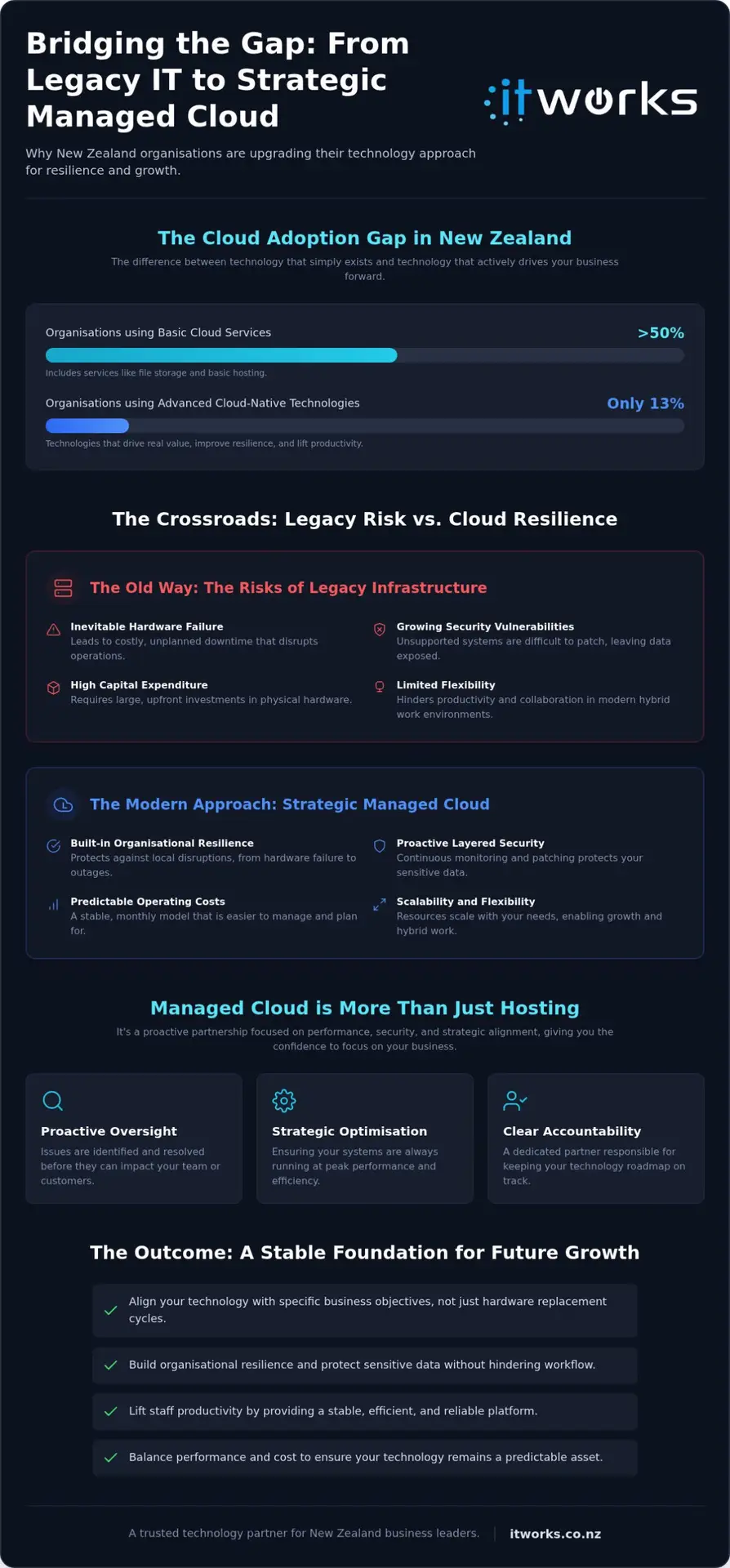
While over half of New Zealand small and medium businesses have adopted basic cloud services, only 13 per cent are currently using advanced cloud-native technologies to drive real value. This gap often represents the difference between a system that simply exists and one that actively propels your organisation forward. It’s common to feel that your technology should be doing more, especially when hidden costs and legacy systems start to hinder your daily operations. You want to feel confident that your data is secure and that your team can work efficiently without constant technical roadblocks. Investing in managed cloud solutions nz provides the strategic oversight needed to bridge this gap, ensuring your infrastructure is an asset rather than a source of stress.
We understand that the transition to more sophisticated systems can feel daunting, but it doesn’t have to be. In this guide, you’ll discover how a managed approach to cloud technology can improve your organisation’s resilience, bolster your security, and lift staff productivity. We will explore how to move from reactive support to a proactive model that offers predictable costs and a stable platform for growth, giving you the confidence to focus on your core business priorities.
Key Takeaways
- Learn how to develop a practical cloud roadmap that aligns your technology with specific business objectives rather than just replacing aging hardware.
- Understand the strategic advantages of managed cloud solutions nz and how proactive oversight prevents the hidden costs associated with unmanaged environments.
- Identify how a layered security posture within the cloud can build organisational resilience and protect sensitive data without hindering staff workflow.
- Discover how to balance performance and cost to ensure your technology platform remains a stable and predictable foundation for future growth.
Beyond Storage: Why Modern NZ Organisations are Moving to the Cloud
The transition away from physical on-premise hardware represents a fundamental change in how New Zealand businesses operate. For years, the standard approach involved purchasing expensive servers, housing them in a dedicated room, and hoping they wouldn’t fail before the next capital expenditure cycle. Today, the conversation has moved toward cloud computing, where organisations access computing power and storage as a flexible service. This shift isn’t just about technical convenience. It’s about ensuring your business remains resilient against local disruptions, whether that’s a hardware failure at a head office or a sudden requirement for staff to work from home.
Many growing organisations find themselves at a crossroads when their existing technology begins to struggle. Common triggers for making the move include aging servers that no longer support the latest software, the need for seamless remote work capabilities, and the growing complexity of security risks. When these legacy systems start to falter, they don’t just cause technical glitches. They silently hinder staff productivity and stifle organisational growth because your team spends more time fighting with their tools than doing their actual jobs. Adopting managed cloud solutions nz provides a pathway to replace this reactive stress with a stable, scalable platform.
Identifying the Risks of Legacy Infrastructure
Legacy infrastructure often hides its true cost behind a facade of “it still works.” However, the risks of staying on older systems are substantial. Hardware failure is an inevitable reality, and the high cost of unplanned downtime can be devastating for a mid-sized business. Beyond the immediate loss of work, there is the ongoing difficulty of maintaining security patches on older systems. As software vendors end support for legacy products, your organisation becomes increasingly vulnerable. Older systems also lack the flexibility required for modern hybrid work environments, making it difficult for your team to collaborate effectively when they aren’t physically in the same room.
Cloud as a Catalyst for Growth
A well-managed cloud environment acts as a foundation for expansion rather than a ceiling on your potential. One of the primary benefits is the ability to scale resources up or down based on your current business requirements. You don’t have to over-provision hardware “just in case.” Instead, you pay for what you use. This shift reduces heavy capital expenditure (CapEx) in favour of predictable monthly operating costs (OpEx), which is far easier for executive teams to manage. The cloud also enables the faster deployment of new tools, including AI-driven capabilities and automation, ensuring your business stays competitive without the traditional delays of hardware procurement.
By choosing managed cloud solutions nz, you’re not just moving files to a different location. You’re building a more resilient, agile, and secure organisation that’s ready for whatever comes next.
Defining Managed Cloud Solutions: More Than Just Hosting
While the concept of hosting is familiar, managed cloud solutions nz provide a much broader level of service that extends far beyond simply storing data. At its heart, a managed approach involves the proactive oversight and optimisation of your entire cloud environment. It’s about having a dedicated partner who ensures your systems are not just running, but performing at their peak. This shift in responsibility means clear accountability, ensuring your technology roadmap stays on track without being derailed by daily technical hurdles. It replaces the uncertainty of managing complex infrastructure with a sense of calm reliability.
The New Zealand government’s Cloud First policy highlights a similar strategic shift, encouraging organisations to leverage the inherent benefits of cloud technology. For a growing business, the difference between ‘unmanaged’ and managed cloud is the difference between DIY maintenance and a professional partnership. In a DIY model, you’re responsible for every update, security patch, and configuration change. In a managed partnership, these tasks are handled for you. Proactive monitoring becomes the standard, allowing your provider to catch and resolve issues before they ever impact your staff or customers.
If you’re unsure where your current infrastructure stands, you can discuss your technology strategy with the IT Works team to identify potential areas for improvement.
The Core Components of a Managed Service
A managed service isn’t a static product. It’s a dynamic relationship where your provider takes ownership of the environment’s health. This includes 24/7 monitoring and performance tuning to ensure your platform remains reliable as your business scales. You also benefit from regular security audits and automated patch management, which are vital for maintaining resilience. Beyond the technical basics, you receive ongoing strategic advice. This ensures your cloud spend remains efficient, avoiding the common trap of paying for resources your organisation no longer needs.
Managed Cloud vs. Traditional IT Support
Traditional support often relies on a reactive break-fix model. Something stops working, you log a ticket, and someone fixes it. Managed cloud turns this on its head by moving toward a continuous improvement cycle. Your technology partner doesn’t just wait for things to go wrong; they identify ways to make your systems faster and more secure over time. Having a local NZ-based team for advisory and support is particularly valuable here. It ensures you have access to experts who understand the local market and can focus on your specific business outcomes rather than just technical metrics.
Balancing Performance, Security, and Cost
Many business owners assume the cloud is automatically a more cost-effective choice. However, a phenomenon known as the ‘Cloud Paradox’ suggests that unmanaged environments can sometimes become more expensive than the legacy on-premise servers they replaced. This typically happens when resources are provisioned without a clear strategy or ongoing oversight, leading to waste and inefficiency. To avoid these pitfalls, organisations should follow formal guidance on creating a cloud plan. Effective managed cloud solutions nz ensure your environment is tuned for performance while keeping costs strictly aligned with your actual business usage.
A significant part of this balance involves your daily productivity tools. It is remarkably easy to over-invest in high-tier subscriptions for staff members who only require basic functionality. By regularly reviewing and refining your setup, you can ensure you are only paying for the features your team needs to stay productive. You can find more detail on this in our guide on Microsoft 365 management New Zealand.
Cost Optimisation Strategies
Managing cloud expenses requires a methodical approach rather than a reactive one. A strategic partner helps you maintain this balance through several key actions:
- Rightsizing resources: We adjust your computing power and storage to match actual workload demands, preventing you from paying for idle capacity.
- Identifying ‘zombie’ resources: We find and eliminate unused storage volumes or temporary servers that have been left running, which can silently drain your monthly budget.
- Predictable budgeting: Moving to a fixed-fee managed service model provides your executive team with a clear, consistent IT spend every month.
Security Without the Scare Tactics
Security should create organisational confidence, not fear. Instead of focusing on “doom-and-gloom” scenarios, we focus on building a resilient foundation that allows your team to work anywhere with peace of mind. This starts with robust identity management and multi-factor authentication (MFA). These tools ensure that only authorised individuals can access your systems, providing a strong layer of protection that is both effective and accessible for your staff.
For New Zealand organisations, data sovereignty is also a vital consideration. You can enjoy the benefits of global platforms while ensuring your information is handled according to local requirements and expectations. Building this resilience is a core component of any modern technology strategy. To learn more about protecting your organisation, explore our guide on cyber security for small business NZ.
Building a Practical Cloud Roadmap for Your Business
A successful transition to the cloud is rarely about the technology itself. It’s about how that technology supports your long-term business goals. Before moving a single file, you should clearly define the specific problems you want to solve. Perhaps you need better collaboration for a remote team working across the country, or you want to eliminate the risk of server failure in a local branch office. Starting with these objectives ensures your investment in managed cloud solutions nz delivers tangible results rather than just moving existing problems to a new location.
Once your goals are set, the next step involves a comprehensive audit of your existing applications and data. Not every piece of software is ready for the cloud, and some data may have specific residency requirements that need to be addressed. This assessment helps you choose the right model for your organisation. You might opt for a public cloud for its scalability, a private cloud for enhanced control, or a hybrid approach that combines the best of both. A phased migration plan is essential here, allowing you to move in manageable stages that minimise disruption to your daily operations.
Phase 1: Assessment and Strategy
This initial phase focuses on laying a solid foundation for the journey ahead. We look for ‘low-hanging fruit’—those simple, high-impact services that can be moved quickly to provide early wins and build organisational confidence. It’s also the time to assess staff readiness. Moving to new systems often requires fresh ways of working, so identifying training requirements early is vital for a smooth transition. Finally, we define clear success metrics, such as improved system uptime or faster access to data, so you can measure the actual impact of the change.
Phase 2: Execution and Optimisation
The execution phase involves the secure migration of your data and applications. Maintaining business continuity is the priority here; your team needs to stay productive while the transition happens in the background. This process is a core part of comprehensive managed IT support services, where technical expertise meets strategic oversight. Once the migration is complete, the work doesn’t stop. A post-migration review allows us to refine performance and costs, ensuring your new environment is as efficient and secure as possible.
Partnering for Confidence: How IT Works Supports Your Journey
Choosing managed cloud solutions nz is more than a technical decision. It’s a commitment to a strategic partnership that prioritises your long-term business outcomes. At IT Works, we act as an extension of your own team, serving as a steady guide through the complexities of modern infrastructure. We replace the frantic energy of reactive support with a methodical, planned approach. This ensures your technology platform remains a stable foundation that supports sustainable growth rather than a source of constant operational stress.
Our focus remains on results that are functional and sustainable in the real world. This means we don’t just implement technology for its own sake. We ensure every tool and configuration aligns with your specific business goals. As you look toward the future, we integrate AI readiness and automation into your cloud strategy. We avoid the speculative hype often associated with these developments. Instead, we focus on practical applications that lift productivity and introduce responsible governance, ensuring your organisation is prepared to leverage new capabilities safely and effectively.
A Local Team with National Reach
There is a distinct advantage in working with experts who understand the New Zealand business environment. Our team possesses deep local knowledge that global providers often lack. We provide strategic oversight and support for organisations across the entire country, ensuring that your technology is grounded in practical stability. This national presence fosters a sense of community and shared identity, allowing for clear, jargon-free communication. We prioritise cultural alignment and partnership, acting as a strategic ally that is invested in your success.
Next Steps for Your Organisation
The journey toward a more resilient and productive organisation starts with a clear understanding of where you stand. Assessing your current technology risk and resilience is a vital first step. By identifying legacy constraints and security gaps, we can help you build a roadmap that leads to predictable costs and a more stable environment. A well-constructed strategy provides a clear path to improved staff productivity and organisational confidence. It moves your systems from being reactive to being truly strategic, giving you the freedom to focus on your core priorities.
Talk to IT Works about your technology strategy.
Securing Your Organisation’s Future in the Cloud
Moving your organisation to the cloud is a strategic shift that requires more than just technical migration. It’s about building a platform that supports your long-term vision while maintaining high levels of security and cost efficiency. By adopting managed cloud solutions nz, you replace the unpredictability of legacy systems with a stable environment designed specifically for growth. We’ve explored how a clear roadmap and proactive monitoring can eliminate hidden technical debt and lift staff productivity, ensuring your technology remains a silent enabler of success.
Our NZ-based support team focuses on delivering results that are functional and sustainable. Through strategic technology roadmaps and proactive system monitoring, we ensure your infrastructure is an asset that builds organisational confidence. Partnership matters. This approach allows you to focus on your core business priorities while we manage the technical complexity. It’s a journey from being reactive to being truly strategic, giving your executive team the peace of mind that systems are secure and costs are predictable.
Investing in the right partnership today creates the resilience your organisation needs for the years ahead. We look forward to helping you build a technology platform that serves your people and your purpose.
Frequently Asked Questions
What are managed cloud solutions and how do they differ from simple hosting?
Managed cloud solutions involve the active management and optimisation of your environment, whereas simple hosting is merely the provision of storage space. With a managed approach, a partner takes responsibility for your system health, performance, and updates. This ensures your infrastructure is always aligned with your business goals. It moves your organisation away from a DIY model toward a professional partnership where technical tasks are handled proactively.
Is my data secure in the cloud compared to an on-site server?
Cloud environments often provide higher levels of security than on-site servers because they benefit from the massive investment in security infrastructure made by global providers. When combined with managed cloud solutions nz, your data is protected by layered security measures like identity management and multi-factor authentication. This approach builds organisational confidence by focusing on risk reduction and resilience, ensuring your sensitive information is handled with professional care.
How much do managed cloud solutions typically cost for an NZ business?
Costs for these services are typically structured as predictable monthly subscription fees rather than large upfront capital outlays. This model covers the proactive monitoring, maintenance, and management of your IT environment. The exact investment depends on the scale of your organisation and the complexity of your requirements. Moving to this subscription-based model allows your executive team to manage the budget with greater visibility and certainty.
Can managed cloud help reduce our monthly IT expenses?
Yes, a managed approach can reduce overall expenses by eliminating the hidden costs of unmanaged environments and reducing the need for expensive hardware refreshes. By rightsizing your resources and identifying unused capacity, you ensure you only pay for what your team actually uses. This shifts your IT spend from unpredictable capital expenditure to a more manageable operational expense model, allowing for better long-term financial planning.
What is the role of cybersecurity in a managed cloud environment?
Cybersecurity is a fundamental component of the environment, providing a layered defence that protects your data and your people. It involves continuous monitoring, automated patch management, and identity protection to reduce risk without creating unnecessary friction for your staff. Instead of using fear-based tactics, a managed partner focuses on building a resilient foundation that gives your organisation the confidence to operate from any location.
Do we need to migrate everything to the cloud at once?
No, a phased migration is usually the most effective way to minimise disruption to your daily operations. A strategic technology roadmap helps identify “low-hanging fruit” that can be moved first to provide immediate benefits. This allows your team to adapt to new tools gradually while ensuring business continuity. Moving in stages ensures that each part of your infrastructure is properly optimised before the next phase begins.
How does managed cloud support remote and hybrid work for NZ staff?
Managed cloud solutions enable your staff to access the tools and data they need from any location, supporting a seamless hybrid work model. This flexibility ensures that productivity remains consistent whether your team is in the office or working remotely. By using centralised platforms for collaboration, your organisation can maintain clear communication and secure access to files, fostering a more agile and connected workforce across the country.
What happens if our internet goes down while using cloud services?
Business continuity planning ensures that your organisation remains resilient even during local connectivity issues. While cloud services require an internet connection, modern setups often include redundant connections or offline sync capabilities for essential files. Because your data is stored in the cloud, your staff can also relocate to a different site or use mobile data to stay productive, ensuring that a local disruption doesn’t lead to a total shutdown.