
Did you know that 59% of New Zealand businesses experienced a cyber incident in the year leading up to March 2026? For many local leaders, this figure reflects a persistent anxiety regarding data breaches and the potential for lasting reputational damage. It’s common to feel overwhelmed by the evolving requirements of the Privacy Act 2020, especially with the introduction of the IPP 3A notification rules earlier this year. You shouldn’t have to settle for reactive IT support that lacks a strategic perspective or leaves you questioning if your technology risks are actually being managed.
Establishing a robust IT governance framework in NZ doesn’t have to be a complex administrative burden. Instead, it’s a foundation for organisational confidence that turns compliance into a strategic asset. This guide provides a clear, jargon-free understanding of your obligations and offers a scalable framework to support your growth. We’ll outline how to move from reactive fixes to a structured approach, ensuring your technology remains a reliable partner in your business success.
Key Takeaways
- Recognise why effective technology governance is a leadership responsibility that ensures your systems actively support long-term business objectives.
- Discover how to implement a scalable it governance framework nz to manage data oversight and secure access for hybrid teams.
- Learn to identify and mitigate common risks such as “Shadow IT” and unsupported legacy systems that can create hidden vulnerabilities.
- Follow a practical roadmap to conduct technology risk assessments and prioritise improvements based on your specific regulatory requirements.
- Understand how a strategic partnership helps transform governance from a complex hurdle into a streamlined asset that builds organisational trust.
Understanding IT Governance in the New Zealand Business Environment
IT governance is often misunderstood as a purely technical concern relegated to the server room. In reality, it serves as the strategic bridge between your business objectives and your technology investments. By consulting an IT governance overview, we see that it’s essentially about who makes decisions and how those decisions are measured. For a growing organisation, an it governance framework nz is a structured approach to risk reduction and organisational confidence.
Leadership teams must move away from the traditional reactive “break-fix” mindset. In that old model, you only hear from your IT provider when something stops working, which creates a cycle of unpredictable costs and downtime. Proactive governance flips this on its head. It ensures technology is an enabler of growth rather than a source of constant frustration. This shift requires directors and managing directors to take ownership of technology risks, treating them with the same level of scrutiny as financial or operational risks.
The Privacy Act 2020 and Your Governance Obligations
The Privacy Act 2020 changed how New Zealand organisations handle personal data. It isn’t just a set of suggestions; it’s a legal mandate based on thirteen Information Privacy Principles. Leadership is now legally responsible for reporting serious privacy breaches to the Privacy Commissioner within 72 hours. This creates a direct link between your governance structure and your legal liability. Building a robust foundation of cyber security for small business NZ ensures that your privacy compliance isn’t just a paper exercise but a practical reality. The introduction of Information Privacy Principle 3A in May 2026 further highlights the need for transparency when collecting data from indirect sources.
Industry Standards vs. Practical Best Practice
While global standards like ISO 27001 provide a comprehensive gold standard, they can often feel unreachable for mid-sized organisations. Many New Zealand businesses find more success with a “governance-lite” approach that focuses on the NIST framework. This prioritises practical controls over exhaustive documentation, allowing you to identify, protect, detect, respond, and recover from incidents effectively. A key part of this practical approach is third-party risk management. As you integrate more cloud services, you must ensure your vendors meet your own high standards for data protection and reliability. This ensures your entire technology ecosystem remains resilient and aligned with your long-term goals.
The Core Pillars of a Robust IT Governance Framework
A robust it governance framework nz relies on several core pillars that move technology from a cost centre to a trust centre. The first of these is comprehensive data oversight. You can’t protect what you haven’t mapped. This involves more than just a list of files; it requires a deep understanding of where your sensitive information lives and exactly who has permission to touch it. For modern hybrid teams, identity and access management becomes the new perimeter. It’s about ensuring the right person has the right access at the right time, regardless of where they’re working.
Maintaining these standards requires consistency and technical expertise. This is where managed IT support services play a vital role. They provide the day-to-day vigilance needed to ensure governance policies aren’t just documents on a shelf, but active processes that protect your organisation. Clear documentation and accountability are non-negotiable, particularly when satisfying board requirements. Directors need to see that technology risks are being measured and managed effectively. Following the Institute of Directors NZ guidance helps boards understand their specific oversight duties, especially as new technologies like AI enter the workplace.
Data Sovereignty and Protection
Data sovereignty is a significant consideration for any New Zealand business. It matters whether your information is stored locally or offshore, as different jurisdictions have different legal protections. A strong it governance framework nz ensures that encryption and strict access controls are applied consistently, maintaining the integrity and availability of your data. Your technology partner should act as a guide here, ensuring these controls are integrated into your existing workflows without causing unnecessary friction for your staff.
Operational Continuity and Resilience
Governance and resilience are two sides of the same coin. A mature framework must incorporate backup and disaster recovery NZ strategies to ensure you can recover quickly from an incident. A business continuity plan shouldn’t be an afterthought; it’s a prerequisite for managing risk. Proactive monitoring identifies potential failures or security gaps before they impact your productivity. If you’re looking to strengthen your resilience, you can discuss your technology priorities with our team to see how these pillars fit your specific growth plans.
Common Governance Gaps NZ Organisations Face
Identifying governance gaps is the first step toward building a mature and resilient organisation. Many New Zealand businesses struggle with “Shadow IT”, which occurs when team members adopt software or cloud services without formal approval. While usually well-intentioned, this practice creates unmanaged data silos and significant security holes that bypass your central controls. Without visibility into these tools, your leadership team cannot accurately assess the organisation’s total risk profile or ensure compliance with privacy obligations.
Legacy systems present another persistent hurdle. These are the critical applications or hardware components that everyone is afraid to touch because they’re essential but no longer receive security updates. Without active support, these systems become a significant liability within your it governance framework nz. This risk is often compounded by inconsistent offboarding processes. When a staff member leaves, their access must be revoked immediately across every platform. If this process is handled loosely, you leave a door open for unauthorised access to sensitive information long after the individual has moved on.
Technology is only half of the equation. Even the most sophisticated technical controls can fail if your people aren’t on board. A lack of regular user awareness training often leaves organisations vulnerable to social engineering and phishing attempts. Strategic governance involves building a culture of security where every team member understands their role in protecting organisational assets. This human-centric approach ensures that your technology investments are supported by a vigilant and informed workforce.
Shadow IT and SaaS Sprawl
The ease of signing up for new software with a corporate credit card has led to significant SaaS sprawl. To regain control, you must audit your environment and bring these disparate tools into a centralised management system. Implementing Microsoft 365 management New Zealand allows leaders to consolidate visibility and apply consistent security policies across the applications their teams actually use. This consolidation reduces complexity and ensures that data remains within your governed environment.
The Documentation Deficit
Policies are only effective if they are living documents that are understood and followed by everyone. A “documentation deficit” occurs when policies are written once to satisfy an audit and then left to gather dust. Every organisation needs clear Acceptable Use and Incident Response policies that are regularly reviewed. By aligning your documentation with a recognised COBIT framework, you can ensure your it governance framework nz meets international standards while remaining practical for your local operations. Set a deliberate rhythm for executive reviews to keep these policies relevant as your business scales and new challenges emerge.
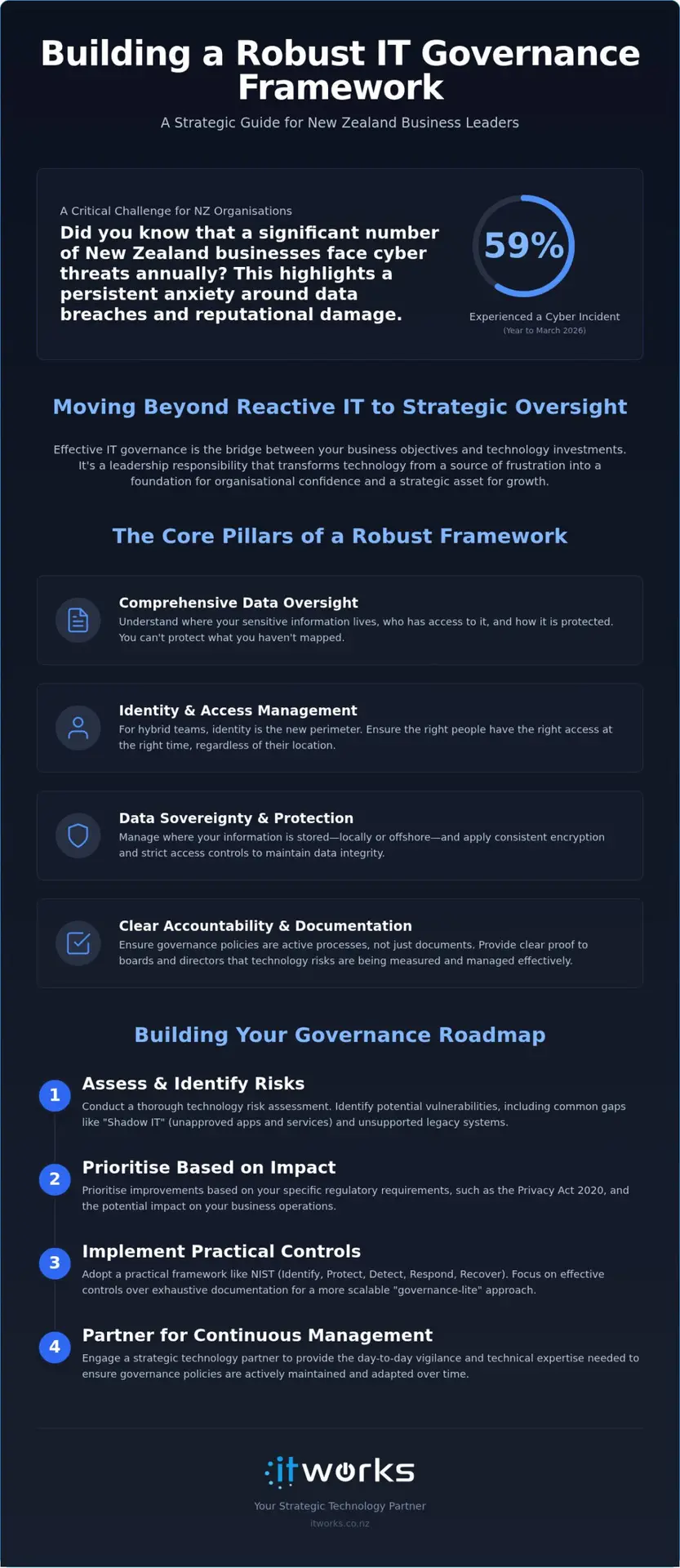
Building Your Governance Roadmap: A Practical Step-by-Step Approach
Moving from a high-level theory to a functional it governance framework nz requires a deliberate, phased approach. It’s easy to feel overwhelmed by the technical details, but the process becomes manageable when broken down into logical steps. This roadmap ensures your technology stays aligned with your business goals while maintaining a strong security posture.
- Step 1: Conduct a technology and risk assessment. You need an objective view of your current environment. This baseline identifies technical debt, security vulnerabilities, and areas where your current processes might be falling short of your legal obligations.
- Step 2: Prioritise gaps based on business impact. Not every finding requires immediate action. Focus first on risks that could lead to data breaches or significant downtime, ensuring your resources are allocated where they provide the most value for your organisation.
- Step 3: Remediate technical vulnerabilities and update policies. This is the active phase where you patch security holes and refresh organisational policies. It’s about ensuring your rules for technology use reflect the way your team actually works in a modern environment.
- Step 4: Implement ongoing monitoring and reporting. Governance isn’t a one-off event. Establishing continuous oversight ensures that new risks are identified early and that your leadership team receives regular reports to maintain your security posture.
Establishing a Baseline Assessment
A professional IT audit provides the clarity needed to make informed decisions. It goes beyond a simple checklist, examining how data flows through your organisation and where potential bottlenecks exist. This information is vital for building a tailored it strategy for non-profits nz or a commercial growth roadmap. Viewing this assessment as the start of a partnership ensures you have a strategic guide to help interpret the findings and turn them into a practical, long-term plan.
Ongoing Governance and Reporting
Effective governance is a living process that evolves alongside your business. It requires regular executive oversight to remain relevant and effective. Quarterly Business Reviews (QBRs) are an excellent tool for this, providing a structured forum to track the health of your IT environment and adjust your priorities. These reviews replace guesswork with data-driven insights. Using automation tools can further simplify this by collecting evidence for compliance and audits in the background, reducing the administrative burden on your leadership team.
How a Technology Partner Simplifies Governance
Implementing an it governance framework nz shouldn’t feel like a weight on your shoulders. IT Works acts as a steady guide, blending high-level strategic advisory with the day-to-day operational support your organisation needs to thrive. We replace the frantic energy of reactive, “break-fix” support with a composed and structured presence. By acting as a strategic ally, we help you transform governance from a stressful administrative burden into a scalable asset that builds trust with your clients and stakeholders.
Working with an NZ-based team provides a distinct advantage when managing local regulatory expectations. We understand the specific nuances of the New Zealand business environment and the reporting requirements expected by local boards. This proximity fosters a sense of partnership and shared identity, ensuring your technology roadmap is grounded in practical stability. A long-term partnership allows your governance posture to mature naturally, ensuring that as your organisation expands, your security and compliance measures remain robust and fully integrated.
Strategic Advisory and Virtual CIO Services
Effective governance starts with clear leadership and purposeful budgeting. Our Virtual CIO services provide executive-level guidance on risk and resilience without the overhead of a full-time hire. We help you budget for governance as a core part of your overall technology spend, ensuring every dollar supports your broader business goals. This approach moves the conversation away from technical specifications and toward long-term value. We focus on aligning your technology with specific business outcomes, ensuring your systems are functional, sustainable, and ready for future growth.
Proactive Management and Layered Security
Automating the heavy lifting of governance is essential for maintaining a consistent posture. We implement layered security measures, such as advanced monitoring, multi-factor authentication, and endpoint protection, which automate many of the repetitive tasks required for compliance. This proactive management ensures your systems are always aligned with best practices, significantly reducing the stress of preparing for board reviews or audits. With 24/7 monitoring in place, your organisation is better positioned to meet incident response and notification duties promptly. You can discuss your cybersecurity priorities with our team to ensure your systems remain resilient, compliant, and focused on enabling your business success.
Transform Technology Into Your Greatest Strategic Asset
Establishing a resilient it governance framework nz is a decisive step toward protecting your organisation and fostering long-term trust. It moves your focus from reactive troubleshooting to a proactive, outcome-based strategy that aligns your technology with your business goals. Strategy leads to stability. By addressing common gaps such as legacy systems and Shadow IT, you create a stable environment that supports sustainable growth and protects your reputation.
Our NZ-based team of experts specialises in building this confidence through a proactive approach to cybersecurity and Microsoft 365 management. We act as your strategic advisor, replacing technical stress with calm reliability. Trust is earned daily. This partnership ensures your technology remains a reliable asset, allowing you to focus on your core mission with peace of mind.
Talk to IT Works about your technology strategy
Taking control of your governance posture today ensures you’re ready for the opportunities of tomorrow. We look forward to leading you through this process and helping you build a more secure, productive, and resilient future for your organisation.
Frequently Asked Questions
What is the most important IT governance regulation for New Zealand businesses?
The Privacy Act 2020 is the primary piece of legislation governing how New Zealand organisations handle personal information. It establishes thirteen Information Privacy Principles that dictate how data is collected, stored, and used. Recent changes, such as the IPP 3A notification obligation effective from May 2026, require even greater transparency. Compliance with these principles is a core requirement for any robust it governance framework nz, ensuring that leadership remains accountable for data protection.
How much does it cost to implement an IT governance framework in NZ?
Costs vary significantly depending on the size and complexity of your organisation. Implementing a framework involves an initial investment in technology risk assessments and policy development, followed by ongoing management fees. Many organisations choose to bundle these costs into their monthly managed service agreements to ensure predictable budgeting. Rather than a one-off expense, governance should be viewed as a strategic investment that reduces the long-term costs of data breaches and operational downtime.
Do small organisations with fewer than 20 staff need to worry about IT governance?
Yes, every organisation that handles personal information or relies on technology for operations needs a governance strategy. While the complexity might scale with the business, the fundamental risks remain the same. Smaller teams are often more vulnerable to disruption because they lack the redundancy of larger firms. A “governance-lite” approach allows smaller organisations to implement critical controls, like identity management and backup strategies, without needing the extensive resources of a larger corporation.
What is the difference between an IT audit and IT governance services?
An IT audit is a specific, point-in-time assessment designed to identify vulnerabilities and compliance gaps. It provides a baseline of your current technical state. In contrast, IT governance services provide the ongoing management, oversight, and strategic guidance needed to maintain your security posture over time. While an audit identifies what needs to be fixed, governance ensures those fixes are implemented and that your technology continues to support your long-term business goals.
How often should our organisation conduct a governance review?
We recommend a structured rhythm of reviews to keep your framework relevant. While day-to-day monitoring happens continuously, a formal executive-level review should occur at least annually. Many growing organisations find that Quarterly Business Reviews (QBRs) provide a better cadence for tracking progress and adjusting priorities. These regular touchpoints ensure that your it governance framework nz evolves alongside emerging threats and changes in your business operations, maintaining consistent organisational resilience.
Can Microsoft 365 help my business meet Privacy Act 2020 requirements?
Microsoft 365 offers a suite of powerful tools that directly support Privacy Act compliance. Features like data loss prevention, encrypted communication, and sophisticated access controls allow you to manage personal information securely. When managed correctly, these tools provide the technical evidence needed to satisfy regulatory requirements and board oversight. It’s about using the platform’s native capabilities to automate your governance tasks, ensuring that privacy protection is built into your team’s daily workflow.
What happens if our organisation is found to be non-compliant with the Privacy Act?
Non-compliance can lead to significant legal and financial consequences. The Office of the Privacy Commissioner can issue compliance notices or fines for failing to report serious breaches within the required 72-hour window. Beyond legal penalties, the reputational damage resulting from a poorly managed data breach can be devastating for a growing business. Proactive governance helps you avoid these pitfalls by ensuring you have the necessary response plans and security controls in place.