
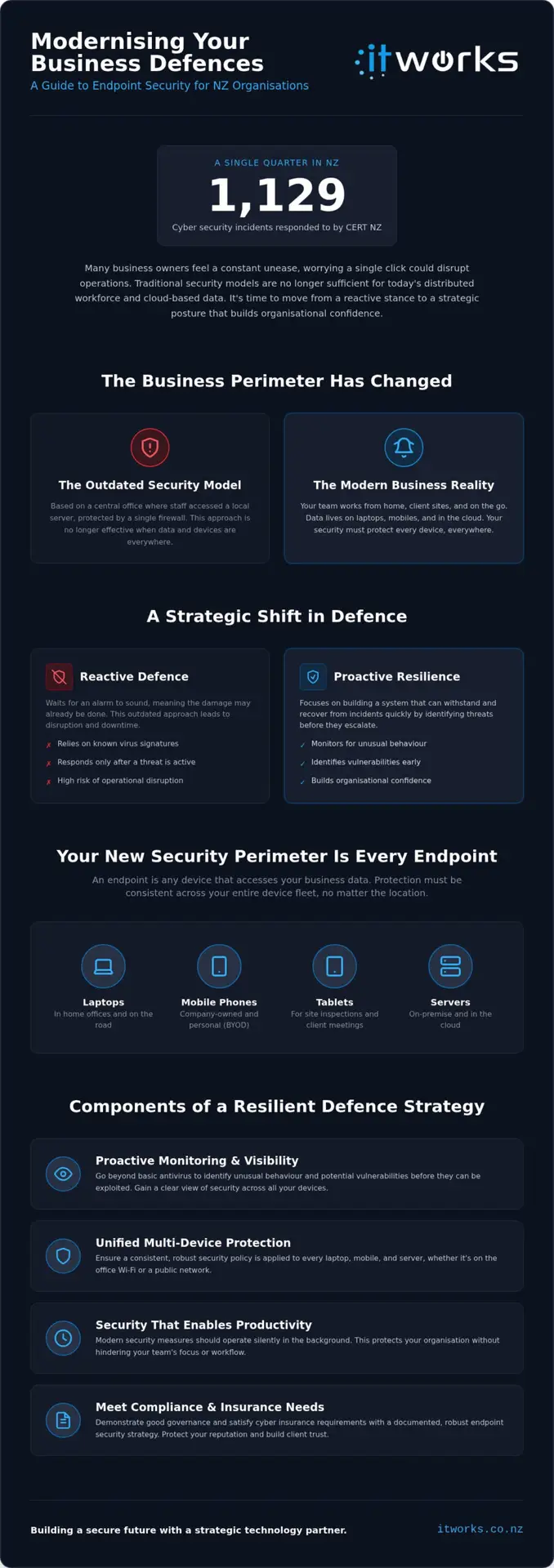
Between April and June 2026, CERT NZ responded to 1,129 cyber security incidents, yet many New Zealand business owners still wonder if their current endpoint security for business nz is actually doing its job. You likely feel a lingering sense of unease. There is a constant worry that a single accidental click could disrupt your entire operation or compromise sensitive data. It is exhausting to feel overwhelmed by technical jargon or pressured by providers using scare tactics to sell you software you don’t fully understand.
We believe that effective security should be a source of organisational confidence, not a cause of daily stress. You can move beyond basic, reactive tools to a strategic posture that protects your data across every laptop and mobile device without hindering your team’s productivity. This guide explains how to modernise your defences and align your technology with your broader business goals. By the end, you will have a clear path toward a more resilient and secure future for your organisation.
Key Takeaways
- Understand why traditional antivirus is no longer enough and how modern endpoint security for business nz provides the visibility needed to detect threats before they cause disruption.
- Learn how to protect your data across all devices, acknowledging that your business perimeter now extends to wherever your team chooses to work.
- Discover the components of a layered defence strategy that builds resilience without relying on a single point of failure.
- Explore how to implement robust security measures that operate silently in the background, ensuring your team stays productive and focused.
- Identify the value of a strategic technology partner who provides ongoing guidance rather than just software installations.
Beyond Antivirus: Why Modern NZ Organisations Need More
For years, the standard approach to IT security was straightforward: install a firewall at the office and put antivirus software on every desktop. This model worked well when your staff sat at the same desks every day, accessing a central server. However, that stationary workforce is largely a thing of the past. With the rapid rise of hybrid work and cloud services, your business data is no longer tucked away behind a single physical wall. It lives on laptops in home offices, smartphones in transit, and various cloud platforms. This shift has fundamentally changed the risk profile for New Zealand organisations. If you’re still relying on basic antivirus, you’re essentially looking at a map of a world that no longer exists. Understanding What is Endpoint Security? and how it has evolved is the first step toward protecting your modern workforce.
When a cyber incident occurs, the direct financial loss is often just the starting point of the trouble. The more lasting damage lies in the erosion of client trust and the total halt of your team’s productivity. A cyber incident in 2026 isn’t just an IT problem; it’s a leadership challenge that can affect your brand’s standing in the market for years. Instead of just trying to achieve “Security”, which often implies a static or finished state, modern businesses should focus on Cyber Resilience. This involves building a system that can withstand an incident and recover quickly, ensuring your operations don’t grind to a halt when a threat appears. A strategic approach to endpoint security for business nz provides the visibility you need to maintain this resilience across all your devices.
The Shift from Reactive to Proactive Defence
The old “break-fix” model is particularly dangerous when dealing with modern ransomware. By the time you notice something is broken, the damage is already done. Proactive monitoring changes this dynamic by identifying unusual behaviour or vulnerabilities before they escalate into full-blown incidents. Instead of waiting for an alarm to sound, proactive systems look for the subtle signs of a breach, such as unauthorised data transfers or unusual login times. This ensures your technology acts as a foundation for success. When your team knows their tools are secure, they can focus on innovation and growth rather than worrying about the next technical hurdle.
Meeting Compliance and Insurance Expectations
Cyber insurance has become a standard requirement for many New Zealand businesses, but obtaining cover is no longer a simple box-ticking exercise. Insurers now look for evidence of robust endpoint protection before they’ll provide a quote. They want to see that you’ve moved beyond basic tools to a more sophisticated posture that includes active monitoring. Beyond insurance, having a documented endpoint security for business nz strategy is increasingly seen as a core governance requirement. It protects your professional reputation and demonstrates to your clients that you take their data privacy and the security of their information seriously.
Defining the Endpoint: Protecting Your Business Wherever It Operates
An endpoint is any device that accesses your business data, including laptops, mobile phones, tablets, and servers. In a modern NZ organisation, the traditional office perimeter has dissolved; your security perimeter is now wherever your staff happen to be working. Whether they are at a kitchen table or a client site, the device they use is the gateway to your most sensitive information. The ‘Bring Your Own Device’ (BYOD) challenge adds another layer of complexity. If staff use personal phones or laptops to check work emails, those devices effectively become part of your business network. Even cloud-based tools like Microsoft 365 rely on secure endpoints for safe access. While your data lives in the cloud, the gateway to that data is the device in your hand. If that gateway is unsecured, your entire cloud environment remains at risk.
The Diverse Fleet of a Modern NZ SME
NZ businesses often manage a diverse range of hardware. This includes laptops used for remote work, tablets used for site inspections, and smartphones used for quick communication on the go. Each of these devices requires a consistent security policy that stays active regardless of where the device is located. It doesn’t matter if a device is on your office Wi-Fi or a public network at a local café; the level of protection must remain identical. We also cannot overlook servers. Whether they are sitting in a cupboard in your office or hosted in a cloud environment, they remain critical endpoints that house your core business applications. Managing this variety is a core part of effective endpoint security for business nz, ensuring no single device becomes a weak link in your chain.
Why Endpoints are the Preferred Entry Point for Attackers
Most modern breaches don’t happen by hacking through a complex firewall. They start at the device level, often through a simple phishing email or by exploiting unpatched software on a single laptop. This makes the identity of the person using the device just as important as the hardware itself. We must ensure that the person logging in is who they say they are, using secure verification methods. Because attackers focus so heavily on the user’s device, endpoint security acts as your last line of defence. When other security layers are bypassed, a robust endpoint security for business nz posture can detect and block malicious activity before it has the chance to spread across your entire network. This proactive approach builds the confidence needed to grow your business without the constant fear of a technical failure.
The Layers of a Resilient Defence Strategy
Resilience in the face of modern threats isn’t about finding one perfect piece of software. Instead, it’s about building a series of hurdles that make it increasingly difficult for an attacker to succeed. We call this layered security. By combining multiple controls, you ensure that if one layer is bypassed, others are ready to catch the threat. A foundational part of this strategy is Multi-Factor Authentication (MFA), which adds a vital verification step to every login attempt. This is your first line of defence against credential harvesting, which remains one of the most common incident categories affecting New Zealand organisations. When combined with rigorous patch management, you effectively close the digital doors that attackers often use to slip into a system unnoticed. A comprehensive approach to endpoint security for business nz involves coordinating these layers so they work together as a single, cohesive system.
EDR vs. Traditional Antivirus: What’s the Difference?
Traditional antivirus relies on ‘signatures’, which are essentially a library of known threats. If a file matches a signature, it’s blocked. The problem is that modern attackers create new, unique threats every day that won’t be in any library. Endpoint Detection and Response (EDR) takes a different approach by focusing on behaviour. Rather than just looking at what a file is, EDR watches what it does. If a programme suddenly starts encrypting files or trying to communicate with an unknown server, EDR identifies that behaviour as suspicious and intervenes. Think of EDR as a flight data recorder for your device. It doesn’t just block a threat; it records the entire event so you can understand how it happened and prevent it from recurring. This leads to faster detection and significantly less time spent on remediation, allowing your team to get back to work sooner.
Identity and Access Management
In a world where staff work from anywhere, the person using the device is just as important as the device itself. Protecting user credentials is a critical component of your security posture. We can now configure tools like Microsoft 365 to perform ‘health checks’ on a device before allowing access to business data. If a laptop hasn’t been updated or is missing key security controls, the system can automatically block access until the issue is resolved. This ensures that only healthy, verified devices can interact with your sensitive information. For more guidance on building this kind of organisational resilience, you can explore our Cyber Security for Small Business NZ guide. By focusing on identity and device health, you create a secure environment that supports growth and safe AI adoption. This strategic alignment ensures that your endpoint security for business nz isn’t just a technical hurdle, but a business enabler.
Implementing Security Without Hindering Productivity
The most common concern we hear from business owners is that tighter security will inevitably slow their team down. It’s a valid worry. Nobody wants to see productivity drop because of intrusive software or complex login processes. However, when managed correctly, endpoint security for business nz should operate almost invisibly in the background. Modern tools are designed to be ‘silent’, providing robust protection without demanding constant attention from your staff. By preventing cyber incidents before they occur, you aren’t just protecting data; you’re ensuring your team avoids the catastrophic downtime that follows a breach. The goal is a strategic and operational blend where security is integrated into your workflow, rather than being bolted on as an afterthought.
Balancing Rigorous Security with User Experience
We prioritise security tools that are exceptionally lightweight on system resources. This ensures that your hardware continues to perform at its peak, even while sophisticated monitoring is active. One effective way to maintain this balance is through automated patching. We can schedule updates and system maintenance to occur outside of your core business hours, such as late at night or over the weekend. This ensures your devices are always current and secure without requiring your team to pause their work for a restart. When security is frictionless, it becomes a natural part of the day-to-day routine rather than a technical hurdle.
The Role of Security Awareness Training
Your people are your strongest defence when they feel empowered with the right knowledge. We move away from scare tactics or doom-and-gloom messaging, focusing instead on building a positive security culture. When staff understand the ‘why’ behind security measures, they are more likely to support them. Training should be practical and accessible, helping your team identify phishing attempts or suspicious links independently. This empowerment actually increases productivity. Informed staff can navigate their digital tools with confidence, making safe decisions without needing to constantly check with the IT department. This human element is the final piece of the endpoint security for business nz puzzle. It’s about creating a resilient organisation where everyone plays a role in collective safety.
Building a Secure Future with a Strategic Technology Partner
Securing your organisation is not a one-off transaction. It’s an ongoing commitment that requires a partner who understands the specific nuances of the New Zealand market. IT Works operates as a strategic ally, ensuring that your endpoint security for business nz is not just a technical requirement, but a foundational element of your broader technology roadmap. When your devices and data are secure, you gain the freedom to innovate. This secure foundation is what allows for the safe and confident adoption of new developments like AI and Microsoft Copilot. Without it, these tools can introduce unnecessary risk. With it, they become powerful drivers of productivity. Our local team provides proactive management and clear accountability, so you always know exactly where you stand.
Moving Beyond ‘Break-Fix’ Support
The traditional break-fix model is built on reactive stress. You wait for something to fail, then scramble to find a solution. We replace that frantic energy with the calm reliability of a managed service. IT Works acts as an extension of your own team, aligning our technical expertise with your specific business goals. We don’t just fix problems; we prevent them. Regular strategic reviews are a core part of this process. These sessions ensure your security posture evolves alongside your business, adapting to new challenges before they become obstacles. It’s about moving from a state of constant technical management to a position of strategic oversight.
Next Steps: Strengthening Your Security Posture
It’s time to shift the conversation about security from a cost centre to a strategic investment. Robust protection is an asset that builds client trust and protects your bottom line. A practical first step is a comprehensive security posture review or a roadmap discussion with our team. This allows us to identify gaps and prioritise actions that provide the most value. Effective endpoint security for business nz is just one part of a total resilience plan. To see how this fits with your data protection strategy, you might find our Backup and Disaster Recovery NZ guide useful. By taking these steps today, you are building a more stable and optimistic future for your organisation.
Securing Your Path to Future Growth
Integrating robust endpoint security for business nz is more than a defensive move; it’s a strategic decision that creates the stable foundation your organisation needs to thrive. By moving beyond traditional antivirus and adopting a layered, proactive approach, you protect your data across every device while empowering your team to work from anywhere with confidence. This resilience replaces the constant worry of technical disruption with a sense of calm reliability, allowing your leadership team to focus on long-term goals.
This secure environment is exactly what allows you to embrace new developments like AI and automation without hesitation. Our local New Zealand-based team provides outcome-focused security management that avoids fear-based tactics, focusing instead on practical results and strategic alignment. We act as a dedicated partner, ensuring your technology roadmap supports your journey rather than creating obstacles along the way.
Talk to IT Works about your technology strategy
Taking control of your security posture today ensures that your business remains competitive, secure, and ready for whatever comes next. We are here to help you build a more resilient and optimistic future for your entire organisation.
Frequently Asked Questions
What is the difference between endpoint security and basic antivirus?
Traditional antivirus relies on a database of known threats to block specific files. In contrast, modern endpoint security for business nz uses behavioural analysis to identify suspicious activity, even if the threat has never been seen before. It acts like a flight recorder, tracking events to help you respond and recover. This shift from reactive blocking to proactive detection is essential for protecting against sophisticated ransomware and zero-day attacks that bypass older tools.
Does my NZ business really need endpoint security if we use cloud services like Microsoft 365?
While Microsoft 365 secures your data in the cloud, the device you use to access that data remains a vulnerability. If a laptop or smartphone is compromised, an attacker can bypass cloud security by using the authorised user’s session. Endpoint protection ensures that every device connecting to your cloud environment is healthy and secure. It provides a vital layer of defence that cloud-native security alone cannot offer to your physical hardware.
Will implementing advanced endpoint security slow down my staff’s computers?
Modern security tools are designed to be lightweight and operate silently in the background. Unlike older, clunky antivirus software that would scan every file and hog system resources, modern endpoint solutions focus on monitoring processes and behaviours. This approach minimises the impact on CPU and memory usage. When configured correctly by a strategic partner, your team won’t even notice the software is running while they perform their day-to-day tasks.
How much does endpoint security for business cost in New Zealand?
The investment for endpoint security for business nz typically follows a per-user or per-device monthly subscription model. This approach provides predictable technology management and allows you to scale the service as your organisation grows. Factors influencing the final cost include the level of active monitoring required and whether the service is bundled into a broader managed IT agreement. We focus on delivering long-term value and strategic alignment rather than just selling software licences.
Can endpoint security help us meet our cyber insurance requirements?
Most New Zealand cyber insurance providers now require robust endpoint protection as a prerequisite for cover. They look for evidence of proactive monitoring and incident response capabilities rather than just basic antivirus. Implementing a strategic endpoint security posture demonstrates to insurers that you are taking a mature approach to risk management. This can lead to more favourable terms and ensures you meet the strict technical standards required to maintain your policy’s validity.
How does endpoint security protect staff who are working from home or in cafes?
Endpoint security travels with the device, providing consistent protection regardless of the network connection. When staff work from home or use public Wi-Fi in cafes, they are often outside the safety of an office firewall. The security software on the device acts as its own perimeter, monitoring for threats and ensuring that data encryption remains active. It allows your team to stay productive and secure from any location across the country without needing a VPN for every task.
Is endpoint security difficult to manage for a business with no internal IT team?
Managing sophisticated security can be complex, but that is where a strategic technology partner adds the most value. We provide proactive management and clear accountability, acting as an extension of your own team. You don’t need to understand the technical jargon or monitor alerts yourself. Our local team handles the configuration, monitoring, and response, allowing you to focus on your business goals while we maintain your security posture and resilience.
What happens if a threat is detected on one of our business devices?
If a threat is detected, the endpoint security system can automatically isolate the affected device from the rest of your network. This prevents the threat from spreading to other users or servers. Our team receives an immediate alert to investigate the incident and begin remediation. Because the system records the event details, we can quickly identify the source of the attack and take steps to ensure your operations return to normal with minimal disruption.