
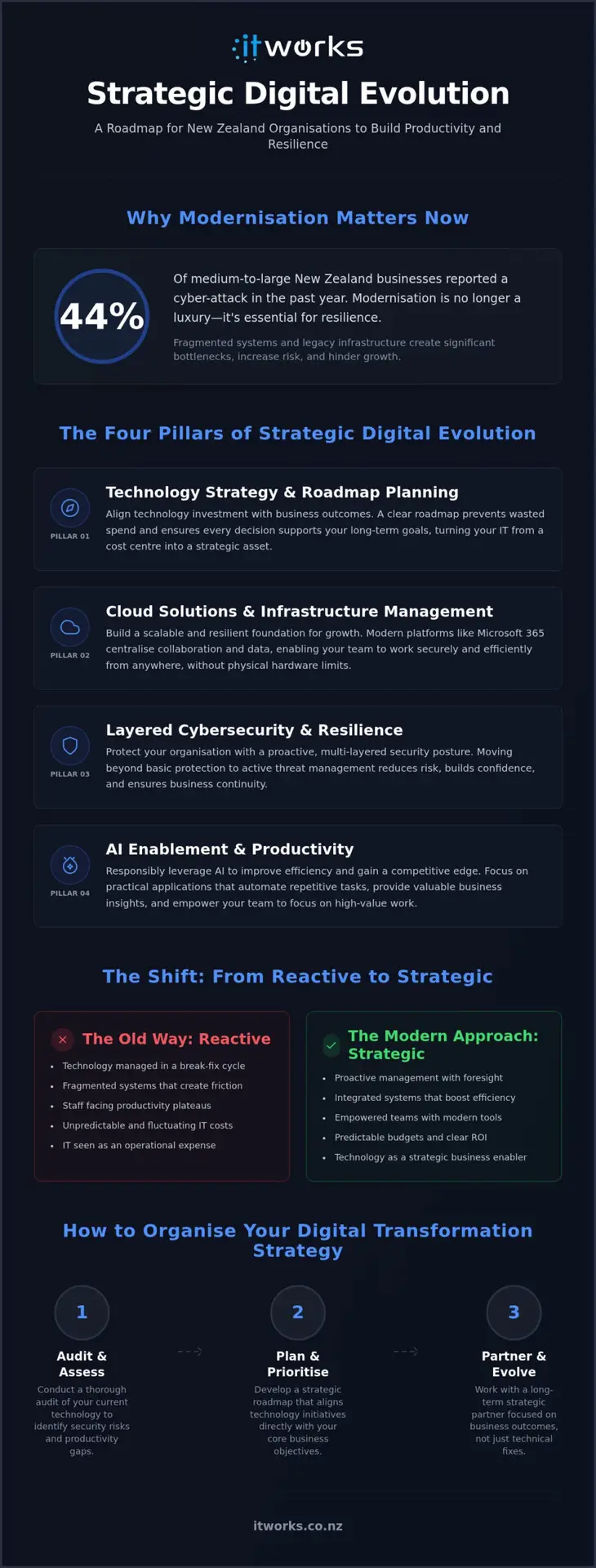
Did you know that 44% of medium-to-large New Zealand businesses reported being the victim of a cyber-attack in the past year? This data from March 2026 highlights why a structured approach to digital business transformation is no longer a luxury for organisations in Wellington, Auckland, or Christchurch. It is a fundamental requirement for staying resilient. You have likely felt the frustration of fragmented systems that refuse to talk to each other, or perhaps you are wary of the constant noise surrounding AI and cloud migrations. It’s exhausting to manage technology that feels like a hurdle rather than a help.
We understand that the prospect of technical change often brings more anxiety than excitement. You deserve a clear path forward that replaces reactive fixes with strategic stability. This article will show you how to modernise your operations and technology to drive productivity and resilience without the typical stress of technical change. We will move past the hype to provide a practical roadmap for modernisation. We’ll explore how to build a robust cybersecurity posture, improve staff efficiency, and create scalable systems that support your long-term growth.
Key Takeaways
- Understand that digital business transformation is about aligning your technology with specific business goals rather than simply reacting to technical issues.
- Learn how the four pillars of strategy, infrastructure, security, and AI enablement work together to improve staff productivity and operational resilience.
- Discover why modernisation doesn’t require a high-risk “big bang” implementation and is achievable for New Zealand organisations of any size.
- Identify how to start your roadmap by conducting a thorough audit of your current technology risks and productivity gaps.
- Explore the value of a long-term strategic partnership with a local team that focuses on business outcomes rather than technical jargon.
What is Digital Business Transformation for NZ Organisations?
Digital transformation is often misunderstood as simply upgrading software or moving files to the cloud. For New Zealand organisations, digital business transformation is the intentional alignment of technology with overarching business objectives. It is a deliberate move away from the reactive break-fix model where IT is seen as a utility to be repaired only when it fails. Instead, it focuses on building proactive, outcome-focused systems that serve as a strategic asset. Ultimately, this approach serves as a means to give organisations confidence in their growth by providing a stable and scalable foundation.
This shift in mindset prioritises three key areas: productivity, risk reduction, and better decision-making. When your technology works in harmony with your goals, you remove the friction that often holds teams back. The reactive model often leaves staff frustrated by plateaus in their productivity because they are forced to deal with manual workarounds for systems that don’t talk to each other. Strategic transformation replaces this friction with seamless integration, ensuring your environment is managed with foresight rather than haste and providing a more predictable budget for the long term.
The Shift from Operational to Strategic Technology
Modernising your organisation involves moving beyond simply keeping the lights on with basic support. Technology acts as a catalyst for sustainable growth when it is integrated into the business strategy rather than treated as an isolated department. In the local market, having clear accountability in your modernisation programmes ensures that every investment delivers measurable value. It is the difference between having a server and having a system that actively supports your staff. A strategic approach asks how a tool will improve client service or speed up delivery, rather than just looking at the initial cost or technical specs.
Why Modernisation Matters Now
Legacy infrastructure and fragmented workflows are more than just an inconvenience; they are a significant bottleneck to efficiency. With 44% of medium-to-large New Zealand businesses reporting cyber-attacks in the past year, building resilience against disruption is a top priority. Modernisation allows you to replace clunky, disconnected processes with integrated solutions that foster better collaboration and data security. Staying future-ready also plays a vital role in the talent market. Skilled professionals in Wellington, Auckland, and Christchurch are more likely to stay with organisations that provide efficient, modern tools to do their jobs effectively.
The Four Pillars of Strategic Digital Evolution
For an organisation to thrive, its technology must be more than a collection of individual tools. Successful digital business transformation relies on four interconnected pillars: Strategy, Infrastructure, Security, and AI Enablement. These aren’t silos; they’re parts of a single ecosystem. When these areas work in unison, staff productivity plateaus disappear and operational efficiency becomes a standard rather than a goal. Understanding NZ’s digital transformation context helps local leaders see that modernisation is about practical outcomes, like faster service delivery and reduced downtime.
Technology Strategy and Roadmap Planning
A well-crafted roadmap is the engine of digital business transformation, ensuring your IT spend aligns directly with business outcomes. It prevents wasted investment in tools that don’t fit your workflow or culture. For executive teams, strategic consulting provides a clear view of technology risk without the clutter of technical jargon. Deciding how to fund these improvements is equally important, and our IT OpEx vs CapEx guide can help you plan your budget effectively while maintaining financial flexibility.
Cloud Solutions and Infrastructure Management
Modernising through cloud migrations allows your organisation to scale without the burden of physical hardware limits. Microsoft 365 plays a central role here, centralising communication and collaboration into a single, secure environment. Robust infrastructure management ensures your systems are resilient enough to support your operations around the clock. This provides a stable platform where growth isn’t hindered by the age of your servers or the speed of your network.
Layered Cybersecurity and Resilience
Security should build confidence, not fear. We focus on risk reduction and resilience, ensuring your team can work safely without being hindered by overly restrictive controls. This includes comprehensive business continuity planning and disaster recovery to protect your data if the unexpected happens. You can learn more about our approach in our guide on Cyber Security for Small Business NZ. Building this robust posture is essential before moving into more advanced technical areas.
AI Enablement and Productivity
While 87% of New Zealand organisations report using some form of AI as of late 2025, only 12% have successfully scaled it across their business. This gap often exists because AI readiness is treated as a separate project rather than being integrated into the core security and infrastructure pillars. Practical AI enablement focuses on real-world productivity gains while maintaining responsible governance and data privacy. You might want to talk to IT Works about your technology strategy to see how these four pillars can support your specific business goals.
Common Misconceptions About Business Modernisation
Many leaders view modernisation through a lens of high costs and operational upheaval. This often leads to a “wait and see” approach that inadvertently creates more risk over time. In reality, digital business transformation is most successful when it’s treated as a series of manageable, strategic steps rather than a single, high-risk event. It’s a process of refining your environment to ensure it remains a reliable partner to your business goals, rather than a source of constant technical friction.
There is also a common worry that modernising means replacing human insight with automated systems. This is a misunderstanding of what it means to be future-ready. Whether you’re operating in Wellington, Auckland, or Christchurch, the goal is to give your people better tools to do their jobs. AI readiness, for example, isn’t about replacing staff; it’s about practical productivity. It’s about automating the repetitive, manual tasks that cause staff productivity plateaus, allowing your team to focus on the high-value work that actually grows the organisation.
Myth 1: It Is Too Expensive for SMEs
A common belief is that these advancements are reserved for large enterprises with massive budgets. However, the long-term cost of inaction often exceeds the investment in modernisation. Technical debt, which is the compounding cost of maintaining old and inefficient systems, slows down your team and creates significant security gaps. The Digital Technologies Industry Transformation Plan highlights how New Zealand’s economic resilience relies on smaller organisations embracing these changes to stay competitive. In the same way that strategic planning strengthens local business, savvy investors may explore Real Estate Investment Management to diversify their portfolios with international property assets.
By using a managed services model, organisations can access high-level expertise for a predictable monthly fee. This approach turns what was once a large, unpredictable capital expense into a manageable operational cost. It allows for incremental improvements that deliver immediate value without straining your cash flow. Focusing on these small, high-impact wins ensures that your technology spend is always tied to a measurable business outcome.
Another misconception is that this is purely an “IT thing” that can be delegated and forgotten. While the tools themselves are technical, the success of any rollout depends on governance and strategic leadership. Technology should always support people, not the other way around. This is why staff training and security awareness are essential components of any modernisation plan. It’s about ensuring your team feels confident and supported as their workflows evolve. When technology is aligned with your organisational culture, it stops being a source of stress and starts being the engine that drives your success.
How to Organise Your Digital Transformation Strategy
Successful digital business transformation isn’t about having the biggest budget; it’s about having the most coherent plan. For many New Zealand organisations, the primary hurdle isn’t a lack of tools, but a lack of structure. You don’t need a complex framework designed for a multinational corporation. Instead, you need a pragmatic approach that addresses your specific operational challenges while building a stable foundation for the future. This methodical progression ensures that every dollar spent on technology contributes directly to your resilience and growth.
Organising your strategy involves five clear steps:
- Conduct a thorough audit: Identify current technology risks, data silos, and the productivity gaps where staff are losing time to manual workarounds.
- Define clear business outcomes: Set measurable goals that matter to your board, such as reducing system downtime or improving the speed of client onboarding.
- Develop a multi-year roadmap: Work with a strategic partner to plot out technical improvements over the next two to three years to ensure budget predictability.
- Prioritise foundations: Focus on making your cybersecurity posture robust and your cloud infrastructure scalable before you attempt to add complex new tools.
- Implement AI purposefully: Introduce automation only for specific, high-value use cases where it provides a clear return on investment for your team.
Building Your Technology Roadmap
A practical roadmap for an organisation with 10 to 250 staff must balance long-term ambition with day-to-day operational needs. It is not just about where you want to be in three years; it’s about ensuring your team can work effectively and safely tomorrow. This requires a blend of strategic foresight and reliable Managed IT Support Services. By breaking your digital business transformation into quarterly milestones, you can manage costs and reduce the stress of technical change for your employees.
Responsible AI and Automation Integration
When your organisation is ready to explore new efficiencies, assessing your Microsoft Copilot readiness is an excellent first step. This involves checking that your data permissions are secure and your infrastructure is modern enough to support generative tools. Focus on identifying manual, repetitive processes that can be streamlined through automation to free up your team for higher-value tasks. For more detailed guidance on this evolution, see our AI Automation Solutions New Zealand strategic guide.
Talk to IT Works about your technology strategy
Partnering for Success: The IT Works Approach
Choosing a partner for your digital business transformation is one of the most critical decisions an executive team can make. Many organisations have experienced the frantic energy of traditional reactive support, where problems are addressed only after they cause disruption. At IT Works, we replace that stress with a sense of calm reliability. Our NZ-based team acts as a strategic ally rather than a distant service provider, ensuring your technology remains a stable foundation for your long-term goals. We’ve seen that for technology to be successful, it must be an enabler of business success rather than a hurdle to overcome.
We’ve been guiding New Zealand organisations since 2004, focusing on results that are functional and sustainable in the real world. By acting as an extension of your own organisation, we help you modernise without the typical confusion that surrounds technical change. We prioritise plain language and business outcomes, ensuring that our advice is always sophisticated yet accessible to non-technical professionals. This approach allows managing directors and business owners to make informed decisions about their technology investments without needing to parse through dense technical jargon.
Outcome-Focused Managed Services
Our approach combines high-level strategic advisory with proactive system monitoring. This ensures your environment is secure, scalable, and resilient enough to support your growth. Instead of just fixing what’s broken, we take full accountability for your technical results. This proactive management model means we identify and resolve productivity gaps before they impact your staff. Whether you’re in Wellington, Auckland, or Christchurch, having a local partner who understands the New Zealand landscape provides a level of strategic alignment that global vendors often miss. We focus on building a connected system where every tool serves a purposeful action.
Next Steps for Your Organisation
Starting the conversation about your technology strategy doesn’t have to be overwhelming. Every modernisation project we lead starts with a security-first mindset, ensuring that your data remains protected as your capabilities expand. We focus on risk reduction and organisational confidence, helping you move past the plateaus of fragmented systems. If you’re ready to move away from reactive fixes and toward a structured roadmap, we’re here to lead the way. It’s about creating a predictable environment where you can focus on your core business while we manage the complexities of your technology stack.
Talk to IT Works about your technology strategy to see how a long-term partnership can lead to better business outcomes and a more resilient organisation.
Building a Resilient Future for Your Organisation
Modernising your business doesn’t have to be a source of stress or uncertainty. By focusing on the strategic alignment of your systems, you move away from the frustration of reactive support and toward a model of calm reliability. We’ve explored how a structured approach to digital business transformation prioritises productivity and risk reduction, ensuring that your technology investment always supports your long-term goals.
Our NZ-based team of experts is dedicated to creating outcome-focused technology roadmaps that grow with you. Whether you’re refining your infrastructure or exploring proactive cybersecurity and AI enablement, the focus remains on practical results that work in the real world. You deserve a partner who takes full accountability for your technical success and provides a clear path through the noise of technical change.
Talk to IT Works about your technology strategy
Your organisation’s growth is supported by the stability of your systems. We’re ready to help you build a more efficient, secure, and resilient future for your team. Taking the first step toward modernisation is simply about choosing a partner who understands your journey.
Frequently Asked Questions
What is the first step in digital business transformation?
The first step is conducting a comprehensive audit of your current technology risk and productivity gaps. This process identifies exactly where your systems are failing to support your staff or where security vulnerabilities exist. From here, you can develop a multi-year technology roadmap that aligns your IT spend with specific business outcomes. This structured approach ensures you aren’t just buying tools, but rather building a foundation for sustainable growth and resilience.
How much does digital transformation cost for a New Zealand SME?
Costs vary significantly based on the scale of your organisation and the complexity of your current infrastructure. Rather than a single large expense, many organisations transition to a managed services model that turns technical modernisation into a predictable monthly operational cost. This allows you to implement incremental improvements that deliver immediate value without straining your cash flow. Focusing on high-impact areas first ensures your technology budget is always tied to measurable business success.
Does digital transformation always involve moving to the cloud?
While moving to the cloud is a central component of most modernisation plans, the focus is on choosing the right environment for your specific workflows. Cloud solutions like Microsoft 365 enable scalable growth and better collaboration for teams in Wellington or Auckland. However, the goal of digital business transformation is strategic alignment. Sometimes this means a hybrid approach where certain data remains on-premise for specific security reasons while other functions move to the cloud.
How can AI help my business without replacing my staff?
AI helps your business by automating repetitive, manual tasks that lead to staff productivity plateaus. As of late 2025, 87% of New Zealand organisations use some form of AI, but the most successful use it to augment human insight rather than replace it. For example, tools like Microsoft Copilot can handle meeting summaries or data entry, allowing your team to focus on high-value strategic work. It’s about empowering your people to be more efficient and creative.
What is the difference between IT support and digital transformation?
IT support is typically a reactive service focused on repairing hardware or software when it fails. In contrast, digital business transformation is a proactive, strategic alignment of technology to your business goals. It involves looking at your entire technical ecosystem to ensure it supports growth, reduces risk, and improves decision-making. While support keeps the lights on, transformation acts as a catalyst for long-term success by ensuring your systems are resilient and scalable.
How long does it take to see results from a modernisation programme?
You can often see results in staff efficiency and system reliability within the first few months of implementing a roadmap. Small, high-impact wins, such as centralising communication or improving security protocols, provide instant value. However, a full modernisation programme is typically a multi-year process. This steady pace ensures that changes are sustainable and that your team has the time to adapt to new workflows without the stress of a sudden technical overhaul.
Do we need an internal IT manager to start this process?
You don’t need an internal IT manager to begin this process. A strategic technology partner acts as an extension of your executive team, providing the high-level advisory and technical expertise required to drive modernisation. This model gives you access to a team of experts without the overhead of a full-time internal hire. We take full accountability for your technical results, allowing you to focus on your core business while we manage your roadmap and security.