

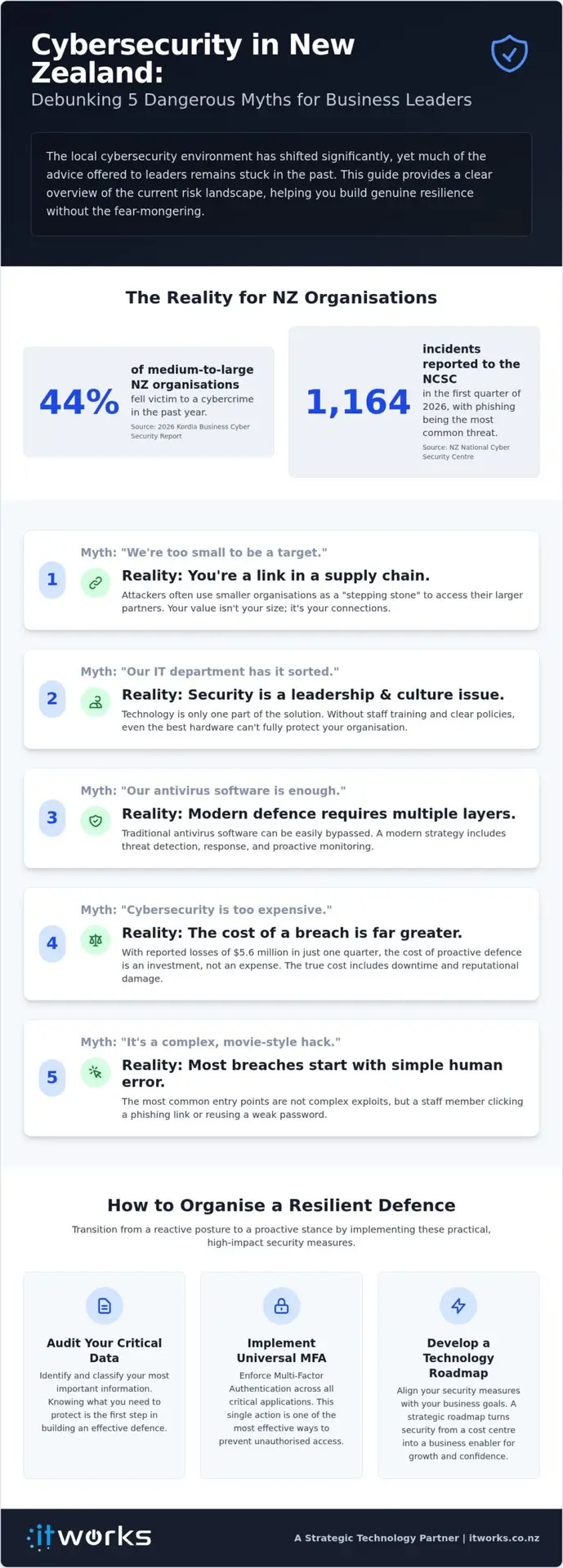
Did you know that 44% of medium-to-large New Zealand organisations fell victim to a cybercrime in the past year? According to the 2026 Kordia Business Cyber Security Report, the local environment has shifted significantly, yet much of the advice offered to leaders remains stuck in the past. It’s completely natural to feel fatigued by the constant stream of “doom and gloom” security warnings, especially when they’re wrapped in technical jargon that feels designed to confuse rather than clarify. You’ve likely wondered if your current IT framework is truly sufficient to withstand a modern cyberattack, or if you’re simply investing in tools that don’t address the real risks your team faces every day.
We believe that cybersecurity shouldn’t be a source of constant stress, but a logical component of your broader technology strategy. We’re going to debunk the most dangerous misconceptions currently circulating in the NZ market to help you build genuine resilience without the unnecessary fear-mongering. This guide provides a clear overview of the 2026 risk landscape, including the impact of the new Privacy Principle 3A and the rise of AI-powered threats. You’ll discover practical, budget-conscious steps to strengthen your defences, allowing you to replace technical anxiety with the confidence of a well-prepared leader.
Key Takeaways
- Learn why your position in the supply chain matters more than your business size when defending against a modern cyberattack.
- Understand that robust security is a leadership and culture priority, moving beyond the misconception that it is solely an IT hardware issue.
- Explore the true impact of a breach by looking past the ransom to the lasting consequences of operational downtime and lost client confidence.
- Identify immediate, practical actions to secure your environment, such as auditing your most critical data and implementing universal Multi-Factor Authentication.
- Discover how to align your security measures with business growth by viewing protection as a journey guided by a strategic Technology Roadmap.
What is a Cyberattack? Defining the Risk for NZ Organisations
Many leaders imagine a cyberattack as a hooded figure in a dark room specifically targeting their server. In reality, it’s a broad term that describes any deliberate attempt to disrupt, steal from, or gain unauthorised access to your business systems. This can range from a single dodgy email designed to harvest a password to a complex ransomware operation that shuts down your entire network. To understand the full scope, we can look at a comprehensive definition of a cyberattack, which highlights how these threats have evolved from simple viruses into sophisticated business risks. A cyberattack is a fundamental business risk that directly impacts the confidentiality, integrity, and availability of your organisation’s data and operations.
Common Types of Attacks Seen in New Zealand
The methods used by criminals are diverse, but they often rely on the path of least resistance. In the first quarter of 2026, New Zealand’s National Cyber Security Centre (NCSC) responded to 1,164 incident reports, with several clear patterns emerging:
- Phishing and Social Engineering: These attacks trick your staff into giving away the keys to your system. With 437 reported incidents of phishing and credential harvesting in Q1 2026, it remains the most common threat for Kiwi businesses.
- Ransomware: This involves locking your essential files and demanding a fee for their release. It’s no longer just about the data; it’s about the total cessation of your ability to trade.
- Business Email Compromise (BEC): Criminals impersonate a supplier or a senior manager to divert funds. These attacks are often highly convincing and rely on exploited trust rather than technical glitches.
The ‘Opportunistic’ Nature of Modern Threats
Modern threats are rarely personal. Automated bots now scan the entire New Zealand internet every hour, looking for unpatched software or weak security settings. Your business size doesn’t matter to an automated script. It doesn’t care if you have ten staff or two hundred; it only cares about finding a doorway left ajar. There is a vital distinction between being targeted and being vulnerable. While your organisation might not be a specific target of interest for a nation-state, having an exposed system makes you a target of opportunity for global criminal networks. Security is no longer about hiding; it’s about ensuring your digital windows and doors are locked against the constant, automated noise of the internet.
5 Dangerous Myths About Cyberattacks Debunked
Believing common misconceptions is often more dangerous than the threats themselves. When leadership teams operate on the assumption that a cyberattack only happens to “the other guy”, they inadvertently create gaps in their own armour. Let’s look at the five most prevalent myths currently circulating in New Zealand boards and offices.
- Myth 1: “We’re too small to be a target.” Reality: You are a vital link in a supply chain. Criminals often use smaller organisations as a “stepping stone” to infiltrate their larger partners or clients.
- Myth 2: “Our IT guy has it sorted.” Reality: Security is a governance and culture issue, not just a hardware one. If your staff aren’t trained and your policies are outdated, no amount of technical patching can fully protect you.
- Myth 3: “Antivirus is enough.” Reality: Modern threats bypass legacy antivirus software with ease. Signature-based detection is no match for “living off the land” attacks that use your own system tools against you.
- Myth 4: “Cybersecurity is too expensive.” Reality: With reported financial losses reaching $5.6 million in Q1 2026 alone, the cost of a breach far outweighs the cost of proactive defence.
- Myth 5: “It’s a movie-style hack.” Reality: Most breaches don’t involve complex code breaking. They start with a simple human error, a reused password, or a staff member clicking a convincing link.
The ‘She’ll Be Right’ Fallacy in NZ Business
The famous Kiwi “she’ll be right” attitude is a source of pride, but it’s a significant vulnerability in digital security. This relaxed approach often leads to a reactive posture, where businesses only act after a cyberattack has occurred. Transitioning to a proactive stance means identifying risks before they are exploited. For a deeper look at building this type of resilience, read our guide on Cyber Security for Small Business NZ.
Antivirus vs. Managed Detection and Response
Think of traditional antivirus as a lock on your front door. It’s necessary, but it won’t stop a determined intruder who finds an open window. Managed Detection and Response (MDR) is more like having a security guard in the building 24/7. In 2026, identity management and Multi-Factor Authentication (MFA) are far more critical than your firewall. Guidance from New Zealand’s lead operational cyber security agency highlights that layered security provides multiple opportunities to stop an intruder before they reach your “crown jewels”. Building this level of protection is much simpler when you have a strategic IT partner to guide the way.
The True Cost of a Breach: It’s Not Just the Ransom
While a ransom demand often grabs the headlines, it usually represents only a fraction of the total financial impact on a business. For many New Zealand organisations, the most crippling expense is the sudden halt of daily operations. Imagine your team arriving on a Monday morning only to find every file encrypted and every system offline. If your staff cannot access your CRM, accounting software, or email for three days, the loss of billable hours and productivity can quickly exceed the cost of the initial cyberattack itself. This “hidden” cost of recovery often drains resources that were originally earmarked for growth and innovation.
We must also consider the evolving regulatory landscape. With the introduction of Information Privacy Principle (IPP) 3A on 1 May 2026, New Zealand organisations now face stricter requirements regarding the notification of individuals when their information is collected via third parties. A data leak today involves a complex legal and compliance process that consumes significant management time. Navigating these privacy laws while managing the intense stress of a recovery operation creates a heavy burden on your leadership team and staff alike.
Reputation and Trust in the NZ Market
New Zealand’s business community is uniquely small and highly connected. A breach isn’t just a technical failure; it’s a public signal about your organisation’s reliability and how much you value your clients’ privacy. For non-profits, the stakes are even higher. Donor data is a high-value target for criminals because it contains sensitive financial and personal details. Once that trust is broken, it can take years to rebuild donor confidence and secure future funding. You can explore specific strategies for this sector in our guide on Cybersecurity for Non-profits NZ.
The Recovery Timeline: What to Expect
Many leaders believe that having a backup means they can be back up and running in an hour. This is rarely the case in a real-world scenario. Restoring from a backup after a cyberattack requires a methodical approach to ensure you aren’t simply re-injecting the original malware back into your clean environment. The process typically involves three distinct phases:
- Immediate Response: Isolating the threat and conducting forensic analysis to find the entry point.
- Remediation: Cleaning all systems and verifying data integrity before any restoration begins.
- Recovery: Gradually bringing services back online while monitoring the network for signs of re-infection.
A robust Business Continuity Plan is the difference between a manageable three-day outage and a three-week struggle. It provides a clear roadmap for recovery, significantly reducing the immense pressure placed on your IT team and the wider organisation during a crisis.
How to Organise a Resilient Defence Strategy
Building a resilient defence doesn’t require an unlimited budget, but it does require a methodical approach. Instead of trying to secure every single file with the same intensity, start by auditing your environment to identify your “crown jewels”. These are the essential data sets, such as client records or proprietary IP, that your organisation simply cannot function without. Once you know what you’re protecting, you can prioritise your investment where it matters most.
The next immediate step is implementing Multi-Factor Authentication (MFA) across every single account. In the current landscape, a cyberattack often succeeds not through technical wizardry, but through stolen credentials. MFA acts as a vital circuit breaker in this process. Coupled with this, your backups must be “air-gapped” or immutable. This ensures that even if an intruder gains access to your primary network, your recovery data remains untouched and ready for restoration. Finally, develop a simple Incident Response Plan. Knowing exactly who to call and what steps to take in the first hour of a breach can save your organisation thousands in recovery costs.
The Power of Cyber Security Awareness Training
Your team members are often portrayed as your greatest vulnerability, but with the right approach, they become your most effective sensors. Effective Cyber Security Awareness Training should be non-punitive and focused on changing behaviour rather than just ticking a compliance box. When staff feel confident reporting a suspicious email without fear of reprimand, you gain an early warning system that no software can replicate. This cultural shift turns a passive workforce into a proactive first line of defence.
Microsoft 365: The Security Goldmine You Already Own
Most New Zealand organisations already utilise Microsoft 365, but few have optimised the sophisticated security features included in their Business Premium licences. “Out-of-the-box” settings are designed for ease of use, not maximum protection, which can leave doors open for a cyberattack. By configuring “conditional access” policies, you can ensure that only authorised users on compliant devices can access sensitive data. Adding “endpoint management” allows you to secure company information on mobile devices and laptops, creating a cohesive security ecosystem that supports your team wherever they choose to work. Strategic configuration of these tools ensures your security infrastructure is both sophisticated and accessible.
Building a Strategic Partnership for Long-term Security
Effective cybersecurity is never a destination you reach with a single software purchase or a one-off audit. It is a continuous journey that requires ongoing attention as the digital environment shifts. While a specific tool might block a threat today, the nature of a modern cyberattack evolves constantly, often using artificial intelligence to bypass static defences. This reality is why the New Zealand government’s 2026-2030 Cyber Security Strategy emphasises a “whole-of-society” approach to resilience. For most organisations, this means moving away from the “break-fix” mentality of traditional IT support and towards a model of integrated, strategic management.
A Technology Roadmap serves as the foundation for this transition. Rather than reacting to problems as they arise, a roadmap allows you to align your security investments with your broader business growth goals. It ensures that as you scale, your defences scale with you. A managed partner provides the proactive monitoring and specialised expertise that most small-to-medium organisations cannot maintain on their own. This partnership allows you to focus on your core mission while knowing that a dedicated team is watching for anomalies and managing your risk in the background.
Outcome-Focused Security: What Does Success Look Like?
True success in cybersecurity isn’t measured by the absence of headlines, but by the presence of resilience. When you move beyond the “doom and gloom” marketing, success looks like a calm and organised office environment. It provides the confidence that your systems are robust and your data is protected, even if a cyberattack attempts to disrupt your flow. This level of preparation is increasingly vital for maintaining professional indemnity insurance and proving to your clients that you are a reliable steward of their information. It turns security from a technical burden into a strategic asset that supports your day-to-day productivity.
Next Steps for Your Organisation
Starting a conversation about your security posture doesn’t have to be a high-pressure event. The goal is to gain clarity on where you stand today and where you need to be tomorrow. A proactive, NZ-based advisory team understands the local market conditions and the specific regulatory expectations, such as the 2026 privacy updates regarding indirect data collection. We recommend starting with a high-level review of your current environment to identify any immediate gaps. Talk to IT Works about your technology strategy to build a practical roadmap that secures your future without breaking the bank. Our focus is on providing the guidance you need to move forward with purpose and peace of mind.
Securing Your Organisation’s Future with Confidence
Building a resilient organisation in 2026 requires moving beyond the “she’ll be right” mentality and embracing a structured, proactive approach. We have seen that the true impact of a cyberattack extends far beyond a ransom payment, affecting your reputation, legal standing, and operational continuity. By debunking common myths and focusing on practical steps like MFA, immutable backups, and staff training, you can transform your security from a source of stress into a strategic advantage.
Success lies in integration rather than isolation. Our NZ-based team of strategic advisors brings over 20 years of experience helping local organisations grow securely through a layered security approach. We focus on long-term resilience, ensuring your technology roadmap aligns perfectly with your business objectives. Taking the first step towards a more secure future is simply a matter of starting the right conversation.
Talk to IT Works about your technology strategy
You have the tools and the knowledge to protect your mission. We are here to help you navigate the journey with clarity and composure.
Frequently Asked Questions
Is my small NZ business really a target for a cyberattack?
Every connected organisation in New Zealand is a potential target because modern threats are largely automated. Scanners don’t look for your business name; they look for unpatched software or weak passwords. In the first quarter of 2026, the NCSC responded to over 1,100 incidents, many affecting smaller entities. Being a target often has less to do with your size and more to do with your vulnerabilities or your links to larger partners.
What is the most common way a cyberattack starts?
Most incidents begin with a simple human interaction, usually through phishing or social engineering. An employee might receive a convincing email that appears to be from a trusted supplier or a senior manager. Once they click a link or enter their login details, the intruder has the keys to the network. This is why identity protection and staff awareness are just as critical as technical firewalls in preventing a cyberattack.
How much does it cost to fix a business after a cyberattack?
The financial impact varies depending on the severity, but it typically includes forensic investigation, legal fees, and system restoration. Beyond these direct costs, you must account for the loss of billable hours and potential regulatory fines under the Privacy Act 2020. While total reported losses in NZ reached $5.6 million in early 2026, even a minor breach can cost a mid-sized organisation tens of thousands in lost productivity and remediation expenses.
Can a firewall alone protect my business from modern threats?
A firewall is a necessary basic defence, but it cannot stop modern, identity-based threats on its own. Many attacks now bypass the network perimeter entirely by using stolen credentials to log in through legitimate channels. To be truly resilient, you need a layered approach that includes Multi-Factor Authentication (MFA), endpoint monitoring, and secure cloud configurations. This ensures that if one layer fails, others are in place to detect and stop the intruder.
What should I do immediately if I think we’ve been breached?
Your first priority is to isolate any affected systems by disconnecting them from the network to prevent the threat from spreading. Do not shut down or restart machines, as this can destroy vital forensic evidence. Immediately contact your managed IT partner or a specialised security team to begin your Incident Response Plan. Early intervention is the most effective way to limit the duration and total cost of a cyberattack.
Do I need cyber insurance if I have good IT security?
Cyber insurance is a vital component of a modern risk management strategy, but it isn’t a replacement for robust technical security. Most insurers now require proof of specific controls, such as MFA and immutable backups, before they will offer coverage. Insurance helps manage the financial fallout of a breach, while your security measures aim to prevent the event or minimise its operational impact in the first place.
How often should we run cyber security awareness training for staff?
Training should be an ongoing process rather than a once-a-year event. Short, frequent sessions or simulated phishing tests every quarter are far more effective at keeping security top-of-mind for your team. This consistent approach helps build a culture where reporting a suspicious email becomes second nature. Regular updates are also necessary to keep pace with new tactics, such as the use of AI to create more convincing lures.
What is the difference between a backup and a disaster recovery plan?
A backup is simply a copy of your data, while a disaster recovery (DR) plan is the documented process for getting your business back to work. Having a backup doesn’t guarantee you can resume operations quickly if your server is destroyed or encrypted. A DR plan outlines the priority of system restoration, the staff responsibilities, and the specific timelines required to meet your business continuity goals. Both are essential for long-term resilience.