
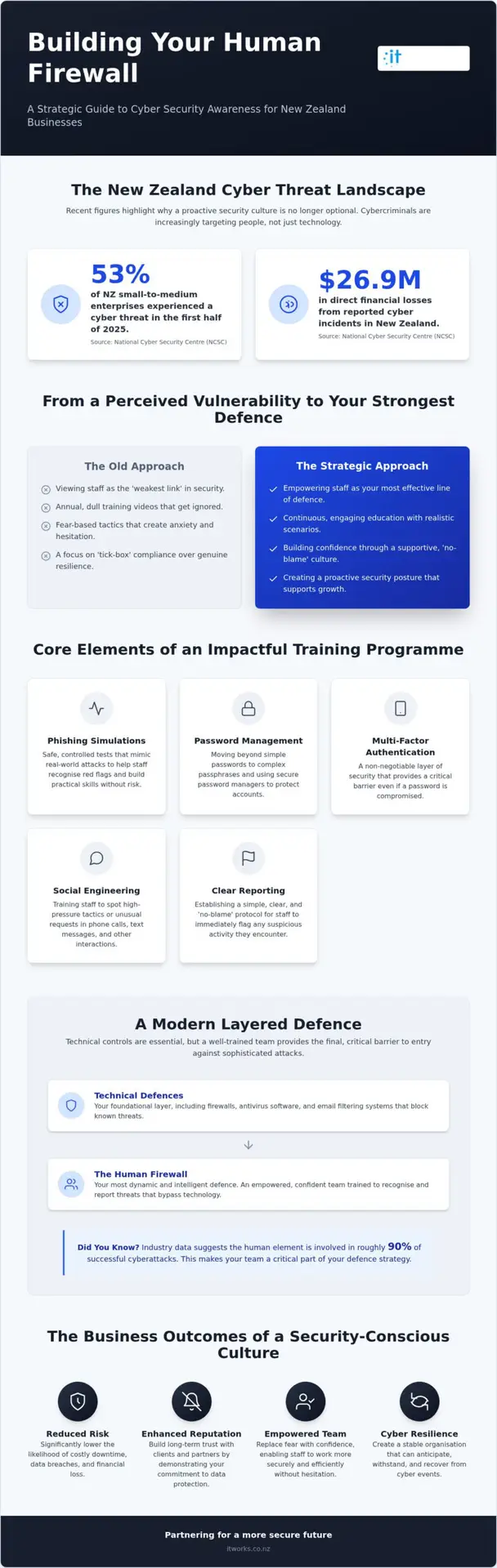
Did you know that 53% of New Zealand’s small-to-medium enterprises experienced a cyber threat in the first half of 2025? It’s a sobering figure from the National Cyber Security Centre (NCSC), especially when direct financial losses from cyber incidents have climbed to $26.9 million. Most Kiwi business leaders feel the weight of these headlines, yet they often find themselves trapped between the fear of a data breach and the frustration of staff ignoring dull, annual training videos. It’s time to rethink cyber security awareness training as a strategic investment in people rather than just a technical requirement.
You aren’t alone if you feel overwhelmed by complex terms or worry that your team is the weakest link in your digital chain. We believe in replacing that stress with a sense of calm reliability. This guide will show you how to build a resilient security culture that empowers your staff to recognise and neutralise threats with confidence. We’ll explore how to move beyond tick-box compliance to create a proactive posture that supports your organisation’s long-term growth and stability.
Key Takeaways
- Understand how continuous education transforms your team from a perceived vulnerability into your most effective line of defence.
- Discover why moving away from scare tactics toward a no-blame culture is essential for building genuine organisational resilience.
- Learn the practical steps to implement cyber security awareness training that empowers staff to identify and report threats without hesitation.
- Identify the core technical pillars, such as phishing simulations and MFA, that provide a layered approach to protecting your digital assets.
- Follow a logical five-step roadmap to assess your current posture and establish clear security goals that support business growth.
Understanding Cyber Security Awareness Training and Its Role in Resilience
Effective cyber security awareness training isn’t a one-off event or a box to tick for compliance. It is a continuous educational journey designed to equip every person in your team with the knowledge to protect themselves and the organisation. Instead of viewing staff as a liability, this approach transforms them into a proactive force capable of identifying threats before they cause damage.
Modern cybercriminals rarely spend weeks trying to crack a complex firewall. They find it much easier to trick a person. Business email compromise (BEC) has become a significant issue for New Zealand organisations, where attackers impersonate trusted colleagues or suppliers to redirect payments. This shift in tactics is why a focus on Security Awareness is now a strategic priority. When your team understands the psychological triggers attackers use, they can act as a sophisticated human firewall.
Why Technical Defences Aren’t Enough
Firewalls and antivirus software are essential components of your infrastructure, but they have limits. Social engineering techniques are specifically designed to bypass these technical barriers by exploiting human trust and urgency. Industry data often suggests that the human element is involved in roughly 90% of successful cyberattacks. This doesn’t mean staff are failing at their jobs; it means attackers have become experts at manipulation.
A layered security model is the most effective way to manage this risk. This is why cyber security awareness training must be viewed as a core pillar of your infrastructure. By combining robust technical controls with a well-trained team, you create multiple opportunities to catch a threat. If a malicious email makes it past your filters, a confident staff member who knows how to spot a suspicious link becomes the final, critical barrier to entry.
The Business Benefits of a Capable Team
Building a security-conscious culture offers advantages that go far beyond basic protection. A capable team significantly reduces the risk of costly downtime and the heavy expenses associated with data recovery. When your staff feel empowered rather than fearful, they work more efficiently and contribute to a more stable operational environment.
There is also a clear reputational benefit. Clients and partners in New Zealand are increasingly scrutinising how their data is handled. Demonstrating that your team is actively engaged in protecting information builds long-term trust and strengthens your brand. Cyber resilience is the ability of an organisation to anticipate, withstand, and recover from adverse digital conditions or attacks.
The Essential Elements of an Impactful Training Programme
Building a resilient organisation requires moving beyond passive learning. An impactful cyber security awareness training programme focuses on active participation and realistic scenarios that reflect the actual threats Kiwi businesses face every day. By integrating these elements into your culture, you ensure that security becomes a shared responsibility rather than a technical burden.
Phishing simulations are a cornerstone of this approach. These safe, controlled tests mimic real-world attacks to help staff recognise the subtle red flags of a malicious email. Rather than punishing those who click, these simulations provide immediate, constructive feedback in a low-stakes environment. This practical experience is far more effective than theoretical lectures, as seen in the success of the Cyber Security for the Tertiary Sector (CSTS) initiative, which has seen significant growth in awareness and capability across New Zealand’s education sector.
Beyond phishing, your programme should emphasise basic digital hygiene. This includes:
- Password Management: Moving away from simple phrases to complex passphrases or password managers.
- Multi-Factor Authentication (MFA): Implementing MFA across all accounts as a non-negotiable layer of protection.
- Social Engineering Awareness: Training staff to spot high-pressure tactics or unusual requests in phone calls and text messages.
- Clear Reporting Protocols: Establishing a simple, ‘no-blame’ way for staff to flag suspicious activity immediately.
Recognising Modern Phishing and Scams
Threats are evolving rapidly in the New Zealand context. Attackers now use ‘vishing’ (voice phishing) and ‘smishing’ (SMS phishing) to target employees on their personal and work mobile phones. With the rise of AI, phishing emails have become perfectly professional, often free of the spelling errors and awkward phrasing that used to give them away. A simple yet effective habit is the ‘hover and check’ method; always hover your cursor over a link to verify the actual destination URL before clicking.
Mobile and Remote Work Security
The shift toward hybrid work has expanded the attack surface for most organisations. Securing home Wi-Fi and understanding the risks of ‘juice jacking’ at public charging ports are now essential skills. Staff must also prioritise keeping software and devices up to date, as many attacks exploit known vulnerabilities that patches have already fixed. Managing sensitive data on the go requires a balance of security and productivity, which is why integrated cyber security strategies are vital for modern businesses. Protecting your team wherever they work ensures your operations remain steady and secure.
Replacing Fear with Confidence: Why Traditional Training Often Fails
Many organisations treat cyber security awareness training as a digital equivalent of a fire drill; something to be endured once a year and then promptly forgotten. This compliance-heavy approach often relies on “scare tactics” that highlight catastrophic data breaches and sophisticated hackers. While the risks are real, doom-and-gloom messaging usually backfires. It creates a sense of helplessness or apathy where staff feel that if a breach is inevitable, their individual actions don’t really matter.
True resilience comes from replacing that fear with confidence. Instead of a rigid set of rules that hinder daily workflow, security should be a shared value that supports productivity. The most successful programmes foster a “no-blame” culture. If an employee accidentally clicks a suspicious link or enters credentials on a dodgy site, they must feel safe reporting it immediately. Speed is the most critical factor in neutralising a threat. A staff member who hides a mistake out of fear of disciplinary action gives attackers a much longer window to operate within your systems.
The Psychology of Security Awareness
Attackers are masters of psychological manipulation. They use manufactured urgency and high-pressure language to trigger a stress response, which naturally clouds human judgment. Effective cyber security awareness training teaches your team to recognise these emotional triggers. By giving your staff the “permission to pause,” you break the attacker’s momentum. Encouraging a culture where it is okay to double-check a request, even if it supposedly comes from the CEO, is more effective than any technical filter.
Continuous Learning vs. One-Off Workshops
The human brain is subject to the “forgetting curve,” where information is rapidly lost if it isn’t reinforced regularly. This is why annual training videos are largely ineffective on their own. Modern organisations are shifting toward micro-learning: short, frequent updates that take only a few minutes but keep security at the front of mind. Using real-world New Zealand examples, such as recent phishing campaigns targeting local banks or government agencies, keeps the content relevant and engaging. This steady, methodical approach ensures that security habits become second nature rather than a chore.
How to Organise Effective Staff Training in 5 Steps
Implementing a structured programme for cyber security awareness training doesn’t have to be a complex technical headache. By following a logical progression, you can move from a reactive state to a composed, strategic presence. This five-step roadmap ensures your efforts are targeted, measurable, and sustainable in the real world.
Step 1: Assessing Your Current Posture
Before you can improve your culture, you must understand your starting point. Running a silent phishing simulation is a highly effective way to identify existing gaps without causing unnecessary alarm. This baseline data reveals how many staff are likely to click a malicious link or provide credentials. During this phase, it’s also vital to review your current password policies and multi-factor authentication (MFA) adoption across the business. Focus extra attention on ‘high-risk’ roles, such as those in finance and HR, who are frequently targeted due to their access to sensitive data and payment systems.
Step 2: Define Clear Objectives. Once you have your baseline, decide what success looks like. Are you aiming for a 50% reduction in phishing clicks, or is the goal 100% MFA enrolment? Setting specific, achievable targets helps keep the programme focused and gives your team a clear sense of purpose.
Step 3: Choosing a Practical Partner
The right partner acts as a strategic ally rather than a distant service provider. For New Zealand organisations, local support is essential for cultural alignment and trust. You need an expert guide who understands the specific threats facing the Kiwi market and focuses on practical outcomes rather than just selling software. A collaborative partner will help you integrate security into your daily operations without creating friction. For more on this approach, read our guide on Cyber Security for Small Business NZ: Building Resilience and Confidence.
Step 4: Launch and Engage. When you roll out the training, keep it accessible and relevant. Use short, punchy modules that respect your team’s time. Avoid dense jargon and instead use storytelling to illustrate how these threats impact their work and personal lives. Engagement is higher when staff realise these skills protect them at home as well as in the office.
Step 5: Measure and Refine. Use the data from ongoing simulations and training completions to refine your approach. If one department is struggling, you can provide tailored support rather than forcing everyone through the same repetitive content. Continuous improvement ensures your cyber security awareness training evolves alongside the threats.
Partnering for a More Secure Future with IT Works
IT Works understands that for many New Zealand business owners, the digital landscape feels increasingly volatile. With the NCSC handling almost 6,000 incident reports over the last year, the need for a steady hand is clear. We simplify cyber security awareness training by acting as your strategic ally, removing the technical complexity so you can focus on sustainable growth. Our approach replaces the typical stress of technical management with a sense of composed, long-term stability.
A proactive security posture requires more than just installing software; it demands a connected system where technology supports your people. We focus on reducing risk without creating unnecessary friction in your daily operations. By integrating the human element into a broader technology roadmap, we ensure that your team remains your strongest asset. This isn’t about a one-off service but a purposeful partnership that evolves as your organisation scales.
Strategic Security Advisory
Our work goes beyond basic training modules. We integrate security into your wider IT strategy to ensure every part of your infrastructure is resilient. This provides essential visibility of risk for executive teams and boards, moving security from a hidden technical concern to a transparent strategic priority. When leadership understands the link between staff capability and business continuity, they can make informed decisions that protect the bottom line. You can start this process by strengthening your cybersecurity posture with our expert guidance.
Practical Next Steps for Your Organisation
Modernising your approach to security doesn’t require an overnight overhaul. We help you organise and manage ongoing staff education through a methodical, deliberate process that fits your specific needs. It starts with a simple conversation about your current challenges and your vision for the future. We provide the structure and tools needed to maintain a high level of awareness without overwhelming your team. Talk to IT Works about your technology strategy to see how we can build a more secure, confident future for your organisation together.
Building a Culture of Digital Confidence
Securing your organisation is no longer just a technical challenge; it is a human one. By shifting the focus from restrictive rules to empowered action, you transform your staff into a sophisticated first line of defence. Effective cyber security awareness training ensures that your team feels capable and calm when faced with modern threats, rather than overwhelmed or afraid. We have seen how a methodical, five-step approach can replace the stress of technical management with a sense of strategic stability.
Our New Zealand-based advisory team is dedicated to providing practical, non-fear-based security models that align with your specific business outcomes. We believe in building resilience through a connected system where technology and people work in harmony to support your growth. This proactive posture allows you to navigate the digital landscape with the assurance that your operations are protected by a capable and vigilant workforce.
The journey toward a more resilient culture starts with a single, purposeful conversation. We are here to guide you through every step of that process, ensuring your security measures are functional, sustainable, and grounded in the real world.
Frequently Asked Questions
What is cyber security awareness training exactly?
It is a continuous educational process that equips your team to recognise, report, and neutralise digital threats. This training goes beyond a simple lecture; it involves realistic simulations and regular updates on evolving tactics. It covers essential areas like password security, multi-factor authentication, and social engineering. The ultimate goal is to build a culture where every staff member understands their role in protecting the organisation’s digital assets and reputation.
How often should my team undergo security training?
Training should be a continuous cycle rather than an annual event. Monthly micro-learning modules combined with quarterly phishing simulations are highly effective for keeping security at the front of mind. This steady rhythm helps combat the forgetting curve and ensures staff stay updated on the latest tactics used by attackers. Regular, short updates are far more memorable and impactful than a single long workshop once a year.
Is cyber security training mandatory for NZ businesses?
While there is no single law that mandates it for every business, it’s often a requirement to comply with existing regulations. The Privacy Act 2020 requires organisations to have reasonable safeguards to protect personal information. Many insurance providers and government departments also require proof of cyber security awareness training before they will offer cover or sign contracts. It is a fundamental part of demonstrating that your organisation takes data protection seriously.
What are the most common cyber threats facing NZ staff in 2026?
Phishing remains the top threat, but it has become more sophisticated with the use of artificial intelligence. Business email compromise is another major risk, where attackers impersonate trusted figures to trick staff into making fraudulent payments. We are also seeing a rise in mobile-based scams, including text and voice phishing. These attacks rely on psychological manipulation, making it vital for staff to understand the emotional triggers that cybercriminals exploit.
Can small businesses afford professional security training?
Yes, professional training is now highly accessible for organisations of all sizes. Modern platforms offer scalable subscriptions that are priced per user, making it a predictable and manageable cost. Investing in prevention is far more cost-effective than dealing with the aftermath of a successful breach. Many Kiwi organisations find that a managed approach provides the best value, as it combines expert guidance with automated tools that save time for managers.
What happens if an employee clicks on a phishing link during a simulation?
A simulation is a safe learning opportunity, not a reason for disciplinary action. If someone clicks, they should receive immediate, helpful feedback that explains what red flags they missed. This teachable moment is the most effective way to build recognition skills. Encouraging a no-blame culture ensures that staff feel comfortable reporting mistakes, which is vital for catching real attacks before they escalate into a serious incident.
How do I measure if the training is actually working?
You can measure effectiveness by tracking specific data points over time. Key indicators include a decrease in the number of staff who click on links during phishing simulations and an increase in the number of suspicious emails reported to your IT team. A high reporting rate is a clear sign that your cyber security awareness training is successful. It demonstrates that your team is not just aware of threats but is actively working to neutralise them.
Does my non-profit organisation need the same level of training as a business?
Non-profits are often targeted because they handle sensitive donor data and may have fewer technical defences. Attackers don’t distinguish between commercial and charitable organisations; they simply look for vulnerabilities. Providing your team with the same level of training as a corporate business is essential for protecting your reputation and your mission. Building a resilient culture ensures that your limited resources are used for your cause rather than recovering from a breach.