
What if fewer support tickets don’t tell you whether your IT investment is working? Measuring the ROI of managed IT services means looking beyond activity reports to the outcomes your organisation depends on, from staff productivity to resilience when disruption occurs.
It’s understandable to focus first on the fees. They’re clear, while the benefits can be harder to quantify. Comparing managed services with internal IT isn’t always straightforward either, particularly when responsibilities, tools and coverage differ.
This guide sets out a practical, repeatable way to assess value against costs, risks and business priorities. You’ll learn how to choose meaningful measures, account for less visible costs of internal support, and compare managed, internal and hybrid models on a like-for-like basis. The aim is to clarify whether your IT approach supports the organisation’s goals and where a more focused review could help.
Key Takeaways
- Start with business outcomes, not ticket totals, to see whether IT is helping your organisation work effectively.
- Use a consistent formula and measurement period when measuring the ROI of managed IT services.
- Compare managed, internal and hybrid support against the same responsibilities, including effort, expertise and continuity planning.
- Build a repeatable review process: agree on outcomes, record baselines, choose measures and assign an internal owner.
- Look for sustained patterns and reliable evidence before deciding whether to adjust the service, the measures or the operating model.
Why measuring managed IT services ROI takes more than counting support tickets
Managed IT service fees are easy to identify in a budget. Value is less visible because it can show up across the organisation: staff spending less time waiting for systems, fewer repeat disruptions, or greater confidence that essential information can be restored. When managed providers like Gradius IT Solutions deliver proactive 24/7 network management, the primary benefit often lies in prevented downtime rather than mere ticket volume. To assess value fairly, look beyond a provider’s activity report and connect IT performance with the work your organisation needs to do.
Ticket counts have a place, but they describe demand for support, not the full effect of the service. A low total might mean systems are working well, or that staff are working around problems without reporting them. A higher total could reflect a new system rollout or better reporting, rather than declining performance.
What managed IT services ROI should tell decision-makers
Return on investment compares relevant benefits with total costs over a defined period. The Return on Investment (ROI) concept offers a useful starting point, but not every benefit needs to be assigned a precise dollar value.
ROI is a way to weigh the costs of a service against the financial and operational outcomes it supports over an agreed period. Financial returns might include avoided expenditure, where it can be evidenced. Operational outcomes could include improved continuity, less staff time lost to IT issues, or greater confidence in the organisation’s technology. Keep these categories distinct so a qualitative benefit isn’t presented as a confirmed financial saving.
Why ticket counts are an incomplete measure of value
A ticket total doesn’t show whether an issue was resolved well, how many people it affected, or whether it returned. For example, repeated reports about a shared application may point to an ongoing disruption that a simple monthly count can obscure. Pair support activity with context: recurring issues, time to resolution, the number of affected staff, and the work delayed or interrupted.
Fewer tickets don’t automatically mean better service. Staff may have stopped reporting minor faults, or a change in reporting practice may have altered the numbers. Check what the data includes and whether the recording method has remained consistent.
That context matters when measuring the ROI of managed IT services. Agree on the service scope, measurement period and outcomes before assessing results. Establish a reliable baseline, such as the current frequency of recurring issues or the typical effect of disruption on staff, and record your assumptions. If scope or reporting changes, note it rather than treating the figures as directly comparable. A transparent method won’t make every benefit easy to price, but it will make the decision more grounded and repeatable.
How to calculate the ROI of managed IT services with a transparent framework
A useful ROI calculation starts with a fair comparison, not a perfect one. Agree on the period you’re measuring, such as a financial year or a set review period, and keep the service scope consistent. If one option includes cybersecurity, backup and strategic advice while another covers support only, the results won’t be like-for-like.
ROI = ((measured benefits − total costs) ÷ total costs) × 100
The formula expresses net measured benefit as a percentage of costs. It works best for benefits that can be reasonably evidenced in financial terms. Operational outcomes, such as improved continuity or greater staff confidence, still matter, but should be reported separately unless there’s a defensible way to value them.
An ROI result is only as reliable as the inputs, assumptions and service scope behind it. Record how each figure was gathered, what was estimated and what couldn’t be confidently quantified.
Which managed IT costs belong in the calculation
Include recurring managed service fees for the agreed period, plus any separately scoped project or consulting work that forms part of the comparison. Add software subscriptions and hardware costs only if they’re included in the service model being assessed. Otherwise, account for them consistently across the options so one approach isn’t unfairly burdened or credited.
Remember your organisation’s own effort. Staff time spent coordinating the provider, overseeing decisions or carrying out work outside the agreed scope is part of the operating picture. Record that effort consistently, even if you choose not to convert it into a dollar value.
How to assess benefits without overstating them
For recovered staff time, agree on a method before calculating a benefit. For example, track time lost to specific recurring issues before and after a service change, then document how you estimated the difference. If you apply an internal hourly cost to that time, record the basis for the rate and treat the result as an estimate, not guaranteed savings.
Compare service and operational measures with the baseline: recurring issues, disruption and support responsiveness. Report security confidence and continuity as outcomes unless evidence supports assigning them a financial value. Don’t count a hypothetical incident that didn’t occur as a confirmed avoided loss.
This approach makes measuring the ROI of managed IT services more useful for decision-making, even when some benefits can’t be reduced to a single figure. If you’re setting up a review, discuss your technology strategy with a trusted adviser and agree which outcomes matter before comparing results.
Managed IT services vs internal or hybrid IT: compare equivalent scope
Use the table as a starting point, then confirm who owns each responsibility in your specific arrangement. These are common patterns, not fixed definitions.
| Area to compare | Managed IT | Internal IT | Hybrid IT |
|---|---|---|---|
| Support and proactive management | Provider handles agreed services; your team coordinates priorities. | Internal staff handle agreed support and system oversight. | Work is split between internal staff and provider. |
| Cybersecurity | Provider manages only the responsibilities included in scope; leadership retains oversight. | Internal staff manage agreed security work, drawing on available expertise. | Provider and internal staff share tasks, with ownership clearly assigned. |
| Projects and advice | May be separate from recurring services; confirm what’s included. | Internal staff plan or deliver work within their capacity and skills. | Internal staff may lead, with provider support for agreed work. |
| Continuity and accountability | Check responsibilities, reporting and continuity arrangements in the agreement. | Confirm how knowledge and responsibilities are maintained if key staff are unavailable. | Agree who leads, escalates and coordinates across both teams. |
Make the service scope like-for-like
Write down support coverage, proactive management, cybersecurity responsibilities and project work as separate items. For each, note who is accountable and what remains with your organisation. Also identify whether licensing, hardware and project charges sit outside recurring fees. A managed service fee may look lower if internal oversight or separately purchased tools aren’t included in the comparison. For more context on defining responsibilities, see this managed IT support guide for New Zealand organisations.
Compare risks and outcomes alongside expenditure
Assess whether each model gives your organisation clear accountability, suitable specialist capability and a practical approach to continuity. Consider whether internal capacity and skills still fit your requirements and growth plans, and how work is covered when people are unavailable. For security measures to compare, refer to this New Zealand cybersecurity resilience guide.
When measuring the ROI of managed IT services, include operating effort and responsibility alongside expenditure. A hybrid model may share the work, but it also needs clear ownership to prevent gaps or duplicated effort. The fairest comparison makes both costs and outcomes visible.
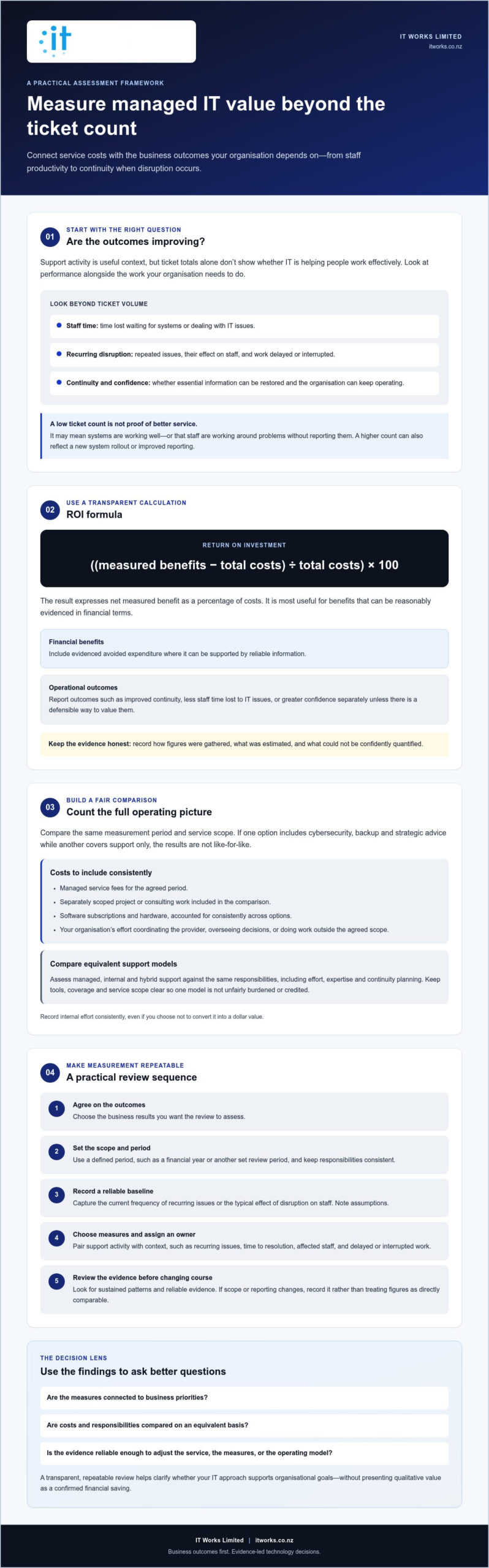
A practical measurement plan for managed IT services ROI
A useful review doesn’t need a complicated dashboard. It needs a clear link between what your organisation wants to achieve, what the IT service does and the evidence you’ll use to assess progress. Use the same process at each review so changes are easier to interpret.
- Agree on outcomes: Choose business priorities the technology service should support, such as reducing disruption to key work or strengthening continuity.
- Record a baseline: Capture the current position before assessing changes, including how the information is collected.
- Choose measures: Use a balanced set of indicators, not a single financial or technical measure.
- Review results: Compare the agreed period with the baseline and discuss what the evidence does and doesn’t show.
- Adjust: Refine measures, reporting or service priorities where the findings point to a gap.
Assign an internal owner to coordinate the review and bring the right stakeholders together. Agree with the provider what information will be reported, how it’s defined and how often you’ll receive it. This connects service reporting with business decisions rather than collecting data without a clear purpose.
Choose measures that connect IT with business priorities
Build a balanced scorecard around outcomes your leadership team already follows. Depending on available data, it could include staff time affected by IT issues, recurring problems, support responsiveness and indicators of continuity. Pair operational measures with relevant business context, such as work delayed by a disruption. For continuity planning and recovery measures, see this backup and disaster recovery resilience guide.
Set a baseline and review results consistently
Before comparing periods, document current performance, data sources, definitions and known limitations. For example, clarify what counts as a recurring issue and how staff time affected by disruption is recorded. Agree on a review frequency with stakeholders and keep the measurement period consistent so the comparison remains useful.
Record changes that could affect interpretation, such as a shift in service scope, staffing or business activity. If a measure changes, explain why and avoid treating the new result as directly comparable without context. Over time, this creates a more dependable view of whether the service supports the organisation’s priorities and where its approach may need to adapt.
Turn managed IT ROI findings into a confident next-step decision
A result is most useful when it’s read in context. Look for patterns across review periods, check whether the service scope stayed consistent, and consider how reliable the underlying evidence is. One unusually strong or weak period may not reflect the service’s ongoing contribution, particularly if responsibilities or business conditions changed.
Use the findings to guide a proportionate decision. You might refine the service if a recurring issue is affecting staff, adjust a measure that isn’t producing useful evidence, or review the operating model if organisational needs have shifted. Consider strategy, cybersecurity and continuity together as connected business priorities, not guaranteed financial returns.
What to do when the ROI is unclear
An unclear result isn’t proof of either value or poor performance. First check that the baseline, service scope and cost inputs are complete and comparable. Then identify benefits that matter but lack usable data, such as reduced disruption or improved confidence in continuity. Agree how to capture that information in future reviews, who will provide it and when it will be assessed.
Keep estimates labelled as estimates. If staff time saved is based on an approximation, don’t present it as a confirmed saving. Equally, missing data shouldn’t be treated as evidence that a benefit hasn’t occurred. The review should make uncertainty visible and help improve the next measurement cycle.
Use the review to align technology with business goals
Discuss whether the current service supports the organisation’s priorities for productivity, security confidence and planned growth. If responsibilities are unclear or priorities have changed, a technology roadmap can help set direction and clarify what the service needs to support. Before changing providers, confirm the outcomes you expect and who is accountable for each part of the work.
That’s the practical value of measuring the ROI of managed IT services: it gives leaders a clearer basis for deciding what to continue, improve or reassess. The next step may be a focused conversation about the evidence and the organisation’s priorities, rather than an immediate change to the operating model.
Make your next IT decision with confidence
Measuring the ROI of managed IT services is most useful when it connects service costs with the outcomes your organisation needs. Look beyond ticket totals: compare equivalent service scopes, use consistent measures and consider productivity, continuity and security confidence alongside financial results.
If the figures are unclear, treat that as a prompt to check your assumptions, improve the evidence and agree on what to measure next. A steady review can help you decide whether to refine the service, update your measures or reassess how IT responsibilities are shared.
IT Works brings together a New Zealand-based support and advisory team, with strategic planning alongside day-to-day support and project delivery. That combination can help your organisation connect technology decisions with business priorities and a practical roadmap.
With clear measures and the right conversations, you can make your next IT decision with greater clarity and confidence.
Frequently Asked Questions
What is the ROI of managed IT services?
The ROI of managed IT services is a way to compare the service’s relevant benefits with its total costs over an agreed period. Financial benefits may be calculated where there’s reliable evidence, while outcomes such as improved continuity, staff confidence or less disruption may be better reported separately. The purpose is to support a sound business decision, not to force every benefit into a dollar value.
How do you calculate the ROI of managed IT services?
Use this formula: ROI = ((measured benefits − total costs) ÷ total costs) × 100. Measuring the ROI of managed IT services starts with setting a consistent period and confirming the service scope being assessed. Include only benefits supported by evidence in the calculation, and label estimates clearly. Report important outcomes that can’t be reliably priced separately, so the percentage isn’t mistaken for a complete account of value.
Which costs should be included when measuring managed IT services ROI?
Include recurring service fees and any separately scoped project or consulting work relevant to the comparison. Account for software subscriptions and hardware if they’re part of the model being assessed, and include internal staff time spent coordinating, overseeing or supplementing the service. Check that each option includes equivalent responsibilities. Costs outside the agreed scope should be identified rather than silently left out or applied to only one model.
Can you measure the value of reduced downtime if there is no reliable baseline?
You can start measuring it, but without a reliable baseline you may not be able to confidently attribute a change to the IT service. Look for credible historical records, such as incident logs or business reports, and note their limitations. Then agree on how to record disruption, affected work and recovery going forward. Treat any retrospective estimate as uncertain, not as proven savings or avoided cost.
How should I compare managed IT services with an internal IT team?
Compare equivalent scope and responsibilities, not just a provider’s fees with an employee’s salary. Include support, proactive management, cybersecurity, project work, licensing, hardware and the time your organisation spends overseeing IT. Assess accountability, specialist capability and continuity planning as well as expenditure. If the internal team retains work that a provider includes, record that difference so the comparison reflects the full operating effort of each model.
How often should an organisation review managed IT services ROI?
Agree on a review schedule that fits your organisation’s planning and reporting cycles, then use it consistently. The right frequency depends on the service scope, available evidence and the decisions leadership needs to make. Review sooner if responsibilities or business priorities change, and document the change so results remain interpretable. Each review should consider the same measures and period where possible, rather than relying on isolated updates.
Does a lower number of IT support tickets mean a better return?
No. Fewer tickets don’t automatically show that technology is working better or delivering a stronger return. Staff may report issues less often, or problems may be recurring without being resolved at the source. Consider ticket patterns alongside resolution quality, disruption, affected staff and work delayed. Check whether reporting practices changed, too. Ticket numbers are useful context, but they’re not a measure of business value on their own.