
If your organisation faced a major system outage tomorrow, would your team be back online in minutes, or would you be part of the $5.6 million in direct financial losses reported by the NCSC in the first quarter of 2026? Most New Zealand business owners recognise that a “she’ll be right” attitude toward technology is no longer a viable strategy for long-term stability. You likely feel the pressure to meet rising stakeholder expectations for data security, yet remain uncertain about which business continuity solutions nz actually provide the protection your specific operations require. It is a common challenge to balance the fear of downtime against the need for practical, cost-effective resilience.
We believe that technology should be a quiet enabler of success rather than a source of constant stress. This guide will help you move beyond reactive support by explaining the critical difference between a basic data backup and a true continuity strategy. You will learn how to build a structured plan that reduces risk and provides the confidence that your staff can stay productive, whether they are working from an office in Wellington or remotely in Christchurch. We will outline a clear path toward organisational resilience that protects your bottom line and supports your future growth.
Key Takeaways
- Learn the critical distinction between simple data backups and a comprehensive strategy that ensures your essential functions remain operational during a crisis.
- Discover how a structured risk assessment and business impact analysis can help you prioritise the systems that are most vital to your daily productivity.
- Explore how proactive business continuity solutions nz move your organisation away from reactive support models and toward a more stable, outcome-focused technology environment.
- Understand the steps required to build a technology roadmap that identifies existing gaps and sets clear recovery objectives tailored to your business needs.
- See why a local, strategic partnership provides the calm reliability needed to navigate New Zealand’s specific regulatory requirements and operational risks.
Understanding Business Continuity Solutions in the NZ Context
Business continuity is the discipline of ensuring your organisation can maintain its essential functions during and after a significant disruption. While many view it as a technical checkbox, Business continuity planning (BCP) is actually a strategic framework that keeps your doors open when external events occur. In a local context, effective business continuity solutions nz are designed to address our specific geographic challenges, such as physical isolation and our reliance on complex global supply chains. By focusing on operational resilience, you turn a potential vulnerability into a strategic asset that supports long-term stability.
Backup vs. Business Continuity: What Is the Difference?
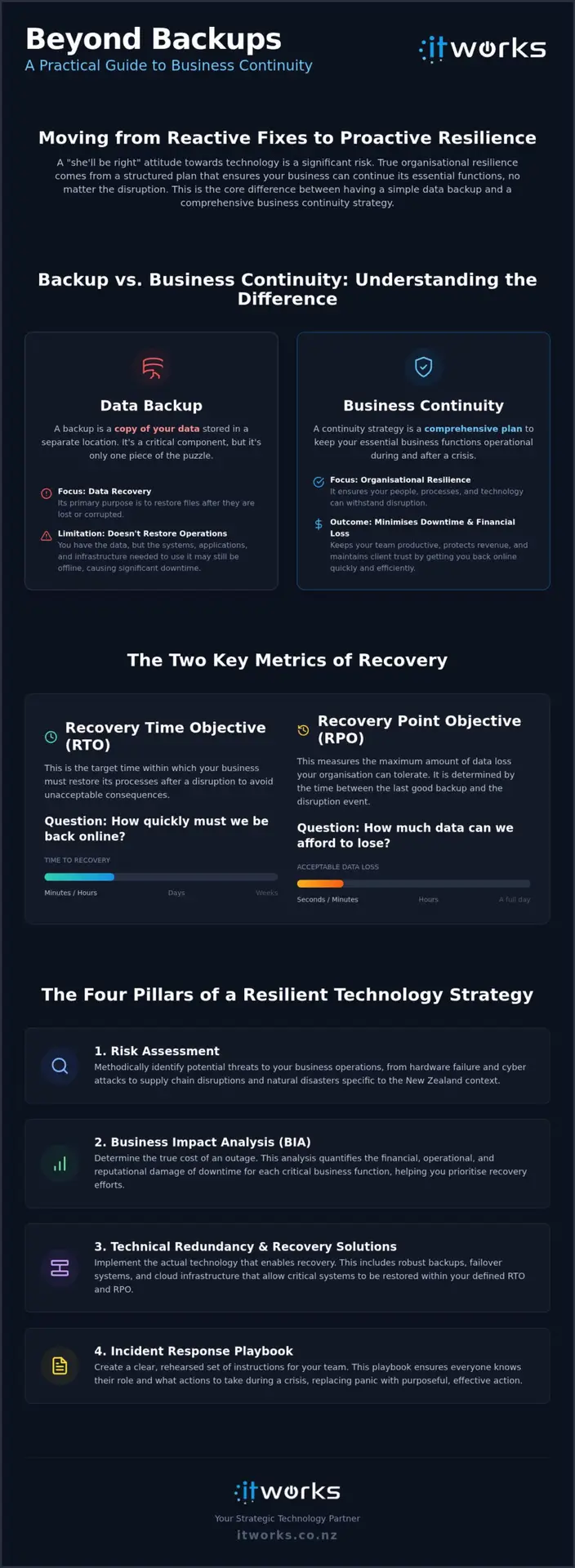
It’s a common misconception that having a backup is the same as having a continuity plan. A backup is simply a copy of your data stored safely elsewhere. If your server fails, you have the data, but you don’t necessarily have a way to use it immediately. A full continuity solution ensures the systems that run that data are also ready to go. This distinction is vital for maintaining productivity.
To understand this, we look at two key metrics: Recovery Time Objective (RTO) and Recovery Point Objective (RPO). RTO is the target time it takes to get back up and running after a failure. RPO refers to how much data you can afford to lose, measured in time. For instance, losing ten minutes of work is very different from losing a full day. These elements of backup and disaster recovery NZ organisations rely on work in tandem to create a safety net that protects both data integrity and operational uptime.
Why a “She’ll Be Right” Attitude Is a Strategic Risk
New Zealanders are known for their resourcefulness, but the “she’ll be right” mentality can be a liability when managing technical infrastructure. Relying on luck or reactive fixes leads to unpredictable downtime. This erodes client trust and halts staff productivity. When systems go down, the cost isn’t just the repair bill. It’s the lost opportunities and the stress placed on your team during the outage.
Shifting toward organisational resilience means treating continuity as a proactive priority. Instead of waiting for a problem to occur, we focus on preventing disruption through deliberate planning. This approach aligns with the Government’s Fuel Response Plan 2026, which encourages organisations to prepare for interconnected risks like transport and logistics failures. By moving away from a reactive model, you build an organisation that is stable, reliable, and ready for sustainable growth.
The Core Pillars of a Resilient Technology Strategy
Building a resilient organisation requires more than just high-quality hardware. It involves a methodical approach to identifying vulnerabilities before they impact your bottom line. Business continuity solutions nz are most effective when they are built upon four fundamental pillars: risk assessment, impact analysis, technical redundancy, and a clear incident response playbook. A thorough risk assessment asks what could go wrong, while a Business Impact Analysis (BIA) determines how much that failure would actually cost the organisation in lost productivity and reputation. By understanding these variables, you can allocate resources where they are needed most. Finally, an incident response playbook provides a rehearsed set of instructions for your team to follow when things go pear-shaped. This replaces panic with purposeful action, ensuring everyone knows their role during the first critical hour of a disruption.
Identifying Your Critical Business Functions
During a disruption, not every task carries the same weight. We categorise functions into urgent, important, and non-essential to ensure your team stays focused on what keeps the lights on. For example, processing payroll or accessing client files is often more urgent than general internal meetings. Robust network security solutions NZ organisations implement ensure that these critical pathways remain protected and available. Mapping the dependencies between your staff, their software, and the physical hardware they use allows for a more seamless transition during a crisis. This mapping identifies hidden risks, such as a critical process that relies on a single staff member’s local computer rather than a central system.
The Role of Cloud Solutions in Continuity
Modern cloud infrastructure has fundamentally changed how we manage organisational resilience. Platforms like Microsoft 365 allow your team to transition from an office in Auckland to a home setup in Christchurch without missing a beat. This flexibility is a core component of modern business continuity solutions nz. However, cloud access introduces new risks that require careful management. Multi-Factor Authentication (MFA) is a non-negotiable layer for secure identity management, acting as a primary gatekeeper for your data. Additionally, cloud-to-cloud backup is essential for modern organisations. Just because your data is in the cloud doesn’t mean it’s immune to accidental deletion or security incidents. Having an independent copy ensures you can recover quickly regardless of the platform’s status.
If you are unsure where your current setup stands, you can talk to IT Works about your technology strategy to find a path toward genuine resilience.
Proactive IT Monitoring: The Engine of Continuity
The most effective continuity plan is the one you never have to trigger. While having recovery protocols is essential, proactive IT monitoring serves as the engine that keeps your organisation running without interruption. This approach involves a real-time view of your system’s health, identifying stresses or security threats before they escalate into significant outages. By addressing these minor issues early, you move away from the frantic energy of reactive “break-fix” support and toward a managed, outcome-focused model. This transition is a core component of modern business continuity solutions nz, as it prioritises operational stability over simple repair speed.
Stopping Issues Before They Impact Operations
Monitoring provides an early warning system for a range of technical problems that often go unnoticed until they cause a failure. Our team prioritises the identification of several key indicators:
- Signs of hardware failure, such as degrading server components or network bottlenecks.
- Unpatched software vulnerabilities that could be exploited by external threats.
- Unusual spikes in network traffic that may indicate a security breach or system strain.
This level of oversight is particularly relevant for cyber security for small business NZ leaders who want to ensure their data remains protected without needing to be technical experts themselves. For executive teams in cities like Auckland or Christchurch, 24/7 monitoring replaces the stress of technical management with a sense of calm reliability, knowing that potential disruptions are being handled before they impact staff productivity.
Predictable Technology Management
Using proactive data allows for much more accurate long-term planning and budgeting. When you understand the performance and age of your hardware, you can manage equipment lifecycles more effectively, avoiding the sudden, large expenses that come with emergency replacements. This process helps reduce “technical debt,” which is the accumulated risk and cost associated with aging or poorly maintained systems. By keeping your technology roadmap on track through constant oversight, you ensure that your infrastructure continues to support your growth objectives. Integrating monitoring into your business continuity solutions nz creates a predictable environment where technology acts as a stable foundation for your daily operations, rather than a variable that might fail when you need it most.
Steps to Building Your Business Continuity Roadmap
Creating a resilient organisation isn’t about complex jargon or expensive, unused manuals. It’s about taking practical steps to ensure your team can keep working when the unexpected occurs. Effective business continuity solutions nz are built through a deliberate, five-step process that aligns your technical capabilities with your operational requirements. This methodical approach replaces the typical stress of disaster recovery with a sense of calm, strategic readiness.
Step 1 involves a high-level technology audit to identify existing gaps in your current infrastructure. You can’t protect what you haven’t mapped. In Step 2, you define your recovery objectives based on business needs rather than technical limits. Instead of asking what IT can do, ask what the business requires to survive. Step 3 focuses on documentation. Your recovery plans must be accessible offline, as a digital-only manual is useless if your network is down. Step 4 is the implementation phase, where you layer backup, security, and proactive monitoring into a cohesive system. Finally, Step 5 establishes a cycle of regular review and testing with your technology partner to ensure the plan remains relevant as your business grows.
Prioritising Your Security Posture
A continuity plan that hasn’t been tested is merely a wish list. We use tabletop exercises to walk through various scenarios with your team in a low-pressure environment. These drills identify where communication might break down or where a process is too slow to meet your recovery targets. Engaging with disaster recovery services Wellington businesses trust allows you to facilitate these drills with expert guidance. This ensures your staff feel confident and prepared, rather than overwhelmed, when a real disruption occurs.
Partnering for Resilience and Long-Term Growth
Choosing the right technology partner is the final, and perhaps most critical, step in securing your organisation’s future. While technical tools are essential, they are most effective when managed within a framework of long-term strategic alignment. An outcome-focused partner doesn’t just fix what is broken; they work to ensure your systems are robust enough to prevent failure in the first place. This shift from a reactive service provider to a strategic ally replaces the typical stress of technical management with a sense of calm reliability. By integrating business continuity solutions nz into your broader organisational goals, you transform technology from a potential risk into a reliable enabler of success.
A local, New Zealand-based team provides a level of cultural and regulatory understanding that offshore providers simply cannot match. We understand the specific operating reality of businesses in Auckland, Wellington, and Christchurch, from local supply chain dependencies to the requirements of the NCSC Minimum Cyber Security Standards. This local expertise leads to better governance and strategic clarity, as your continuity plan is built to satisfy both your internal needs and external regulatory expectations. A long-term partnership ensures that as your organisation grows, your resilience strategies scale alongside you, providing a stable foundation for sustainable expansion.
Beyond Technical Support: A Strategic Ally
We act as an extension of your internal team, providing the high-level advisory and operational support usually reserved for much larger organisations. This relationship is built on clear accountability and transparent processes, ensuring you always know the status of your critical systems. We focus on business results rather than selling specific hardware or software packages. Our goal is to ensure your staff remain productive and your data remains secure, regardless of external events. By prioritising these outcomes, we help you reduce technical debt and maintain a modern, efficient infrastructure that supports your daily operations without constant intervention.
Next Steps for Your Organisation
Building organisational resilience starts with a simple, jargon-free conversation about your current priorities and concerns. We recommend a proactive review of your existing systems to identify any hidden vulnerabilities that could impact your continuity. This process doesn’t have to be overwhelming; it’s about taking small, deliberate steps toward a more secure and stable future. By addressing these areas now, you avoid the frantic energy of a crisis later and build genuine confidence among your stakeholders and staff.
Talk to IT Works about your technology strategy to begin developing a roadmap that protects your operations and supports your long-term growth.
Building a Stable Foundation for Your Future Growth
Organisational resilience isn’t a destination, but a continuous state of readiness that allows your business to thrive regardless of external events. By shifting your focus from simple data backups to comprehensive business continuity solutions nz, you ensure that your staff stay productive and your operations remain stable during disruptions. We’ve explored how a structured approach, from risk assessment to proactive monitoring, replaces technical stress with calm reliability.
Our NZ-based team of experts is dedicated to helping you navigate these complexities through an outcome-focused partnership model. We focus on creating Strategic Technology Roadmaps that align your IT infrastructure with your long-term business goals, ensuring your technology enables success rather than creating risk. This strategic alignment provides the clarity needed to make confident decisions about your organisation’s future.
You have the opportunity to turn technical stability into a competitive advantage for your organisation. We look forward to helping you build a business that is resilient, secure, and ready for whatever comes next.
Frequently Asked Questions
What is the difference between disaster recovery and business continuity?
Business continuity is the broad strategy for keeping your entire organisation running, while disaster recovery is the specific technical process of restoring systems after a failure. Think of continuity as the plan for staying operational and recovery as the plan for getting back online. Effective business continuity solutions nz integrate both to ensure minimal disruption to your staff and clients during an unexpected event.
Does my NZ small business really need a formal continuity plan?
Yes, every organisation needs a plan to protect against direct financial losses, which reached $5.6 million for cyber incidents in the first quarter of 2026. Beyond financial risk, a formal plan builds confidence with stakeholders and ensures you meet the NCSC Minimum Cyber Security Standards. It replaces a “she’ll be right” attitude with a structured approach that secures your long-term productivity and reputation.
How often should we test our disaster recovery systems?
We recommend conducting technical recovery tests at least twice a year and tabletop exercises annually. Regular testing ensures your team remains familiar with their roles and identifies any gaps in your documentation before a real crisis occurs. A plan that remains untested is simply a wish list. Frequent reviews allow you to adjust for changes in your staff, software, or hardware dependencies as your business grows.
Can cloud solutions like Microsoft 365 replace a continuity plan?
Cloud services are powerful enablers of resilience, but they don’t replace a comprehensive continuity plan. While Microsoft 365 allows for remote work, you still need protocols for data recovery, secure identity management, and communication during an outage. A plan ensures you have an independent backup of your cloud data and a clear roadmap for how your team operates if the primary platform experiences a service disruption.
How much does it cost to implement business continuity solutions in NZ?
The investment varies based on your organisation’s size and the complexity of your critical functions. Rather than focusing on a single price point, we look at the value of reducing potential downtime and protecting your bottom line. Most organisations find that a managed, proactive approach is more cost-effective than the high expenses associated with emergency repairs and lost productivity during an unmanaged system failure.
What are the most common causes of business disruption for NZ organisations?
Proactive monitoring identifies system stresses and security vulnerabilities in real-time, often resolving issues before they cause an outage. By maintaining a constant view of your network health, you reduce the likelihood of ever needing to trigger a full disaster recovery plan. This shift from reactive support to continuous oversight ensures your technology remains a stable foundation for your daily operations and long-term strategic growth.