
What if your team had to decide who was in charge during a disruption, without having agreed on it beforehand? A business continuity plan template NZ organisations can adapt gives you a starting point, but a generic document cannot show what your people should prioritise or how your work gets done.
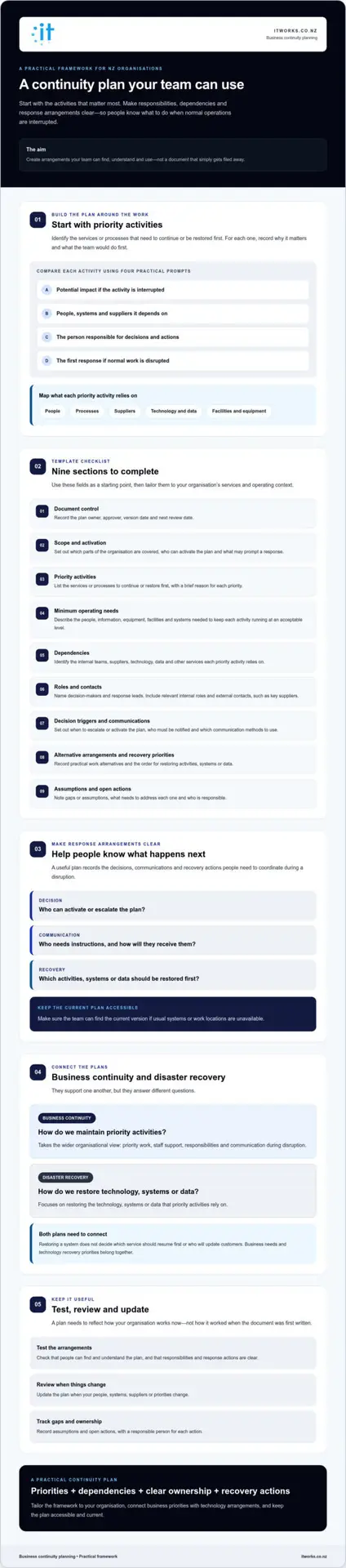
Start by identifying the services that matter most, then map the people, systems and suppliers they depend on. Make ownership of decisions, communications and recovery tasks clear. The goal is a plan your team can find, understand and use, not a document that simply gets filed away.
This guide explains what to include in a practical business continuity plan and how to tailor each section to your organisation. You’ll learn how to set priorities, document response and recovery actions, connect business needs with technology and disaster recovery, and keep the plan current through testing and review.
Key Takeaways
- Use a business continuity plan template NZ organisations can adapt to record essential activities, key contacts and response arrangements.
- Compare priority activities by their potential impact, dependencies, responsible owner and first response to set practical recovery priorities.
- Clarify who can activate the plan, how staff will receive instructions and what actions to take during a disruption.
- Test the arrangements and update them when your people, systems, suppliers or priorities change.
- Connect continuity planning with cybersecurity, cloud services and disaster recovery so your technology arrangements support business priorities.
What is a business continuity plan, and why does your NZ organisation need one?
An unexpected interruption can affect more than one task. Staff may be unable to work, customers may not receive a service, and leaders may need to decide quickly what comes first. A clear plan helps your organisation coordinate its response instead of working out responsibilities as events unfold.
A business continuity plan is a set of documented arrangements to help an organisation maintain or restore its priority activities during a disruption. It records what needs to continue, who is responsible for decisions and actions, how people will communicate, and what alternatives may be available if normal operations are interrupted. Business continuity planning provides a broader overview of the approach and its relationship with disaster recovery.
A business continuity plan template NZ organisations can use is a framework, not a ready-made plan for every workplace. You still need to identify your essential services, people, processes, suppliers and technology dependencies. For example, a service may rely on particular staff, access to a work site, accurate records and an online system. If one of these is unavailable, the plan should help the team decide what to do next.
What should a business continuity plan help your team decide?
The plan should help your team answer practical questions: who can activate the arrangements, who needs to be informed, which activities take priority, and who is responsible for each response task? Reflect your organisation’s actual services and operating context rather than treating every function as equally urgent. Include people and processes as well as technology, so your team can see how work might continue if usual arrangements aren’t available.
How is business continuity different from disaster recovery?
Business continuity takes a wider organisational view. It considers how to maintain priority activities, support staff and communicate with affected people during disruption. Disaster recovery focuses on restoring the technology, systems or data those activities rely on. The plans should connect, but neither replaces the other. Restoring a system, for instance, doesn’t decide which service should resume first or who will update customers. For more detail, read our business continuity and disaster recovery guide.
Keep the framework practical. Start by documenting the decisions your team would need to make, then tailor the prompts to your organisation’s responsibilities and dependencies. This turns a generic template into arrangements people can understand and use.
Business continuity plan template NZ: the sections to complete
Use the framework below as a copy-ready starting point for your business continuity plan template NZ. Add your organisation’s information under each prompt, then adjust the fields to match how your services operate. It’s a planning aid, not a ready-made plan or a downloadable IT Works product.
Begin with a short summary that explains the plan’s purpose and scope, who can activate it, and where to find the current version. Keep the main document accessible if usual systems or work locations are unavailable.
Copy-ready plan fields
- Document control: Record the plan owner, the person or group approving it, the version date and the next review date.
- Scope and activation: Note which parts of the organisation the plan covers, who can activate it and what kinds of interruption may prompt a response.
- Priority activities: List the services or processes that need to continue or be restored first, with a brief reason for each priority.
- Minimum operating needs: Describe the people, information, equipment, facilities and systems needed to keep each activity running at an acceptable level.
- Dependencies: Identify the internal teams, suppliers, technology, data and other services each priority activity relies on.
- Roles and contacts: Name the decision-maker, response leads and relevant internal roles. Add external contacts, such as key suppliers, where needed.
- Decision triggers and communications: Set out when to escalate or activate the plan, who must be notified and which communication methods to use.
- Alternative arrangements and recovery priorities: Record practical work alternatives and the order for restoring activities, systems or data.
- Assumptions and open actions: Note gaps or assumptions, the action needed to address each one, and the person responsible.
Contacts and response arrangements
Use role names as well as individuals’ names, so responsibilities stay clear if someone is unavailable. Check that contact details are current and state how staff can access them if email, shared files or other usual systems can’t be reached. An appropriately controlled offline copy may help. Decide how updates will reach staff, including people working away from their usual workplace.
If responsibilities for technology support need clarifying, see the managed IT support guide for New Zealand organisations. IT Works can also help connect business priorities with technology and recovery arrangements through business continuity planning and disaster recovery.
Tailor the template to your NZ organisation’s priorities
A template becomes useful when it reflects what your organisation does and what could happen if an activity stops. Ask team and process owners which services must continue, who relies on them, and what could be affected if they were unavailable. Consider the impact on staff, customers, service delivery, records and other organisational priorities.
Your continuity plan should reflect your organisation’s essential activities and the people, processes, suppliers and technology they depend on. Priorities vary between organisations and even between teams. A service that can pause briefly in one operating model may need a different response in another.
Use a simple comparison table to make assumptions visible and help decision-makers spot where responsibilities or dependencies need attention:
| Activity | Potential impact | Key dependencies | Responsible owner | Initial response |
|---|---|---|---|---|
| Customer appointments | Services may be delayed | Staff, booking information, communications | Service lead | Contact affected customers and consider an alternative arrangement |
| Order processing | Orders may not be received or fulfilled | Online system, internet access, supplier information | Operations lead | Confirm what is unavailable and use an agreed alternative process if suitable |
Use these examples as prompts, not assumptions about your organisation. The business continuity plan template NZ teams adapt should capture their own activities, impacts, owners and practical first steps.
How can a business impact analysis shape the plan?
A business impact analysis helps you understand what disruption could mean for your activities and which ones need attention first. Talk with each process owner about the people, information, equipment, systems, facilities and suppliers their activity relies on. Ask what would change if a dependency became unavailable, which workarounds are realistic, and what other services might be affected. Use the findings to set recovery priorities that suit your organisation rather than assuming a standard recovery timeframe.
Which New Zealand operating conditions should teams consider?
Discuss scenarios relevant to your operations, such as severe weather, an earthquake, a power or internet interruption, or a cyber incident. You don’t need to predict every event. Instead, test whether responsibilities and alternatives make sense in different circumstances. Consider whether staff can work remotely, how they’ll communicate if usual channels are unavailable, whether suppliers can still provide essential goods or services, and how the team can access the information it needs.
Local hazards and operating conditions vary. Check which scenarios are relevant to your people, sites and supply chain. Before relying on the plan, verify any legal, contractual or sector-specific obligations that apply to your organisation.
How to activate, test and improve your business continuity plan
A plan is useful only if people know when to use it and what to do next. Set out a clear activation path in your business continuity plan template NZ, including who can make the decision and how instructions will reach staff if usual communication channels are unavailable.
Use this sequence as a starting point, then tailor the roles and actions to your organisation:
- Identify the disruption: Confirm what has happened, which activities or people are affected, and what information is still needed.
- Notify the decision-maker: Contact the person authorised to assess the situation. Name a deputy or alternative contact route in case they can’t be reached.
- Activate the arrangements: The authorised person decides whether to activate the plan and which parts apply. Record who made the decision and when.
- Communicate instructions: Tell staff what to do, who is leading the response and where to get updates. Identify an alternative channel if normal systems are unavailable.
- Review and adjust: Check whether the response is working, update instructions as circumstances change, and record decisions and follow-up actions.
For cyber incident scenarios, consider how your team will coordinate business priorities, communications and technology recovery. The cybersecurity resilience guide for New Zealand small businesses offers related guidance on building resilience and confidence.
How can you test the plan without disrupting normal work?
Start with a discussion-based tabletop exercise. Present a plausible scenario, such as a temporary loss of internet access, and ask decision-makers to talk through their roles and next steps. Check whether the right people can be contacted, staff can access essential information, and decision paths and communication methods are clear.
Keep the exercise focused on learning, not catching people out. Record any confusion, missing information or impractical steps. Assign each improvement to a named owner, track its status and update the plan when changes are completed.
When should the plan be reviewed?
Name a plan owner and set clear review triggers. Revisit the plan after an exercise, a significant change to services, staff, suppliers or technology, or an incident that exposes a gap. Choose a review frequency that fits your operating context instead of assuming one schedule suits every organisation. If your sector has specific review expectations, confirm them with an appropriate adviser.
Make the continuity plan part of how your organisation works
A continuity plan needs more than an approving signature. It also needs visible support from leaders, clear ownership and enough staff awareness that people know where to find guidance when usual arrangements change. Make it part of operational decision-making, rather than a document separate from everyday work.
Who should own and contribute to the plan?
Set clear responsibilities. An executive sponsor can endorse priorities and help resolve decisions that affect multiple teams. A plan coordinator can maintain the document and organise reviews, while owners of priority activities keep their sections accurate. Include operational, people, communications and technology stakeholders when their responsibilities affect continuity.
Be specific about escalation and delegated authority. Note who can make a time-sensitive decision if the usual decision-maker is unavailable, who informs staff, and who approves a change to the response. Share the plan’s location and explain each person’s role. Staff don’t need to memorise every detail, but they should know where to find current instructions and whom to contact.
How can technology support continuity arrangements?
Map the technology that supports essential activities, including key systems, information, access requirements and the people responsible for recovery. Consider how staff will securely access the tools and data they need if they’re working from another location or normal access is disrupted. Link recovery responsibilities to business priorities, so technology restoration supports the activities your organisation needs to resume.
Backups are an important part of recovery, but they don’t keep an organisation operating by themselves. Consider who can access restored information, which other dependencies must be available, and how staff will continue or restart work. Connect these arrangements with your cybersecurity, cloud services and disaster recovery planning.
Review the business continuity plan template NZ teams have adapted whenever roles, systems or dependencies change. If your internal team needs help mapping technology dependencies or clarifying recovery responsibilities, external advice can help connect technical arrangements with business priorities. IT Works works with organisations on business continuity planning and disaster recovery as a New Zealand-based strategic technology partner.
Turn your continuity plan into a practical working tool
A useful business continuity plan links priority activities to clear responsibilities, communication steps and realistic recovery arrangements. The business continuity plan template NZ organisations adapt should reflect their own people, processes, suppliers and technology, rather than remain a generic document. Keep it accessible, assign owners and review it when exercises, incidents or operational changes reveal a gap.
Continuity planning is a business-led responsibility, supported by technology arrangements that help essential work continue or resume. IT Works provides Business Continuity Planning & Disaster Recovery, combining strategic guidance with practical technology support to help organisations connect business priorities with recovery responsibilities.
Start with the activities that matter most, then build and improve the plan with the people who understand how your organisation operates. Clear preparation can help your team respond with greater confidence.
Frequently Asked Questions
What should a business continuity plan template include?
A business continuity plan template should prompt you to record priority activities, their dependencies, response responsibilities and communication arrangements. Include document ownership and approval details, the plan’s scope, who can activate it, and where staff can find the current version. Add practical alternatives for continuing work, recovery priorities, key contacts and unresolved gaps with named owners. Adapt each prompt to your organisation so the plan reflects how its services actually operate.
How do I write a business continuity plan for a small business in NZ?
Start with the activities your small business needs to maintain, then ask who relies on them and what people, suppliers, information and systems they depend on. A business continuity plan template NZ businesses can adapt offers a useful structure, but the details need to reflect your own operating context. Assign owners, document first actions and communication methods, and decide who can activate the plan. Walk through a realistic scenario with the people responsible before relying on it.
Is a business continuity plan the same as a disaster recovery plan?
No. A business continuity plan focuses on maintaining or restoring priority organisational activities during disruption. A disaster recovery plan focuses on restoring the technology, systems or data that support those activities. The plans are connected, but one doesn’t replace the other. Recovering a system, for example, won’t determine which service should resume first, who makes that decision or how staff and customers will be updated. Make sure business priorities and technology recovery arrangements work together.
How often should a business continuity plan be reviewed?
Set a review trigger and name someone responsible for keeping the plan current, rather than assuming one schedule suits every organisation. Review it after an exercise, an incident that reveals a gap, or a significant change to services, staff, suppliers or technology. Check that contacts, responsibilities and access instructions remain accurate. If your organisation has sector-specific review expectations, confirm them with an appropriate adviser instead of relying on a general rule.
What is a business impact analysis, and do I need one?
A business impact analysis helps you understand how disruption could affect activities and which ones need attention first. Ask process owners what people, information, systems, equipment and suppliers each priority activity depends on, then consider the effects if a dependency becomes unavailable. This helps make recovery priorities relevant to your organisation. The level of detail can suit your needs, but even a simple activity-and-dependency review can reveal assumptions the plan should address.
How can we test a business continuity plan?
Begin with a discussion-based exercise, such as asking decision-makers how they’d respond to a temporary loss of internet access. Talk through who makes decisions, how staff receive instructions, where current contacts are available and what alternatives exist. Record confusing steps, missing information or unclear responsibilities. Assign follow-up actions to named owners and update the plan when changes are made. A focused discussion can identify practical improvements without starting with a complex test.
Does a business continuity plan need to cover cyber incidents?
Include cyber incidents if they could interrupt your organisation’s priority activities or access to essential systems and information. Decide who assesses the situation, who coordinates the response, how staff will receive instructions and what work may need to continue or pause. Connect these steps with your cybersecurity and technology recovery arrangements, including who is responsible for restoring affected systems or data. Keep the focus on clear roles, coordinated decisions and supporting the organisation’s recovery.