
If your internal IT person is always busy, you might assume your technology is in good hands, but what if their constant activity is actually a mask for mounting technical debt? Many New Zealand business leaders value the perceived control of having a technician just down the hall. It feels reassuring to have a familiar face available for immediate troubleshooting, yet this comfort often comes at a price that doesn’t appear on a standard profit and loss statement. The hidden costs of in-house IT management can quietly erode your margins and stall your long-term strategy.
We understand that you want a predictable budget and a team that focuses on growth rather than fixing printers. This guide will help you discover the true financial and strategic impact of internal management, from the rising 3.5% KiwiSaver contributions and 1.75% ACC levies to the significant cost of key staff being distracted by technical issues. You’ll learn how to recognise the obscured expenses hindering your progress and how to build a technology roadmap that supports genuine business success. We’ll examine the gap between basic support and the high-level security and AI adoption required to stay competitive in the current market.
Key Takeaways
- Learn how to calculate the fully burdened labour cost of internal staff, moving beyond base salaries to include KiwiSaver, ACC levies, and recruitment overheads.
- Identify the operational risks of a “single point of failure” and how to protect your business continuity during the “holiday gap” when key staff are away.
- Recognise the hidden costs of in-house IT management that stem from a reactive “break-fix” culture rather than proactive system monitoring.
- Bridge the strategic gap between your current technology and your growth goals to ensure innovation doesn’t stall due to slow response times.
- Discover how a technology partnership provides access to a wider pool of specialist expertise, helping you build a clear roadmap for future success.
Beyond the Basic Salary: Calculating the Full Employee Overhead
For many New Zealand business owners, hiring an internal IT specialist seems like a clear financial commitment. You look at the gross salary and assume that’s the figure to budget for. Base salary is just the start. Focusing solely on the base pay is a financial trap that ignores the hidden costs of in-house IT management. The reality of employment in New Zealand involves several mandatory overheads that quickly inflate the true expense of a full-time staff member.
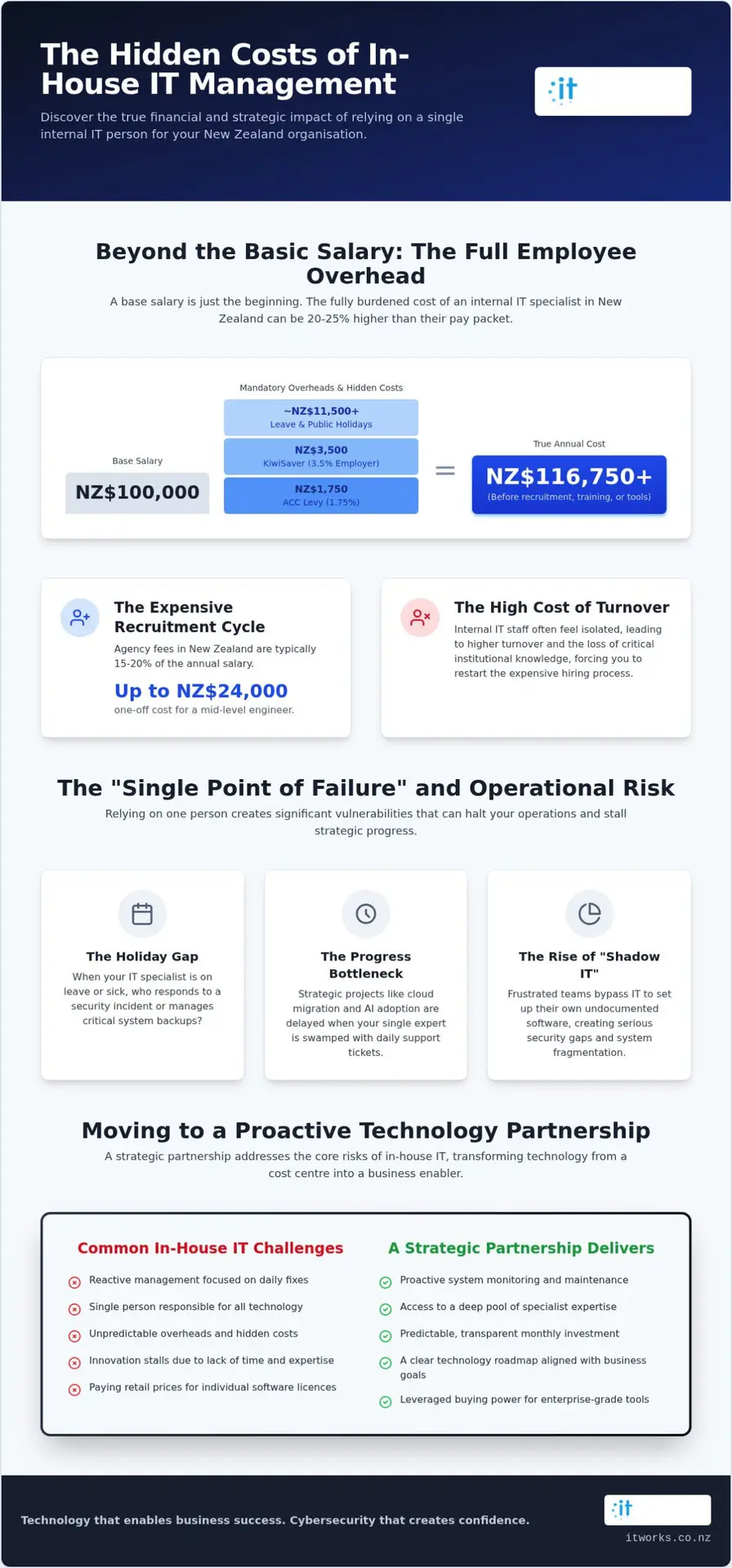
To understand the financial reality, you need to look at the Total Cost of Ownership (TCO) for your human resources. As of April 2026, the minimum compulsory employer contribution for KiwiSaver is 3.5%. Add to this the ACC Earners’ Levy rate of 1.75% and the costs of annual leave, sick pay, and public holidays. For a Systems Engineer earning a typical salary of NZ$100,000, these “fully burdened” costs can easily add an extra 20% to 25% to your annual expenditure before they even touch a keyboard. Beyond the statutory costs, you must consider office space, hardware, and the management time required to oversee a technical role. A managing director often spends hours each week acting as a de facto IT manager, which is a significant drain on high-value leadership time.
The Recruitment and Retention Cycle
Recruiting in a competitive local market is expensive. Recruitment agency fees in New Zealand typically range from 15% to 20% of a candidate’s annual salary. For a mid-level engineer, this is a one-off hit of up to NZ$24,000 just to get them through the door. There’s also the risk of turnover. Internal IT staff often feel isolated without a peer group of technicians to learn from. This lack of a professional community is one of the primary hidden costs of in-house IT management, as it leads to higher turnover and the subsequent cost of replacing specialised skills. When they leave, they take institutional knowledge with them, forcing you to restart the expensive hiring cycle. It isn’t sustainable.
Training, Tools, and Subscriptions
Managing technology requires more than just a person; it requires a professional “IT Stack”. This includes remote monitoring tools, security licences, and helpdesk software. Most internal teams pay retail prices for these subscriptions. In contrast, a strategic partner often provides these as part of a managed service, leveraging their scale to reduce individual costs. You also need to account for the time spent on professional development. Technology moves fast. If your staff aren’t spending hours each month training on new Microsoft 365 features or security protocols, your organisation is falling behind. This training time is a direct cost to your productivity, yet it is essential to ensure your systems remain secure and efficient.
The ‘Single Point of Failure’ and Operational Risk
Relying on a single internal IT person is a gamble many New Zealand organisations take without realising the stakes. While it feels efficient to have a dedicated staff member, this setup creates a “single point of failure”. If that individual is unavailable, your entire operation is at risk. This fragility is often masked by the convenience of having someone on-site, but the underlying vulnerability remains a significant threat to business continuity.
Consider the “Holiday Gap”. When your IT lead takes a well-deserved break or falls ill, who manages your backups or responds to a security incident? This lack of redundancy is one of the most significant hidden costs of in-house IT management. It forces business owners to choose between interrupting an employee’s leave or leaving the organisation vulnerable. Maintaining robust cybersecurity for small business requires constant vigilance that a single, busy person often struggles to provide alongside their daily duties.
Internal staff often become a bottleneck for progress. When they are swamped with helpdesk tickets, strategic projects like cloud migration or AI enablement are pushed to the bottom of the pile. This delay is a lost opportunity for growth. It often leads to “shadow IT”, where frustrated departments bypass the IT lead to set up their own undocumented software. This fragmentation creates security gaps and makes it nearly impossible to maintain a cohesive technology roadmap. Discussing your needs with a team providing Managed IT Services can help remove these bottlenecks.
The Burnout Factor: Wearing Too Many Hats
Your IT person might be a great generalist, but they can’t be an expert in everything. Expecting one person to handle high-level strategy while fixing a paper jam is a recipe for fatigue. Tired employees make mistakes. They might miss a critical security patch or misconfigure a firewall. This burnout doesn’t just affect their health; it impacts your organisational resilience. A specialised team provides a depth of knowledge that a single generalist simply cannot match, ensuring that complex systems are managed with precision rather than haste.
Knowledge Silos and Documentation Gaps
“It’s all in my head” is a dangerous phrase for any business. When a single person manages your infrastructure, knowledge silos naturally form. Documentation is often the first thing to be sacrificed when someone is busy. This lack of transparency leads to several issues:
- Increased time to resolve recurring technical problems.
- Difficulty for new staff or temporary cover to understand the system.
- A total loss of institutional knowledge if the IT person leaves the company.
Knowledge silos create a dependency that makes it difficult to scale. Professional partners prioritise transparent processes and clear accountability, ensuring your infrastructure is documented and manageable by the whole team. This shift is essential for reducing the hidden costs of in-house IT management and building a more stable future.
Security Gaps and the True Cost of Reactive Management
Building a resilient organisation starts with a shift in mindset. Instead of viewing security as a series of defensive barriers designed to keep threats out, consider it a foundation for organisational confidence. When your team knows their data is secure and their systems are resilient, they can focus on innovation without hesitation. A reactive approach, often called “break-fix”, is one of the primary hidden costs of in-house IT management because it prioritises repair over prevention. This model essentially waits for a failure to occur before taking action, which is a high-risk strategy in a landscape where threats are constant.
The financial impact of a reactive culture extends far beyond immediate repair bills. Insurance providers now scrutinise an organisation’s security posture before setting premiums. If your internal team lacks the capacity for proactive monitoring or fails to implement modern standards, you may find yourself paying significantly higher rates or being denied coverage altogether. A layered security approach reduces this risk by integrating protection into your daily workflows. This ensures safety doesn’t come at the expense of operational speed, allowing your staff to remain productive while staying protected. These hidden costs of poor security posture can quietly drain your budget if not addressed through a strategic partnership.
The Compliance and Governance Burden
Internal teams frequently struggle to keep pace with evolving data privacy expectations. In New Zealand, the Privacy Act 2020 requires mandatory breach notifications. While the fines for specific offences are capped at NZ$10,000, the reputational damage and loss of trust can be devastating. This is particularly true for the non-profit sector, where donor confidence is everything. With 5,995 cyber incidents reported to the NCSC in the 2024/2025 period, the risk is real. Implementing a structured cyber security for small business NZ strategy helps you meet these governance requirements while building long-term resilience.
Proactive Monitoring vs. Emergency Response
The cost of a managed security subscription is predictable and manageable. In contrast, the expense of a one-off incident response can be astronomical. With the average time to identify and contain a data breach now standing at 247 days globally, the hidden costs of in-house IT management often manifest as prolonged downtime and data loss. Investing in robust backup and disaster recovery NZ ensures that your business continuity is protected even when the unexpected happens. “Set and forget” is no longer a viable strategy. Modern threats require active, continuous oversight to maintain a secure environment. This proactive stance is what separates a thriving organisation from one that is constantly in crisis mode.
Strategic Opportunity Costs: Why Innovation Often Stalls
The “Strategic Gap” represents the distance between your current technical capabilities and where your organisation needs to be to remain competitive. While research shows that 82% of New Zealand businesses plan to increase their technology investment in 2026, many will find their ambitions thwarted by the hidden costs of in-house IT management. When your internal resources are consumed by the daily grind of “keeping the lights on”, there’s simply no room for the high-level thinking required to move the needle. Technology should be a strategic asset that drives efficiency; it shouldn’t be a constant drain on your leadership’s energy.
One of the most significant missed opportunities is the adoption of AI automation solutions New Zealand. Implementing these tools requires dedicated time for research, testing, and governance. These are luxuries that a busy internal technician doesn’t possess. Slow response times for new project launches don’t just delay progress; they hand an advantage to competitors who are already moving toward modernised, automated workflows. This delay is a quiet but heavy cost that never appears on a balance sheet.
Maintenance vs. Growth
Many internal teams are trapped in a cycle of maintaining legacy systems. This technical debt creates a ceiling for your organisation’s growth and negatively impacts staff morale. Employees struggle with outdated tools while the rest of the market moves forward, leading to frustration and lost productivity. Transitioning to a managed IT support services model shifts the focus from reactive maintenance to proactive growth initiatives. This allows your team to leverage modern systems that actually support their daily work rather than hindering it.
The Value of a Technology Roadmap
A clear 12-to-24-month technology roadmap is essential for any organisation aiming for sustainable success. This plan aligns your technical investments with your broader business goals, ensuring every dollar spent serves a clear purpose. It replaces the stress of “emergency spend” cycles with predictable technology budgeting. An external partner acts as a strategic ally, providing the unbiased advice needed to make informed decisions. This guidance helps you avoid the hidden costs of in-house IT management by identifying upcoming requirements before they become expensive crises.
Moving Towards a Proactive Technology Partnership
Transitioning from an internal model to a managed partnership is an evolution, not merely a cost-cutting exercise. While the primary goal is often to mitigate the hidden costs of in-house IT management, the true value lies in the strategic lift it provides your organisation. By shifting the burden of daily maintenance to a dedicated team, your internal leadership can return their focus to high-value tasks that drive the business forward. This creates a “Strategic + Operational” blend where technology acts as a catalyst for growth rather than a constant administrative hurdle.
A partnership model provides immediate access to a wider pool of specialist expertise that is difficult to maintain within a single internal role. Instead of relying on one person’s knowledge, you gain the collective experience of a team that handles diverse technical challenges every day. This depth of skill is supported by a fixed-fee model, which is a significant advantage for financial predictability and board reporting. You no longer have to worry about the “emergency spend” cycles discussed earlier. Instead, you have a clear, monthly investment that aligns with your long-term technology roadmap.
Augmenting vs. Replacing Internal IT
It’s a common misconception that moving to a managed provider means replacing your current staff. In many cases, we act as an extension of your team, supporting existing IT managers with complex project delivery and high-level escalation. This shared responsibility ensures your systems have 24/7 coverage and redundancy, effectively closing the “Holiday Gap” that puts many organisations at risk. Choosing a local, New Zealand-based team is critical for this trust. Cultural alignment and a shared understanding of the local business environment ensure that the support you receive is relevant, approachable, and grounded in practical reality.
Next Steps for Your Organisation
If you suspect the hidden costs of in-house IT management are hindering your progress, the first step is to conduct a simple IT Cost Audit. Look beyond the base salary of your staff and calculate the total investment in tools, training, recruitment, and the time your executive team spends on technical troubleshooting. This clarity allows you to make an informed decision based on business outcomes rather than just technical features. Selecting a partner who is outcome-focused, rather than product-led, ensures your technology strategy is always aligned with your organisational goals.
The journey toward a more resilient and productive future begins with a conversation. Talk to IT Works about your technology strategy to find a path that supports your growth and replaces technical stress with calm reliability.
Building Your Path to Strategic Growth
Recognising the hidden costs of in-house IT management is the first step toward reclaiming your organisation’s focus. By moving beyond the simple calculation of salaries and hardware, you can address the strategic gaps that often stall innovation and leave your team vulnerable. A shift toward a proactive partnership ensures that your technology serves your business goals rather than creating a constant cycle of technical debt. This transition replaces the stress of reactive troubleshooting with a sense of calm reliability.
Since 2004, our 100% New Zealand-based team has acted as a strategic ally for organisations looking to build resilience and confidence. We believe that technology should be a driver of success, providing a clear roadmap that supports your specific business outcomes. This approach allows your leadership to focus on high-value initiatives while we ensure your systems remain secure, efficient, and ready for future developments.
Your organisation deserves a technology environment that supports growth and provides genuine peace of mind. We look forward to helping you navigate this journey with practical, outcome-focused guidance that leads to better business results.
Frequently Asked Questions
What are the most common hidden costs of internal IT?
Common hidden costs include recruitment fees, which can reach 20% of a salary, and mandatory employer contributions like the 3.5% KiwiSaver rate and 1.75% ACC levy. You should also account for the management time spent by non-technical leaders overseeing IT staff. These hidden costs of in-house IT management often go unnoticed until a full audit is performed. Professional development and retail-priced software licences further inflate the true expense of internal management.
Is managed IT support more expensive than hiring an employee?
Managed IT support is often more cost-effective when you consider the total cost of ownership for an employee. A single salary doesn’t include office space, equipment, or the cost of technical tools required for the role. With a managed service, you gain access to a full team of specialists for a predictable fee. This removes the financial burden of recruitment and training while providing a wider range of skills than a single individual could offer.
How does a managed service provider help with budgeting?
A managed service provider helps with budgeting by moving your technology spend from an unpredictable capital expense to a steady operational expense. Instead of facing “emergency spend” cycles when hardware fails, you pay a fixed monthly fee that covers proactive maintenance and support. This model allows for more accurate board reporting and financial planning. It ensures that your technology costs remain consistent, even as your organisation scales or adopts new tools like AI.
Can we keep our internal IT person and still use a managed service?
You can certainly keep your internal IT person while partnering with a managed service provider. This co-managed approach allows your internal lead to focus on high-value, business-specific projects while we handle routine maintenance and helpdesk support. We act as an extension of your team, providing escalation support for complex issues and ensuring coverage during holidays. This partnership reduces the pressure on your staff and prevents them from becoming overwhelmed by daily troubleshooting tasks.
What is the risk of a “single point of failure” in IT?
A single point of failure occurs when your entire technology infrastructure depends on the knowledge and availability of one person. If that individual is on holiday, ill, or leaves the organisation, your business continuity is at risk. This vulnerability is one of the most significant hidden costs of in-house IT management. Relying on a team-based model provides the redundancy needed to ensure your systems remain operational and secure at all times, preventing costly downtime and disruption.
How does outsourcing IT improve our cybersecurity?
Outsourcing IT improves your cybersecurity by providing access to a layered defence strategy that is difficult for a single person to maintain. A dedicated partner provides continuous monitoring, endpoint protection, and identity management to build organisational resilience. This proactive approach identifies vulnerabilities before they are exploited, reducing the risk of a breach. It replaces the reactive “break-fix” mindset with a focus on confidence and long-term security posture without creating unnecessary operational friction for your staff.
What should be included in a technology roadmap?
A technology roadmap should include a 12-to-24-month plan that aligns your digital systems with your business objectives. It outlines upcoming infrastructure upgrades, security improvements, and plans for AI enablement or cloud migrations. The roadmap provides a clear timeline for investment, helping you avoid unexpected costs and ensuring that every technical decision supports your growth. It serves as a strategic guide that keeps your organisation future-ready while replacing the stress of technical management with calm reliability.
Why is a New Zealand-based support team important?
A New Zealand-based support team is important for cultural alignment and building a relationship based on trust. Local experts understand the specific regulatory environment, such as the Privacy Act 2020, and the unique challenges faced by organisations in our region. This shared context ensures that the advice you receive is practical and relevant. Dealing with a local partner also means your support is delivered during your business hours by people who understand your specific community and business needs.