
What if the most complex part of your technology stack became the most predictable foundation for your growth? Many New Zealand business leaders find that the initial promise of the cloud has been replaced by the stress of fluctuating monthly bills and the weight of maintaining strict data sovereignty. Professional cloud infrastructure management NZ wide is no longer a technical luxury. It’s a strategic necessity for local organisations that need to balance high performance with the practical requirements of the Privacy Act 2020.
We recognise that your internal IT team is likely stretched thin, balancing daily operations while trying to navigate the arrival of local hyperscale data centres. It’s difficult to feel confident in your cybersecurity posture when you’re constantly reacting to new complexities. This guide explains how to regain control over your technology costs and build a scalable environment that supports your long-term vision. We will explore the essentials of sovereign data governance, cost optimisation, and strategic alignment, helping you turn your cloud infrastructure into a calm, reliable partner for your business success.
Key Takeaways
- Understand how transitioning from physical servers to scalable virtual environments allows your organisation to remain agile and responsive to market changes.
- Discover how the four pillars of security, cost optimisation, performance, and compliance form the foundation of effective cloud infrastructure management NZ wide.
- Learn why a strategic partnership model reduces long-term costs and prevents recurring technical issues compared to traditional, reactive support.
- Gain clarity on the NZ Privacy Act 2020 and how data sovereignty ensures you maintain control over where your sensitive information is stored.
- See how a structured technology roadmap aligns your cloud environment with your specific business objectives to support sustainable organisational growth.
Understanding Cloud Infrastructure Management for NZ Organisations
Traditionally, managing IT meant looking after a physical server room filled with noisy hardware and tangled cables. Today, that responsibility has shifted to the continuous oversight of virtual resources. Effective cloud management involves more than just keeping the lights on; it’s a strategic discipline that ensures your digital environment remains secure, cost-effective, and fully aligned with your business goals. For local organisations, professional cloud infrastructure management NZ wide provides the stability needed to grow without the constant worry of technical debt.
The move from physical servers to scalable environments allows you to pay for exactly what you use. However, this flexibility requires a local perspective on governance. New Zealand businesses must navigate specific regulatory requirements, such as the Privacy Act 2020, which dictates how personal information is handled and stored. We view cloud management as a tool for resilience. It’s about creating a system where technology actively supports your productivity rather than acting as a bottleneck to your daily operations.
The Core Components of a Cloud Environment
A modern cloud stack is typically composed of three distinct layers. Infrastructure as a Service (IaaS) provides the fundamental building blocks, like virtual servers and storage. Platform as a Service (PaaS) offers the tools and frameworks your team needs to build and deploy applications. Finally, Software as a Service (SaaS) delivers the finished products your staff use every day. These components must work together in a unified system to support seamless collaboration. Integrating Microsoft 365 management New Zealand into your broader strategy ensures that your team remains productive while your data stays secure within a familiar ecosystem.
Why ‘Set and Forget’ Fails in the Cloud
There is a common misconception that the cloud manages itself once the initial migration is complete. In reality, an unmanaged environment can quickly lead to ‘cloud sprawl’. This occurs when unused or redundant resources are left running, leading to wasted budget and unnecessary security risks. If you aren’t actively monitoring your subscriptions, you might find your monthly NZ$ billing becomes unpredictable and inflated.
Proactive monitoring is the solution to this complexity. Instead of waiting for a system to crash or a bill to skyrocket, a managed approach identifies potential disruptions before they occur. We focus on right-sizing your resources to match your actual demand. This ensures your infrastructure is lean, efficient, and ready to scale when your business reaches its next milestone. By treating your cloud environment as a living system, you replace reactive stress with a composed, strategic presence. This is particularly important when managing complex data ecosystems; for example, global consultancies like Kagool specialise in optimising Microsoft and Databricks environments to ensure they remain high-performing as your needs evolve.
The Four Pillars of Effective Cloud Management
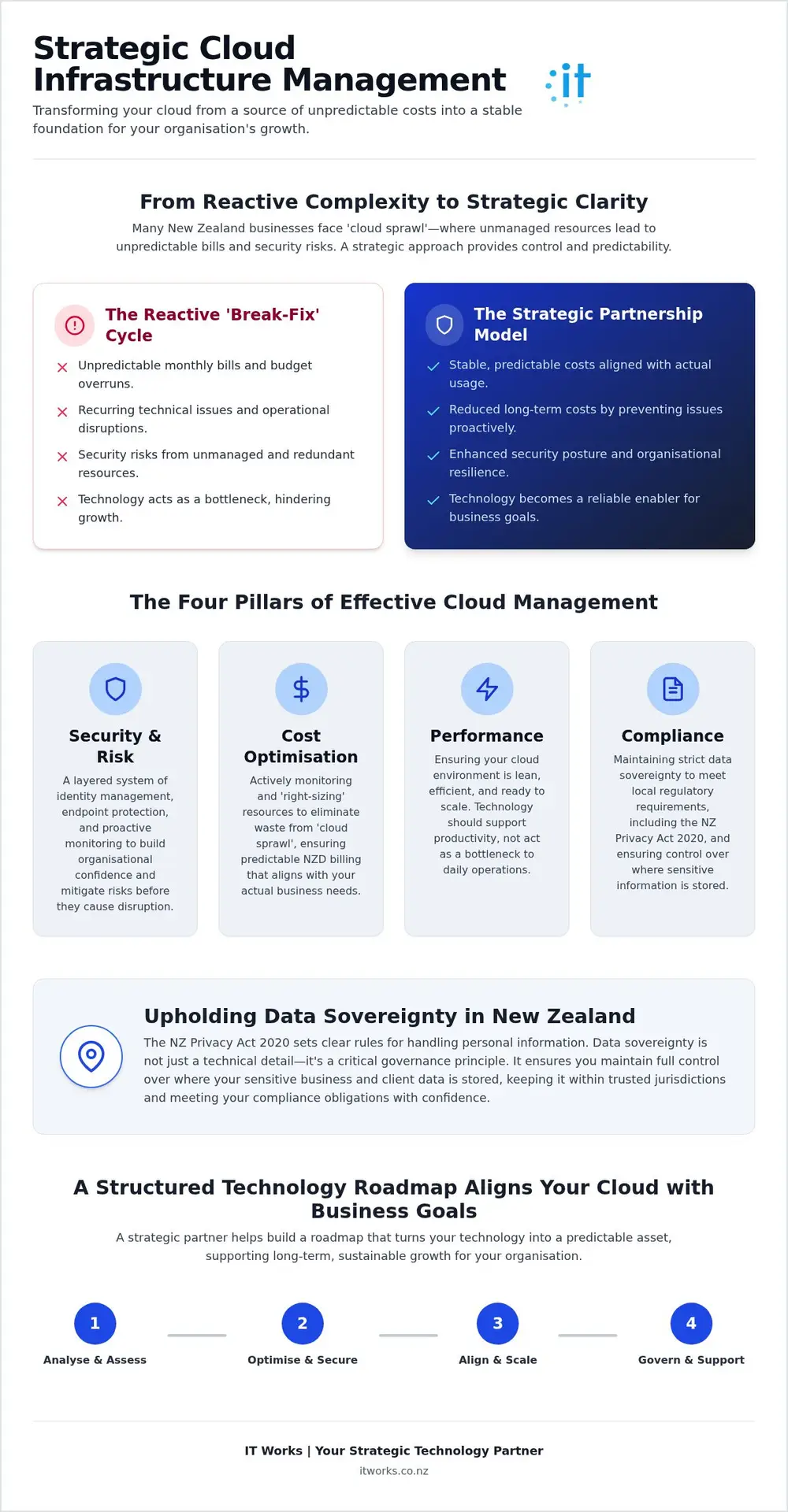
Building a resilient organisation requires more than just adopting new technology. It requires a structured framework that ensures every virtual resource serves a specific purpose. We define this through four key areas: security, cost optimisation, performance, and compliance. Together, these elements form a stable foundation for cloud infrastructure management NZ leaders can rely on. By focusing on these pillars, you move away from a product-led approach where you’re simply collecting software licenses, and instead adopt a strategic model that prioritises business outcomes.
The maturity of this approach is reflected in the New Zealand government’s Cloud First policy, which encourages organisations to look at the long-term strategic value of cloud services over traditional on-premise systems. When these pillars are integrated into your technology roadmap, they replace the typical stress of technical management with a sense of calm reliability. This alignment ensures that your infrastructure doesn’t just exist; it actively enables your success.
Security and Risk Mitigation
Security in the cloud isn’t a single barrier. It’s a layered system of identity management, endpoint protection, and email security. Effective management builds confidence by showing you exactly where your risks lie and how they are being mitigated. This proactive stance is a core part of cyber security for small business NZ, focusing on risk reduction and organisational resilience. We avoid fear-based tactics, choosing instead to provide the clarity you need to make informed decisions about your data protection.
Cost Optimisation and Predictability
One of the biggest frustrations for managing directors is the ‘zombie’ resource. These are virtual machines or storage volumes that were spun up for a temporary project and then forgotten, continuing to inflate your monthly NZ$ bills long after they’ve served their purpose. Rightsizing your environment means ensuring each instance matches your actual workload requirements. This level of oversight provides the predictability you need for accurate budgeting. If you want to refine your spending, you can talk to IT Works about your technology strategy to identify where efficiencies can be made.
Performance and Scalability
As your organisation grows, your systems must remain responsive. Proactive cloud infrastructure management NZ wide uses automated scaling to handle peak periods without manual intervention. This ensures your staff aren’t hindered by slow access or unreliable systems during busy times. When your infrastructure scales seamlessly, productivity remains high, and your team can focus on their core roles rather than fighting with technical bottlenecks. This stability is essential for maintaining a modern, professional presence in a competitive market.
Reactive vs. Strategic: Choosing the Right Partnership Model
Many organisations still view IT support through the lens of a “break-fix” model. You wait for a system to fail, call for help, and pay to get back to a baseline. While this approach might seem simple, it often leads to higher long-term costs and a cycle of recurring technical issues that frustrate your team. Strategic cloud infrastructure management NZ businesses rely on moves away from this reactive energy. Instead of being a distant service provider, a strategic partner acts as an extension of your executive team, providing the guidance needed to make informed technology decisions that support your broader goals.
This partnership model replaces the frantic pace of reactive support with a composed, forward-thinking presence. By focusing on alignment rather than just maintenance, your technology partner helps you avoid the hidden costs of outdated systems. You gain a strategic ally who is invested in your journey, ensuring that your infrastructure remains a functional asset rather than a growing liability. This shift in perspective allows you to view technology as a driver of success rather than a necessary expense.
The Impact of Proactive Management on Productivity
Proactive management is a tool for operational continuity that identifies potential bottlenecks before they disrupt your workflow. When you reduce downtime, you aren’t just saving on repair bills; you are protecting your bottom line. Every hour your team spends waiting for a system to respond is an hour of lost productivity and wasted wages. We use regular technology roadmaps to prevent the accumulation of technical debt, ensuring your systems evolve alongside your organisation. This structured approach allows your staff to focus on their core roles, confident that their tools will work as intended every morning. By staying ahead of updates and security patches, you create a stable environment where your team can thrive.
The Importance of Local Accountability
New Zealand organisations value partners who understand the local business environment and its specific regulatory challenges. Working with a local team provides a level of accountability that a faceless global helpdesk cannot offer. You deserve transparent processes and clear communication from people who are grounded in the same geographic context as your business. This local expertise is particularly important when navigating the complexities of data sovereignty and jurisdictional risk. Knowing exactly where your data lives and who is responsible for it is a fundamental part of modern governance.
A local partner understands that your data is a taonga and must be treated with respect and care. By choosing a partner with a local presence, you ensure that your cloud governance is handled by experts who understand the nuances of the NZ Privacy Act 2020. This proximity fosters a sense of community and shared identity, turning a technical service into a collaborative partnership focused on sustainable growth. It’s about having a steady guide who is as invested in your results as you are.
Governance, Compliance, and Data Sovereignty in NZ
For many New Zealand organisations, the question of where data lives has moved from a technical detail to a boardroom priority. Data sovereignty isn’t just about physical location; it’s about jurisdictional control and ensuring your information remains subject to New Zealand law. With the recent launch of local hyperscale regions by major providers, professional cloud infrastructure management NZ now includes the strategic oversight of these onshore resources. This ensures you honour the principles of the Privacy Act 2020 while maintaining the performance benefits of global platforms.
We view data as a taonga that requires careful guardianship. For non-profits and businesses with strict data handling requirements, this means moving beyond simple storage to a model of active governance. You need to know who can access your information, how it is protected from foreign legislation like the US CLOUD Act, and how quickly it can be recovered. This level of control creates the confidence needed to innovate without compromising your ethical or legal obligations.
Meeting New Zealand Privacy Standards
Compliance isn’t a one-time checkbox. It’s a continuous process of managing how personal information is collected, stored, and accessed. Under the Privacy Act 2020, your organisation remains accountable for data even when it’s held by a third-party cloud provider. Managed services provide the necessary layers of encryption and multi-factor authentication to protect this information. If you are planning a Microsoft 365 migration NZ based, it’s the perfect opportunity to audit your permissions and ensure your configuration meets these strict local standards from day one.
Building a Cloud Governance Framework
A robust framework replaces uncertainty with a structured set of rules that guide your technology use. This doesn’t have to be a rigid or slowing process; instead, it provides the guardrails that allow your team to move faster with less risk. We recommend a three-step approach to establishing this foundation:
- Step 1: Define roles and responsibilities. Clearly map out who has the authority to access sensitive data and who can make changes to your cloud environment.
- Step 2: Establish procurement policies. Create clear guidelines for how new cloud resources are requested and approved to prevent ‘shadow IT’ and unmanaged spending.
- Step 3: Implement continuous auditing. Use automated reporting to give your executive team visibility into your compliance status and security posture at any time.
This structured rhythm builds trust throughout the organisation. When your board can see that data is being managed according to a clear strategy, technology stops being a source of anxiety and becomes a reliable pillar of your business resilience. You move from reactive fixing to a composed, strategic presence that reflects the professional standards of your organisation.
Next Steps: Building Your Cloud Roadmap
Transitioning from a reactive setup to a strategic cloud posture is a defining moment for any organisation. It marks the shift from seeing technology as a hurdle to seeing it as a catalyst for growth. A structured approach to cloud infrastructure management NZ ensures that your virtual environment isn’t just a collection of tools, but a cohesive system designed for resilience. By moving away from reactive habits, you create the space needed for your executive team to focus on high-level strategy rather than technical troubleshooting.
A technology roadmap is the bridge between your current operations and your future success. It provides a clear, documented path that aligns every virtual resource with your business goals. This alignment replaces the typical stress of technical management with a sense of calm reliability. When your infrastructure is purposeful, it supports productivity, protects your data, and scales alongside your ambitions without the risk of unpredictable costs.
Assessing Your Current Cloud Maturity
Is your current environment actually supporting your long-term vision? Many leaders find that their technology has grown organically, leading to a complex web of services that are difficult to manage. To identify the gap between your current operations and your desired outcomes, consider asking your team these questions:
- Does our cloud environment automatically scale to meet demand without manual intervention?
- Can we clearly demonstrate our compliance with the NZ Privacy Act 2020?
- Are we still paying for resources from projects that have already finished?
- Is our security posture built on organisational resilience or just reactive fixing?
Focusing on long-term value rather than short-term budget fixes allows you to build a foundation that lasts. If the answers to these questions are unclear, it’s a sign that your cloud maturity could be improved through more deliberate oversight; to help you navigate this transition, check out IT Cloud Consulting and their guide to strategic cloud adoption. Assessing these gaps is the first step toward regaining control over your technology stack.
Partnering for Success with IT Works
IT Works provides the strategic and operational blend that New Zealand organisations need to thrive. We aren’t a distant service provider; we’re a local team of specialists who act as an extension of your own executive team. Our approach is built on guidance and active collaboration, ensuring your technology roadmap is functional and sustainable in the real world. We replace technical jargon with clear, business-focused outcomes that drive success.
Your journey toward a more resilient cloud environment starts with a conversation. We can help you audit your current setup, identify efficiencies, and build a strategy that creates confidence throughout your organisation. Talk to IT Works about your technology strategy to ensure your cloud infrastructure is a reliable partner in your growth.
Securing a Resilient Future for Your Organisation
Effective technology management is the difference between an organisation that merely survives and one that consistently thrives. By moving away from reactive habits and embracing a structured technology roadmap, you ensure your virtual environment remains a stable foundation for growth. Our New Zealand-based team of experienced advisors focuses on business outcomes rather than technical features, providing the calm reliability you need to lead with confidence.
Professional cloud infrastructure management NZ wide allows you to master the complexities of data sovereignty while maintaining peak performance. You gain the peace of mind that comes from robust cybersecurity and a predictable budgeting model. This strategic approach transforms your IT from a source of stress into a purposeful partner that actively enables your long-term success.
Talk to IT Works about your technology strategy
We’re here to help you navigate this journey with a pragmatic, sophisticated approach that respects your unique business needs and supports your vision for the future.
Frequently Asked Questions
What is the difference between cloud hosting and cloud infrastructure management?
Cloud hosting provides the virtual space and hardware where your data lives, while cloud infrastructure management NZ involves the strategic oversight and continuous optimisation of those resources. Management ensures your environment remains secure, cost-effective, and aligned with your organisational goals. It’s the difference between renting an empty office and having a professional team manage the entire facility’s operations, security, and long-term strategy on your behalf.
Does our data have to stay in New Zealand for compliance reasons?
The Privacy Act 2020 doesn’t strictly mandate that all data stays in New Zealand, but it does hold your organisation accountable for its protection regardless of location. Many local leaders prefer onshore data centres to simplify compliance and ensure data sovereignty. Storing sensitive information within New Zealand jurisdictions reduces risks associated with foreign legislation and provides clearer, more reliable legal protections for your business and your clients.
How can cloud management help reduce our monthly IT spending?
Strategic management identifies and eliminates “zombie” resources that continue to inflate your monthly NZ$ billing long after they’ve served their purpose. By rightsizing your instances to match your actual workload requirements, you avoid paying for unused capacity. This proactive oversight turns unpredictable expenses into a structured, manageable cost that aligns directly with your current organisational needs, ensuring your technology budget is used efficiently and purposefully.
Is cloud infrastructure more secure than on-premise servers?
Cloud infrastructure is often more secure than on-premise servers because providers like Microsoft invest billions in physical security and global threat intelligence. However, the security of your specific configuration remains your responsibility. Professional management ensures that identity controls, encryption, and endpoint protection are correctly implemented. This creates a resilient posture that is difficult for most organisations to achieve with a traditional, physical server room.
What happens to our cloud management if our organisation grows rapidly?
Your cloud environment is designed to scale seamlessly as your organisation expands. A management partner uses automated scaling to ensure your systems remain responsive during periods of rapid growth without requiring a complete hardware overhaul. This flexibility allows you to add new users and resources instantly, ensuring that technical bottlenecks never hinder your momentum or disrupt your team’s daily productivity as you reach new milestones.
Can you manage our existing Microsoft 365 environment as part of cloud infrastructure?
Yes, we integrate Microsoft 365 management into your broader cloud infrastructure management NZ strategy. This ensures that your productivity tools and your backend infrastructure work together as a unified, secure system. By managing your 365 environment alongside your virtual servers, we provide a holistic view of your technology stack. This streamlines support and ensures consistent security policies are applied across all your digital assets.
How often should we review our cloud technology roadmap?
We recommend reviewing your technology roadmap at least every six months to ensure it stays aligned with your changing business objectives. These sessions allow us to adjust your infrastructure in response to new developments or shifts in your industry. A regular review rhythm prevents technical debt from accumulating and ensures your technology remains a functional tool for success rather than becoming a reactive burden for your team.
Do we need an internal IT manager if we have a cloud management partner?
You don’t necessarily need an internal IT manager when you have a strategic management partner. We act as a professional extension of your executive team, providing the high-level guidance and operational support typically handled by a senior technical leader. This model allows business owners and managing directors to focus on their core roles while remaining confident that their technology strategy is being handled by experienced advisors.