
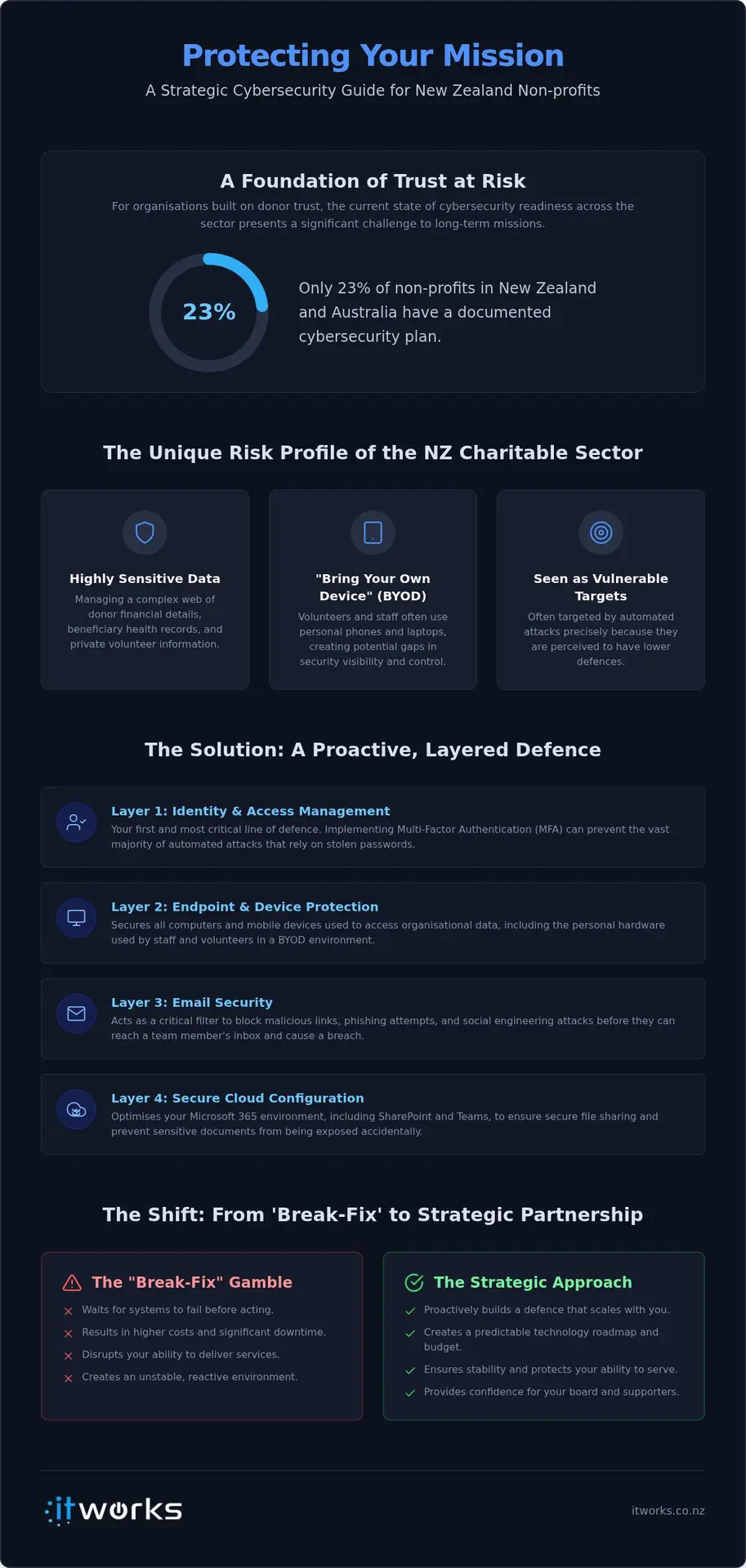
Did you know that only 23% of non-profits across New Zealand and Australia currently have a documented cybersecurity plan? For an organisation built on the foundation of donor trust, this statistic represents a significant risk to your long-term mission. Developing a cohesive IT strategy for non-profits NZ is no longer just a technical requirement; it’s a vital part of protecting your supporters and ensuring your team can work without disruption. We recognise that you’re often balancing limited resources with a diverse mix of staff and volunteers, making traditional security feel complex and out of reach.
You likely agree that your focus should remain on making a difference, rather than managing the stress of potential data breaches. This article will show you how to build a resilient, layered security posture that safeguards sensitive data without exhausting your budget. We’ll outline how to meet your obligations under the NZ Privacy Act 2020, including the 2026 updates, while establishing a predictable technology roadmap. By shifting from reactive fixes to a strategic approach, you can provide your board with the confidence that your organisation is secure, stable, and ready to grow.
Key Takeaways
- Understand why cybersecurity is the foundation of donor trust and how protecting sensitive information ensures your mission remains uninterrupted.
- Learn how to implement a layered defence, focusing on identity management and Multi-Factor Authentication to secure a workforce of both staff and volunteers.
- Align your organisational governance with the NZ Privacy Act 2020 to give your board full confidence in your data handling and compliance status.
- Discover how a structured IT strategy for non-profits NZ creates a predictable technology roadmap that fits your budget while supporting long-term growth.
- Recognise the value of a local technology partner who provides a strategic and operational blend tailored specifically to the New Zealand non-profit environment.
Protecting the Mission: Why Cybersecurity for Non-profits in NZ is Critical
Cybersecurity isn’t just about firewalls or complex passwords; it’s about the promise you make to your supporters. For a New Zealand non-profit, your mission relies on the foundational belief that donor data and beneficiary information are handled with absolute care. A breach doesn’t just interrupt your daily operations; it erodes the donor trust that took years to build. When we discuss a robust IT strategy for non-profits NZ, we’re describing a framework that ensures your organisation remains resilient and focused on its purpose, rather than being sidelined by avoidable technical crises.
Many local charities believe they’re too small to be noticed by cybercriminals. However, NZ organisations are often targeted precisely because they’re perceived to have lower defences while holding high-value personal data. A single incident can lead to direct financial loss, but the long-term impact on fundraising is often more severe. Donors want to know their contributions are making an impact, not funding a recovery effort from a preventable attack. Viewing security as a strategic asset allows you to build a stable platform for growth.
The Unique Risk Profile of the NZ Charitable Sector
NZ charities manage a complex web of sensitive information. This includes donor credit card details, beneficiary health records, and private volunteer data. The challenge is amplified by a strong “Bring Your Own Device” (BYOD) culture. Volunteers often use personal phones or laptops to access organisational systems, which can create gaps in visibility and control. Whether you’re a small community group or a large trust anywhere in New Zealand, automated cyberattacks don’t discriminate based on your size. They look for vulnerabilities, making every organisation a potential target for professionalised cybercrime.
Moving Beyond the “Break-Fix” Mentality
Relying on a “break-fix” model is a high-stakes gamble for any charitable organisation. Waiting for a system to fail before addressing it often results in higher costs and significant downtime that disrupts your service delivery. A proactive approach involves understanding fundamental cybersecurity principles to build a layered defence that scales with your needs.
This shift from reactive support to a strategic partnership creates long-term confidence. It ensures your IT strategy for non-profits NZ is built on stability and foresight, rather than constant fire-fighting. By prioritising security now, you protect your future ability to serve the community and ensure that every dollar raised goes exactly where it’s intended.
A Layered Defence: Essential Security Components for Charities
Building a resilient security posture doesn’t mean purchasing every tool on the market. Instead, it involves creating a “layered defence” where multiple barriers work together to protect your organisation. If one layer is bypassed, others remain in place to stop the threat before it reaches your sensitive donor data. This structured approach is a cornerstone of an effective IT strategy for non-profits NZ, ensuring you focus resources where they provide the most protection without overcomplicating your systems.
Identity management serves as your first line of defence. Implementing Multi-Factor Authentication (MFA) is perhaps the single most effective step you can take to secure your accounts. According to guidance from the National Cyber Security Centre (NCSC), MFA can prevent the vast majority of automated attacks that rely on stolen passwords. Beyond identity, you must consider endpoint protection for all devices. This is especially vital in the non-profit sector where volunteers often use personal hardware to access files. Robust email security also acts as a critical barrier, filtering out malicious links and social engineering attempts before they reach a staff member’s inbox.
Securing Your Microsoft 365 Environment
Most New Zealand charities rely on the Microsoft ecosystem for their daily operations. Optimising your Microsoft 365 management New Zealand ensures that security settings are tailored to your specific needs. This involves configuring SharePoint and Teams for secure file sharing, ensuring that sensitive documents aren’t accidentally shared with the wrong parties. You should also leverage the Microsoft Cloud for Nonprofits, which offers specialised security features and grants designed to make high-level protection more accessible for charitable budgets.
The Human Element: Building a Security-Conscious Culture
Technology alone cannot solve every risk. Since phishing remains a primary entry point for attackers, cyber security awareness training is often the most cost-effective investment you can make. The goal is to empower your staff and volunteers to spot red flags, such as unusual sender addresses or urgent requests for data, without creating an environment of anxiety. Clear, simple policies regarding data handling and device usage provide a helpful roadmap for your team. This proactive mindset should be a central part of your IT strategy for non-profits NZ, turning your workforce into an active part of your defence.
By integrating these layers, you move away from reactive fixes toward a state of calm reliability. You might find it helpful to discuss your cybersecurity priorities with our team to see how these layers fit into your broader organisational goals and mission.
Evaluating Cybersecurity Partners: What NZ Non-profits Should Look For
Selecting a technology partner is one of the most consequential decisions for your organisation’s future. It requires moving beyond simple vendor relationships toward a strategic partnership that prioritises your mission. A well-constructed IT strategy for non-profits NZ isn’t just a list of hardware; it’s a commitment to long-term resilience. You need a partner who views security through the lens of organisational confidence, rather than just a series of technical boxes to tick. This distinction is vital for ensuring that your technology supports, rather than hinders, your ability to make an impact.
Local, NZ-based support is essential for this level of alignment. A partner based in New Zealand understands our unique regulatory environment and shares the cultural values that drive your work. This proximity ensures a higher level of accountability and a deeper understanding of the specific challenges faced by charities in centres like Auckland, Wellington, and Christchurch. When you’re managing sensitive data, you need an ally who is as invested in the NZ Privacy Act compliance as you are.
Outcome-Focused vs. Product-Led Services
Be wary of providers who lead with fear-based tactics or “doom-and-gloom” scenarios to sell software. While risks are real, a supportive partner focuses on building your capacity to withstand challenges. They should speak the language of your board, translating complex technical risks into clear business impacts. Look for those who discuss outcomes like “uninterrupted service delivery” and “donor data integrity” rather than just listing product features. This approach ensures that every security investment is understood as a way to protect donor trust and organisational stability.
Transparency in Budgeting and Roadmapping
Non-profits operate under unique financial pressures, often managing tight budgets across multiple funding cycles. A strategic partner understands this and provides a predictable technology roadmap that aligns with your long-term goals. Instead of unexpected invoices for reactive repairs, you should expect transparent, monthly managed service fees. This structure allows you to plan for necessary security upgrades well in advance, ensuring that your IT strategy for non-profits NZ remains sustainable and fits within your financial constraints. Clear accountability in these areas is essential for robust non-profit governance and gives your executive team the peace of mind they need to focus on their core mission.
Aligning Security with Governance and the NZ Privacy Act
For many non-profit boards, technology has historically been viewed as a back-office expense rather than a strategic priority. This perception is shifting as the legal and ethical responsibilities of data stewardship become clearer. Under the NZ Privacy Act 2020, your board is ultimately responsible for ensuring that “reasonable security safeguards” are in place to protect the personal information of donors, volunteers, and beneficiaries. Integrating a clear IT strategy for non-profits NZ into your governance framework ensures that risk management is proactive rather than a desperate response to a crisis.
The core cyber security for small business NZ principles of resilience and confidence apply directly to your charitable organisation. Major donors and grant providers are increasingly looking beyond your social impact to evaluate your operational stability. They want to know that their contributions won’t be swallowed by the costs of a data breach. By treating security as a governance pillar, you demonstrate a level of professionalism that can differentiate your organisation in a competitive funding environment. A well-defined IT strategy for non-profits NZ provides the board with the visibility they need to make informed decisions about technology investments.
Meeting Your Obligations Under the Privacy Act
A “notifiable privacy breach” occurs when personal information is accessed or disclosed in a way that causes serious harm, or is likely to do so. Since May 2026, the introduction of Information Privacy Principle 3A has added further requirements for organisations that collect data indirectly. Your board must have a clear incident response plan that outlines exactly how to notify the Privacy Commissioner and affected individuals. Proactive monitoring isn’t just a technical tool; it’s the mechanism that allows your leadership to fulfil their legal obligations by detecting leaks before they escalate into systemic failures.
Building Donor Confidence Through Transparency
Your commitment to data safety can be a powerful trust-builder in your annual reports and funding applications. Instead of hiding your security measures, being transparent about your posture shows supporters that you value their privacy as much as their generosity. Large-scale donors are more likely to commit to long-term partnerships when they see a documented technology roadmap and a clear investment in security training. Robust security governance ensures that your organisation remains a trusted vessel for community support, safeguarding the mission for years to come.
Strengthening Your Organisation with IT Works
Technology should be a quiet engine for your success, not a source of constant friction. At IT Works, we position ourselves as a strategic ally for New Zealand non-profits, providing the expertise needed to turn complex technical challenges into operational strengths. Our approach is defined by a strategic and operational blend; we ensure your systems are secure and efficient on the ground while providing your board with the high-level reporting they need to feel confident in your risk management. This dual focus allows you to move away from the stress of reactive support and toward a state of calm reliability.
A central part of our mission is removing the “fear factor” from cybersecurity. While the risks to donor data are real, we believe that security should be built on resilience and purposeful action rather than alarmist tactics. We help your organisation navigate the specific complexities of the Microsoft Cloud for Nonprofits, ensuring you leverage available grants and optimise your environment for maximum protection. By integrating a clear IT strategy for non-profits NZ, we ensure that your cloud migrations and security upgrades are handled safely, with minimal disruption to your essential services.
A Partnership Built on Trust and Practicality
Our NZ-based team acts as a natural extension of your own organisation. We understand the local landscape and the unique cultural values that drive the charitable sector in centres like Auckland, Wellington, and Christchurch. By managing your day-to-day technology needs, we free your team to focus entirely on making an impact. We also recognise the financial constraints inherent in the sector; our technology roadmaps are designed to align with your specific funding cycles, ensuring that security improvements are both sustainable and predictable. This long-term partnership model prioritises your mission above all else.
Next Steps for Your Security Strategy
The best time to review your defences is before an incident occurs. A proactive assessment of your current systems can identify immediate gaps in your layered security, from identity management to volunteer device policies. We invite you to engage in a consultative conversation to explore how a structured IT strategy for non-profits NZ can provide the stability your organisation deserves. This is not about a sales pitch; it’s about identifying practical steps to protect your donor trust and ensure your mission remains resilient in the face of evolving threats.
Talk to IT Works about your technology strategy and how we can support your mission.
Securing the Future of Your Mission
Protecting your organisation is about more than just software; it’s about the enduring trust of your donors and the safety of those you serve. By shifting from reactive support to a proactive IT strategy for non-profits NZ, you ensure your mission remains resilient against evolving risks. We’ve explored how a layered defence and clear governance alignment provide the stability your board needs to lead with confidence.
At IT Works, our NZ-based expert team provides a proactive, non-fear-based approach to security. We bring specialist knowledge of the non-profit sector to every partnership, helping you navigate technical complexities with ease. Our goal is to replace technical stress with a sense of calm reliability, allowing your team to focus on making a tangible difference in our communities.
Building a secure foundation is a journey, and having the right guide makes all the difference. We look forward to helping you strengthen your organisation and protect the vital work you do across New Zealand.
Frequently Asked Questions
Is cybersecurity really necessary for a small NZ charity?
Yes, because cybercriminals use automated tools to target vulnerabilities rather than specific organisations. Small charities often hold sensitive donor data but have fewer defences, making them attractive targets for automated attacks. A breach can devastate your reputation and halt your essential operations. Prioritising security ensures you protect the trust of your community and maintain your ability to deliver services without the stress of avoidable technical disruption.
How does the NZ Privacy Act 2020 affect non-profit organisations?
The Act requires all NZ organisations to have “reasonable security safeguards” to protect personal information from loss or unauthorised access. It also mandates reporting “notifiable privacy breaches” to the Privacy Commissioner and affected individuals if serious harm is likely. Integrating these requirements into your IT strategy for non-profits NZ is essential for meeting your legal obligations and ensuring your data handling practices meet modern compliance standards.
Can we use volunteer-owned devices for our organisation’s work safely?
Yes, but only with a structured “Bring Your Own Device” (BYOD) policy and appropriate technical controls. You can use identity management tools to ensure volunteers only access the specific data they need for their roles. Implementing “app-level” security allows you to protect organisational data on personal phones without infringing on private content. This approach balances the flexibility of a volunteer workforce with robust data protection.
What is Multi-Factor Authentication and why do we need it?
Multi-Factor Authentication (MFA) requires users to provide two or more forms of identification before accessing a system, such as a password and a code from a mobile app. It’s your most effective defence against password theft, which remains a primary entry point for attackers. By requiring this extra layer, you significantly reduce the risk of unauthorised access, even if a staff member’s password is compromised by a phishing attempt.
How can we afford professional cybersecurity on a non-profit budget?
Professional security is made affordable through strategic planning and leveraging available non-profit grants. Instead of expensive one-off fixes, a managed service model provides predictable monthly costs that fit your budget cycles. We help you access Microsoft 365 discounts and cloud grants, ensuring your IT strategy for non-profits NZ maximises every dollar while building a resilient, layered defence that grows with your organisation over time.
What should we do if we suspect our donor data has been breached?
You should immediately activate your incident response plan and contain the breach to prevent further data loss. Once the risk is contained, assess whether the breach is “notifiable” under the NZ Privacy Act by evaluating the potential for serious harm. You must notify the Privacy Commissioner and affected donors if that threshold is met. Having a dedicated technology partner ensures you have the expertise to manage these steps calmly.
How does Microsoft 365 help with non-profit security?
Microsoft 365 provides a suite of integrated security tools, including encrypted file sharing, identity protection, and advanced threat detection. For eligible charities, the Microsoft Cloud for Nonprofits offers specialised features and significant price reductions on premium security settings. These tools allow you to centralise your data management and apply consistent security policies across your entire organisation, whether your team is working in the office or remotely.
What is the difference between an IT provider and a strategic technology partner?
An IT provider typically operates on a “break-fix” basis, reacting only when things go wrong and focusing on technical features. In contrast, a strategic technology partner acts as a business advisor, focusing on long-term resilience and organisational outcomes. They provide a technology roadmap that aligns with your mission, ensuring your systems support growth and security rather than just providing a temporary patch for technical issues.