
What if the persistent technology frustrations your team faces every day aren’t actually technical faults, but growing pains? It’s common to feel that IT should simply work in the background, yet many leaders find themselves caught in a cycle of reactive repairs and recurring downtime that stalls productivity. You might feel that while your provider is helpful when things break, they lack a clear vision for how tools like AI can actually benefit your operations. If you’re starting to feel vulnerable to modern security threats despite having support, you’re likely seeing the first signs your business has outgrown its IT support.
We understand that outgrowing a partner is a natural part of business evolution, not a failure of service. This guide will help you identify the critical indicators that your current technology setup is no longer fit for purpose. We’ll show you how to align your systems with your growth ambitions to ensure your team feels supported rather than frustrated. We’ll explore a strategic checklist for 2026, focusing on proactive security, practical AI governance, and building a technology roadmap that treats IT as a core asset for your success.
Key Takeaways
- Recognise when your current technology support has reached a “growth ceiling” and learn how to transition towards a model that actively enables your business ambitions.
- Identify the operational signs your business has outgrown its IT support, including recurring downtime and a reliance on reactive “fix-it” services.
- Understand how to bridge strategic gaps by prioritising proactive cybersecurity and practical AI applications over basic, set-and-forget tools.
- Learn the value of a structured technology roadmap to align your IT investment with your three-year business plan and organisational goals.
- Discover the steps to conduct a technology audit that reveals hidden risks and sets the stage for a more resilient, productive partnership.
Why Your IT Support Needs to Scale with Your Ambition
Technology should be a strategic asset that fuels your growth, not a source of daily friction that slows your team down. When your systems work seamlessly, they fade into the background, allowing your people to focus on their actual roles. However, as your organisation expands, the technical requirements shift from simple maintenance to complex strategic alignment. One of the clearest signs your business has outgrown its IT support is when your current provider struggles to offer advice that goes beyond just fixing what’s broken.
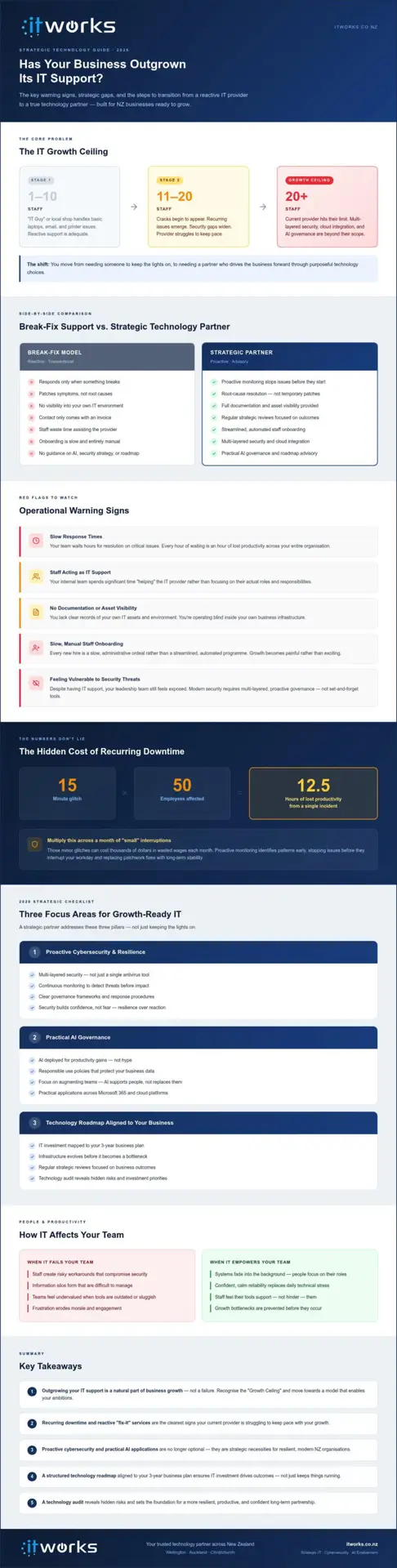
Many organisations in New Zealand reach what we call a “Growth Ceiling.” This usually happens when a team grows beyond 20 staff members. At this size, the traditional “IT guy” or small local shop often reaches their limit. They can handle a single server or a few laptops, but they often lack the depth to manage multi-layered security, cloud integration, and the governance required for modern tools. You move from needing someone who can keep the lights on to needing a partner who can drive the business forward through purposeful technology choices.
The Difference Between IT Support and a Technology Partner
Basic support is almost entirely reactive. You call when something breaks, they fix it, and the cycle repeats. While this might seem cost-effective initially, this “break-fix” model eventually leads to higher costs through lost productivity and recurring issues that are patched rather than solved. A true technology partner focuses on proactive resilience. They look at your long-term goals and ensure your infrastructure is ready for them. This shift brings clear accountability and transparent processes, replacing the stress of technical management with a sense of calm reliability.
How Technology Impacts Your Staff Productivity
When systems are unreliable, staff naturally find workarounds to get their jobs done. These shortcuts might seem helpful in the moment, but they often compromise security and create silos of information that are hard to manage later. There is also a significant psychological impact; a team that feels their tools are outdated or sluggish often feels undervalued and frustrated. A technology roadmap ensures that your infrastructure evolves alongside your business objectives, preventing future growth bottlenecks. By investing in a roadmap, you provide your team with the confidence that their tools will support them, not hinder them.
Operational Warning Signs: The Reactive Support Red Flags
Operational friction often builds up so slowly that it becomes the new normal. You might find yourself accepting small glitches as just part of the job. However, these inconveniences are often the primary signs your business has outgrown its IT support. If your provider is constantly “fixing” the same printer issue or email sync error, they aren’t solving the root cause. They are merely applying a temporary patch to a deeper structural problem.
There are several red flags that suggest your current support model is struggling to keep pace with your growth:
- Response times are slipping, leaving your team waiting for hours on critical issues.
- Your internal staff spend significant time “helping” the IT provider instead of focusing on their own roles.
- Onboarding new staff is a slow, manual process rather than a streamlined, automated programme.
- You lack clear documentation or visibility into your own IT assets and environment.
When these patterns emerge, the partnership has become a burden. A growing organisation needs a partner who provides clarity and speed, not more administrative work for your leadership team.
The Hidden Cost of Recurring Downtime
Downtime is rarely a total blackout. It’s usually a series of small, nagging interruptions that drain your momentum. Consider a minor 15-minute glitch that affects 50 employees. That represents 12.5 hours of lost productivity in a single morning. Over a month, these “small” issues can cost thousands of dollars in wasted wages. Proactive monitoring identifies these patterns early. It allows for infrastructure management that stops issues before they interrupt your workday, replacing patchwork fixes with long-term stability.
Communication and Accountability Gaps
A professional partnership relies on visibility. You should have clear documentation of your IT assets and a deep understanding of your own environment. If you feel left in the dark, or if you only hear from your provider when you receive a monthly invoice, there is a significant accountability gap. You should expect regular strategic reviews that focus on business outcomes. Moving to a more comprehensive model of Managed IT Services ensures that technology supports your growth rather than hindering it. You can discuss your technology strategy with our team to see how a more structured approach might benefit your organisation.
Strategic Gaps: Security, Resilience, and AI Readiness
Beyond daily helpdesk tickets, the most significant signs your business has outgrown its IT support often appear at the executive level. If your technology discussions only happen when something is broken, you’re missing the strategic alignment needed for growth. A maturing organisation requires a technology roadmap and a clearly defined budget for the next 12 to 24 months. Without this, you’re essentially flying blind, making reactive hardware purchases instead of investments that support your three-year business plan.
Resilience also extends to your business continuity planning. If your backup systems haven’t been tested in years, or if you don’t have a documented recovery process, your organisation is exposed to unnecessary risk. A strategic partner doesn’t just manage backups; they verify them and lead you through simulations to ensure you can recover quickly from any disruption. This level of maturity is essential as your complexity increases, ensuring that technology remains a reliable foundation for your success.
Cybersecurity Beyond the Basics
Many organisations rely on a “set and forget” approach, assuming a basic firewall and antivirus software are enough. While these are necessary, they are no longer sufficient for building true organisational resilience. A strategic partner helps you move toward a layered cyber risk management approach. This includes regular security awareness training, which builds confidence among your staff and reduces the likelihood of human error. For more on this, you can read our guide on Cyber Security for Small Business NZ. Building resilience isn’t about fostering fear; it’s about creating a stable environment where your team can work without hesitation.
Preparing for the AI-Enabled Workplace
AI is no longer a futuristic concept, but many businesses lack the framework to adopt it safely. If you’re curious about tools like Microsoft Copilot but have no framework for safe adoption or governance, these are clear signs your business has outgrown its IT support. Your technology partner should be guiding you through this transition. They should help identify specific use cases for automation within your current workflows to boost productivity. Responsible governance ensures your data is organised and secure before AI integration begins. This proactive preparation is what separates a basic service provider from a strategic advisor who understands your growth ambitions.
Evaluating Your Current Model vs. a Strategic Partnership
Identifying the signs your business has outgrown its IT support is the first step toward building a more resilient organisation. The next step is evaluating whether your current model, be it a “Lone Ranger” individual or a basic helpdesk, can actually support your future ambitions. A “Lone Ranger” is often a dedicated technician who knows your systems inside out, but they represent a significant risk as you scale. They lack the redundancy to handle leave or illness, and they often struggle to keep up with the rapid pace of developments in cybersecurity and AI governance.
A strategic partnership moves away from the individual and toward a collective team approach. This doesn’t necessarily mean replacing an internal IT person if you have one. In many cases, larger organisations use a Managed Service Provider (MSP) to provide escalation support and specialist guidance for their internal team. The key assessment criterion is the nature of your conversations. When you notice the signs your business has outgrown its IT support, you should look for a partner who asks about your business goals rather than just your hardware specs.
The Scalability Test for IT Providers
Depth is the defining factor of a scalable partner. You need to know if they can support your organisation if you were to double your headcount by next year. This requires more than just more hands on deck; it requires mature processes for procurement and hardware lifecycle management. A scalable partner should also have the technical depth to handle complex projects, such as cloud migrations or infrastructure overhauls, without disrupting your daily operations. They should act as a bridge between your current state and your growth ambitions.
Budgeting for Outcomes, Not Hours
The traditional “billable hour” model creates a fundamental misalignment of interests. In that scenario, your provider actually profits when your systems fail, as every glitch results in more billable time. This is often called the “billable hour trap.” Transitioning to a fixed-fee managed service model shifts the focus to outcomes. Under this arrangement, your partner is incentivised to ensure your systems are stable, secure, and efficient. It provides more predictable technology management and allows you to link your IT spend directly to business outcomes, such as reduced risk or increased staff productivity.
Once you have recognised the signs your business has outgrown its IT support, the transition toward a more capable partnership should be a structured and reassuring process. It begins with a comprehensive technology audit. This process involves more than just counting laptops; it is a rigorous assessment of your existing gaps, security risks, and operational bottlenecks. By identifying these vulnerabilities early, you can move away from reactive fixes and start building a foundation based on resilience, productivity, and security.
A technology roadmap serves as the bridge between your current state and your long-term vision. By aligning your IT investment with your three-year business plan, you ensure that every dollar spent is a purposeful step toward greater efficiency. This strategic document replaces the traditional cycle of emergency spending with a predictable, outcome-focused budget. It allows your leadership team to move forward with the confidence that your infrastructure can scale as fast as your ambitions. It ensures that technology remains an enabler of your success rather than a recurring hurdle. For many growing enterprises, this includes implementing robust validation tools like CWORT to maintain compliance with international security standards as they scale.
The first 90 days of a new partnership are critical for establishing a sense of calm reliability. During this period, you should expect a thorough onboarding process that prioritises clear accountability for your Microsoft 365 management and cloud solutions. Cultural alignment is also vital for building a long-term relationship. Working with a local, NZ-based support team means your partner understands the specific nuances of our market and shares your commitment to the community. This proximity fosters a level of trust and accessibility that distant, offshore helpdesks simply cannot replicate.
Next Steps for Your Organisation
To begin this transition, we recommend reviewing your organisation’s current list of recurring technical issues. If you find that the same problems are appearing month after month, it is a clear indicator that your current support model has reached its limit. Addressing the signs your business has outgrown its IT support often requires an external perspective to see the strategic opportunities you might be missing. A fresh set of eyes can help you identify where automation or better governance could unlock significant time for your team.
Technology should be a quiet, powerful engine that supports your journey, not a source of constant noise. If you are ready to move beyond basic maintenance and toward a model that supports your growth, we invite you to take the next step. Talk to IT Works about your technology strategy and discover how a collaborative, strategic approach can transform your relationship with technology.
Building a Foundation for Future Growth
Recognising the signs your business has outgrown its IT support is an opportunity to redefine how technology serves your organisation. By moving away from a reactive model and toward a strategic partnership, you ensure that your tools enable success rather than creating friction. A balanced approach that combines day-to-day operational excellence with long-term strategic vision allows you to navigate developments like AI with confidence.
Our New Zealand-based team is dedicated to providing this stability, offering a strategic and operational blend that supports your unique growth path. We focus on building resilience and organisational confidence through a non-fear-based approach to cybersecurity, ensuring your staff feel empowered by their tools. Transitioning to a structured technology roadmap doesn’t just solve today’s glitches; it secures your business for the years ahead.
We look forward to helping you turn your technology into a reliable asset that evolves alongside your ambition.
Frequently Asked Questions
What are the first signs that we’ve outgrown our current IT guy?
The first indicators are usually operational friction and a lack of strategic guidance. You might notice recurring glitches that are patched but never solved, or find that your support person is overwhelmed by the complexity of a growing team. These are common signs your business has outgrown its IT support. As you scale beyond 20 staff, you need a partner who understands multi-layered security and long-term planning rather than someone who just fixes computers.
How often should our organisation review its technology roadmap?
We recommend a formal review of your technology roadmap at least once a year, with shorter tactical check-ins every quarter. This rhythm ensures your technology remains aligned with your three-year business plan and allows you to adjust for new developments like AI. Regular reviews prevent technology from becoming a bottleneck, ensuring your infrastructure scales alongside your ambitions while keeping your budget predictable and focused on business outcomes.
Is it better to hire an internal IT person or use a managed service provider?
This depends on your organisational complexity, but many businesses find a managed service provider offers better depth and resilience. While an internal person provides immediate presence, a managed partner brings a team of specialists in cybersecurity, cloud solutions, and AI governance. For many organisations, a hybrid model works best. The internal person handles daily tasks while the partner provides the strategic guidance and escalation support needed for long-term growth.
What should be included in a modern cybersecurity strategy for an NZ business?
A modern strategy must move beyond basic antivirus software to include a layered risk management approach. This includes multi-factor authentication, regular security awareness training for staff, and a tested backup and disaster recovery plan. The goal is to build organisational confidence through resilience rather than fear. Your strategy should focus on protecting your data while ensuring your team can work productively from any location without compromising security.
How can we tell if our current IT provider is being proactive or reactive?
A proactive provider leads the conversation about your technology strategy, while a reactive one only appears when something breaks. If you find yourself chasing your provider for updates or if they only send a monthly invoice without a strategic review, they are likely stuck in a reactive mindset. These are clear signs your business has outgrown its IT support. A proactive partner provides regular visibility and identifies potential risks before they impact your operations.
What does ‘AI readiness’ actually mean for a medium-sized organisation?
AI readiness involves preparing your data and infrastructure for secure automation. It starts with robust data governance within your Microsoft 365 environment to ensure sensitive information is protected before you integrate tools like Microsoft Copilot. It also means identifying specific, practical use cases where AI can improve productivity for your team. Readiness is about building a secure, organised foundation so your organisation can adopt new tools responsibly and effectively.
Will switching IT providers cause significant disruption to our daily operations?
Switching providers should be a smooth, managed process with minimal impact on your daily work. A professional strategic partner uses a structured transition plan to document your environment and migrate services without causing downtime. Most of the transition work happens in the background, focusing on auditing your systems and establishing clear accountability. By the time the new support goes live, your team should feel a sense of calm reliability rather than technical stress.