
The cheapest way to manage your technology might actually be the one that costs your business the most in the long run. Many Kiwi organisations rely on a “break-fix” model, believing they’re saving money by only paying for help when a problem arises. You’ve probably experienced the sudden dread of an unpredictable IT bill or the quiet frustration of watching your team’s productivity stall during an afternoon of unexpected downtime. It’s a cycle that creates unnecessary stress and makes strategic planning feel like guesswork.
Understanding the nuances of it support vs managed services is the first step toward reclaiming control over your digital environment. We’ll show you how to move beyond reactive fire-fighting to find a more stable, cost-effective path for your organisation’s future growth. You’ll discover how a proactive approach can turn technology from a source of anxiety into a reliable foundation for your daily operations.
This guide breaks down the critical differences between traditional helpdesks and comprehensive managed solutions. We explore how a tailored technology roadmap provides predictable monthly costs and ensures your systems are monitored around the clock, allowing you to focus on your core mission while a strategic ally handles the technical complexity.
Key Takeaways
- Understand the core differences of it support vs managed services to shift from reactive troubleshooting to a proactive model that prevents disruptions before they occur.
- Identify the financial benefits of moving from unpredictable hourly “break-fix” bills to a structured, subscription-based approach with clear monthly costs.
- Discover how a strategic IT roadmap can align your technology with your long-term business goals, turning digital infrastructure into a driver for growth.
- Learn how 24/7 monitoring and integrated cybersecurity provide a robust layer of protection, replacing technical anxiety with calm, reliable stability.
- Apply a practical decision matrix to evaluate your current pain points and choose the most cost-effective service model for your organisation’s future.
Defining the Divide: Reactive IT Support vs Proactive Managed Services
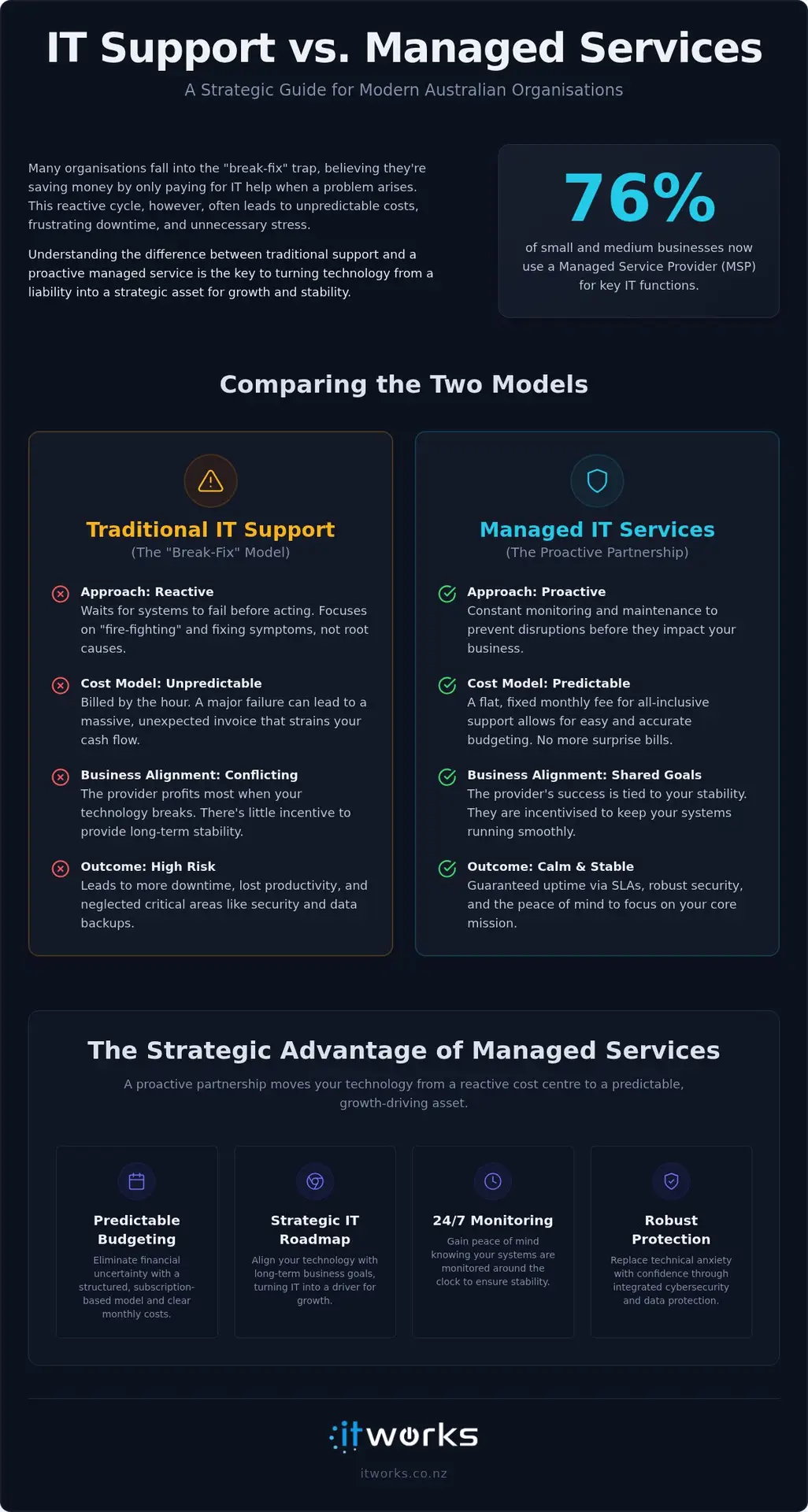
The choice between it support vs managed services isn’t just about how you pay your bills. It represents a fundamental shift in how your organisation views technology. Traditional IT support operates as a reactive safety net, focusing on “break-fix” repairs that only occur after a disruption has already cost you time and money. In contrast, Managed services provide a holistic, subscription-based framework designed to maintain the continuous health of your entire digital ecosystem.
By 2026, the landscape of business technology has become too complex for ad-hoc repairs to be effective. Research indicates that 76% of small and medium businesses now utilise a managed service provider for at least some of their IT functions. This transition happens because modern Kiwi organisations no longer want IT to be a “cost centre” that only drains resources during a crisis. They’re looking for a strategic asset that supports growth, improves staff productivity, and offers a clear roadmap for the future.
The “Break-Fix” Mentality: Waiting for Trouble
Traditional support is purely transactional. You have a problem, you call a technician, and you pay an hourly rate to resolve it. This model often creates a hidden conflict of interest. There is very little incentive for a provider to address the root cause of a recurring issue if they’re being paid by the hour to fix the symptoms. Most small businesses enter this cycle through an emergency, such as a hardware failure or a sudden software glitch. It’s a high-stress way to manage a business, leaving you vulnerable to unpredictable costs and extended periods of downtime that disrupt your team.
The Managed Services Mindset: Prevention Over Cure
Transitioning to a Managed Service Provider (MSP) changes the dynamic from a vendor relationship to a partnership. Under this model, the provider takes full responsibility for the ongoing health of your systems. This commitment is usually backed by Service Level Agreements (SLAs) that guarantee specific response times and system uptime. Because you pay a flat monthly fee, the provider’s goals align perfectly with your own success. If your systems run smoothly, they operate more efficiently. This partnership moves the focus from simply “fixing” things to constantly optimising them, ensuring your technology is always ready to support your next big move.
Traditional IT Support: Analysing the ‘Break-Fix’ Model
Ad-hoc IT support is the default starting point for many Kiwi businesses. It’s a simple, transactional arrangement. When a laptop screen fails, a printer refuses to connect, or a software update crashes a workstation, you call a technician to resolve that specific problem. This “break-fix” model covers the basics of hardware repair and software troubleshooting, providing a sense of flexibility for those who don’t want to commit to a long-term contract. However, relying on this method means you’re essentially paying for a cure rather than investing in health.
The financial reality of this model is often its biggest drawback. Because you only pay for the hours worked during a crisis, your IT budget becomes entirely unpredictable. A quiet month might cost nothing, but a major system failure can lead to an invoice that strains your cash flow. Understanding the key differences between IT support and managed services helps clarify why this reactive posture is becoming a liability. In a break-fix scenario, you’re also entering a “response time lottery.” Without a formal agreement, you aren’t a priority client. If your provider is busy with their contracted partners, your business stays offline until they’re free.
This reactive approach often leaves critical infrastructure neglected. Security patches, data backups, and system optimisations are frequently overlooked because no one is actively looking at them. You only discover a backup has failed when you desperately need to restore data, or you realise your cybersecurity is outdated after a breach has already occurred. If you’re feeling the weight of this uncertainty, it might be time to explore a more reliable approach to your technology management.
When Ad-Hoc Support Makes Sense
Break-fix support can be appropriate for micro-businesses or startups with very few employees and no critical data dependencies. If your operations can handle a few days of downtime without significant loss, the low barrier to entry for ad-hoc support might be tempting. It allows for minimal overhead during the earliest stages of a business. However, as an organisation scales, the complexity of managing multiple users and sensitive client information quickly outgrows this model’s capabilities.
The Hidden Costs of Downtime
The hourly rate on an IT invoice is only a small fraction of the true cost of an outage. When your systems are down, you’re paying for staff who cannot work, losing potential sales, and risking damage to your professional reputation. Research indicates that a single hour of IT downtime can cost a mid-sized enterprise hundreds of thousands of dollars. Reactive support fails to address the long-term health of your infrastructure, meaning you’re often paying to fix the same recurring issues instead of building a stable environment that supports your team’s productivity.
Managed IT Services: A Comprehensive Strategic Framework
A managed service model provides a structured ecosystem designed to keep your organisation running without interruption. It rests on three core pillars: 24/7 proactive monitoring, a responsive helpdesk, and multi-layered cybersecurity. To ensure complete protection, you can explore EDR, XDR, anti-phishing, anti-malware and anti-spam. This framework moves away from the isolated repairs of traditional support, offering a connected system where every component is managed under a single strategic umbrella. Instead of waiting for a hardware failure to trigger a service call, your provider maintains constant visibility over your entire network.
The fundamental difference in the it support vs managed services comparison lies in the shift from fixing to preventing. Modern providers now utilise AI and automation to monitor system health in real time. These tools can resolve up to 85% of technical issues before a staff member even notices a glitch. This level of remote efficiency is balanced with on-site technical assistance for more complex physical infrastructure needs. This hybrid approach ensures you have expert help available whether the challenge is a cloud configuration or a physical server upgrade at your business premises.
Hardware procurement and lifecycle management are also integrated into this framework. An MSP doesn’t just suggest new equipment; they manage the entire process from selection to disposal. They track the age and performance of every device, ensuring you have a clear replacement schedule. This prevents the sudden productivity drops caused by ageing, sluggish computers and allows for more accurate financial planning. You gain a partner who ensures your team always has the right tools for the job.
Cybersecurity and Data Continuity
Managed services treat cybersecurity as an ongoing process rather than a one-off installation. This includes managed endpoint protection, regular security audits, and robust backup and disaster recovery systems. For New Zealand non-profits and charities, this protection is particularly vital. These organisations often handle sensitive community data but lack the internal resources to defend against sophisticated modern threats. A managed approach ensures that data continuity and compliance are handled by experts, providing peace of mind that your mission is protected from digital disruption. This level of professional oversight mirrors the high standard of quality care provided by Im with you, where the focus is always on creating a safe and supported environment for participants.
Strategic Roadmapping and vCIO Services
One of the most valuable aspects of a managed partnership is access to a virtual Chief Information Officer (vCIO). This role focuses on long-term strategy rather than daily tickets. Your vCIO helps develop a tailored technology roadmap that aligns your digital investments with your business growth. It’s a transition from simply maintaining old systems to modernising your entire landscape. By planning for future developments like AI integration or cloud migration, you ensure your technology remains a competitive advantage rather than a legacy burden.
The Decision Matrix: Which Model Suits Your Business Goals?
Selecting the right path between it support vs managed services requires a clear-eyed look at your risk tolerance and operational goals. While the lower entry cost of ad-hoc support is tempting for startups, it often becomes a bottleneck as your team grows. To make an informed choice, you must evaluate three key metrics: cost predictability, risk management, and scalability. A reactive model offers low costs during “quiet” times but leaves you exposed to massive financial spikes during a crisis. A managed model provides a flat, monthly fee that covers everything, essentially turning your IT into a predictable utility like electricity or water.
The “tipping point” for most Kiwi organisations occurs when the annual cost of a managed contract is lower than the combined price of emergency repairs and lost productivity. If your staff lose just a few hours of work each month to slow systems or minor glitches, you’ve likely already crossed that threshold. Some business owners worry they are “paying for what they don’t use” in a managed contract. It is more accurate to view it as an investment in resilience. You aren’t just paying for a technician’s time; you are paying for the certainty that your systems are being monitored, protected, and optimised while you sleep. To see how a tailored strategy can stabilise your technology costs, explore our managed service options today.
Assessing Your Risk Profile
Your decision should be driven by the sensitivity of your data and the true cost of an hour of downtime. Ask yourself: if your network went dark for four hours on a Tuesday morning, what would it cost you in wages and lost opportunities? For the New Zealand non-profit sector, the stakes are even higher. A data breach or extended outage doesn’t just impact productivity. It can damage donor trust and jeopardize community programmes. You should also evaluate your internal capacity. If your most “tech-savvy” employee is spending their afternoons fixing colleagues’ printer issues instead of doing their actual job, your current support model is costing you far more than you realise.
Budgeting for Growth vs Maintaining Status Quo
Managed services transform IT from a series of capital expenditure (CapEx) shocks into a stable operational expenditure (OpEx). Instead of facing a massive bill every few years when your server fails or your laptops become obsolete, a managed framework allows you to bake hardware and software licensing into a steady monthly budget. This stability is essential for organisations looking to scale. It ensures your workforce is always “AI-ready” and equipped with modern, efficient tools. By moving away from the “fix-it-when-it-breaks” cycle, you free up your financial resources to invest in technology that actually drives business growth rather than just maintaining the status quo.
Future-Proofing with IT Works: Beyond Standard Support
Choosing between it support vs managed services is ultimately a decision about where you want to focus your energy. Since our founding in 2004, IT Works has been dedicated to replacing technical friction with a sense of calm reliability. We bring over 20 years of expertise to the New Zealand market, understanding the specific operational challenges faced by local businesses and non-profits alike. Our goal is to act as your strategic ally, ensuring your digital infrastructure is not just functional, but a purposeful driver of your long-term success.
We believe technology should work for you, not the other way around. By integrating sophisticated automation into our service delivery, we move beyond the frantic energy of traditional reactive support. Our systems are designed to identify potential disruptions before they reach your team, allowing you to transition from daily firefighting to a state of strategic digital evolution. This proactive stance provides the practical stability needed to explore new opportunities without the constant anxiety of system failure.
AI Integration and Modernisation
As we move through 2026, the ability to adopt new tools like Microsoft Copilot has become a significant competitive advantage. However, AI integration requires more than just a software license; it demands infrastructure readiness. IT Works guides organisations through this modernisation process, ensuring your data is secure and your network is optimised before you deploy advanced automation. By refining your daily workflows through purposeful AI adoption, we help you save time and improve accuracy across your entire team, creating a more efficient and future-ready workforce.
Your Journey to Calm Technology
The transition to a managed partnership is a methodical and reassuring process. We begin with a deep dive into your current environment, identifying hidden risks and immediate opportunities for improvement. Our onboarding process is designed to be seamless, ensuring your staff feel supported from day one. You gain immediate access to our 24/7 remote helpdesk and the reassurance of on-site assistance when physical hardware needs attention. This consistent rhythm of support builds trust, as our team works behind the scenes to maintain the health of your complete digital ecosystem.
If you’re ready to leave the unpredictability of ad-hoc repairs behind and embrace a more stable, forward-thinking strategy, we’re here to guide the way. It’s time to turn your technology into a reliable foundation for growth. Organise a strategic IT review with IT Works and discover the peace of mind that comes from a truly connected and managed system.
Empowering Your Digital Future
Choosing the right path between it support vs managed services is about more than just maintaining your computers; it’s about deciding whether your technology will be a constant source of friction or a silent engine for your success. We’ve explored how moving away from the unpredictability of “break-fix” repairs allows you to reclaim your time and focus on your core mission. By embracing a proactive framework, you gain the stability of predictable costs and the security of a system that’s monitored 24/7 to prevent disruptions before they impact your team.
With over 20 years of expertise in the New Zealand market, IT Works provides a steady hand to guide your digital journey. We specialise in supporting local businesses and non-profits with tailored solutions that include proactive monitoring and a responsive remote helpdesk. Our approach replaces technical anxiety with a sense of calm reliability, ensuring your infrastructure is ready for the opportunities of tomorrow. Discover how IT Works can stabilise and scale your organisation and take the first step toward a more resilient future. Your journey to seamless, strategic technology starts here.
Frequently Asked Questions
Is managed IT support more expensive than break-fix services?
Managed services generally offer a lower total cost of ownership despite the fixed monthly fee. While ad-hoc support seems cheaper during quiet periods, a single major outage or security breach can result in massive, unbudgeted expenses. A managed model eliminates these financial shocks by providing a consistent cost structure that covers ongoing maintenance and emergency repairs. You’re paying for the prevention of problems rather than just the hourly rate to fix them.
What exactly is included in a typical managed services contract?
A standard agreement typically covers 24/7 system monitoring, remote helpdesk assistance, and multi-layered cybersecurity. It also usually includes data backup management, software patching, and strategic IT consulting to ensure your technology supports your organisation’s growth. This creates a complete ecosystem where every part of your digital infrastructure is actively managed by a team of specialists.
Can managed services help my business implement AI and automation?
Yes, managed services are essential for organisations looking to adopt AI and automation tools safely. We help you prepare your underlying network and data structures before implementing technologies like Microsoft 365 Copilot. This ensures your systems are secure and your data is organised, allowing you to gain the full productivity benefits of modern automation without risking your internal information security.
How do response times differ between ad-hoc support and managed services?
Response times in a managed contract are guaranteed by Service Level Agreements (SLAs), whereas ad-hoc support relies on “best effort” availability. When comparing it support vs managed services, the priority level is a major factor. If you use reactive support, you’re often at the back of the queue during busy periods. Managed clients receive priority assistance, ensuring that critical issues are addressed within specific timeframes to minimise business disruption.
Do I still need an internal IT person if I hire a Managed Service Provider?
Not necessarily, as an MSP can either replace the need for an internal hire or act as a strategic partner for your existing IT manager. Many Kiwi organisations find that outsourcing routine maintenance and security allows their internal staff to focus on high-value business projects. This collaboration provides a broader range of expertise than a single employee can typically offer, reducing the risk of a single point of failure in your team.
How does an MSP handle cybersecurity differently than a regular repair shop?
An MSP focuses on proactive prevention through continuous monitoring and layered security protocols, while a repair shop typically only acts after a breach occurs. We implement endpoint protection, regular security audits, and automated threat detection to stop attacks before they penetrate your network. This strategic approach is far more effective than trying to “clean up” a system after data has already been compromised or stolen.
Are managed services suitable for non-profit organisations with tight budgets?
Managed services are often the most cost-effective choice for non-profits because they provide total budget predictability. The fixed monthly fee allows charities to allocate funds accurately without fearing unexpected technical bills. Additionally, specialised providers understand the unique compliance and security needs of the non-profit sector, protecting sensitive donor information from emerging digital threats while supporting the organisation’s core mission.