
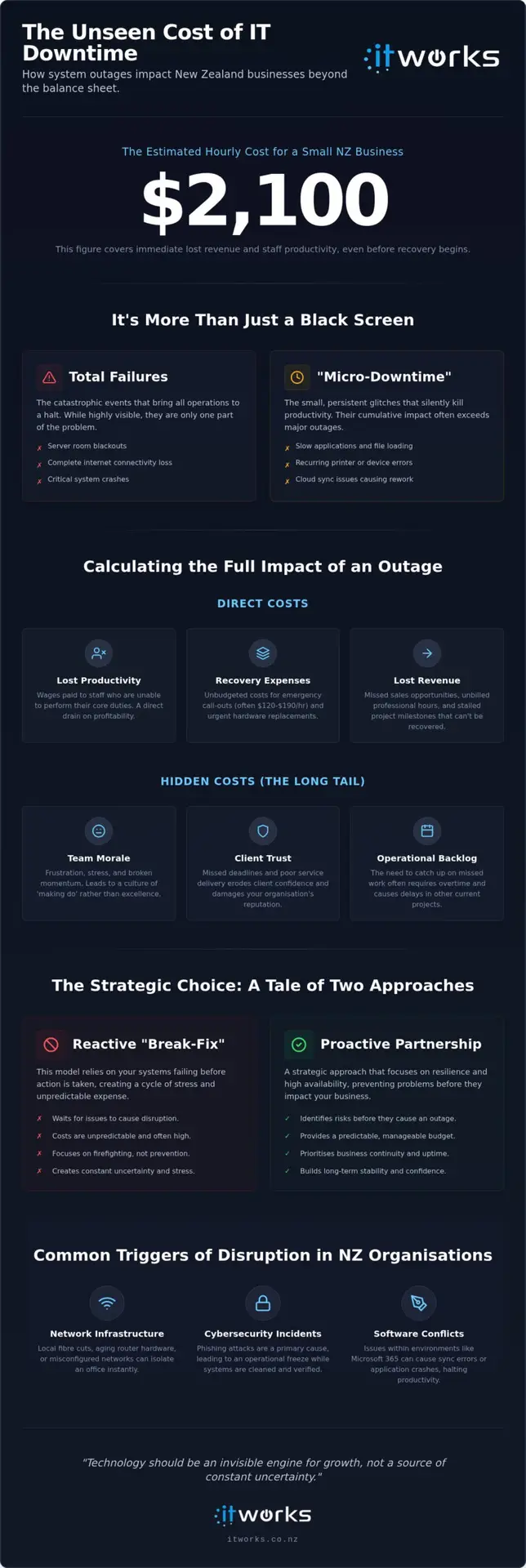
Did you know that the estimated cost of IT downtime for small business NZ has reached approximately $2,100 per hour, even before the recovery process begins? While that figure is sobering, most leaders in Christchurch and Auckland recognise that the true damage isn’t just the immediate loss of revenue. It’s the collective sigh of frustration from a team that can’t do their jobs, the erosion of client trust, and the persistent stress of wondering when the next reactive “break-fix” emergency will strike.
We understand that technology should be an invisible engine for growth, not a source of constant uncertainty. In this article, you’ll discover how to calculate the comprehensive impact of system outages on your organisation and why shifting toward proactive management is the most sustainable financial choice. We’ll provide a practical framework to measure these hidden costs, helping you justify the move toward a more resilient and strategically aligned IT environment that supports your long-term goals.
Key Takeaways
- Recognise that downtime includes both total system failures and the “micro-downtime” caused by slow, inefficient technology.
- Use a structured approach to measure the true cost of IT downtime for small business NZ, including lost staff productivity and recovery expenses.
- Learn why New Zealand SMEs face higher risks from outages due to limited redundancy and the high value placed on client service.
- Identify practical steps to build resilience, such as auditing your current systems for single points of failure and implementing disaster recovery plans.
- Understand how strategic managed IT support replaces the stress of unpredictable “break-fix” bills with a proactive, outcome-focused partnership.
Beyond the Blue Screen: What IT Downtime Really Means for NZ SMEs
Many business owners in Wellington or Christchurch view IT downtime as a rare, catastrophic event. They picture a server room fire or a total system blackout that brings everything to a grinding halt. In reality, downtime is any period when your technology fails to support your daily business operations. For a local accounting firm or a busy construction office, this might mean an inability to access client files, a failure to process invoices, or a simple lack of internet connectivity. When calculating the cost of IT downtime for small business NZ, we have to look past the obvious total failures.
We also need to consider “micro-downtime”. These are the smaller, persistent glitches that plague many workplaces. It’s the five minutes spent waiting for a slow application to load, the recurring printer error, or the cloud sync issue that creates duplicate files. While these moments seem minor, they are the silent killers of productivity. They aggregate over weeks and months, creating a hidden drain on your resources that often exceeds the impact of a single, major outage. Modern workplaces are more dependent on technology than ever before, making these “minor” interruptions far more damaging than they were a decade ago.
The psychological toll on your team is just as significant. When systems are unreliable, staff lose their momentum. Frustration builds, and the sense of professional flow is broken. Instead of focusing on high-value work, your people spend their energy troubleshooting tech problems they aren’t trained to solve. This creates a culture of “making do” rather than one of excellence. Over time, this erosion of confidence can lead to higher staff turnover and a general decline in organisational morale.
The Difference Between Reactive and Proactive Support
The traditional “break-fix” model is fundamentally flawed because it relies on your business failing before your IT provider makes any money. This reactive approach creates a cycle of stress and unpredictable expenses. By contrast, proactive management focuses on high availability, where systems are designed to be resilient and redundant. Proactive monitoring identifies a failing hard drive or a security vulnerability before it results in an actual outage. This shifts the relationship from a simple technical helpdesk to a strategic partnership that prioritises your business uptime and long-term stability.
Common Causes of Disruption in New Zealand Organisations
Disruptions in NZ often stem from three main areas. First, network infrastructure issues, such as local fibre cuts or aging router hardware, can isolate an office instantly. Second, cybersecurity incidents, particularly phishing attacks, can lead to an operational freeze while systems are cleaned and verified. Finally, software conflicts within the Microsoft 365 environment often cause sync errors or application crashes. Understanding these triggers is the first step toward reducing the total cost of IT downtime for small business NZ and ensuring your team remains productive.
Calculating the Bill: Direct and Indirect Costs of a System Outage
When a system fails, the clock starts ticking on your balance sheet. The most immediate impact is direct labour. If you have ten staff members earning an average wage and they are unable to access their tools for three hours, you aren’t just losing three hours of progress. You are paying for thirty hours of unproductive time. Understanding the cost of IT downtime for small business NZ requires looking at these idle wages as a direct drain on profitability. This is a core component of the true cost of downtime that many leaders overlook.
Recovery costs add another layer of expense. In New Zealand, reactive “break-fix” support rates typically range between $120 and $190 +GST per hour. These emergency call-outs are rarely budgeted for and often involve hardware replacements at short notice. Then there is the revenue loss. For a service-based business in Auckland or Wellington, three hours of downtime might mean several missed sales opportunities or a significant block of unbilled professional hours that can never be recovered. With the average small business in NZ experiencing about 14 hours of unplanned downtime per year, these figures accumulate quickly.
The “long tail” of an outage extends far beyond the moment the systems come back online. Your team must then work through a backlog of emails, data entry, and missed tasks. This often requires overtime pay or causes delays in current projects, further stretching your resources. When you add these factors together, the total cost of IT downtime for small business NZ becomes a significant operational burden that hampers your ability to compete and grow.
Hidden Costs: Reputation and Opportunity
Client trust is a fragile asset. If a system failure causes you to miss a critical deadline, the damage to your brand value can be permanent. Beyond external perceptions, recurring issues create internal friction. High-performing staff want to work in an environment that supports their success; constant technical glitches lead to frustration and, eventually, higher turnover. There is also the lost opportunity cost. Every hour your team spends wrestling with a printer or a locked account is an hour they aren’t innovating or growing your business.
The Cybersecurity Factor
A security breach represents the most expensive form of downtime. In the first quarter of 2026 alone, New Zealand organisations reported $5.6 million in direct financial losses from cyber security incidents. The costs involve more than just lost time; they include forensic investigations, data recovery efforts, and potential regulatory fines. Prioritising cyber security for small business NZ is no longer optional. It’s a fundamental strategy for reducing financial risk and ensuring your organisation remains resilient. You might consider how to discuss your technology strategy with a partner who understands these local risks.
Why NZ Small Businesses Feel the Pinch More Than Enterprises
While a multinational corporation might have the infrastructure to absorb a few hours of system failure, the cost of IT downtime for small business NZ is often far more punishing. Large enterprises typically invest in redundant hardware and failover systems that trigger automatically when an issue occurs. For a local firm in Auckland or a regional business in the Waikato, those safety nets rarely exist. When the primary system goes offline, there are no manual workarounds or secondary servers to pick up the slack. The operation simply stops.
This vulnerability is exacerbated by the high-touch nature of New Zealand SMEs. Many local businesses differentiate themselves through exceptional, personal service. When you can’t access a client’s records or respond to an urgent query because of a server glitch, that reputation for reliability is immediately compromised. Unlike a large utility company where customers expect a certain level of bureaucracy, an SME’s competitive advantage is its responsiveness. A single day of total downtime doesn’t just hurt the week’s revenue; it can threaten the long-term viability of a growing firm by damaging those hard-won relationships.
Fixed overheads also play a significant role. Rent, insurance, and salaries don’t decrease when your systems are down. When productivity drops to zero, these costs effectively double in weight. You are still paying for the space and the people, but the output required to cover those expenses has vanished. For a firm with thin margins, this sudden spike in unrecovered costs can be devastating.
Resource Constraints and Recovery Time
Most small organisations don’t have the luxury of a dedicated internal IT department. Often, the responsibility falls on a single staff member who happens to be “good with computers,” or a lone external contractor. This creates a dangerous bottleneck during an outage. If that one person is unavailable or overwhelmed, your recovery time stretches from minutes into hours or days. A strategic partnership provides access to a team with diverse technical skills, ensuring that a single point of failure in your support structure doesn’t increase the cost of IT downtime for small business NZ. This is why many organisations look to established providers like uptimeco.com for reliable network administration and technology consulting.
Cloud Dependency and Connectivity
New Zealand businesses have embraced cloud-based operations with enthusiasm, relying on platforms like Microsoft 365 for almost every daily task. While this provides great flexibility, it also means that your business is only as resilient as your network infrastructure. Poorly managed connectivity or a lack of redundancy in your home-office setups can lead to frequent, frustrating “micro-outages.” Ensuring resilience in a hybrid work environment requires more than just a fast connection; it needs a structured approach to network management that keeps your team connected regardless of where they are working.
Building Resilience: Practical Steps to Minimise Operational Disruption
Building resilience begins with a clear-eyed assessment of your current environment. You need to identify single points of failure, such as an aging server or a single internet connection that lacks a backup. By auditing your technology landscape, you can pinpoint where your organisation is most vulnerable. This isn’t just about technical specifications; it’s about understanding which business processes would stop if a specific piece of hardware or software failed. This proactive audit allows you to prioritise investments that provide the greatest return on stability.
A structured Technology Roadmap is a vital tool for this process. Instead of making hurried purchases when things break, a roadmap allows you to plan upgrades and security enhancements that align with your business goals. This strategic approach ensures that your infrastructure grows alongside your team, reducing the likelihood of the performance bottlenecks discussed earlier. Additionally, training your staff to recognise and report minor glitches early is essential. When your team feels confident reporting a slow application or a recurring sync error, you can often resolve the underlying issue before it escalates into a full-scale outage.
How to Calculate Your Business Downtime Cost
To move from reactive management to a strategic model, you first need to quantify the risk. You can use a simple formula to estimate the impact: (Average Hourly Wage x Number of Staff x Hours of Downtime) + Lost Revenue. At its core, the financial impact of a system outage is measured by the total value of professional output that remains unproduced while staff are unable to access their core applications. When you factor in the verified average cost of IT downtime for small business NZ, which sits at approximately $2,100 per hour, the business case for more robust systems becomes clear. This data provides the necessary justification to invest in managed it support services that prioritise uptime.
The Role of Business Continuity Planning
A Business Continuity Plan (BCP) is your organisation’s playbook for when things go wrong. It should outline clear response steps for different scenarios, from a simple power cut to a significant cybersecurity event. A key part of this plan is defining your Recovery Time Objective (RTO). This is the maximum amount of time your business can afford to be offline before the damage becomes critical. Setting an RTO helps you choose the right backup and disaster recovery solutions to meet that target. Finally, you must regularly test your backups. Having a backup is only half the battle; ensuring that data can be restored quickly and accurately is what truly protects your bottom line. To ensure your organisation is prepared for any scenario, you can talk to IT Works about your technology strategy.
Strategic Partnerships: How Managed IT Support Protects Your Bottom Line
The transition from reactive “break-fix” support to a strategic partnership represents a fundamental shift in how your organisation values its time. While we have already explored how the cost of IT downtime for small business NZ can reach $2,100 per hour, the solution isn’t simply fixing things faster. It’s about moving away from unpredictable emergency invoices toward a predictable, fixed monthly fee. This financial stability allows you to budget with confidence, knowing that your technology costs are aligned with your operational success rather than your technical failures.
A proactive approach relies on 24/7 system monitoring and maintenance that happens entirely behind the scenes. Our team identifies potential disruptions, such as failing hardware or security vulnerabilities, before they can escalate into an outage. This invisible layer of protection ensures that your staff can stay focused on their core duties without the constant interruption of minor glitches. By providing clear accountability and expert support, a managed service provider removes the technical burden from your leadership team, replacing stress with a sense of calm reliability.
Beyond maintenance, a strategic partnership offers the benefit of high-level advisory. We ensure your technology isn’t just “working,” but is actively supporting your long-term business goals. This involves regular reviews of your infrastructure to ensure it remains fit for purpose as your organisation grows. When you have a dedicated partner who understands your specific business context in Auckland or Wellington, technology becomes a catalyst for productivity rather than a recurring hurdle.
Why Proactive Management is a Strategic Investment
Proactive management is about more than just preventing outages; it’s about optimising the tools you already use. We focus on ensuring your Microsoft 365 environment and cloud applications are configured for maximum efficiency and security. This reduces the “micro-downtime” that often goes unmeasured but significantly impacts your annual results. IT Works acts as a seamless extension of your management team, providing the technical depth and strategic foresight required to navigate an increasingly complex digital environment. We help you avoid the common pitfalls of cloud dependency by building redundancy into your connectivity and workflow processes.
Next Steps for NZ Business Leaders
To secure your organisation’s future, start by reviewing your current IT support arrangements for hidden risks. Consider whether your current provider is truly proactive or if they only profit when your systems fail. We recommend booking a conversation to develop a practical technology roadmap that prioritises resilience and sustainable growth. This roadmap serves as your guide for future investment, ensuring every dollar spent on technology delivers measurable business value. Talk to IT Works about your technology strategy to ensure your organisation remains resilient, productive, and ready for whatever comes next.
Securing Your Operational Future
The true impact of a system outage is rarely found in the repair bill alone. It’s reflected in the silent hours of lost productivity, the stress placed on your team, and the potential damage to your client relationships. By quantifying the cost of IT downtime for small business NZ, you gain the clarity needed to transition from reactive “break-fix” cycles to a more stable, strategic model. This shift ensures that technology remains an invisible engine for success rather than a recurring source of frustration.
Resilience is a deliberate choice. Our NZ-based team provides the strategic advisory and proactive support your organisation needs to thrive. We focus on business outcomes rather than just technical fixes, acting as specialists in cybersecurity and business continuity for local SMEs. When your systems are aligned with your long-term goals, they stop being a source of uncertainty and become a reliable foundation for growth.
Talk to IT Works about your technology strategy to ensure your infrastructure remains a robust asset. We look forward to helping you build a more secure and productive future for your business.
Frequently Asked Questions
How much does IT downtime typically cost an NZ small business per hour?
The estimated financial loss for a small organisation in New Zealand is approximately $2,100 per hour of downtime. This figure accounts for immediate revenue loss and idle labour costs, but it doesn’t include the subsequent expenses for system recovery or hardware replacement. For many firms, the cumulative impact of these factors can significantly strain monthly cash flow.
What are the most common causes of IT downtime for New Zealand organisations?
Downtime in NZ is frequently caused by hardware failures, outdated software, and human error. Cybersecurity incidents, particularly phishing and credential harvesting, are also major contributors. Additionally, local businesses often face disruptions from network infrastructure issues, such as fibre cuts or connectivity glitches that isolate remote teams from their core cloud applications.
Is managed IT support more expensive than paying for repairs as they happen?
While the “break-fix” model has no fixed monthly cost, it’s often more expensive over the long term due to high emergency hourly rates. In New Zealand, reactive support typically costs between $120 and $190 +GST per hour. When you add the massive productivity loss during an outage, the total cost of IT downtime for small business NZ usually far exceeds the investment in a proactive managed service.
How can business continuity planning reduce the cost of an outage?
A business continuity plan reduces costs by minimising the time it takes to return to normal operations. By defining clear recovery time objectives and having a tested response playbook, your team avoids the confusion and delays that typically follow a system failure. This structured approach ensures that staff can return to productive work as quickly as possible, protecting your bottom line.
Does Microsoft 365 guarantee that my business will never experience downtime?
No, Microsoft 365 doesn’t provide a total guarantee against disruption. While the platform itself has high availability, your access depends on local factors like your internet connection and internal network configuration. You also remain responsible for your own data security and backups, as Microsoft doesn’t protect against data loss caused by accidental deletion or malicious internal activity.
What is the first thing I should do if my business experiences a major IT failure?
You should immediately activate your Business Continuity Plan and contact your technology partner. Clearly communicate the situation to your staff and provide instructions for any manual workarounds that are available. It’s vital to prevent team members from attempting their own technical fixes, as “DIY” troubleshooting can often lead to further data loss or extended recovery times.
How does proactive monitoring help prevent downtime before it occurs?
Proactive monitoring identifies early warning signs of failure, such as a degrading hard drive or unusual network patterns. By detecting these issues in real time, your IT partner can perform maintenance or replace hardware before a total outage occurs. This shift from reactive to proactive care ensures that your systems remain stable and your team stays productive without unexpected interruptions.
Can cyber insurance help cover the costs associated with IT downtime?
Yes, many cyber insurance policies are designed to cover business interruption costs and the expenses related to data recovery. However, insurers increasingly require proof that you have robust security measures in place, such as multi-factor authentication and regular software patching. Maintaining these standards not only helps with insurance claims but also reduces the overall cost of IT downtime for small business NZ by preventing incidents in the first place.