

What if the strongest case for cybersecurity isn’t the threat it prevents, but the business it helps you keep moving? For many New Zealand leaders, convincing management to invest in cybersecurity means balancing competing priorities and explaining technical risks in terms that matter to the organisation.
That challenge is understandable. Security can look like another IT cost when vulnerabilities are described in technical language, rather than connected to operational continuity, customer trust and the ability to grow with confidence. A clear business case shifts the conversation from worst-case scenarios to practical risk reduction and resilience.
This article will show you how to make that shift. You’ll learn to translate vulnerabilities into business impacts, prioritise investment around your organisation’s goals and use a technology roadmap to plan budgets over time. We’ll also explore how foundational safeguards and the right support can strengthen confidence without overwhelming your team. The aim is a constructive management discussion and a security plan that enables the business rather than competing with it.
Key Takeaways
- Make technical risks meaningful to decision-makers by connecting them to business priorities and outcomes.
- Frame cybersecurity as an enabler of client trust, resilient operations and confident growth.
- Build a practical case for investment by weighing potential disruption against the costs of prevention and recovery.
- Use a review of current security gaps and your 12-month business roadmap to shape clear investment priorities.
- When convincing management to invest in cybersecurity, show how a long-term technology partner can support resilience and fill internal capacity gaps.
Understanding the Communication Gap Between IT and the Board
Cybersecurity proposals can stall when the technical case is clear to IT but hard for business leaders to connect with organisational priorities. The issue isn’t that executives don’t care about security. They need to understand what a risk could mean for customers, staff and day-to-day operations before they can weigh it against other investment needs.
Why Technical Jargon Often Backfires
Terms such as “endpoint detection” and “SIEM” may describe useful security capabilities, but they don’t explain the business outcome. To a decision-maker managing competing budgets, a list of tools and acronyms can sound like another technical expense, creating budget fatigue rather than clarity.
Translate the risk into a realistic operational scenario. For example, explain that a weakness in access controls could allow an unauthorised person to reach important systems, disrupting staff work while access is investigated and restored. Instead of leading with “we need better threat monitoring”, describe what the organisation needs to detect, how that supports a timely response, and which business activities it helps protect.
The Security Language Barrier is the gap between describing a technical vulnerability and explaining its potential business impact. Left unaddressed, this communication gap becomes a barrier to strategic resilience because leaders can’t make informed decisions about risks they can’t see in business terms.
The Executive Perspective on Risk
General managers and business owners are responsible for the whole organisation. They’re likely to consider whether an issue could affect reputation, staff productivity, customer relationships or cash flow. These concerns provide a practical starting point for convincing management to invest in cybersecurity.
Shift the conversation from “IT problems” to business liabilities and decisions. Rather than asking for a tool because a system is outdated, explain what business process depends on it, what disruption could look like, and how the proposed investment would reduce that exposure. Be clear about what’s known, what needs further assessment and what the recommended next step is. That’s more useful than presenting a worst-case scenario as a certainty.
Build a shared language around the organisation’s purpose. If the priority is delivering reliable service, connect security to keeping essential systems and information available to the people who need them. If growth depends on customer confidence, explain how responsible protection of information supports trust with clients and partners. Security then becomes part of enabling the work, not just another item in the IT budget.
This approach reflects the principles of Information Security Governance, where security is directed and controlled in line with organisational priorities. The shift is from fixing things after they go wrong to planning technology that supports continuity, confident decisions and sustainable growth.
Reframing Cyber Resilience as a Strategic Business Asset
Cybersecurity is often easier to fund when it’s connected to what the organisation wants to achieve. Resilience supports dependable service, protects confidence among clients and partners, and gives leaders a stronger foundation for planned growth. It isn’t a promise that incidents won’t happen. It’s a practical way to reduce risk and prepare the organisation to keep operating.
This reframing also helps with convincing management to invest in cybersecurity. Rather than presenting security as a standalone technical programme, explain how it supports priorities such as serving customers reliably, working productively across locations, or meeting the information needs of a procurement process. The US Cybersecurity and Infrastructure Security Agency offers a useful starting point for making the business case for security, including connecting investment to organisational needs.
Beyond Protection: Enabling Innovation
Good security can create room to adopt technology with greater confidence. Before introducing AI or automation, consider what information the tools will handle, who should have access, and how their use will be governed. These decisions help teams explore practical applications without treating new technology as a substitute for sound planning. For further guidance, see this overview of AI automation solutions in New Zealand.
The same thinking applies to Microsoft 365 and flexible work. Clear access controls, appropriate information-sharing practices and well-managed accounts can help staff collaborate across locations while keeping business information appropriately protected. Security becomes part of making technology useful, not a reason to slow every change.
Building Market Trust and Confidence
Customers, partners and funders may ask how an organisation manages information, particularly during procurement or tendering. Being able to explain your approach clearly can help demonstrate that security is considered as part of doing business. Avoid promising perfect protection. Instead, describe the safeguards in place, how responsibilities are managed, and how the organisation reviews its priorities.
Reliable systems also support a simple but valuable outcome: being easy to do business with. Staff can focus on serving clients when essential tools and information are accessible to the right people. A deliberate approach to resilience can therefore strengthen trust while supporting consistent service.
As an organisation grows, its systems, users and information-sharing needs can change. A technology roadmap helps leaders plan security alongside that growth, rather than treating each new requirement as a separate reaction. If you’re assessing how security fits your plans, you can discuss your technology priorities with IT Works.
Calculating the Real Cost of Inaction Without Scare Tactics
A useful cybersecurity business case doesn’t rely on dramatic predictions. It shows management what disruption could mean for this organisation, using reasonable assumptions and information leaders can check. Start with the systems and work processes the business depends on, then consider how a period of disruption might affect staff, customers and revenue.
The Productivity Drain of Unreliable Systems
Recurring technology issues have costs that may not appear as a single line in the budget. Staff may spend time waiting, repeating work or finding workarounds. If core systems are unavailable, the organisation may also delay sales, service delivery or invoicing. Repeated friction can affect morale as well as productivity.
Build an estimate from your own operating information rather than relying on generic industry figures. Consider:
- Staff time: which roles would be affected, and how many paid hours could be lost?
- Business activity: what sales, appointments or services might be delayed?
- Recovery work: what internal time and external assistance could be needed to restore systems and check information?
- Customer impact: could disruption affect confidence, repeat business or important partner relationships?
Proactive monitoring and planned security management can help identify issues earlier and reduce reliance on unplanned recovery work. They don’t remove every risk, so compare the approach against your organisation’s actual needs and the work required to respond if systems are disrupted.
Risk vs. Investment: A Balanced View
Use a side-by-side comparison to guide discussion, not to imply that an outage is certain or that protection guarantees a particular result. Leave amounts blank until your finance and technology teams have assessed relevant figures.
Planned managed protection
Assess the proposed service or security investment, what it covers, the internal time required, and how it aligns with your technology roadmap. Use a supplier’s confirmed pricing for your organisation.
Estimated week-long outage
Estimate affected staff hours and wages, delayed or lost sales, recovery effort, and possible effects on customer retention. Use your own payroll, sales and operational information, and state any assumptions clearly.
This comparison makes convincing management to invest in cybersecurity a more grounded conversation: leaders can weigh a planned investment against a clearly explained exposure, without overstating either side. A breach may also require time and care to rebuild confidence with customers and partners, even after systems are restored.
There’s a confidence dividend, too. When risks, responsibilities and response plans are understood, leaders can spend less time wondering whether basic protections are in place and more time focusing on business priorities. Resilience is a planned outcome, not a lucky one.
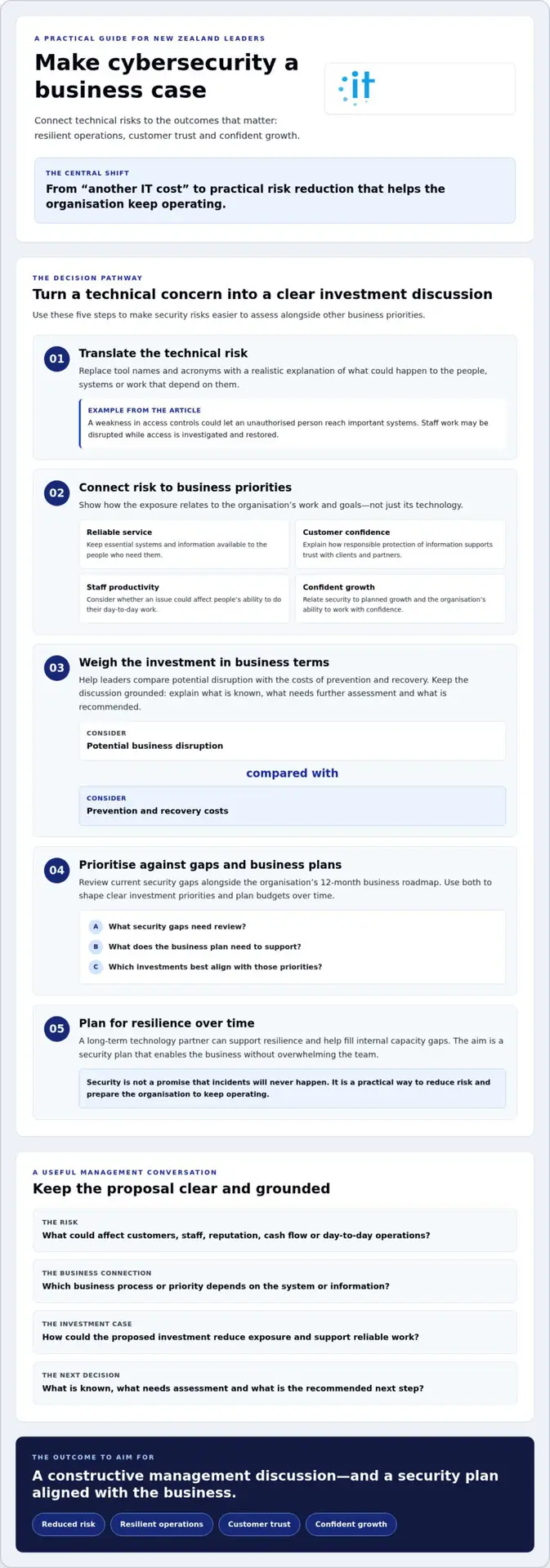
A Step-by-Step Framework for Your Cybersecurity Proposal
A strong proposal makes the decision clear: what needs attention, why it matters to the organisation, and how progress can be planned. This framework helps turn convincing management to invest in cybersecurity into a practical discussion about priorities, responsibilities and outcomes.
- Step 1: Review your current position. Identify the systems and information the organisation relies on, the safeguards already in place, and the gaps that need attention. Separate confirmed issues from areas that still need assessment.
- Step 2: Connect priorities to the business roadmap. Show how security needs relate to planned changes, such as growth, new ways of working or a Microsoft 365 migration. A technology roadmap can help management sequence investment and plan budgets across multiple years. For an example of roadmap thinking, see this guide to IT strategy for non-profits in New Zealand.
- Step 3: Recommend layers, not a silver bullet. Explain how different measures address different risks. Identity controls help ensure people access only what they need; email protection helps reduce exposure to suspicious messages; and endpoint protection helps safeguard the devices staff use. No single measure covers every situation.
- Step 4: Describe outcomes without overpromising. Focus on goals such as reducing avoidable disruption, protecting access to important information and supporting staff productivity. Avoid promises such as “guaranteed uptime”. Instead, state what the proposal is designed to improve and how progress will be reviewed.
- Step 5: Offer a manageable path forward. If it suits the organisation, propose a pilot or phased implementation. Explain what each phase includes, who is responsible, what decisions are needed and how the investment fits the budget cycle.
Make the Roadmap Practical
Security is easier to plan when it’s considered alongside projects already on the calendar. During a Microsoft 365 migration, for example, include decisions about account access, information sharing and staff guidance in the project plan. This helps avoid treating security as an afterthought or an unexpected addition once a project is under way.
Show How Accountability Works
A layered approach depends on people as well as technology. Include security awareness training so staff understand how to handle common situations, such as an unexpected request for sensitive information. Then make ownership visible: name who approves priorities, who coordinates the work, and how the organisation will review progress. Clear accountability helps management see how the proposal will be put into practice, not just what tools it recommends.
A concise proposal should leave executives with a clear view of the business need, recommended sequence, expected outcomes and decisions required. It gives technical teams and management a shared plan to refine together.
Partnering for Long-term Resilience and Growth
A security product can address a particular need, but choosing a tool is only one part of building resilience. Organisations also need to decide how security priorities fit their plans, who is responsible for putting them into practice, and how progress will be reviewed. A technology partner can help connect those decisions, rather than leaving leaders to coordinate separate tools and advice on their own.
For internal IT leaders, that relationship can provide extra strategic and operational capacity. A partner who works as an extension of the organisation can help translate business priorities into technology decisions, support clear accountability, and keep a roadmap moving. This makes it easier to connect leadership’s direction with the practical work of strengthening cybersecurity.
The Value of Local Advisory
Local context matters. A New Zealand-based advisory team can discuss priorities with an understanding of the environment local organisations operate in, including the regulatory considerations relevant to their circumstances. For specific obligations, organisations should seek appropriate advice rather than assume one approach applies to every business.
That local conversation can also make it easier to explain the organisation’s structure, customers and working practices, then shape advice around those realities. For internal IT leaders managing competing demands, a proactive partner can help identify priorities and coordinate planning, reducing the burden of carrying every strategic and operational decision alone.
Taking the First Step Toward Confidence
A partnership doesn’t need to begin with a large programme or a commitment to a particular product. Start with a conversation about business goals, current concerns and upcoming plans. Strategic consulting can help clarify where technology and security decisions support those goals, which gaps need attention first, and what can be planned over time.
This approach also strengthens the case for convincing management to invest in cybersecurity. Leaders can consider a clear set of priorities, responsibilities and next steps, rather than being asked to approve an isolated tool without the context needed to assess its value.
IT Works brings a strategic and operational perspective to technology planning for New Zealand organisations. Discussing your goals and current priorities is a practical first step towards a partnership that supports resilience and growth.
Turn Cybersecurity Priorities into Confident Action
A strong cybersecurity case connects risk to the organisation’s goals. Explain what needs protecting in business terms, weigh the potential impact of disruption fairly, and propose clear steps that fit the technology roadmap and budget. This makes convincing management to invest in cybersecurity a strategic conversation, not simply a request for more IT spending.
Long-term resilience also depends on clear ownership and advice that reflects your organisation’s context. Proactive, outcome-focused technology roadmaps help leaders plan ahead, while local New Zealand-based support and advisory can provide a grounded perspective. A strategic partner can work alongside your team to align technology decisions with priorities for productivity and growth.
You don’t need to solve every security challenge at once. Start by agreeing on the priorities, responsibilities and next steps that matter most. With a considered plan and the right partnership, your organisation can build confidence steadily and make security an enabler of business success.
Frequently Asked Questions
How do I explain the ROI of cybersecurity when nothing happens?
Explain that the value is in reducing disruption and helping the organisation continue operating, not in claiming a breach has been prevented. Track practical indicators such as recurring security gaps addressed, staff training completed, backup recovery tests and time spent resolving technology issues. These measures give management visibility of progress. Be clear that they show preparedness and risk reduction, not a guaranteed financial return or proof that an incident would otherwise have occurred.
Can we just use insurance instead of investing in cybersecurity?
No. Cyber insurance and cybersecurity serve different purposes. Insurance may help with some losses, subject to the policy’s terms, while security measures aim to reduce risk and support operational resilience. Insurers may also expect organisations to have foundational controls in place. Review policy requirements with your broker, and assess security priorities separately so the organisation isn’t relying on insurance as a replacement for practical safeguards.
What are the most critical security areas to fund first on a tight budget?
Start with a review of your organisation’s most important systems, information and current gaps, then prioritise foundational measures. These commonly include keeping software updated, using multi-factor authentication, backing up critical data and providing staff security awareness training. The right order depends on your environment and existing protections. A documented assessment helps management direct limited funding towards the risks most relevant to business operations.
Is cybersecurity just an IT problem or a management problem?
Cybersecurity is an organisational issue, with IT contributing specialist knowledge and management setting priorities, approving resources and clarifying accountability. Decisions about access, information handling and business continuity affect teams beyond IT. Leaders don’t need to manage technical controls themselves, but they should understand the business risks and agree on how they’ll be addressed. Shared ownership helps align security with the organisation’s goals and day-to-day responsibilities.
How does modern security actually improve staff productivity?
Well-planned security can support productive work by helping staff access the systems and information they need, while reducing avoidable interruptions. For example, clear access arrangements and reliable account management can make collaboration smoother, while staff guidance helps them handle suspicious messages with confidence. Security needs to be practical and proportionate. If controls create unnecessary friction, review how they’re configured and whether they fit the way people work.
What happens if management refuses to invest despite the risks?
If a proposal isn’t approved, document the risks discussed, the reasons for the decision and any agreed alternatives. Offer a staged option that addresses the highest-priority gaps first, and clarify which risks remain. This keeps the conversation factual rather than confrontational. Agree when the decision will be reviewed, such as during budget planning or after a material change to systems, services or business priorities.
How do I justify the cost of managed security services vs. doing it in-house?
Compare the options by looking at the capabilities required, internal capacity, accountability and ongoing effort, not just the quoted service fee. Consider who will coordinate security work, maintain the roadmap and provide specialist input alongside existing responsibilities. An in-house approach may suit some organisations; external support may add capacity for others. Use confirmed proposals and your own staffing information to make a fair comparison without assuming one model is always cheaper.
How often should we review our cybersecurity investment with the board?
Set a regular review that fits your governance and budgeting cycle, and revisit priorities when there are material changes to the organisation’s systems, operations or growth plans. A useful update can cover progress against the roadmap, unresolved risks, planned work, responsibilities and decisions needed from the board. Keep the discussion focused on business impact and next steps, so leaders can adjust investment as priorities change rather than relying on a one-off approval.