

Did you know that direct financial losses from cyber incidents in New Zealand reached $5.6 million in the first quarter of 2026? This 76% increase from the previous quarter highlights a growing reality for local organisations. You’ve probably experienced the frustration of a sudden system crash slowing down your staff or the confusion of an unpredictable IT invoice that wasn’t in the budget. It’s easy to fall into the trap of break-fix thinking, where you only address technology when it stops working. However, the risks of not having a dedicated IT strategy go much deeper than daily annoyances. Without a structured plan, your business faces hidden security gaps and operational friction that can quietly hinder your long-term progress.
We believe technology should be a steady partner in your success, not a source of constant stress. This article explains how a structured technology roadmap provides the clarity you need to make informed decisions for your team in Auckland, Wellington, or Christchurch. We’ll explore how moving away from reactive support leads to predictable costs and a more resilient organisation. You’ll learn how to align your systems with your actual business goals, ensuring your team has the tools they need to perform without the vulnerabilities of an unplanned environment.
Key Takeaways
- Shift from reactive “break-fix” habits to a proactive technology roadmap that aligns your systems with your 12-month and 36-month business objectives.
- Understand the critical risks of not having a dedicated IT strategy, including the hidden security vulnerabilities created when staff use unmanaged tools to solve everyday problems.
- Reduce staff frustration and improve retention by ensuring your technology supports daily workflows rather than creating unnecessary friction or burnout.
- Secure your organisation’s financial health by moving toward predictable IT budgeting that eliminates surprise invoices and wasteful emergency spending.
- Gain a clear understanding of your current risk profile through a comprehensive environment audit designed to identify and close immediate security gaps.
Understanding the Gap Between Technology and Business Goals
Many New Zealand organisations view their technology as a utility, similar to electricity or water. You expect it to work when you flip the switch, and you only call someone when the lights go out. This reactive approach is often a result of rapid growth or limited internal capacity, where teams are too busy keeping the lights on to plan for the future. However, a dedicated IT strategy is not just a list of hardware to buy. It’s a proactive roadmap that ensures every piece of software and every server supports your operational efficiency and service reliability.
Shifting your mindset from viewing IT as a cost centre to seeing it as a strategic asset is essential for sustainable growth. When technology is aligned with your business goals, it stops being a hurdle and starts being a catalyst. Understanding What is a Technology Strategy? helps clarify that this process is about making informed choices that provide long-term value rather than just solving immediate technical glitches. One of the primary risks of not having a dedicated IT strategy is that you’re always playing catch-up, spending money on emergency fixes rather than investing in systems that drive your business forward.
The Difference Between IT Support and IT Strategy
It’s easy to confuse these two concepts, but they serve very different purposes. IT support is reactive; it focuses on fixing what is already broken to get you back to work. In contrast, an IT strategy is outcome-focused. It’s designed to prevent the break from happening in the first place. While support handles the daily tickets, strategy involves detailed budgeting, risk management, and lifecycle planning. This ensures your systems are always ready to support your next stage of growth without the stress of unexpected failures.
Why Standing Still is a Business Risk
Standing still in a fast-moving market is effectively moving backwards. This often leads to technical debt, which is the accumulated cost of maintaining outdated systems instead of upgrading them. Old systems don’t just cost more to maintain; they create future expenses and security vulnerabilities that can be difficult to manage. Meanwhile, your competitors in Auckland or Wellington may be using strategic technology to outpace you, automating their workflows and providing better service to their clients. If your technology doesn’t evolve alongside your business objectives, it becomes a weight that holds you back from reaching your full potential.
The Practical Risks of Reactive Technology Management
Reactive management often feels like you’re constantly putting out fires. When a business lacks a clear direction, employees naturally look for their own ways to stay productive. This leads to “Shadow IT,” where staff use unmanaged apps or personal cloud accounts to bypass clunky internal systems. While they’re just trying to get the job done, they’re inadvertently opening doors for data breaches and creating significant Tech-Related Risk Factors that management might overlook. As teams experiment with new tools, especially in the realm of AI, a lack of governance means sensitive company data could be fed into public platforms without any oversight.
Without a roadmap, you also risk creating data silos. Information gets trapped in individual departments, making it impossible to get a single, accurate view of your business performance. This lack of integration is one of the major risks of not having a dedicated IT strategy, as it prevents your team from collaborating effectively. When systems don’t talk to each other, your people have to fill the gaps, leading to frustration and, eventually, burnout.
Operational Friction and Productivity Losses
Disjointed systems force your team into manual workarounds and double-handling of data. If your project management tool doesn’t align with your accounting software, someone has to type that information twice. It’s a waste of talent. Recurring downtime further compounds the issue, making it difficult to meet deadlines or maintain customer trust. Many organisations also pay for premium licenses like Microsoft 365 but only use a fraction of the available features. Strategic management ensures these tools actually support your workflow rather than just being a monthly expense on an invoice.
Cybersecurity Gaps and Resilience
A reactive stance is particularly dangerous for security. Evolving threats require a layered defence that reactive support simply cannot provide. One of the key risks of not having a dedicated IT strategy involves the failure to build long-term resilience, as basic maintenance like patching and identity management often falls through the cracks. This leaves your infrastructure vulnerable to credential harvesting and phishing attacks, which are increasingly common in New Zealand.
Resilience is about more than just having a backup; it’s about business continuity. A strategic partner helps you plan for how the business will function if a disruption occurs, building organisational confidence. If you’re concerned about your current setup, you can discuss your cybersecurity priorities with our team to ensure your foundations are solid and your team is protected.
Financial and Operational Fallout: The Cost of Standing Still
The financial impact extends far beyond the invoice from a technician. Hidden costs often include lost revenue from disrupted sales and the wages paid to staff who are unable to perform their duties while systems are down. According to the NCSC, direct financial losses from cyber incidents in New Zealand reached $5.6 million in the first quarter of 2026 alone. While not every technical failure is a cyber attack, the financial stakes of operational downtime are higher than ever. Predictable technology management allows boards and executive teams to move away from these volatile spikes, favouring a structured approach that supports long-term stability. For leaders seeking to bridge this gap, TechAxis Advisors provides executive technology advisory that aligns operational execution with high-level business strategy.
Fire-fighting is a costly way to run a business. When you lack a technology roadmap, procurement becomes a series of impulsive decisions rather than a strategic exercise. A managed service model provides a consistent monthly fee, making it easier to forecast cash flow and allocate resources where they are needed most. By implementing lifecycle management, you can predict exactly when hardware will need refreshing, allowing for multi-year financial planning. This prevents sudden capital expenditure hits that can derail other business initiatives.
Strategic management also identifies opportunities for vendor consolidation and cloud optimisation. Many organisations in Auckland and Wellington find they are paying for overlapping services or underutilised software licenses. A dedicated strategy ensures you only pay for what you actually use, turning your IT spend into a lean, purposeful investment.
Reputational Damage and Lost Trust
Your technology is often the primary interface between your organisation and your customers. When systems are unreliable, it sends a message that the business is struggling to keep up. This can lead to a slow erosion of trust that is difficult to rebuild. For those in the charitable sector, these issues are even more sensitive. Donor confidence relies on the perception of professional, secure, and efficient operations. If you’re operating in this space, exploring an IT Strategy for NZ Not-for-profits can help you align your mission with your technical capabilities, ensuring your supporters feel their contributions and data are in safe hands.
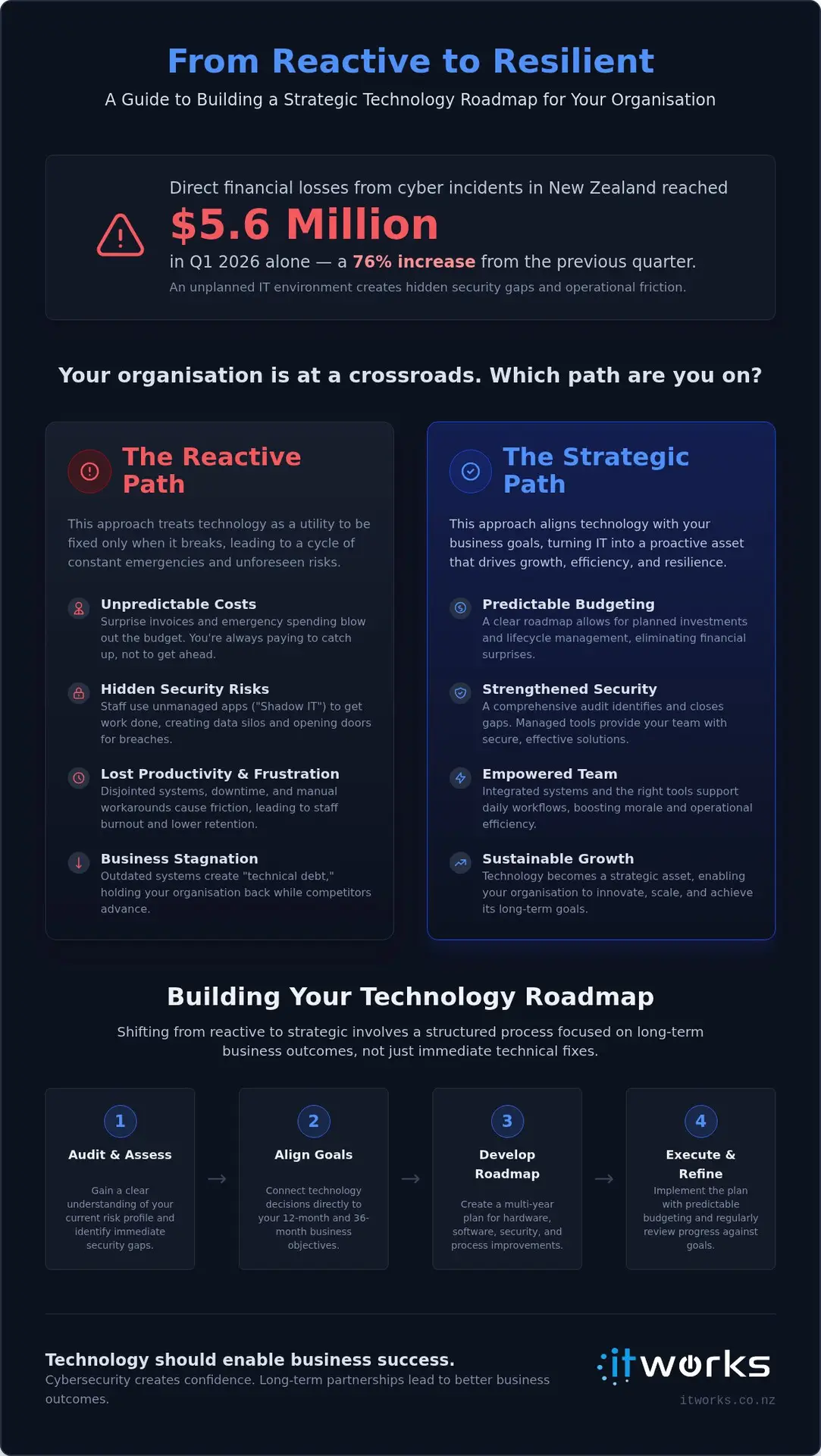
Reactive to Resilient: Building a Technology Roadmap
Moving from a reactive stance to a resilient one requires more than just better support. It requires a structured framework. A technology roadmap serves as this framework, acting as a living document that guides your organisation through complex technical decisions. By aligning your technology with your 12-month and 36-month business objectives, you ensure that every investment serves a clear purpose. This approach effectively mitigates the risks of not having a dedicated IT strategy by replacing guesswork with a clear, actionable plan that evolves as your business grows.
Step 1: The Technology Audit and Risk Assessment
The first step is understanding exactly where you stand. A comprehensive audit looks beyond just whether your computers turn on. It examines your entire infrastructure, your security posture, and your software licensing to ensure everything is compliant and efficient. We look for “single points of failure,” such as a critical server with no redundancy or a single person holding all the administrative passwords. We also evaluate staff pain points. If your team in Wellington or Auckland is using manual workarounds because a tool is too slow, that’s a risk to productivity that needs addressing. Identifying these gaps early is the only way to avoid the long-term risks of not having a dedicated IT strategy.
Step 2: Defining Strategic Priorities
Once the gaps are identified, you must decide what to fix first. Not everything can be a priority. You might need to choose between a cloud migration to improve remote access or security hardening to meet new compliance standards. For many modern organisations, this also includes a “Copilot readiness” framework. This ensures your data is clean and your permissions are secure before you enable AI tools. By focusing on projects that offer the highest risk reduction and productivity gains, you ensure your technology supports your business growth rather than hindering it.
Step 3: Budgeting and Implementation
A roadmap is only useful if it’s actually followed. This requires a transparent timeline for project delivery and hardware refreshes, ensuring everyone knows when to expect changes. Establishing clear accountability is vital; someone must be responsible for managing the roadmap and conducting regular reviews. This prevents the business from slipping back into reactive habits. For a deeper look at how to structure this, you can refer to our Guide to Managed IT Support, which provides the necessary implementation frameworks for local organisations.
Securing Your Future with Strategic Technology Advisory
Choosing to ignore the risks of not having a dedicated IT strategy often leads to a state of constant, low-level anxiety for business owners. You might find yourself waiting for the next system failure or wondering if your data is truly protected. Moving beyond this reactive cycle requires a shift toward strategic advisory. IT Works acts as a strategic ally, providing the professional guidance needed to turn your technology into a reliable asset. Our team understands the New Zealand business landscape, from the unique challenges facing organisations in Auckland to the operational needs of firms in Wellington and Christchurch.
A long-term partnership model offers far more than traditional technical support. It provides a clear window into your organisation’s governance and risk profile. When you have a partner who is deeply invested in your journey, you gain the visibility required to make informed decisions. This collaborative approach replaces the frantic energy of “break-fix” management with a sense of calm reliability. By focusing on purposeful action rather than emergency repairs, you can lead your organisation with a newfound state of confidence.
The Value of a Strategic Technology Partner
We don’t just provide a helpdesk; we act as an extension of your executive team. This blend of operational support and strategic consulting, often referred to as a virtual Chief Information Officer (vCIO) service, ensures your daily technical needs are met while your long-term goals remain in focus. We prioritise practical outcomes over selling specific products. Our focus is on ensuring your systems are integrated, secure, and ready to support sustainable growth. This strategic alignment helps you avoid the common risks of not having a dedicated IT strategy, such as wasteful spending on tools that don’t fit your workflow.
Next Steps for Your Organisation
It’s never too late to start building a technology roadmap. Whether you’re managing a team of 10 or 250, the first step is simply having an open conversation about your current challenges and future goals. We’re here to help you identify immediate gaps and plan for the years ahead. This process isn’t about complex jargon or high-pressure sales; it’s about finding a pragmatic path forward that works for your specific team and budget.
If you’re ready to move away from the stress of reactive management, we invite you to reach out. We can help you audit your current environment and begin the journey toward a more resilient, productive future.
Talk to IT Works about your technology strategy or discuss your cybersecurity priorities with our team to ensure your organisation is built on a stable foundation.
Building Resilience Through Strategic Alignment
Moving from a state of constant technical friction to one of calm reliability is a deliberate choice. It requires a commitment to looking beyond the immediate fix and prioritising long-term stability for your team. By aligning your systems with specific business goals, you create an environment where your people thrive without the threat of downtime or hidden security gaps. Understanding the risks of not having a dedicated IT strategy is the essential first step toward building a more resilient and predictable organisation.
IT Works brings over 20 years of experience to this journey, acting as a steady guide for organisations across New Zealand. Our NZ-based team of strategic advisors specialises in practical AI readiness and Microsoft 365 enablement, ensuring your systems support your daily operations rather than hindering them. We focus on providing the clarity you need to make informed decisions, replacing the stress of reactive management with a structured, forward-thinking approach.
We’re here to help you build a technology roadmap that provides both security and peace of mind for the future of your organisation.
Frequently Asked Questions
What is the first sign that our organisation lacks an IT strategy?
Recurring technical glitches and a feeling of being reactive are common indicators. When your staff frequently experience the same issues and your IT team is constantly fire-fighting rather than planning, you’re likely missing a roadmap. This lack of direction often leads to operational friction where technology hinders rather than supports your team’s productivity. It’s a clear signal that your systems aren’t aligned with your business goals.
How much does it cost to develop a technology roadmap in New Zealand?
The cost of developing a technology roadmap varies based on the size and complexity of your organisation’s infrastructure. Rather than a one-size-fits-all price, it’s often included as part of a strategic partnership or delivered as a professional service project. Factors like the number of users, current security posture, and your 36-month growth objectives influence the investment required. We recommend discussing your specific needs to get an accurate estimate for your environment.
Can we build an IT strategy without hiring a full-time IT Manager?
Yes, many organisations successfully develop and manage their technology strategy through a partnership with a managed service provider. This model gives you access to virtual Chief Information Officer (vCIO) services without the overhead of a full-time executive salary. You benefit from a team of specialists who understand the local business environment. This approach ensures your strategy remains proactive and aligned with your organisational goals while your team focuses on their core work.
What is the difference between a disaster recovery plan and an IT strategy?
A disaster recovery plan is a reactive document focused on restoring systems after a failure, while an IT strategy is a proactive roadmap for long-term growth. One is about resilience in a crisis; the other is about strategic alignment and productivity. While a recovery plan is a vital component of your overall strategy, it doesn’t address the ongoing risks of not having a dedicated IT strategy, such as financial waste or missed innovation.
How often should a technology roadmap be reviewed and updated?
We recommend a formal review of your technology roadmap at least once a year, with quarterly check-ins to monitor progress. Technology moves fast, and your business objectives may shift as you grow. Regular reviews ensure your infrastructure and security measures remain relevant. This methodical approach prevents your strategy from becoming a static document, allowing you to adapt to new developments like AI while maintaining a stable and secure operational foundation for your organisation.
Does our IT strategy need to include AI and automation right now?
Incorporating AI and automation into your strategy is increasingly important for maintaining a competitive edge. However, the focus should be on practical enablement and responsible governance rather than following hype. Your roadmap should outline a Copilot readiness framework, ensuring your data is secure and your permissions are correctly managed before adoption. This structured approach helps you identify specific use cases where automation can truly improve staff productivity and operational efficiency across the organisation.
How does a dedicated IT strategy improve cybersecurity resilience?
A dedicated strategy improves resilience by replacing fragmented security fixes with a layered, proactive defence model. It ensures that essential maintenance, such as identity management and vulnerability patching, happens consistently rather than as a reaction to a threat. By identifying the risks of not having a dedicated IT strategy, you can close security gaps before they are exploited. This builds organisational confidence, knowing your data is protected by a structured and monitored system.
Can an IT strategy help reduce our monthly software licensing costs?
Yes, a strategic review often identifies significant opportunities for licence optimisation and vendor consolidation. Many organisations pay for premium features in tools like Microsoft 365 that they don’t actually use, or they pay for overlapping services across different departments. A roadmap helps you audit these subscriptions, ensuring you only invest in tools that provide genuine value. This leads to more predictable IT costs and eliminates wasteful spending on underutilised software.