

What if the most expensive part of your technology isn’t the hardware you buy, but the strategy you don’t have? For many local organisations, managing IT feels like a constant cycle of putting out fires, where unpredictable spending and staff frustration become the daily norm. Developing a structured it roadmap for small business nz is the most effective way to break this cycle, moving your team away from reactive support and toward a position of calm, strategic control.
We understand that you want to feel confident in your systems rather than anxious about the next crash or the fact that nearly half of all New Zealand businesses reported a cybersecurity attack last year. This article will show you how a deliberate technology strategy protects your organisation from hidden risks and provides a reliable path for sustainable growth. We will explore how to create predictable budgets, strengthen your security posture, and establish a clear list of priorities for the next 12 to 24 months, ensuring your tools finally align with your broader business goals.
Key Takeaways
- Understand how the reactive trap leads to unpredictable spending and unmanageable technical debt that eventually hinders your ability to grow.
- Learn how a structured it roadmap for small business nz serves as a living document to guide your technology investments over a clear 12 to 36 month period.
- Discover the practical benefits of shifting from a break-fix model to a managed partnership that focuses on preventing faults before they disrupt your team.
- Identify the essential steps for building a strategy, starting with a comprehensive audit to align your tech priorities with your specific business goals.
- See why partnering with local experts ensures your technology remains secure and compliant with New Zealand regulations while supporting long-term organisational success.
The True Risks of Not Having a Dedicated IT Strategy
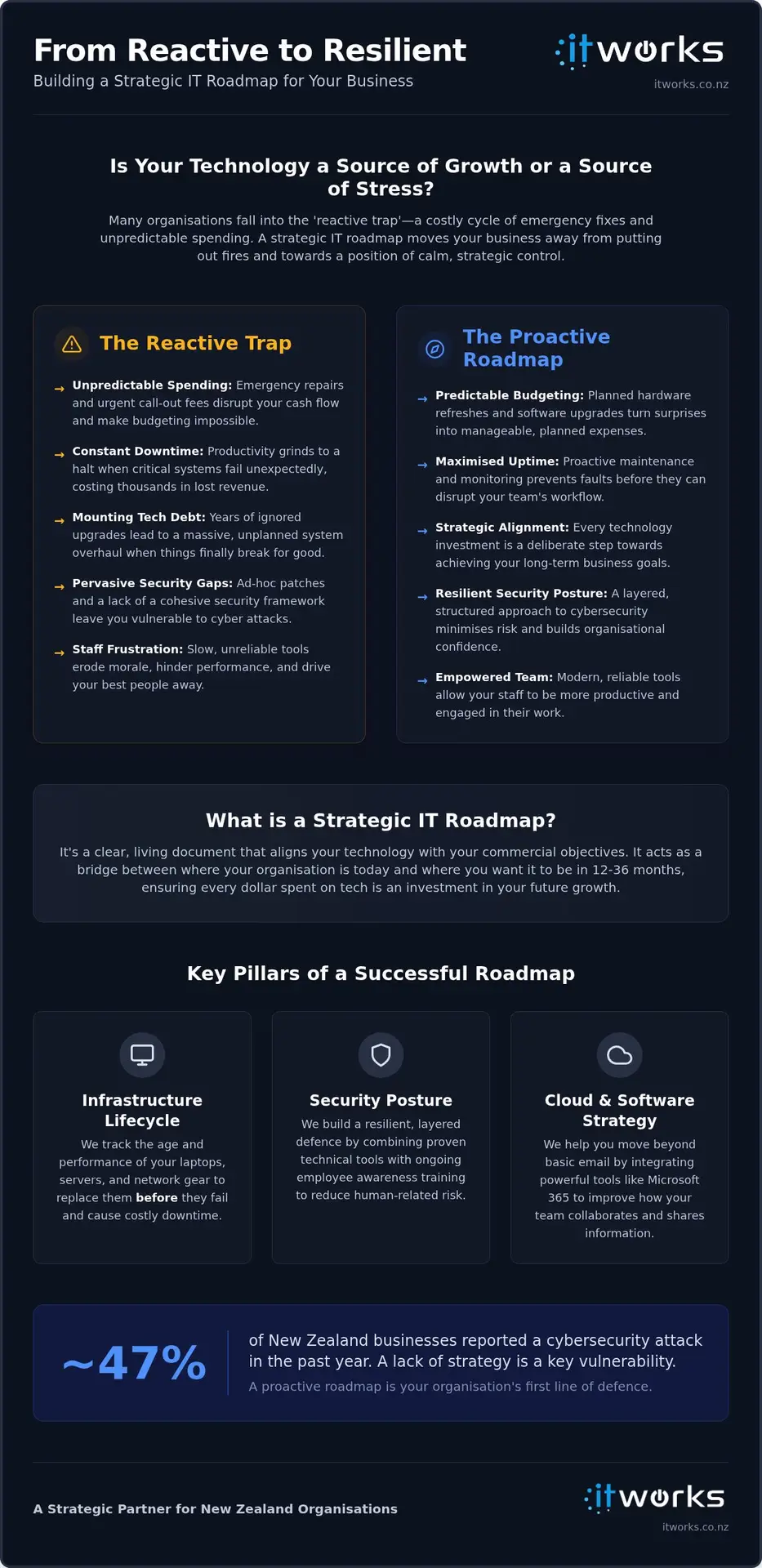
Running a business without a clear plan for your technology often leads to what we call the reactive trap. It’s a cycle where you only spend money when something fails. While this might seem like a way to save on monthly costs, it’s actually the most expensive method of management. You aren’t just paying for the repair. You’re paying for the sudden loss of productivity and the stress of an emergency. Over time, this creates tech debt. This is the unmanageable bill that arrives when years of ignored upgrades finally force a total, unplanned system overhaul.
A strategic approach, often defined through a What is a Technology Roadmap?, helps you avoid these spikes. Without a structured it roadmap for small business nz, your systems slowly become a collection of mismatched tools that frustrate your staff. When your team spends more time fighting with slow software than doing their actual jobs, talent retention becomes a real challenge. No one wants to work with tools that make their day harder. Unreliable tech eventually erodes morale and drives your best people toward competitors who prioritise a modern work environment.
The Financial Toll of Unpredictable IT Costs
Surprise hardware failures are more than just a nuisance; they disrupt your cash flow and make budgeting nearly impossible. When a server or a critical network switch fails in Auckland or Wellington, the cost of an hour of lost productivity can quickly reach thousands of dollars. Reactive support often carries higher service fees because you are paying for urgent, after-the-fact interventions rather than planned maintenance. A proactive strategy allows you to replace equipment before it fails, turning surprises into predictable, manageable line items. This shift ensures that your technology supports your growth instead of draining your reserves during a crisis.
Cybersecurity Gaps in a Plan-less Environment
Nearly half of all New Zealand businesses reported a cybersecurity attack in the past year. In a plan-less environment, security is usually handled through ad-hoc patches rather than a cohesive framework. This leaves significant gaps that modern threats can exploit. If client data is compromised because of a lack of strategy, the damage to your reputation can be permanent. A lack of strategy also makes disaster recovery almost impossible to trust. Without a roadmap, you have no way to verify if your backups actually work until you are already in the middle of a crisis. Building a resilient organisation requires a structured approach to risk that moves beyond simple antivirus software.
What is an IT Roadmap for Small Business? A Practical Definition
Many business owners imagine an IT roadmap as a complex, 100-page technical manual filled with jargon. In reality, a functional it roadmap for small business nz is a clear, living document that aligns your technology with your commercial objectives. It acts as a bridge between where your organisation is today and where you want it to be in three years. By documenting your priorities, you ensure that every dollar spent on tech is an investment in your future growth rather than just another expense.
This alignment between technology and business goals is a key element of strategic transformation, a process often guided by multidisciplinary advisory firms such as Formatour Incorporated to ensure long-term operational performance and organisational resilience.
A strategic roadmap typically looks 12 to 36 months ahead. This timeframe is critical because it moves you beyond the current financial year’s immediate needs. It allows you to plan for major hardware refreshes or software migrations well in advance, protecting your cash flow from sudden shocks. When you talk to IT Works about your technology strategy, the goal is to create a visual timeline that makes sense to non-technical leaders, providing a sense of calm and predictability.
Core Components of a Successful Roadmap
A well-rounded strategy covers three main areas to ensure your foundation is stable and secure:
- Infrastructure lifecycle: We track the age of your laptops, servers, and networking gear. This ensures we replace them before they fail and cause downtime.
- Security posture: This involves a phased approach to building layered defences. It’s about combining technical tools with employee awareness training to reduce risk.
- Cloud and software strategy: We look at how to move beyond basic email. We focus on integrating tools like Microsoft 365 to improve how your team collaborates.
Why ‘Modernisation’ Beats ‘Transformation’ for SMEs
While larger corporations often talk about “transformation,” most New Zealand organisations benefit more from steady modernisation. This approach focuses on making reliable, incremental improvements rather than attempting disruptive overhauls that can overwhelm your staff. We prioritise projects based on two factors: the return on investment and the reduction of risk. This ensures that your team can actually adopt and use the new tools you implement, leading to better productivity without the usual stress of technical change.
Strategic Planning vs. Reactive Support: A Comparison
The choice between reactive support and strategic planning is often the difference between a business that survives and one that thrives. The traditional “break-fix” model functions like an emergency room. You only call for help when something is already broken, meaning you’re always starting from a position of loss. In contrast, a managed partnership focuses on health and prevention. This approach uses an it roadmap for small business nz to ensure your systems are monitored and maintained before they have the chance to fail.
Response times tell the real story. In a reactive model, your business stops while you wait for a technician to arrive and diagnose a fault. In a strategic model, most faults are identified and resolved in the background without your team ever knowing there was a problem. This shift changes your financial relationship with technology. Instead of facing high-stress, variable invoices that disrupt your cash flow, you move to a predictable monthly investment. This allows you to treat IT as a utility rather than a series of expensive surprises.
The Hidden Benefits of Business IT Strategy
Beyond basic stability, a proactive strategy provides a distinct competitive edge. When your systems are fast and integrated, your team can serve customers much quicker than rivals who are still struggling with legacy tools. Scalability also becomes a seamless process. If you decide to open a new office in Christchurch or hire five more staff in Auckland, your roadmap already contains the blueprint for their equipment and access. This gives the executive team genuine peace of mind, knowing the technology is ready to support the next big move without the usual growing pains. For organisations looking even further afield, you may also discover Israel Cross Border Law Firm to help facilitate international investment and business between the US and Israel.
Infrastructure Risks: When Your Foundation Fails
Ignoring your underlying infrastructure creates significant risks that a roadmap is designed to mitigate. “End-of-life” software and hardware are particularly dangerous because they no longer receive security updates from vendors like Microsoft. This leaves a door wide open for cyber threats. Outdated network gear often creates subtle bottlenecks that slow down your entire team’s productivity, even if the systems haven’t technically crashed. A well-maintained it roadmap for small business nz ensures your foundation grows at the same pace as your headcount, preventing your technology from becoming a ceiling on your success.
How to Build an IT Roadmap That Actually Works
Creating a functional it roadmap for small business nz requires a methodical approach that moves beyond simple troubleshooting. It begins with a comprehensive audit. You can’t plan your future without an honest assessment of your current tools, including their age, reliability, and security status. Once you understand your baseline, the next step is to align your technology with your business goals. If you plan to expand your service offerings or increase your headcount in the next two years, your technology must be ready to support that scale.
A gap analysis then identifies the distance between your current setup and those future objectives. This leads to the final step of prioritisation. While every upgrade feels important, we focus on balancing essential security must-haves with efficiency-driven nice-to-haves. This structured progression ensures you invest in the areas that provide the highest return for your organisation, rather than spending money on tools that don’t move the needle.
Assessing Your Current Technology Landscape
A thorough audit goes deeper than just counting laptops. We examine hardware age, software versions, and existing security protocols to identify hidden liabilities. It’s equally important to survey your staff to find out where daily technical frustrations lie. Often, the biggest drain on productivity isn’t a total system failure, but a series of small, recurring glitches that slow people down. Reviewing your current IT spending during this phase also helps identify wasted subscriptions or areas where under-investment is creating a bottleneck.
Setting Realistic Timelines and Budgets
The most successful roadmaps are those that respect your business’s cash flow. We phase projects to ensure that major upgrades don’t overwhelm your finances or your team’s capacity for change. A realistic budget must also account for training and change management. Implementing a new tool is only half the battle; your staff need the confidence to use it effectively. To remain relevant, your roadmap should be treated as a living document. We recommend regular reviews, at least quarterly, to adjust for new opportunities or changing market conditions in New Zealand. To start this process for your organisation, you can talk to IT Works about your technology strategy today.
Partnering for Success: Why Local Expertise Matters
Choosing a technology partner who understands the local environment is as important as the technology itself. New Zealand organisations operate under specific regulations, such as the Privacy Act 2020, which require a nuanced approach to data protection and governance. An it roadmap for small business nz that is built with local expertise ensures you aren’t just following global trends, but meeting the standards expected by your clients and regulators here at home. This geographic context matters when you’re looking for a partner who can respond to the unique pressures of the New Zealand market.
We view our role as a strategic ally rather than just an external service provider. This means acting as an extension of your leadership team, providing the high-level guidance you need to make informed decisions about your future. Moving from a vendor relationship to a strategic partnership changes the conversation from how to fix a problem to how to enable growth. It’s about long-term alignment where our success is directly tied to the stability and productivity of your organisation.
The IT Works Approach to Roadmap Planning
Our approach to roadmap planning is grounded in practical stability. We avoid the hype often associated with new developments, focusing instead on how tools like AI and automation can solve real-world business challenges. To ensure these tools are used responsibly within your governance framework, you can discover Centrum voor IT for expert guidance on drafting AI policies. Cybersecurity is handled with a focus on resilience and confidence, aligning with benchmarks like the NZ Minimum Cyber Security Standards without relying on fear-based messaging. We also work to ensure your existing tools, like Microsoft 365, are fully utilised to support both the security of your data and the efficiency of your staff.
Taking the First Step Toward a Secure Future
You don’t need to have a complete technical vision before you reach out. Our job is to help you define that vision through clear accountability and transparent processes that take the stress out of technology management. Starting the conversation is the first step toward a more predictable and secure future for your team. To learn more about how we support local businesses, you can explore our Guide to Managed IT Support for New Zealand Organisations. When you’re ready to discuss your priorities, Talk to IT Works about your technology strategy.
Securing Your Growth with a Clear Technology Vision
Transitioning from the constant stress of reactive fixes to a position of strategic control is one of the most impactful changes you can make for your organisation. By establishing a structured it roadmap for small business nz, you replace unpredictable emergency costs with a clear, 12 to 36 month investment plan. This approach ensures your technology finally supports your people rather than creating daily frustrations or security blind spots that put your reputation at risk.
Our NZ-based team acts as your strategic partner, blending high-level advisory with the proactive management needed to keep your systems secure and efficient. We prioritise business outcomes, ensuring your tools are a genuine asset to your long-term growth. If you are ready to move beyond the reactive trap and build a more resilient foundation, we invite you to Talk to IT Works about your technology strategy. Taking this small step today ensures your organisation is prepared for every opportunity that lies ahead.
Frequently Asked Questions
What exactly is an IT roadmap for a small business?
An IT roadmap is a strategic document that outlines your technology goals over a 12 to 36 month period. It moves your organisation away from reactive repairs by aligning your hardware, software, and security needs with your broader business objectives. This visual timeline helps you understand what investments are coming up, ensuring that your tech supports your team’s productivity rather than hindering it.
How much does it cost to develop a technology strategy in NZ?
The investment required to build a strategy varies based on the complexity of your current infrastructure and the depth of the audit required. While we don’t provide fixed pricing here, most organisations find that the cost is significantly lower than the expense of unplanned downtime or emergency repairs. A structured strategy often pays for itself by identifying wasted subscriptions and preventing the reactive trap of surprise hardware failures.
Do we need an IT roadmap if we only have 15 staff?
Yes, even small teams benefit from a structured it roadmap for small business nz because the risks of downtime are often higher for smaller organisations. With 15 staff, a single system failure can halt your entire operation and cause immediate financial loss. A roadmap ensures that your limited resources are spent on the most critical priorities, such as cybersecurity and reliable cloud tools, rather than ad-hoc fixes.
How often should our business review its IT strategy?
We recommend reviewing your technology strategy at least every quarter to ensure it remains aligned with your operational goals. Technology and security threats change rapidly, and a quarterly check-in allows you to adjust your priorities based on new developments or changes in your headcount. These regular reviews prevent the roadmap from becoming a static document and ensure it remains a practical tool for your leadership team.
What are the biggest risks of not having a formal IT plan?
The primary risks include unmanageable technical debt, unpredictable spending spikes, and significant cybersecurity vulnerabilities. Without a plan, you’re likely to keep legacy systems running past their safe lifespan, which increases the chance of a data breach. Nearly half of all New Zealand businesses reported a cybersecurity attack last year, and those without a formal plan often struggle to recover quickly or maintain client trust.
Can an IT roadmap help with cybersecurity insurance requirements?
A formal it roadmap for small business nz is an excellent tool for meeting the increasingly strict requirements of cyber insurance providers. Many insurers now require proof of proactive security measures, such as multi-factor authentication and regular patch management, before they’ll issue or renew a policy. By documenting these measures in your roadmap, you provide the evidence needed to satisfy underwriters and potentially secure better coverage terms.
How does a roadmap help with budgeting for new hardware?
A roadmap provides a clear lifecycle for every piece of hardware in your office, from laptops to network switches. Instead of being surprised by a failed server, you can see exactly when equipment is due for replacement 12 to 24 months in advance. This foresight allows you to spread the cost over several budget cycles, protecting your cash flow and ensuring your team always has reliable tools to do their work.
Do I need to be a ‘tech person’ to help create the roadmap?
Not at all, as the best roadmaps are built on business outcomes rather than technical jargon. Your role as a leader is to define where the business is going and what challenges your staff face daily. Your technology partner then translates those goals into the necessary technical requirements. This collaborative approach ensures the final strategy is grounded in your practical business needs rather than just technology for technology’s sake.