
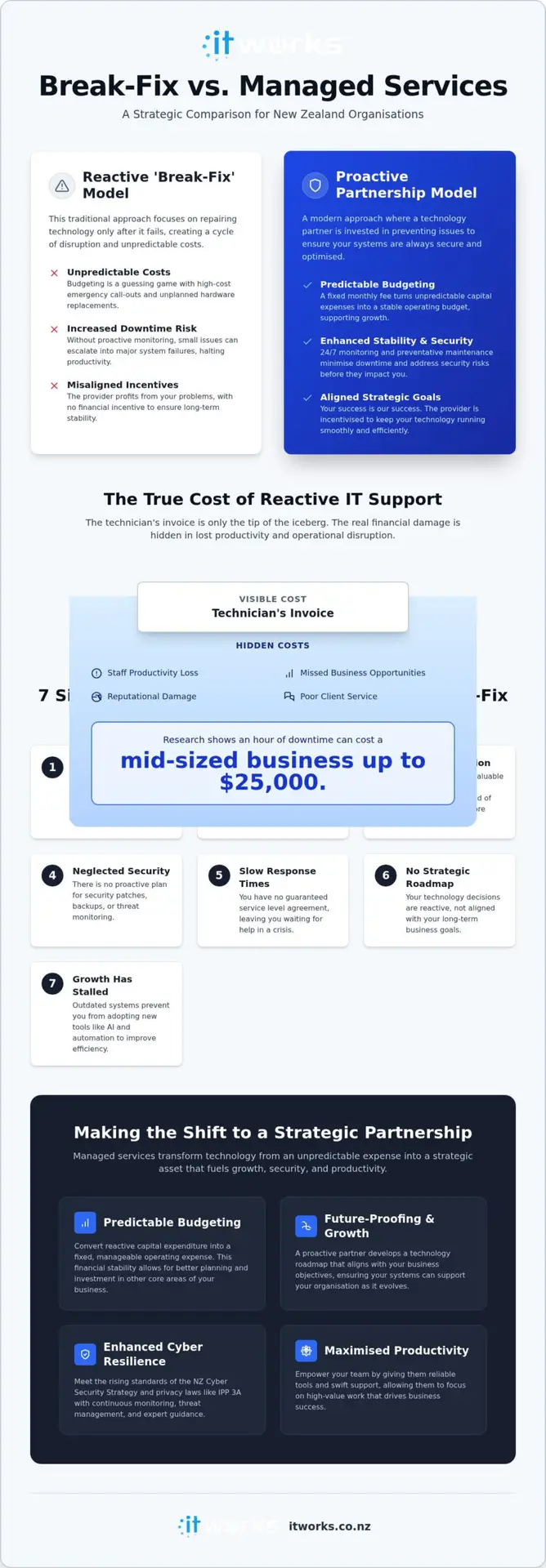
The most expensive way to manage your technology is often to wait until it stops working. While paying for repairs only as they happen might seem like a sensible way to protect your bottom line, the reality of break fix vs managed services nz is that reactive support often leads to hidden costs that far outweigh a monthly fee. You aren’t just paying for a technician’s time; you’re paying for the hours your team sits idle. With 2025 research showing that an hour of downtime can cost a mid-sized business up to $25,000, the “budget” choice can quickly become a significant financial burden.
We understand the desire for financial clarity and the need for systems that just work without constant intervention. You deserve a technology partner that focuses on your long-term success rather than just putting out fires. In this strategic comparison, you’ll discover whether your organisation is better served by reactive repairs or a proactive partnership. We’ll examine how the 2026 New Zealand Cyber Security Strategy and the latest privacy law updates, like IPP 3A, are changing the stakes for local businesses. This guide provides a clear path toward predictable costs and a resilient digital environment that supports your growth.
Key Takeaways
- Learn the core differences between reactive repairs and a proactive partnership when evaluating break fix vs managed services nz.
- Calculate the true cost of reactive IT by looking beyond the invoice to the impact of staff downtime and emergency service premiums.
- Identify the critical signs that your business has outgrown basic support, from fluctuating monthly costs to persistent technical workarounds.
- See how shifting to a managed model turns unpredictable capital expenses into a stable operating budget that supports long-term growth.
- Understand the role of a technology roadmap in ensuring your hardware and security systems are fit for purpose as your organisation evolves.
Understanding the Models: Break-Fix vs Managed IT Services in NZ
Every New Zealand business leader eventually faces a crossroads regarding their technology support. The choice between break fix vs managed services nz isn’t just a matter of how you pay your invoices; it’s a decision about who owns the responsibility for your digital stability. Traditionally, many organisations relied on a reactive approach, calling for help only when something stopped working. While this feels straightforward, it places the entire burden of downtime on your shoulders.
Modern managed services represent a shift toward a proactive partnership. Instead of waiting for a crisis, this model focuses on continuous health, security, and strategic alignment. The provider becomes an extension of your internal team, invested in keeping your systems running smoothly rather than simply billing for the time it takes to fix a disaster. This fundamental shift in responsibility is what separates a functioning business from one that is constantly hampered by technical roadblocks.
By 2026, technology is too integrated into daily operations for the “repair person” model to remain effective. With the release of the New Zealand Government’s Cyber Security Strategy 2026–2030, the requirements for resilience and data protection have reached a level that reactive support simply cannot meet. You don’t just need someone to fix a laptop; you need a partner to secure your entire ecosystem.
The Reactive Nature of Break-Fix Support
The break-fix model operates on a “wait-for-failure” cycle. This creates a natural friction between the business and the service provider. When your systems are healthy, the technician doesn’t get paid. When things go wrong, they earn their living. This lack of incentive to address root causes often leads to technical debt, where small, unresolved glitches eventually snowball into major system failures.
- Staff lose momentum and productivity during recurring, avoidable outages.
- Critical security patches may be neglected until a vulnerability is actively exploited.
- Budgeting becomes a guessing game due to unpredictable, high-cost emergency repairs.
The Proactive Philosophy of Managed Services
Managed IT services align the provider’s goals with your own success. Because you pay a fixed fee, the provider is financially incentivised to prevent problems before they occur. If your systems stay up, they remain profitable; if things break, it costs them time and resources. This creates a shared interest in stability and long-term performance.
This approach moves beyond simple maintenance. It involves a sophisticated layer of 24/7 monitoring and preventative care that identifies potential issues before they disrupt your team. It changes the dynamic from a transactional repair service to a strategic alliance where your technology is managed as a purposeful asset that supports your organisational growth.
The Hidden Costs of Reactive IT Support
The invoice you receive from a technician after a repair is rarely the true cost of the incident. In a break fix vs managed services nz comparison, the visible price of labour is merely the tip of the iceberg. The real financial impact lies beneath the surface, hidden in lost productivity, disrupted client service, and the high cost of emergency intervention. When your systems fail, you aren’t just paying for a fix; you’re paying for the total cessation of your business operations.
Reactive support often carries an “Emergency Premium”. Because there’s no service level agreement in place, you’re at the mercy of the provider’s availability. Urgent call-outs frequently attract higher hourly rates, and the lack of a pre-planned hardware lifecycle means you may end up overpaying for replacement parts simply because you need them immediately. These unplanned expenses can wreak havoc on your quarterly cash flow, making it impossible to maintain a predictable budget.
There’s also a significant opportunity cost to consider. While your team is busy “working around” a slow server or a glitchy application, they aren’t focusing on high-value tasks that drive growth. In 2026, where AI and automation are becoming standard for operational efficiency, being tethered to outdated or poorly maintained systems prevents your organisation from adopting these new tools. If you’re constantly looking backward to fix what’s broken, you cannot look forward to innovate. You can talk to IT Works about your technology strategy to ensure your systems are an asset rather than a liability.
Productivity Drain and Staff Frustration
Recurring minor technical glitches aggregate into hundreds of hours of lost productivity across an organisation every year. This constant friction does more than just slow down work; it erodes workplace culture and impacts staff retention. High-performing employees want to work in an environment where their tools support their talent. When slow response times from a break-fix provider stall critical projects, the resulting frustration can lead to a disengaged workforce and a measurable dip in service quality.
Security Vulnerabilities and Compliance Risks
Operating without proactive management leaves your organisation perpetually behind the curve on security patches and endpoint protection. Statistics from 2023 show that 41% of small businesses experienced a cyberattack, and the risks have only grown more complex. With the introduction of Information Privacy Principle 3A in May 2026, the legal requirements for data handling in New Zealand have become much stricter.
A lack of proactive oversight can lead to more than just data loss. Many New Zealand insurers are now tightening requirements for cybersecurity insurance, and failing to demonstrate consistent system maintenance can result in premium hikes or even claim denials. Building resilience is about more than just responding to incidents; it’s about creating a secure environment that gives your clients and stakeholders confidence in your professional standards.
7 Signs Your Organisation Has Outgrown Break-Fix IT
Recognising the tipping point between break fix vs managed services nz is essential for maintaining operational momentum. While reactive support might suffice for a solo operator, growing organisations eventually reach a stage where technical friction begins to outweigh the perceived savings of hourly billing. If you find yourself nodding along to these scenarios, your current model may be holding your business back.
- Unpredictable IT Spend: Your monthly invoices fluctuate wildly. One month is quiet; the next brings a massive bill for emergency repairs that makes budgeting impossible.
- The “Workaround” Culture: Staff are frequently making do with slow systems or recurring glitches because they don’t want to trigger another hourly charge for a minor fix.
- Hardware Blind Spots: You have no clear visibility over your hardware lifecycle or a technology roadmap. Replacements happen only when a device fails completely.
- Cybersecurity Uncertainty: Security feels like a black box. You hope your antivirus and firewalls are working, but you have no verified reporting to prove your data is resilient.
- Backup Anxiety: You know you have a backup system, but you aren’t sure if it has been tested recently or how long it would actually take to get your team back online after a failure.
The Complexity Threshold: When 10+ Staff Change the Game
Manual management typically fails once an organisation scales past ten employees. At this size, the need for centralised Microsoft 365 management and robust identity security becomes a priority rather than an option. You can no longer rely on “best effort” support to keep everyone connected and secure. When evaluating break fix vs managed services nz, larger teams realise that the administrative burden of managing individual devices and user permissions requires a more structured, automated approach to ensure consistency and compliance.
The Strategy Gap: Thinking Beyond the Next Patch
A break-fix relationship is inherently transactional. It lacks the executive-level technology advice required to navigate modern business challenges. If your current support provider only talks to you when something is broken, you’re missing out on critical guidance regarding AI readiness or cloud optimisation. Transitioning to a managed model allows you to move away from simply keeping the lights on. It provides the strategic partnership needed to drive the business forward, ensuring your technology investments actually support your long-term commercial goals. This shift enables leaders to invest time in professional development and referral networking through organisations like Network In Action.
Evaluating the ROI: Why Managed Services is a Strategic Investment
Calculating the true return on investment in the break fix vs managed services nz debate requires looking past the monthly subscription fee. A proactive model effectively turns unpredictable capital expenditure into manageable operating expenses. Instead of being hit with a massive bill for a server replacement you didn’t see coming, you gain a flattened cost structure that allows for more accurate financial forecasting. This stability provides the breathing room needed to invest in other areas of your business with confidence.
The financial value of proactive monitoring cannot be overstated. By identifying potential system failures before they occur, a managed partner prevents the catastrophic outages that stall revenue generation. Whether it’s a failing storage component or a misconfigured cloud permission, resolving these issues in the background means your team stays productive without ever knowing a crisis was averted. This invisible support is where the highest ROI is often found, as it preserves your most valuable asset: your staff’s time.
Gaining a Strategic Edge with an IT Roadmap
A significant differentiator of the managed model is the implementation of a 12 to 36 month technology roadmap. This plan ensures that every dollar spent on technology is aligned with your specific growth goals, preventing wasted expenditure on hardware or software that doesn’t fit your future needs. Regular strategic reviews with a dedicated partner allow you to adjust this plan as your organisation evolves. For a deeper look at how this fits into your overall business plan, you can read our Guide to Managed IT Support for New Zealand Organisations.
AI Readiness and Practical Enablement
As we move through 2026, AI readiness has become a critical business priority. Managed services provide the necessary foundation for tools like Microsoft Copilot by ensuring your data environment is organised, secure, and properly governed. A strategic partner guides you through responsible AI adoption, focusing on practical applications that reduce operational overheads without compromising security. While break-fix providers are often consumed by immediate repairs, a managed partner has the capacity to implement these high-level efficiencies that drive long-term value. You can discuss your technology strategy with IT Works to see how these advancements can support your specific business outcomes.
Making the Transition: How IT Works Partners for Growth
The shift from a reactive model to a proactive partnership is more than a change in service; it’s a fundamental change in organisational mindset. When comparing break fix vs managed services nz, the most significant gain is the replacement of technical anxiety with strategic confidence. At IT Works, we specialise in helping organisations with 10 to 250 staff transition away from the stress of constant repairs toward a secure, resilient digital environment. We act as a steady guide, ensuring your technology remains a silent engine for success rather than a source of disruption.
Our NZ-based team provides the cultural alignment and trust that distant or automated services simply cannot match. Having a partner who understands the local regulatory environment, such as the 2026 privacy law updates and the national Cyber Security Strategy, ensures your compliance is never in question. We focus on building a long-term relationship where we are invested in your journey, acting as a strategic ally rather than a distant service provider. This local presence across centres like Auckland, Wellington, and Christchurch fosters a sense of community and shared identity that is essential for a successful partnership.
A Seamless Onboarding Experience
Onboarding is a methodical and deliberate process designed to replace chaos with order. It begins with a deep discovery phase where we learn about your specific business goals and operational challenges. We perform a comprehensive audit to establish security baselines and clear accountability for every part of your system. This phase is about more than just checking hardware; it’s about understanding how your team works. We stabilise your environment first, resolving any lingering technical debt before moving into a strategic growth phase where we can introduce new efficiencies like AI and automation.
Your Long-Term Technology Ally
We operate with an “extension of your team” philosophy. This means our success is directly tied to yours. We prioritise practical outcomes and business success over simply selling software licences or hardware. Our role is to provide the expert guidance you need to make informed decisions about your digital future. By removing the frantic energy of traditional reactive support, we allow your executive team to focus on what they do best: leading the organisation. You can talk to IT Works about your technology strategy today to begin the journey toward a more predictable and secure future.
Building a Resilient Foundation for Your Digital Future
Choosing between break fix vs managed services nz is ultimately a choice between managing crises and managing growth. By moving away from reactive repairs, you gain more than just technical support; you gain the peace of mind that comes with predictable costs and a secure, resilient environment. We’ve seen how the hidden costs of downtime and the lack of a strategic roadmap can hinder even the most ambitious organisations, creating unnecessary friction in daily operations.
Our NZ-based strategic advisory team is dedicated to replacing technical stress with calm reliability. We focus on proactive, non-fear-based cybersecurity and practical AI enablement to ensure your technology supports your specific business outcomes. Our team has a proven track record of delivering results for organisations with 10 to 250+ staff, providing a steady guide through the complexities of modern IT management across Auckland, Wellington, and Christchurch.
It’s time to stop working around technical glitches and start leveraging your systems as a purposeful asset. You can talk to IT Works about your technology strategy to take the first step toward a more stable and confident future. Your team deserves tools that enable their success, and we’re here to guide you through that journey.
Frequently Asked Questions
What is the main difference between break-fix and managed services?
The fundamental difference lies in the approach to system health and responsibility. Break-fix is a reactive model where you pay a technician only after a failure occurs, whereas managed services provide a proactive partnership where your provider continuously monitors your systems to prevent issues before they disrupt your team. This shift ensures that your technology remains a stable asset rather than a source of recurring stress. When comparing break fix vs managed services nz, the managed model offers a higher level of accountability for your overall business continuity.
Is managed IT support more expensive than break-fix for a small NZ business?
While break-fix invoices might appear lower in months with no issues, the total cost of ownership is often higher due to unpredictable downtime and emergency repair premiums. Managed services provide a fixed monthly fee, which allows for precise budgeting and eliminates the financial shocks associated with major system failures. For most New Zealand organisations, the gain in productivity and the reduction in risk far outweigh the subscription cost. It’s an investment in stability that prevents the high price of being reactive.
How does switching to managed services improve our cybersecurity?
Managed services integrate security into the daily maintenance of your network rather than treating it as an afterthought. This includes automated patching, advanced endpoint protection, and regular security audits that align with the New Zealand Government’s Cyber Security Strategy 2026–2030. By maintaining a consistent security baseline, you reduce the risk of data breaches and ensure your organisation meets the latest IPP 3A privacy requirements. This proactive oversight creates a resilient environment that gives your clients and stakeholders genuine confidence.
Can managed services help our organisation with AI and Microsoft Copilot?
A managed partner prepares your data environment for AI tools by ensuring your information is organised, secure, and properly governed. Implementing Microsoft Copilot effectively requires more than just a licence; it needs a structured approach to data permissions and internal policies. Managed services provide the strategic guidance necessary to adopt these tools responsibly, helping your team focus on practical productivity gains rather than technical hurdles. We ensure your infrastructure is ready to support these advancements safely.
Will we still have a say in our hardware procurement if we switch?
You retain full control over your hardware decisions while benefiting from expert procurement guidance. Your partner provides recommendations based on your long-term technology roadmap, ensuring that new devices are compatible, secure, and fit for purpose. This collaborative approach prevents wasted spend on incorrect hardware while allowing you to leverage the provider’s relationships with vendors like HP and Microsoft for better value. We act as an advisor to ensure your hardware investments support your specific growth goals.
What happens if we have an internal IT person but need extra support?
We often work alongside internal IT staff through a co-managed model. This partnership allows your internal person to focus on high-level business projects while we handle the repetitive maintenance, 24/7 monitoring, and helpdesk overflow. It provides your team with access to a broader range of specialist knowledge and ensures that your technology remains supported even when your internal staff are on leave or busy with strategic initiatives. This hybrid approach often results in a more resilient and efficient IT department.
How long does it take to transition from a break-fix provider to managed services?
The transition typically takes between two to four weeks depending on the complexity of your environment. This period includes a thorough discovery phase, security audits, and the establishment of a baseline for your systems. We focus on a methodical onboarding process that ensures a smooth handover with minimal disruption to your daily operations. This structured approach allows us to stabilise your environment quickly so we can move into the strategic growth phase of our partnership.
Does IT Works provide on-site support across New Zealand?
Yes, IT Works provides on-site support to organisations across New Zealand, with a strong focus on Auckland, Wellington, and Christchurch. While many technical issues can be resolved remotely through our proactive monitoring tools, we understand that some challenges require a physical presence. Our local team ensures that you receive the hands-on assistance you need, maintaining the personal connection that is essential for a long-term technology partnership. We are committed to being a steady and approachable guide for your team.