A full-time IT manager isn’t the only way to get the leadership and expertise your organisation needs. Alternatives to hiring a full-time IT manager include part-time or fractional leadership, specialist contractors for defined projects, and managed IT support that can adapt to your workload.
It makes sense to want someone consistently overseeing technology, but the role often combines different needs: setting direction, managing day-to-day systems and bringing in specialist expertise. Those needs don’t always require one full-time hire, particularly when priorities or workloads change.
This guide explains how each option works, when it may suit a New Zealand organisation, and what to consider when choosing between ongoing leadership and targeted expertise. You’ll also learn how to match the arrangement to your workload, so technology management supports business priorities without adding more structure than you need.
Key Takeaways
- Match the arrangement to your workload: flexible contracts can scale with changing priorities, while part-time support provides regular input without a full-time role.
- Define whether you need strategic leadership, hands-on technical expertise or oversight before engaging a specialist contractor.
- Fractional and virtual management costs depend on the scope of work, level of expertise and amount of support required.
- Clear responsibilities, communication and access arrangements help reduce the risks of outsourcing IT management.
- Choose an approach that supports your organisation’s goals and can adapt as its needs change.
1. Flexible contract arrangements and staffing levels
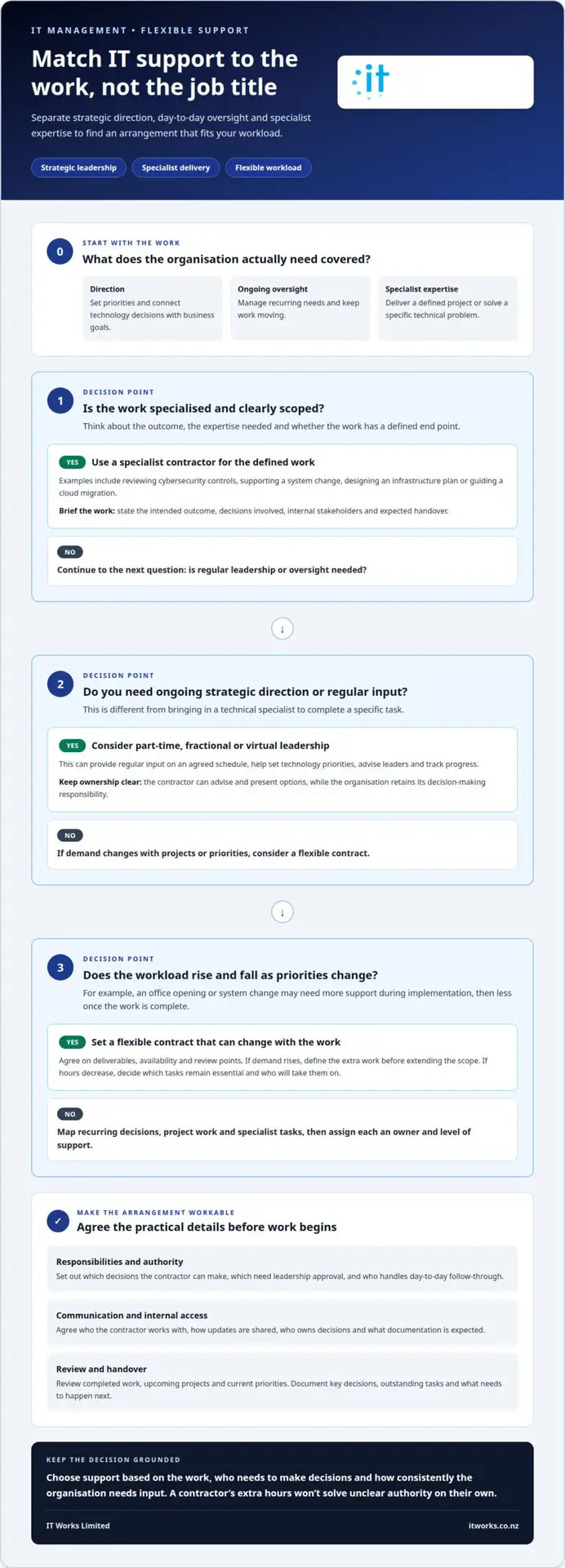
A flexible contract can match IT support to changing business demand. For example, a New Zealand start-up entering a growth phase could bring in contractors for specialist expertise. If activity later slows, it could reduce their hours or end the engagement. This makes it easier to adjust support as priorities shift.
First, identify the work that needs to be covered. A business preparing to open an office may need help planning its technology, coordinating equipment and setting up access. Once the project is complete, its ongoing workload may focus on routine oversight. Separating these needs helps define a suitable contract.
Contractors can work at different levels of involvement. One arrangement might cover a defined project, such as reviewing an IT plan. Another could provide regular input on an agreed schedule. A business with changing priorities can set expectations for deliverables, availability and review points, then adjust the arrangement as its needs become clearer.
Staffing should follow workload, not assumptions. A growing organisation might need extra help during a system change or office expansion, then less input once implementation is complete. A clear scope helps distinguish a temporary increase in demand from an ongoing need for strategic direction or operational oversight.
Flexibility works best when responsibilities are explicit. Set out which decisions the contractor can make, which need leadership approval, and who handles day-to-day follow-through. For example, a contractor might recommend a technology change, while an internal manager approves its timing and business impact. Clear ownership separates temporary expertise from internal accountability.
Plan how the arrangement will change before the workload does. Agree on a review process covering completed work, upcoming projects and current priorities. If a contractor’s hours need to decrease, decide which tasks remain essential and who will take them on. If demand rises, define the extra work before extending the scope.
Flexible contracts are less useful when an organisation needs a consistent decision-maker but hasn’t assigned that responsibility. Simply adding contractor hours may not resolve unclear authority. A practical first step is to map recurring decisions, project work and specialist tasks, then assign each category an owner and level of support.
This approach helps business leaders avoid treating every IT need as a permanent role. A defined project can have a defined contract, while changing workloads can prompt a review of time and scope. The right arrangement depends on the work, who needs to make decisions, and how consistently the organisation needs support.
2. Hiring contractors for specialised or leadership work
A contractor can fill a specific expertise gap without taking on every IT responsibility. Before engaging someone, identify whether the priority is management, hands-on technical problem-solving or oversight. These needs can overlap, but they aren’t interchangeable. A manager may focus on priorities and decisions, while a technical specialist may concentrate on solving specific system problems.
Start with the business outcome. For example, a New Zealand organisation planning a cloud migration may need a specialist to plan and guide the project. A business seeking clearer technology priorities may instead need an experienced leader to review plans, advise executives and track progress. Naming the outcome helps define the contractor’s role and avoids hiring for an impressive-sounding title alone.
Specialist contractors suit work with a clear scope and result. Examples include reviewing cybersecurity controls, supporting a system change or designing an infrastructure plan. A start-up might also engage contractors to build a website or manage social media. These projects call for specific skills, rather than someone responsible for the organisation’s entire technology environment.
Leadership work needs a different brief. A fractional or virtual leader can help set priorities, connect technology decisions with business goals and provide oversight. For instance, a managing director might need guidance on whether a proposed system change supports planned growth. The contractor can advise and present options, while the organisation retains ownership of its decisions.
Write a role brief around the work, not a broad list of desirable credentials. Include the intended outcome, decisions involved, internal stakeholders and expected handover. For a cybersecurity review, specify whether the contractor should assess existing practices, explain priorities to leadership or help plan improvements. A focused brief makes it easier to identify the expertise required.
Agree how the contractor will work with internal staff before the engagement begins. A project specialist may need access to a systems administrator, while a leadership contractor may need regular discussions with the executive team. Set communication channels, decision owners and documentation expectations. These details help turn recommendations into action instead of leaving them in a report.
Plan for knowledge transfer, too. A contractor completing a cloud project should document key decisions, configurations and outstanding tasks for whoever will manage the environment afterwards. A leadership contractor can record priorities and explain the reasoning behind them. Clear handover reduces reliance on one external individual and supports continuity.
Use a contractor when the need is specialised, time-bound or focused on independent guidance. Choose the role by separating technical delivery from strategic leadership and oversight. If the work combines these responsibilities, define how they connect and who remains accountable internally. This helps ensure the engagement addresses the actual gap, rather than adding another role without a clear purpose.
3. Cost of fractional or virtual IT managers in New Zealand
There’s no single standard price for a fractional or virtual IT manager in New Zealand. Costs depend on the scope of work, expertise required, level of responsibility and frequency of support. Before seeking a quote, define what the engagement needs to deliver.
Start by defining the role. A business seeking occasional strategic advice has different needs from one requiring regular oversight of projects, suppliers and technology decisions. For example, advising on a planned cloud move may have a defined project scope. Ongoing guidance to an executive team involves different responsibilities and time commitments.
Engagements can be structured in different ways. An hourly or daily arrangement may suit a focused piece of advice, while a recurring retainer may suit continuing leadership input. A project-based agreement can fit a defined outcome, such as reviewing an IT roadmap. These models affect how work is planned and billed, so match the structure to the work.
Compare proposals using the same brief. Include expected deliverables, meeting frequency, decision-making responsibilities and project work. If one proposal covers executive advice and another includes operational coordination, their prices won’t represent the same service. Ask for the scope and assumptions to be clear in the quote.
Distinguish leadership from technical delivery, too. A fractional manager may set priorities, review plans and guide decisions, while a separate specialist completes a technical project. For example, a business might need strategic oversight for a cloud migration alongside technical expertise for implementation. Combining different tasks can make cost comparisons misleading.
Consider the internal time required to work with the manager. An executive who prepares priorities, attends planning meetings and approves decisions contributes to the engagement’s overall effort. If responsibilities are unclear, discussions can expand without producing agreed outcomes. Assigning a decision owner and setting meeting agendas helps keep the work focused.
Evaluate cost against the work delivered, not just the number of contact hours. A short meeting that resolves a key decision may be more valuable than frequent discussions without clear actions. Set practical measures, such as completed roadmap milestones, documented recommendations or executive decisions. Review these outcomes against the original scope.
For a New Zealand organisation, a useful next step is to outline the required outcomes before seeking a quote. Specify whether the need is strategic advice, ongoing oversight or delivery support, then note the expected involvement and decision-making boundaries. This gives potential arrangements a consistent basis for comparison and clarifies what the quoted cost covers.
4. What are the risks of outsourcing IT management, and how can businesses reduce them?
Outsourced IT management can leave gaps if responsibilities are unclear. For example, an external adviser may recommend a system change while internal staff assume the contractor will implement it. Set out who recommends, approves and completes each task. A named internal decision-maker keeps business priorities connected to the work.
Limited organisational context can also affect advice. A contractor who doesn’t know about a planned office move or busy seasonal period may propose poorly timed changes. Provide a concise briefing on business goals, key systems, planned projects and operational constraints. Update it when priorities change so recommendations reflect current conditions.
Manage access to systems and information carefully. Give each contractor access suited to their agreed responsibilities, rather than sharing general credentials across a team. Record who can access which systems, and remove access when the work ends. For example, a specialist reviewing a network may need different permissions from an adviser preparing a technology roadmap.
Communication gaps can slow decisions and leave staff unsure where to raise an issue. Agree on a primary contact, a method for recording decisions and regular review meetings. A short written summary after each meeting can list actions, owners and due dates. This gives executives and internal staff a shared record, even when they don’t attend every discussion.
Continuity is another consideration if a contractor becomes unavailable or the engagement ends. Reduce reliance on individual knowledge by documenting system decisions, project status and outstanding tasks. For a cloud migration, keep a record of completed work, open issues and who is responsible for each next step. A clear handover helps internal staff maintain progress.
Scope can expand gradually when new requests are added without discussion. A contractor engaged initially for strategic advice may start handling operational tasks, leaving less time for leadership work. Review new requests against the agreed scope, then decide whether to reprioritise, change the arrangement or assign the work elsewhere. Recording agreed changes prevents misunderstandings.
Outsourcing doesn’t transfer every business decision to an external person. The organisation still needs an internal owner who understands its objectives and can approve priorities. For example, an adviser can explain the trade-offs between delaying a system upgrade and changing its timing, but business leaders decide which option fits their plans.
Before work begins, document responsibilities, access, communication, decision rights and handover arrangements. Review them when the scope changes or a new project starts. These practical controls help an external manager contribute expertise while the organisation retains clarity, oversight and knowledge of its technology decisions.
5. Part time
A part-time IT manager can provide regular leadership without occupying a full-time position. This suits an organisation with ongoing decisions to manage, but not enough work to keep someone focused on technology every working day. For example, a growing professional services firm may need regular planning and oversight, alongside staff who handle routine operational tasks.
Set the role around decisions and responsibilities, not simply a fraction of a full-time schedule. An IT manager might maintain the technology roadmap, coordinate suppliers and present options to executives. Internal staff could remain responsible for everyday requests. Defining this division directs part-time hours towards work that needs judgement and business context.
Agree on a predictable schedule for leadership tasks. A regular planning session can cover upcoming projects, risks, priorities and decisions awaiting approval. For example, a managing director and part-time manager could review a proposed system change, then record its owner and next steps. Consistent meeting time keeps important work visible between sessions.
Part-time arrangements need clear boundaries around availability. A remote worker may be available for half a day while caring for children for the rest of the day. For an IT leadership role, the organisation can similarly agree on working windows, meeting times and how staff raise matters outside those periods. This makes the arrangement workable without implying constant access.
Before the role starts, identify which tasks need a timely response and which can wait until the next scheduled session. For example, a planned software review can go on the manager’s agenda, while an urgent operational issue needs a separate owner. Without this distinction, staff may assume limited hours cover every IT need.
Part-time leadership can also work alongside specialist support. The manager can set priorities for a network improvement while a technical specialist carries out the agreed work. Name who approves changes, communicates with staff and records decisions. A simple responsibility map prevents the manager from becoming the default contact for every task.
Review the arrangement against actual work, rather than assuming the original schedule will remain suitable. Track recurring decisions, project demands and work waiting between sessions. If strategy and oversight consistently exceed available time, adjust the arrangement. If planned work finishes and priorities ease, revisit the schedule and responsibilities.
Part-time management is most useful when the organisation can define a consistent leadership remit and cover day-to-day needs separately. A written role brief, agreed working windows and a regular review give executives a practical way to assess whether the arrangement still matches the workload. To discuss how this could work for your organisation, talk with IT Works about part-time IT management support.
IT Works
IT Works helps New Zealand organisations align technology support with their workload and business priorities. If you’re weighing part-time leadership, specialist input or broader ongoing support, its team can help clarify the responsibilities and level of support that fit.
Through Managed IT Services, Cyber Security, AI & Automation and Cloud Solutions, IT Works supports organisations with practical guidance and day-to-day technology needs. This helps business leaders connect technology decisions with productivity, security and future plans, rather than treating management as a standalone hire.
Talk to IT Works about the right technology support for your organisation.
Choose support that can grow with your priorities
Choosing among alternatives to hiring a full-time IT manager starts with the outcomes your organisation needs next. Consider which technology decisions need leadership, where specialist expertise would help, and how those needs may change as the business develops. This gives your next conversation a clear purpose, rather than starting with a job title.
IT Works can connect those priorities with practical support through Managed IT Services, Cyber Security and AI & Automation. The right mix should make technology easier to manage and better aligned with how your organisation works.
Use your priorities to shape a considered next step, whether you’re planning for growth or refining how technology supports your team.
You can contact IT Works about IT support to discuss a practical next step.
A clear plan can help your organisation move forward with confidence.
Frequently Asked Questions
What are the alternatives to hiring a full-time IT manager for a small business?
A small business can use a fractional technology leader, engage a specialist for a defined project, or combine internal coordination with external expertise. The key distinction is where decisions sit: a business owner may retain approval authority while an external adviser provides analysis. Before expanding into a new market, for example, leadership could commission an assessment of technology readiness without creating a permanent management position.
What does a managed IT services provider do, and how much does it cost in New Zealand?
A managed IT services provider can act as an outsourced IT department, covering support, monitoring, security, cloud, infrastructure and strategy. In New Zealand, pricing depends on the provider’s scope and the organisation’s environment. IT Works builds its monthly fee from people, devices and network equipment, so changes to those counts affect the total. A quote clarifies what the agreement includes and which project work or licences are separate.
What are the pros and cons of hiring an IT consultant or contractor instead of a full-time IT manager?
A consultant can help leaders assess options before making a decision, while a contractor can deliver defined work. This distinction is useful when a business needs an independent review before approving a major system change. Advice may not include implementation, and delivery work may not include broader strategic guidance. Make the expected output explicit, such as a decision paper or completed project deliverable.
When should a business use a managed service provider versus an in-house IT manager?
A managed service provider can suit an organisation seeking an external team for ongoing technology operations. An in-house manager may be more appropriate when technology decisions require close, frequent involvement in internal planning and coordination. Consider how closely the role must work with other departments. A business integrating technology decisions into regular operational planning, for example, may value an internal leader who participates directly in those discussions.
Can a business outsource IT support while keeping IT strategy and governance in-house?
Yes. A co-managed arrangement can separate operational support from internal governance. The organisation can retain decisions about priorities, investment and acceptable risk, while an external team handles agreed operational responsibilities. To make this work, set approval boundaries for changes and purchases, and decide which updates executives need. A scheduled governance review can assess whether external activity remains aligned with business objectives.
How can a business assess its IT needs and choose the right alternative to a full-time IT manager?
Assess both current demands and planned business changes. Review recurring staff issues, upcoming projects, existing internal skills and decisions that regularly wait for approval. Then consider how growth, new locations or changes to service delivery could alter those needs. A useful comparison records each option’s decision authority, expected outputs and internal time commitment. This reveals whether the main gap is capacity, expertise or leadership.