What if your next major technology bill wasn’t a stressful surprise, but a planned step in your growth strategy? For many Kiwi leaders, the reality of IT budgeting for small business nz often feels more like reactive guesswork than deliberate governance. You’re likely familiar with the frustration of unpredictable “break-fix” invoices that arrive without warning, or the subtle drain on productivity when ageing hardware can no longer keep pace with your team’s ambition. It’s difficult to focus on expansion when you’re constantly managing the anxiety of potential cybersecurity gaps or shifting cloud licensing costs.
We believe that technology should be a steady, invisible force that supports your success rather than a source of financial friction. This guide provides a practical framework to help you regain control, moving from unexpected expenses to a proactive, structured strategy. We’ll outline how to develop a clear three-year roadmap, leverage local tax incentives like the Investment Boost, and ensure your technology spend directly fuels your business objectives. By establishing this logical approach, you can replace technical stress with a sense of calm, predictable reliability.
Key Takeaways
- Learn how to transform technology from a reactive expense into a strategic asset that reduces operational friction for your team.
- Understand how to structure a modern it budgeting for small business nz plan by distinguishing between steady monthly costs and periodic project investments.
- Identify the hidden costs of managing IT in-house, such as the time and resources needed for recruitment and ongoing technical training.
- Discover how a three-year technology roadmap creates financial predictability and ensures your hardware lifecycle aligns with your growth goals.
- Learn how a local technology partner provides the strategic guidance of a virtual CIO to help you navigate New Zealand’s specific compliance requirements.
Understanding the Role of IT Budgeting in NZ Business Growth
Many New Zealand business owners view technology as a “grudge purchase”, a necessary evil that only demands attention when something stops working. However, effective it budgeting for small business nz is actually a tool for growth rather than a drain on resources. When you shift your perspective from managing costs to enabling outcomes, technology becomes a strategic asset that removes friction from your daily operations. A well-planned budget isn’t just about limiting spend; it’s about ensuring every dollar invested contributes to a more efficient and productive workplace.
This structured approach provides a level of financial predictability that allows for long-term business confidence. Instead of reacting to a sudden server failure or a series of expensive emergency call-outs, you can allocate funds toward systems that actively improve your team’s output. This shift eliminates the “break-fix” cycle, which is often the biggest hurdle to accurate financial planning. To complement your IT strategy, you can explore monthly fixed-fee accounting and advisory packages from Proledger to maintain the same level of predictability across your wider business finances. Reactive models are inherently volatile; they rely on luck rather than logic, often leading to spikes in expenditure that disrupt cash flow.
From Reactive Fixes to Strategic Investment
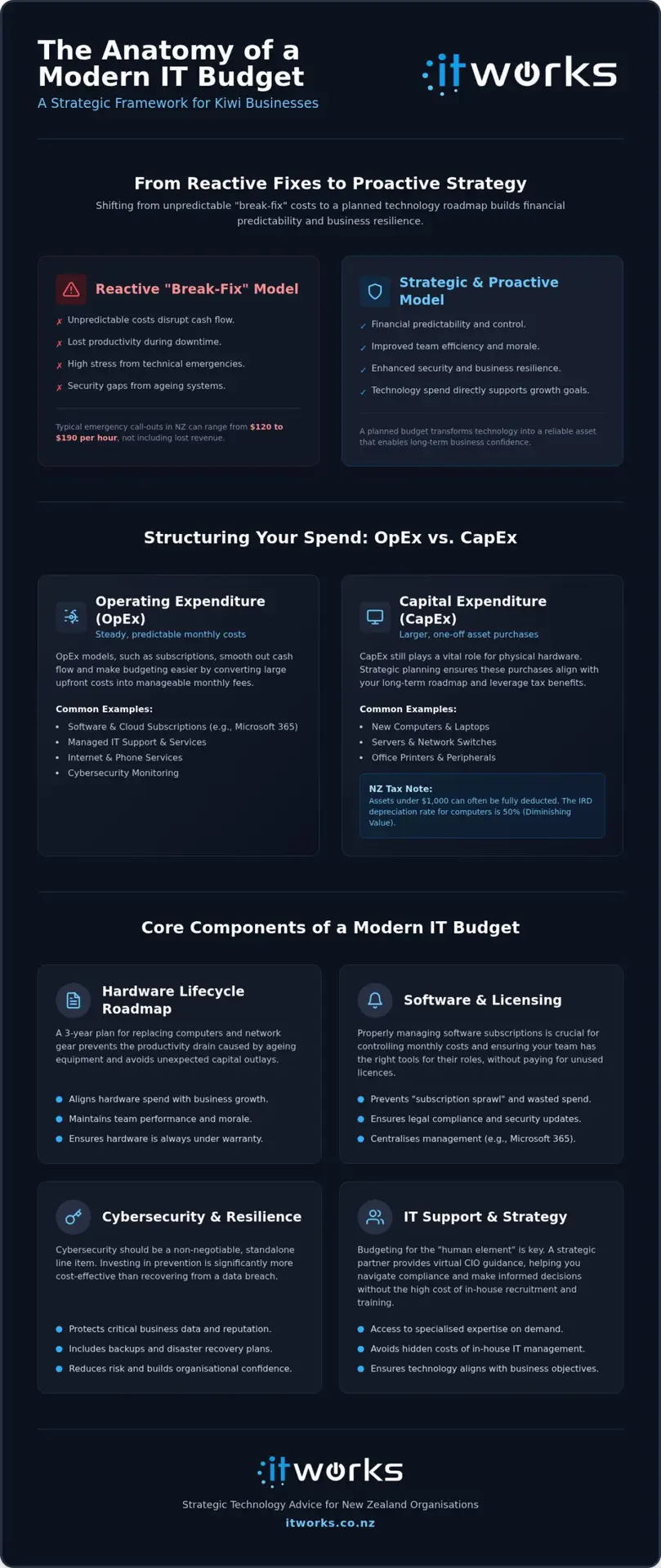
Waiting for hardware to fail before replacing it is a hidden tax on your business. The true cost isn’t just the repair bill, which often ranges from $120 to $190 per hour in the local market, but the lost hours of staff productivity while they wait for a solution. By moving toward a proactive model, you can replace the stress of technical emergencies with a clear breakdown of IT costs. This clarity helps shift the internal mindset from viewing IT as a cost centre to seeing it as a growth engine. When your team has reliable tools, morale improves and they can focus on high-value tasks rather than fighting with slow software.
The Impact of Technology on Business Resilience
Resilience is built through preparation, not just recovery. For organisations in Auckland or Wellington, scaling securely requires a budget that accounts for both growth and protection. It’s often far more expensive to recover from a data breach than it is to invest in preventative measures. A strategic budget ensures you have the right backup and disaster recovery systems in place before you need them. This forward-thinking approach aligns your technology roadmap with your broader business goals, giving you the stability to pursue new opportunities with confidence. By planning for the next three years, you ensure that your infrastructure is a solid foundation for whatever comes next.
The Anatomy of a Modern Small Business IT Budget
Building a functional plan for it budgeting for small business nz requires a move away from generic spreadsheets. You need a granular view that distinguishes between the “keep the lights on” costs and the investments that drive your business forward. A modern budget should treat cybersecurity as a non-negotiable, standalone line item rather than a sub-category of general maintenance. This ensures that your protection isn’t squeezed when other expenses rise. Expert firms like ManagePoint provide the necessary oversight to ensure these security investments are structured correctly within your operational budget. You should also account for the human element, ensuring your team has the support they need to use technology effectively without getting bogged down in technical hurdles.
Success lies in creating a structure that mirrors your operational reality. This means looking beyond just the hardware on desks and considering the entire ecosystem that keeps your organisation running, including specialised needs like event production services Auckland for corporate functions. By categorising your spend accurately, you can identify areas where you’re over-investing and where gaps might be leaving you vulnerable. This clarity is the first step toward transforming your technology from a series of invoices into a strategic asset.
OpEx vs. CapEx: Changing the Way You Pay
The shift toward Operating Expenditure (OpEx) has simplified cash flow for many organisations. Subscriptions for software and cloud services provide a predictable monthly fee, which is easier to manage than large, infrequent outlays. However, Capital Expenditure (CapEx) still plays a role, especially with hardware. For example, assets costing $1,000 or less can be fully deducted in the year of purchase. For larger items, the IRD has set the depreciation rate for office computers at 50% for Diminishing Value. Balancing these two models allows you to maintain modern equipment while keeping monthly costs stable. You can find more guidance on financial planning through NZ government business resources.
Categorising Your Technology Spend
Your budget should be broken down into logical categories to provide better visibility. Software licensing, particularly Microsoft 365, requires careful management due to recent price adjustments, such as the 12% increase for Business Standard plans in July 2026. Managed service fees should cover your helpdesk and proactive monitoring, while connectivity and backup solutions ensure your data remains accessible. Don’t forget to include emerging tech; for instance, the MBIE AI Advisory Pilot has highlighted the value of budgeting for practical AI adoption. If you’re unsure where to start, you might discuss your technology strategy with a specialist to ensure your categories align with your growth.
The Hidden Costs of In-House IT Management
When calculating it budgeting for small business nz, many leaders overlook the “shadow costs” associated with internal management. It’s easy to account for a new laptop or a software subscription, but the invisible expenses of managing technology internally can quietly erode your bottom line. These costs often manifest as lost productivity when staff members are distracted by persistent technical issues or when a non-technical manager spends hours troubleshooting a network failure. These distractions pull your team away from their primary roles, creating a ripple effect of inefficiency across the organisation.
Recruiting and retaining specialised IT talent in the local market is another significant hurdle. With high demand for technical skills in hubs like Auckland and Wellington, the cost of hiring a dedicated professional involves more than just a competitive salary. You must also consider the ongoing investment required for training and certifications to ensure their skills remain current. For many small organisations, this level of investment is difficult to sustain, often leading to a reliance on outdated methods that don’t support modern business goals.
The True Cost of In-House Staffing
The total cost of employment for an internal IT person extends far beyond their base pay. You’re also responsible for ACC levies, office space, specialized equipment, and the administrative overhead of managing an additional employee. There’s also the significant risk of a “single point of failure”. If your only technical staff member is away on leave or moves to a new role, your business is left vulnerable without immediate support or institutional knowledge. The knowledge gap cost becomes a silent burden when internal teams fall behind emerging technology trends, leaving your business exposed to outdated security and inefficient processes.
ROI and Predictability through Managed Services
Choosing a managed service model replaces these variables with a fixed, predictable monthly fee. This stability simplifies financial forecasting and allows you to adopt strategic IT budgeting approaches that align with your long-term growth. Instead of paying for a single person’s limited capacity, you gain access to a full team of specialists who provide proactive monitoring and strategic guidance. This model ensures that your technology is always being managed by experts who are across the latest developments in cybersecurity and productivity tools. You can explore how this compares to other models in our Managed IT Services guide, which helps you identify the most cost-effective path for your specific needs.
Building Your Multi-Year Technology Roadmap
While many general accounting practices suggest looking only six to twelve months ahead, technology cycles operate on a much longer timeline. A single-year view is often insufficient for sustainable management, as it fails to account for the natural lifecycle of hardware and the shifting demands of modern software. Effective it budgeting for small business nz requires a three-year perspective. This approach allows you to anticipate major investments before they become emergencies, ensuring your cash flow remains stable while your infrastructure stays current. For those seeking broader advice on managing business finances alongside these technical roadmaps, ASAP Solutions provides comprehensive accounting support for small businesses.
The process begins with a comprehensive audit of your current environment to identify immediate risks, such as software that is nearing its end-of-life or hardware that is no longer receiving security updates. Once you have a clear picture of your assets, you can align replacement cycles with your financial year. This ensures that you’re not hit with a massive procurement bill all at once. By layering in strategic projects, such as cloud migrations or practical AI integrations, you create a path that supports your growth goals. Reviewing this roadmap quarterly allows you to remain agile, adjusting your priorities as your business evolves.
Lifecycle Management for Hardware and Software
Adhering to a “4-year rule” for laptops and desktops is a pragmatic way to avoid performance decay. Beyond the four-year mark, the cost of maintenance and the loss in staff productivity often exceed the price of a new device. For a typical Kiwi organisation, budgeting between $1,200 and $2,000 per employee every three years for hardware refreshes is a solid benchmark. This planning also extends to your infrastructure; you should decide well in advance whether to refresh physical servers or move those workloads entirely to the cloud. Proactive replacement ensures your team always has tools that are supported, secure, and capable of running the latest productivity applications.
Prioritising Cybersecurity and Resilience
Cybersecurity should never be an afterthought in your roadmap. Industry benchmarks suggest that security spending should represent a consistent percentage of your total IT budget to ensure resilience against evolving threats. This isn’t just about software; you must also allocate funds for staff awareness training and incident response planning. Investing in business continuity, such as reliable backup and disaster recovery systems, provides the confidence that your organisation can recover quickly if an issue arises. By treating security as a core component of your multi-year plan, you build a foundation of organisational confidence that supports long-term success.
Partnering for Strategic Budgeting Success
Managing a technology budget involves more than just tracking monthly expenses. It requires a level of foresight that ensures your infrastructure supports your future growth rather than hindering it. A technology partner functions as a virtual CIO for your organisation, providing the strategic oversight usually reserved for much larger corporations. Whether you are working with local specialists or observing the bespoke strategies used by international leaders like Cornerstone Business Solutions or Trinity Networx, LLC, the goal is to align your IT spend with your long-term vision. This partnership ensures that your it budgeting for small business nz remains focused on business outcomes rather than just technical fixes. By delegating the complexities of vendor management and procurement, you free up your leadership team to focus on what they do best.
This collaborative approach transforms technology into a competitive advantage in the Kiwi market. Instead of reacting to problems, you’re following a structured plan that anticipates your needs. This level of organisation reduces the stress of management and provides a sense of calm reliability for your entire team. It allows you to move away from the frantic energy of reactive support and toward a composed, strategic presence that benefits your bottom line.
Why Local Expertise Matters
Understanding the New Zealand business landscape is essential for effective planning. Local challenges, from regional compliance requirements to the specific needs of teams in Auckland, Wellington, or Christchurch, require a nuanced approach. The benefit of having a partner with local knowledge means your strategic planning is grounded in reality. IT Works helps organisations build practical, actionable roadmaps that account for these local factors. This ensures that your technology spend is purposeful and directly contributes to your stability and success. Having “boots on the ground” for strategic planning means your roadmap isn’t just a theoretical document; it’s a functional tool for your business.
Taking the Next Step
Moving from a simple spreadsheet to a strategic technology partnership is a significant step toward maturity. It introduces clear accountability for your technology management, ensuring that nothing is left to chance. This transition replaces the typical anxiety of technical management with a composed and strategic presence. You can begin this journey by choosing to talk to IT Works about your technology strategy. This conversation is the first step toward turning your technology from a surprise expense into a strategic asset that fuels your long-term growth.
Building a Foundation for Sustainable Growth
Transforming technology from a source of friction into a predictable growth engine starts with a change in perspective. By adopting a structured approach to it budgeting for small business nz, you replace the volatility of emergency repairs with the stability of a planned roadmap. This shift doesn’t just protect your cash flow; it ensures your team always has the reliable tools they need to stay productive and secure.
A clear three-year strategy allows you to anticipate hardware lifecycles and align your technology investments with your broader business goals. With a focus on proactive management and local NZ expertise, you can navigate technical challenges with confidence. You’ll know your infrastructure is being guided by a steady, experienced partner committed to your long-term success.
It’s time to move beyond the guesswork of reactive fixes and start building a foundation for sustainable success. We’re ready to help you turn technology management into a strategic advantage for your organisation.
Frequently Asked Questions
How much should a small business in NZ spend on IT per employee?
A common benchmark for New Zealand organisations is to allocate approximately 3.8% of total revenue toward technology. For a more granular view, many businesses budget around $210 per employee per month for a fully managed service that includes support and security. This investment ensures your team has the necessary tools and protection to remain productive without the risk of unexpected technical debt.
Is it better to lease or buy IT hardware for a small business?
The choice between leasing and buying depends on your cash flow and tax strategy. Buying allows you to utilise the $1,000 low-value asset threshold for immediate deductions and the 20% Investment Boost tax incentive available for new assets. Leasing can be beneficial if you prefer a predictable monthly operating expense and want to simplify the process of refreshing your hardware every three to four years.
What are the most common hidden costs in an IT budget?
The most frequent hidden costs are lost productivity from staff troubleshooting their own issues and the high hourly rates of reactive “break-fix” repairs. You should also account for the administrative time spent on procurement and managing multiple software vendors. These “shadow costs” can quietly erode your profitability if they aren’t consolidated into a proactive management plan.
How often should we update our technology roadmap?
You should review your technology roadmap every quarter to ensure it stays aligned with your business goals and any new developments. While the roadmap itself provides a strategic three-year view, these regular check-ins allow you to adjust your it budgeting for small business nz for emerging priorities. This consistent rhythm prevents your technology from falling behind and helps you maintain a steady, predictable spend.
Does managed IT support actually save money compared to break-fix?
Managed IT support generally provides a better return on investment by preventing expensive downtime and major system failures. Reactive support models often lead to volatile spending and high repair bills when things go wrong. A managed service offers financial predictability through a fixed fee, focusing on proactive maintenance that reduces the overall cost of ownership for your technology.
Should cybersecurity be part of my IT budget or a separate expense?
Cybersecurity should be a dedicated, standalone line item within your total IT budget. This ensures that essential protections like multi-factor authentication and endpoint monitoring aren’t compromised when other technical needs arise. By giving security its own visibility, you can more accurately track your investment in risk reduction and build greater organisational confidence.
What is the typical lifecycle for business laptops and servers in NZ?
The standard lifecycle for business laptops and desktops is three to four years to ensure they remain compatible with modern security tools. For physical servers, a five-year cycle is typical, though many Kiwi businesses are now budgeting to migrate these services to the cloud. Sticking to these timelines prevents the productivity slumps and high maintenance costs associated with ageing hardware.
How can I reduce my IT costs without compromising security?
You can reduce costs by auditing your software subscriptions to eliminate unused licenses and consolidating your vendors. Implementing a structured lifecycle management plan also prevents expensive, unplanned hardware purchases. A strategic approach to it budgeting for small business nz helps you identify these efficiencies while ensuring your core protections, such as backups and network monitoring, remain robust and effective.