
What if the best first step in AI adoption is deciding which business problem is worth solving? For New Zealand organisations, the challenge isn’t finding another AI tool. It’s identifying where AI could make work more useful while keeping people, information and business priorities at the centre.
It’s understandable to have questions before moving ahead. Which tasks are suitable for AI? How should sensitive information be handled? How will you know whether a trial is delivering value? AI adoption is a business and technology decision, not simply a software purchase. A clear purpose and practical safeguards can help your team explore its potential with confidence.
This guide explains how to identify useful opportunities, assess risks and prepare people for change. You’ll also learn how to set review criteria and build an adoption plan that can be improved over time. The aim is steady progress: start with a real need, test responsibly and build on what works.
Key Takeaways
- Start with a business challenge and a clear outcome, rather than choosing an AI tool first.
- Assess people, data and technology readiness before deciding how to approach a use case.
- Weigh potential value against feasibility, information sensitivity and the need for human judgement.
- Make AI adoption practical with a defined owner, clear trial boundaries and criteria for reviewing results.
- Keep AI useful over time by reviewing workflows, safeguards and alignment with wider technology priorities.
Why AI adoption needs to start with a business challenge
With day-to-day demands competing for attention, deciding where AI could help can feel like another task on the list. Starting with a tool because it’s available can add complexity without addressing a meaningful need. Instead, look for a recurring task, delay or information bottleneck that affects how work gets done. A specific problem gives you something practical to investigate.
AI adoption is the ongoing process of selecting, introducing and governing AI so it supports the way an organisation works. It’s more than buying software or switching on a feature. Its value depends on a clear purpose, suitable processes, informed people, appropriate information and ongoing oversight.
What does AI adoption mean for an organisation?
Adoption is a business capability, not a one-off installation. Teams need to understand where AI fits into their work, what information it uses and where people remain responsible for decisions. The broader field of Artificial intelligence includes a range of approaches and applications, but an organisation’s focus should be on the specific use that supports its work.
For example, a team could explore using AI to draft an internal update, summarise meeting notes or find information across approved documents. Each use depends on the process around it: who checks the output, how it will be used and whether the information is suitable for that purpose. AI may assist with a task, but people still provide context and judgement.
Why begin with the problem rather than the technology?
A defined need makes it easier to judge whether AI is suitable and what a useful trial might involve. Compare “we should use AI” with “staff spend time turning the same source material into routine internal summaries”. The second statement describes a workflow challenge that can be examined. It gives the organisation a basis for considering whether AI could help, what human review is needed and how to assess the result.
Start by asking:
- Which task or process needs attention?
- Who does the work, and where does friction occur?
- What would a helpful change look like?
The answer may be AI, but it could also be a clearer process, better access to existing information or a more suitable technology setting. Choosing the right response matters more than adopting AI for its own sake. A problem-first approach connects the decision to business priorities and gives your team a practical way to assess possible uses.
Assess AI readiness across people, data and technology
A promising use case still needs the right foundations. Before selecting a tool, identify who will be accountable, which staff will use it and what business outcome it should support. A clear owner can coordinate decisions, gather feedback and keep a trial focused on its purpose.
A useful readiness check covers purpose, people, information, safeguards and a review plan. These areas are connected: the information available shapes what a tool can do, while staff skills and existing systems affect how safely and smoothly it fits into work.
Is your organisation ready to use AI with its information?
Map the information a proposed use needs. Consider where it is held, whether it is accurate and current, and who is authorised to access it. For example, a trial that sorts incoming service requests may depend on consistent records and clear rules about what information can be processed.
Set boundaries before staff begin. Decide what information must not be entered, who reviews AI-generated outputs and how people should raise concerns or report errors. Consider the privacy and regulatory requirements that apply to the specific use case, and document how the organisation will meet them. The Government’s New Zealand’s Strategy for Artificial Intelligence provides a national reference point as organisations consider responsible AI use.
How do staff skills and existing systems affect readiness?
Readiness also depends on the people doing the work. Identify which teams need guidance, practice or clearer responsibility for checking outputs. Staff should understand what the AI tool is intended to assist with, where its limits are and when a person needs to make the final decision.
Next, consider the technology around the use case. Does it fit the way work currently moves through your systems? If your organisation uses Microsoft 365, consider how the proposed tool and workflow relate to that environment, including access settings and information controls. Plan for security, support and integration together, rather than treating them as afterthoughts once a tool has been selected.
If you find gaps, turn them into planning tasks. Improve information quality, clarify access, prepare staff guidance or adjust the process before expanding a trial. These steps can make AI adoption more considered without requiring every part of the organisation to be ready at once.
For support connecting readiness with your wider technology priorities, explore AI adoption planning with IT Works.
Choose AI use cases by value, risk and feasibility
Once you understand your readiness, compare possible uses before committing to a tool or workflow. A sensible first trial should be useful enough to matter, limited enough to manage and straightforward enough for staff to review. It should support people doing the work, not shift accountability to an automated system.
Which business tasks may be suitable for an initial AI trial?
Repetitive, information-heavy tasks can be worth assessing, particularly when staff can check the result before using it. For example, AI might help organise internal enquiries or produce a first-pass categorisation of routine requests. These are ideas to investigate, not proof that AI will suit every organisation. Check the quality of the output and the effort required to review it.
Take particular care with uses involving sensitive information or decisions that could materially affect people. Don’t begin with decisions that require specialist judgement unless appropriate expertise, boundaries and safeguards are in place. A person should remain responsible for decisions and for checking outputs where accuracy matters.
How can leaders compare potential AI use cases?
Use the same questions to compare each option. Estimate the likely business benefit, then consider feasibility, information sensitivity and the level of oversight required. The Public Service AI Framework is a New Zealand public-sector example of structured AI guidance. Organisations can refer to it without assuming it sets requirements for every business.
| Use case profile | What to assess | Possible approach |
|---|---|---|
| Lower-complexity trial | A defined task, accessible information, limited sensitivity and outputs staff can review. | Test within a bounded workflow, with a named owner and clear review criteria. |
| More complex use | Sensitive information, integration with core systems, or outputs that need substantial human judgement. | Plan stronger safeguards, specialist input and closer oversight before proceeding. |
This comparison can’t guarantee that a use case is suitable. It helps leaders identify what they need to understand before a trial begins.
Keep the scope narrow enough to evaluate. Define the task, intended users, information boundaries and what would count as a useful result. Then review staff feedback, output quality and any additional checking or process work required. This gives your organisation a grounded basis for deciding whether to refine, extend or stop the trial.
Frame AI as support for specific tasks, not as a plan to replace employees. People contribute context, judgement and accountability. Thoughtful AI adoption helps teams assess where AI may assist while keeping responsibility clear.
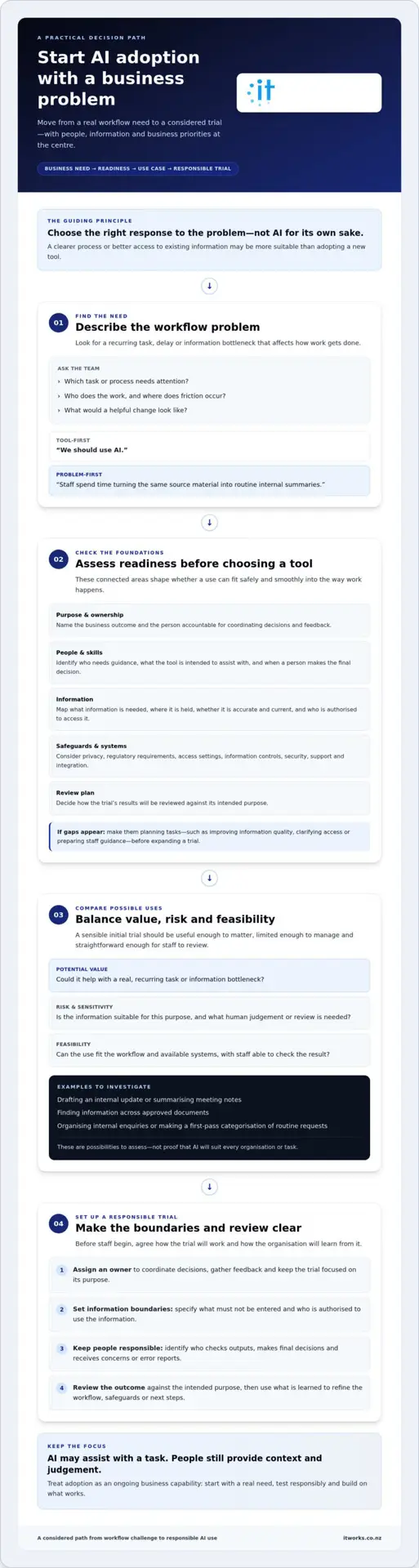
Build a responsible AI adoption plan in practical stages
A clear plan helps teams move from a promising idea to a carefully reviewed trial. Keep the process proportionate to the use case, and agree responsibilities and decision points before work begins.
A practical sequence is:
- Define the need: Describe the workflow challenge and intended business outcome.
- Assess readiness: Confirm the owner, users, information and technology involved.
- Set safeguards: Agree acceptable use, information boundaries and human checks.
- Trial: Test the defined use with the intended user group.
- Review: Compare what happened with the purpose and success criteria.
- Refine: Decide whether to adjust, extend or stop the trial.
How should an organisation run a first AI pilot?
Keep the pilot bounded. Document its purpose, the staff involved, the approved information and the tasks AI may assist with. Specify who checks outputs before they are used, and give staff practical guidance on the tool’s limits. This keeps the trial tied to the work it is intended to support.
Agree how users will record feedback, errors and unexpected results. At the review point, consider whether the trial addressed the original need, how much checking it required and what staff experienced. Use these findings to decide whether to refine the process, change its scope or end the trial.
What should responsible AI governance cover?
Governance should make accountability clear in everyday work. Assign a business owner, set acceptable-use guidance and define how information may be handled. Explain when human review is required, how staff can identify an error and where to raise concerns or questions about an output.
Keep the process for raising issues clear and practical. Staff should know whom to tell and what to do if an output seems unreliable or the tool is used outside agreed boundaries. Review guidance as tools, workflows and organisational requirements change. Update it when experience shows that a safeguard needs clarification.
These steps make AI adoption a managed business activity rather than an informal experiment. They also give leaders a sound basis for deciding what to learn from a trial and what should happen next.
Make AI adoption sustainable with connected technology support
A trial is a starting point, not the end of the work. As people use AI in a real workflow, they may raise new questions about output quality, information access or how the task fits with existing systems. Regular review keeps the use aligned with business priorities and gives leaders a basis for adjusting the approach.
How do you know whether AI adoption is working?
Return to the need the trial was intended to address. Ask the people using the workflow what has changed, where they still need to check or rework outputs, and whether the process is manageable. Then compare what you learn with the criteria agreed for the trial.
Measures should reflect the use case and the organisation’s priorities. Depending on the task, review output quality, the time or effort required for human oversight, workflow fit, staff feedback and any issues raised. There’s no single benchmark that suits every organisation. The aim is to make a considered decision: refine the use, extend it with appropriate safeguards or stop.
When can an external technology partner help?
AI planning often involves more than the tool itself. Cybersecurity controls, Microsoft 365 settings, cloud services and existing workflows can all affect how a proposed use fits into an organisation. Considering these factors early helps keep adoption aligned with operational needs and wider technology strategy.
IT Works’ AI Enablement supports practical use-case discovery and Microsoft Copilot readiness, alongside strategic advice and operational technology support. IT Works helps organisations connect AI planning with the systems and safeguards that support their work. Further reading on AI and automation or Microsoft Copilot can help teams explore relevant topics as their plans develop.
Sustainable AI adoption comes from learning and adjustment, not simply switching on a tool. Keep listening to users, reviewing safeguards and checking that each use remains connected to a real business priority.
Take the next step with a clear purpose
Effective AI adoption starts with a real business need, not a tool looking for a use. Assess whether your people, information and systems are ready, then choose a use case that balances value with risk and feasibility. A focused trial, clear safeguards and regular review help your organisation learn what works and decide what to do next.
AI should support the way your people work, with human judgement and accountability kept clear. IT Works’ AI Enablement helps organisations explore practical use cases and Microsoft Copilot readiness. This work connects strategic technology advice with operational support and project delivery, so adoption can sit alongside wider business priorities.
A considered start can make the path ahead clearer. Choose a useful problem, learn from the people closest to the work and build from there with confidence.
Frequently Asked Questions
What does AI adoption mean for a business?
AI adoption means selecting, introducing and governing AI to support specific organisational work. It involves more than purchasing a tool: a business needs to consider its purpose, people, processes, information and oversight. For example, a team might assess whether AI could help draft routine internal material, then decide who checks the output and how the task fits existing procedures. Adoption is an ongoing capability that benefits from review as needs change.
How can a business start adopting AI?
Start by identifying a clear business need, then consider whether AI is an appropriate way to address it. Choose a bounded task, name an owner, identify the people and information involved, and set guidelines for use and output checking. Run a trial with clear criteria for reviewing what happens. Staff feedback and observations from the workflow can help determine whether to refine the approach, expand it carefully or stop.
Is AI adoption suitable for small businesses?
Small businesses can consider AI adoption when a use case matches their needs and capacity to manage it. A focused task, such as preparing a first draft for staff review, may be easier to assess than a broad change across several processes. Consider information sensitivity, staff guidance, existing systems and who will oversee the work. The right scope depends on the business, not its size alone.
How can organisations adopt AI responsibly?
Responsible adoption starts with clear ownership, acceptable-use guidance and boundaries for information handling. Staff should know which tasks AI may assist with, what outputs need human review and how to raise concerns or report errors. Consider relevant privacy and organisational requirements for each use case. Review safeguards as workflows or tools change, and make sure people remain accountable for decisions that need human judgement.
Will AI adoption replace employees?
AI adoption doesn’t have to mean replacing employees. It can be explored as support for particular tasks, such as organising information or preparing a draft that a staff member checks and improves. People remain important for context, judgement, relationships and accountability. Leaders should explain the purpose of a proposed use, involve the people affected and assess how it changes their workflow before deciding whether it is useful.
How should a business measure the success of AI adoption?
Measure success against the business need and criteria set before a trial, rather than relying on a standard benchmark. Depending on the task, assess output quality, staff feedback, workflow fit and the effort required to check or correct results. Record issues and whether safeguards worked as intended. These observations help leaders decide whether to adjust the use, expand it with suitable oversight or discontinue the trial.