
What should your organisation do if personal information is exposed or accessed without authorisation? A clear data breach response plan New Zealand organisations can rely on turns uncertainty into named responsibilities, practical first steps and considered decisions.
It’s understandable to be unsure who should lead, whether a cyber incident is also a notifiable privacy breach, and what to tell staff or customers while the facts are still emerging. Not every cyber incident involves personal information, and not every privacy breach meets the threshold for notification. Under New Zealand’s Privacy Act 2020, the assessment centres on whether the breach has caused, or is likely to cause, serious harm to affected individuals.
This guide explains how to prepare before an incident, who to involve and what to do first. You’ll learn how to assess a potential privacy breach, make communication decisions as information develops, and connect incident response with business continuity. The aim is practical readiness, so your organisation can respond with clarity and confidence.
Key Takeaways
- A practical data breach response plan New Zealand organisations can use assigns clear ownership, escalation pathways and decision-making responsibilities.
- Separate the technical work of containing an incident from the privacy assessment that determines what steps may be needed next.
- Set out who leads, advises, acts and approves, so teams can coordinate without uncertainty about their roles.
- Build the plan around response actions, communication steps and a decision log, while protecting sensitive details.
- Review and exercise the plan so it supports business continuity as well as incident response.
What a data breach response plan does for a New Zealand organisation
A data breach response plan is an agreed process for deciding who does what when personal information may have been compromised. It sets out the roles, actions and decisions that help an organisation respond in a coordinated way, from reporting a concern to assessing what happened and managing its effects.
A response plan tells your people how to act during a suspected breach; a cybersecurity policy sets broader expectations for protecting systems and information. The two should work together, but they serve different purposes. A cyber incident, such as malware affecting a business system, may not involve personal information. A privacy breach can occur without a cyberattack, such as when information is sent to the wrong recipient. For wider context on the term, see Understanding Data Breaches.
What counts as a potential privacy breach?
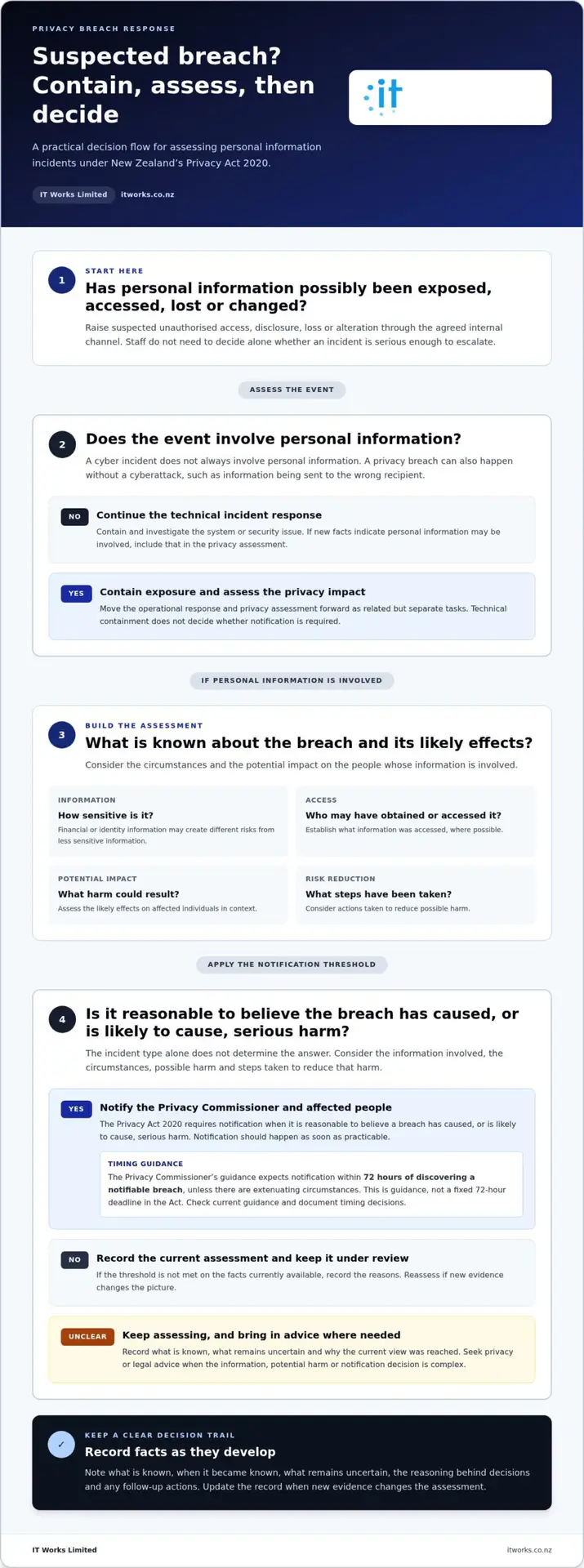
Include suspected unauthorised access, disclosure, loss or alteration of personal information in the plan’s scope. The word “suspected” matters: staff should raise a concern even if they don’t yet know exactly what happened or how many people may be affected.
For example, an employee might realise that a spreadsheet containing customer details was emailed to the wrong person. Or a compromised account might have been used to access information in a shared system. Both situations warrant prompt escalation and assessment, but neither automatically meets the threshold for notification. The circumstances and potential impact need to be considered.
For a data breach response plan New Zealand organisations can use confidently, make the first step clear: report the concern through an agreed internal channel instead of trying to decide alone whether it is serious enough to escalate.
Why prepare before an incident?
During an incident, information is often incomplete. A written process reduces hesitation by clarifying who coordinates the response, who investigates the technical issue, and who considers privacy and communication decisions. Staff don’t need to resolve every question themselves; they need to know how to raise a concern and where it goes next.
Keep the process practical. It should tell staff:
- who to contact when they suspect information has been exposed, lost or changed;
- who brings the relevant technical, privacy and operational people together; and
- where to record known facts, decisions and follow-up actions.
This preparation supports continuity as well as privacy. Clear ownership helps the organisation coordinate its response and consider which services, teams or customer processes may be affected. It also gives leaders a more reliable basis for decisions as the picture develops, helping staff and stakeholders receive considered updates rather than conflicting messages.
New Zealand privacy breach assessment: contain, assess and notify
Once a suspected breach is escalated, two related decisions need to move forward: how to limit further exposure, and whether the event is a notifiable privacy breach. Containment is an operational step. Notification is a separate judgement under the Privacy Act 2020, based on the information available about the breach and its likely effects.
The Act requires an organisation to notify the Privacy Commissioner and affected people when it is reasonable to believe a privacy breach has caused, or is likely to cause, serious harm. The incident type alone does not determine whether the threshold is met. A lost device, for example, needs to be assessed in context, including what personal information it held and whether steps have reduced the risk of harm. For the legal framework, see this New Zealand Data Protection Legal Framework, and refer to the Privacy Commissioner’s current privacy breach guidance when assessing an actual event.
Assessing whether a breach may be notifiable
Notification decisions depend on the breach and its likely effects on the people whose information is involved. Consider the sensitivity of the information, the potential harm, who may have obtained or accessed it, and what actions have been taken to reduce possible harm. Financial or identity information, for instance, may create different risks from less sensitive information. The circumstances matter.
Record the facts and reasoning as they develop. A useful assessment note captures what is known, when it became known, what remains uncertain and why the organisation reached its current view. Update it when new evidence changes the picture. This creates a clear decision trail without treating an early assumption as a final answer.
If notification is required, the Privacy Act says it should happen as soon as practicable. The Privacy Commissioner’s guidance expects notification within 72 hours of discovering a notifiable breach, unless there are extenuating circumstances. That is guidance, not a fixed 72-hour deadline in the Act. Check the Commissioner’s current advice and document the reasons for decisions about timing.
When a cyber incident also involves personal information
Technical teams may need to secure affected accounts or systems, preserve evidence and establish what information was accessed. These actions help clarify the facts, but they don’t decide whether the privacy notification threshold is met. Assign the technical and privacy assessment work to the appropriate people, and connect them through a shared incident lead or decision process.
Bring in privacy or legal advice when the information, potential harm or notification decision is complex. Technical specialists can explain what happened and what containment has achieved. For cyber security incidents, the National Cyber Security Centre (NCSC) is a New Zealand resource for reporting and guidance. Its role complements, rather than replaces, an organisation’s Privacy Act assessment.
A data breach response plan New Zealand organisations can rely on should name who coordinates this assessment and who approves notification decisions. IT Works helps connect technical incident response with organisational preparedness through its cybersecurity and incident response support.
Who leads a data breach response, and what decisions need owners?
A response can lose momentum if several people assume someone else is in charge. Name one incident lead to coordinate the work, keep decisions moving and give staff a clear point of contact. Also nominate an alternate so the process can continue if the lead is unavailable.
Not every organisation has separate IT, privacy or communications departments. In a lean team, one person may hold more than one role. The important thing is to assign each responsibility clearly, including who has authority to approve decisions. A data breach response plan New Zealand organisations can use should make these assignments before an incident, rather than relying on people to work them out during one.
Give each decision a clear owner
Use a responsibility map to show who leads, advises, acts and approves. These are functions, not necessarily job titles. For example, a managing director might lead the response and approve external communications, while an IT manager investigates the technical issue and advises on containment.
| Area | Lead or act | Advise or approve |
|---|---|---|
| Overall response | Incident lead coordinates actions and updates | Executive leader approves major business decisions |
| Technical investigation | IT lead or technical specialist investigates and acts on systems | Incident lead approves actions with wider business impact |
| Privacy assessment | Privacy lead gathers relevant facts and assesses implications | Executive decision-maker approves notification decisions |
| Staff and customer communication | Communications owner prepares consistent updates | Authorised executive approves external messages |
| Business operations | Relevant team lead identifies service and customer impacts | Incident lead coordinates priorities |
Coordinate distinct decisions
Technical investigation, external reporting and customer communication are connected, but they’re not the same decision. Technical findings help establish what systems or information may be involved. The privacy lead uses relevant facts to inform the privacy assessment, while the communications owner prepares accurate messages for the audiences approved by leadership.
Set approval boundaries in advance. Specify who can authorise containment actions, such as restricting access to an affected account, and when an action with broader operational impact needs executive approval. If the incident involves a senior leader, route decisions to another authorised executive or board-level contact. If a shared system affects several teams, involve their operational leads rather than leaving impact assessment to IT alone.
Assign someone to maintain one incident timeline and decision log. Record key findings, actions, owners, approvals and the time decisions were made. This helps the team work from a consistent picture and explain how its response developed.
Finally, define how the lead can bring in specialist technical or legal advice when internal capability is stretched or the situation is complex. Clear escalation routes let leaders combine technical findings, privacy considerations and business priorities without blurring accountability.
How to build and use a practical data breach response plan
A useful plan needs to be easy to find, clear enough to follow and current enough to trust. Build it around the decisions your organisation may need to make, then practise using it. For a data breach response plan New Zealand organisations can put into action, keep the main document concise and store sensitive operational details separately with appropriate access controls.
Build the plan in practical steps
- 1. Set the scope. Explain which suspected events should be escalated, including possible unauthorised access, disclosure, loss or alteration of personal information. Make clear that staff should report concerns rather than decide whether a breach is notifiable.
- 2. Assign roles. Name the response lead and alternate, and identify who handles technical investigation, privacy assessment, business operations and communications. State who can approve significant actions and external messages.
- 3. Map escalation and contacts. Record how staff raise an incident and how the response lead reaches decision-makers and relevant specialists. Keep a controlled contact list separate from the plan, and make it accessible through an appropriate alternative if normal systems are affected.
- 4. Set out response actions. Prompt the team to limit further access where appropriate, preserve relevant evidence, establish what information may be involved, and assess possible privacy and business impacts. Link to existing continuity arrangements, including backup and disaster recovery plans, so response decisions account for important services.
- 5. Prepare communications. Identify who drafts, reviews and approves messages for staff, customers and relevant external bodies. Include prompts to confirm what is known, what remains uncertain and when an update can be provided. Avoid putting sensitive personal information or detailed system instructions in general communications.
- 6. Review and improve. Set a regular review point and update the plan when key people, systems, suppliers or contact pathways change. Record the date and owner of each review.
Keep the plan free of passwords, security answers and unnecessary personal details. Store the document and its controlled contact information securely, with access limited to people who need them. During an incident, maintain a separate decision log with the time, known facts, action, owner and approval for each key decision. This creates a useful record without turning the plan itself into a store of sensitive incident information.
Practise the process before it is needed
Run a short tabletop exercise using a realistic scenario, such as a staff member reporting that a file may have been shared with the wrong recipient. Ask participants to locate the plan, identify who leads, follow the escalation route and decide what information needs to be gathered. No system changes are required. Note unclear instructions, unavailable contacts or approval gaps, then assign each improvement to a named owner.
Connect breach readiness with wider continuity planning. A clear link between incident response and backup and disaster recovery arrangements helps decision-makers consider how to maintain essential services while an issue is being assessed.
IT Works’ incident response planning support can help your organisation connect response actions with its wider technology and resilience planning.
Strengthen your New Zealand organisation’s readiness with the right support
A written plan is a strong starting point, but readiness depends on people being able to use it and technical response working alongside business decisions. Internal leaders remain responsible for organisational choices, including privacy and communication decisions. Technical specialists can help establish what has happened and support an effective response, while privacy or legal advice can inform decisions that need specialist judgement.
This joined-up approach helps organisations avoid treating a breach as only a technology issue. A technical finding may affect the privacy assessment, customer communications and the continuity of day-to-day services. Planning these connections in advance makes it easier to coordinate the right people and weigh the operational impact of response actions.
When external support can help
Specialist support can help review response processes, strengthen technical readiness and clarify how incident response connects with cybersecurity, business continuity and disaster recovery planning. For example, an organisation can consider how it would coordinate a technical investigation while maintaining essential services and gathering the facts needed for privacy decisions.
IT Works provides cybersecurity and incident response support as part of practical technology and resilience planning. Its Wellington-based team works with organisations across New Zealand, helping connect technical response with business priorities. External support can contribute expertise and coordination, but it doesn’t take the place of executive ownership or the organisation’s legal and privacy decisions.
- Internal leaders retain authority for business priorities, approvals and accountability.
- Technical specialists help investigate and contain issues, and explain their operational impact.
- Privacy or legal advisers can help leaders assess complex questions and consider appropriate next steps.
Agreeing how these roles work together before an incident helps ensure advice reaches the people making decisions. It also keeps technical actions connected to business needs, rather than managing them in isolation.
Turn the plan into ongoing organisational readiness
Choose an owner to maintain the plan, coordinate reviews and track improvements after an exercise or incident. That person can check that contact pathways still work, responsibilities remain clear and agreed actions have been completed. Keep the review process proportionate, so the plan stays useful and manageable.
Leaders can also build their wider understanding of practical cyber security through IT Works’ New Zealand small-business cybersecurity guide. Together, clear ownership, technical preparation and considered privacy processes help turn a data breach response plan New Zealand organisations can rely on into an ongoing part of organisational readiness.
Make readiness part of the way you work
A response plan earns its place when it helps people make sound decisions as circumstances change. Treat it as part of how your organisation governs technology and protects trust, not as a document to file away after approval. Agree who will keep it current and set a time to review it with the people expected to use it.
A data breach response plan New Zealand organisations can rely on should reflect how the organisation works now. As systems, responsibilities and ways of communicating evolve, consider whether the plan still gives decision-makers a useful foundation. Invite the people involved to share what would help them act with clarity, and turn practical observations into improvements with clear owners.
This steady approach makes preparedness an ongoing leadership practice rather than a one-off task. It gives your organisation room to strengthen its processes as it learns, while keeping decisions connected to business priorities and the trust of the people it serves.
With clear ownership and a willingness to keep improving, your organisation can build confidence one considered step at a time.
Frequently Asked Questions
What should a data breach response plan include?
It should fit the way your organisation operates, rather than rely on a generic template. Alongside response instructions, make clear which business services and information types the plan covers. Add a document owner, version date and a simple way for staff to identify the current copy. A brief quick-start page can help people orient themselves before following the full process.
When must a New Zealand organisation notify the Privacy Commissioner about a breach?
Notification is required when it is reasonable to believe a privacy breach has caused, or is likely to cause, serious harm. Use the Office of the Privacy Commissioner’s current guidance to assess the circumstances, and seek suitable advice if the situation is complex. Before preparing a notification, organise the facts into what is confirmed, what is still being established and what steps have been taken. Keep updates accurate as the investigation develops.
What is the difference between a cyber incident and a privacy breach?
A cyber incident concerns an event affecting technology or information, while a privacy breach involves personal information being handled inappropriately. To determine whether both considerations apply, identify the information involved and whether it relates to identifiable people. This distinction helps with triage: a technical issue may need investigation even when there’s no apparent privacy impact, while a privacy concern can arise outside a cyberattack.
Who should lead a data breach response in a small organisation?
A senior person with authority to coordinate the organisation’s response should lead, supported by people who understand its systems and operations. Make role assignments resilient to staff changes by recording both the responsible position and the person currently in it. If a key person leaves or changes responsibilities, update the assignment promptly and tell relevant staff where to find the revised version.
Should an organisation report a cyber incident to the NCSC?
Use the NCSC’s current guidance to decide whether and how to report a cyber security incident. Before making a report, prepare a concise account of the affected technology, when the issue was noticed and what is known so far. Separate confirmed details from assumptions, and avoid sharing personal information unless it’s necessary for the reporting process. This makes the information easier to review and reduces confusion as the incident develops.
How often should a data breach response plan be reviewed?
There’s no single review interval that suits every organisation. Alongside scheduled reviews, check whether the plan is still usable when staff responsibilities, suppliers or important business processes change. Keep a record of the current version and replace older copies in shared locations, so people don’t follow conflicting instructions. A brief check that staff can locate the right document can reveal a practical issue before it matters.
Does a backup and disaster recovery plan replace a data breach response plan?
No. The plans address different needs, so connect them without merging them into one set of instructions. During an exercise, consider a scenario where restoring a service affects the timing or scope of the technical investigation. This helps leaders identify who needs to coordinate restoration decisions with incident handling, and where the plans refer to each other. Keep each document’s purpose clear for the people expected to use it.
How can staff report a suspected data breach?
Make the reporting route easy to remember and include it in staff induction materials, not only in a policy stored online. Consider how people can raise a concern if email or the usual collaboration system is unavailable. Reinforce that reporting is useful even when the person isn’t sure what happened. A clear route helps concerns reach the right people without requiring staff to diagnose the issue first.