
If your team is spending more time managing hardware “quirks” than driving business growth, is your technology actually working for you, or are you working for it? For many local organisations, effective it asset lifecycle management nz has drifted into a reactive game of whack-a-mole rather than a strategic advantage. It’s a common pressure to face unpredictable hardware costs or feel a lingering anxiety about whether legacy software is leaving your data vulnerable. You likely want your staff to feel empowered by their tools, yet outdated devices often lead to daily frustrations that stall your momentum.
We agree that technology should be a quiet enabler of success, not a source of constant stress. In this article, you’ll learn how to identify the critical signals that your current management model is creating risk and holding back your progress. We’ll provide a clear roadmap for moving toward predictable budgeting, reduced security risks, and a solid foundation for AI adoption. We have structured this guide to help you transition from reactive repairs to a proactive system that supports long-term stability and growth across your New Zealand operations.
Key Takeaways
- Learn how to identify when recurring performance issues are a signal that your hardware replacement cycle is no longer supporting your team’s productivity.
- Discover how a structured approach to it asset lifecycle management nz replaces unpredictable technology invoices with a stable, forecastable budget.
- Understand the critical link between modern hardware and your organisation’s ability to successfully adopt AI tools like Microsoft Copilot.
- Identify the security vulnerabilities inherent in legacy systems and how a proactive maintenance schedule reduces your overall cyber risk.
- Access a practical checklist to evaluate your current asset register and ensure your technology roadmap is aligned with your 2026 growth objectives.
Understanding IT Asset Lifecycle Management in the NZ Context
Effective it asset lifecycle management nz is far more than a simple inventory of serial numbers in a spreadsheet. It is a deliberate, strategic framework that governs how your organisation selects, utilises, and eventually retires every piece of hardware and software in its ecosystem. When you approach this process with intention, your technology remains a stable foundation for growth rather than a source of unexpected risk or hidden costs.
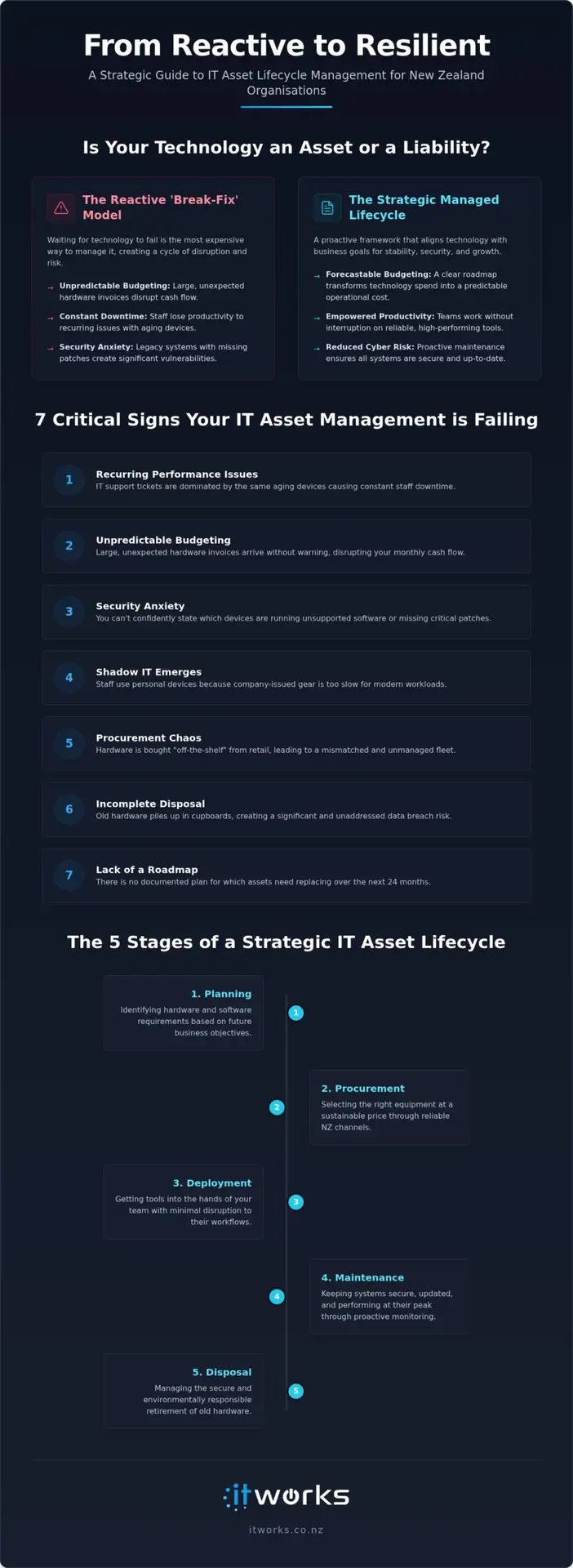
This lifecycle consists of five distinct stages that ensure your infrastructure remains healthy and aligned with your needs:
- Planning: Identifying your hardware and software requirements based on future business objectives.
- Procurement: Selecting the right equipment at a sustainable price point through reliable channels.
- Deployment: Getting tools into the hands of your team with minimal disruption to their daily workflows.
- Maintenance: Keeping systems secure, updated, and performing at their peak through proactive monitoring.
- Disposal: Managing the secure and environmentally responsible retirement of old hardware.
Contrast this structured journey with the traditional “break-fix” model. While waiting for something to fail might seem like a way to save costs, it actually creates a culture of reactive firefighting. A managed lifecycle model focuses on resilience, ensuring that your infrastructure is always ready to support your next move without the stress of sudden system failures.
The Shift from Reactive to Strategic
Waiting for hardware to fail is the most expensive way to manage your technology. The hidden costs of staff downtime, lost productivity, and emergency procurement fees quickly stack up. By aligning your technology spend with your long-term business goals, you move away from unpredictable spikes in expenditure. A strategic partner provides the oversight needed to identify risks before they become problems, offering a level of clarity that internal teams often struggle to maintain while managing daily tasks. This approach ensures your technology roadmap remains a proactive tool for success.
The Role of Local Expertise
Working with an NZ-based team for procurement and on-site deployment provides a level of practical stability that offshore providers cannot match. Local experts understand the unique supply chain challenges we face in New Zealand, from shipping delays to specific regional requirements in centres like Auckland or Christchurch. This proximity ensures that when you need hardware deployed or a strategy reviewed, your partner is physically and culturally aligned with your organisation. This shared identity fosters a sense of community and ensures your technology roadmap is grounded in local reality.
7 Critical Signs Your IT Asset Lifecycle Management Strategy is Failing
Identifying the cracks in your technology management doesn’t always require a total system failure. Often, it’s a slow leak of resources, time, and confidence. If your current approach to it asset lifecycle management nz feels more like reactive firefighting than strategic oversight, you’re likely noticing one or more of these red flags:
- Recurring performance issues: Your IT support tickets are dominated by the same aging devices causing constant staff downtime.
- Unpredictable budgeting: Large, unexpected hardware invoices arrive without warning, disrupting your monthly cash flow.
- Security anxiety: You can’t confidently state which devices are running unsupported software or missing critical patches.
- Shadow IT: Staff begin using personal laptops or tablets because company-issued gear is too slow to handle modern workloads.
- Procurement chaos: Hardware is bought “off-the-shelf” from retail stores, leading to a mismatched fleet with no standard configuration.
- Incomplete disposal: Old laptops and hard drives are piling up in cupboards, creating a significant data breach risk.
- Lack of a roadmap: There is no documented plan for which assets need replacing over the next 24 months.
Recognising these signs is the first step toward reclaiming control. Ignoring them only compounds the risk to your organisation’s stability and hinders your ability to scale effectively.
The Productivity Drain of Aging Tech
Micro-downtime is a silent profit killer. A three-minute boot-up or a weekly software crash might seem minor in isolation. However, across a team of fifty, these moments accumulate into hundreds of lost hours every year. Beyond the financial cost, outdated equipment actively frustrates your best talent. High-performing employees expect reliable tools that match their pace. When technology hinders their work, morale drops, and recruitment becomes significantly harder as your organisation gains a reputation for being “behind the times”.
Security Risks of Legacy Systems
Unpatched or unsupported assets are the primary targets for cyberattacks. Many successful breaches originate from a “forgotten” asset, such as an old tablet or a legacy server that hasn’t seen an update in months. Moving toward a model of cyber resilience requires a structured it asset lifecycle management nz process. This ensures every device on your network is accounted for, secured, and replaced before it becomes a liability. If you’re unsure where your vulnerabilities lie, you can discuss your cybersecurity priorities with our team to ensure your fleet is as secure as it is productive.
Strategic Stagnation: How Poor Asset Management Hinders Growth
When your organisation’s growth outpaces its infrastructure, the friction becomes visible in every department. Strategic stagnation occurs when leadership is forced to focus on the limitations of their tools rather than the potential of their market. For many Kiwi businesses, it asset lifecycle management nz is the missing link that connects operational stability with the ability to scale. Without a clear view of your assets, adding new team members or opening new locations becomes a logistical nightmare rather than an exciting milestone.
Consider the drain on leadership when managing directors or business owners are pulled into the weeds of IT procurement. Every hour spent researching hardware specifications or managing vendor disputes is an hour lost to high-level strategy. This reactive approach doesn’t just waste time; it ensures your technology remains a disjointed collection of parts rather than a unified system designed for expansion. True scalability requires an environment where technology is ready before the new hire arrives, not weeks after they’ve started.
AI Readiness and Modern Capabilities
AI adoption is the top technology opportunity for 51% of New Zealand businesses in 2026, yet many are discovering that their current hardware is a significant barrier. Tools like Microsoft Copilot require more than just a software subscription; they demand modern processing power and specific hardware architecture to function at their peak. Running advanced AI on outdated infrastructure leads to lag, crashes, and employee frustration. Effective asset management ensures your fleet is prepared for these processing demands, creating a foundation for responsible and productive AI integration across your team.
The Value of a Technology Roadmap
A 3-year technology roadmap shifts the conversation from “buying laptops” to “investing in organisational capability”. This long-term view turns IT from a perceived cost centre into a genuine growth enabler. By documenting a clear replacement schedule, you remove the guesswork and allow for more accurate financial forecasting. Partnering with experts for managed IT services for NZ organisations provides the strategic oversight needed to keep this roadmap on track. It ensures that your technology evolves alongside your business objectives, rather than lagging behind them. This methodical approach builds trust, as your team knows they will always have the tools required to perform their best work without technical roadblocks.
The Strategic IT Asset Lifecycle Management NZ Checklist
Moving from a reactive to a proactive model requires a clear understanding of where your organisation stands today. While technical teams often focus on the specifications of individual devices, business leaders must focus on the visibility, security, and financial predictability of the entire fleet. Use this checklist to evaluate the health of your current it asset lifecycle management nz strategy and identify where hidden risks may be lingering.
- Centralised Asset Register: Do you have a single, updated source of truth that lists every piece of hardware and software currently in use?
- Documented Replacement Schedule: Is there a clear policy to replace devices before they reach the four-year mark to avoid the steep climb in maintenance costs?
- Licence Audits: Are your software subscriptions regularly reviewed to ensure you aren’t paying for “ghost” accounts or unused features?
- Certified Disposal: Do you have a documented process for data destruction and e-waste disposal that meets New Zealand environmental standards?
- Security Parity: Is every asset, including those used by remote staff, covered by your primary cybersecurity monitoring and response tools?
- Financial Forecasting: Is your technology spend for the next 12 months already budgeted and predictable, or are you waiting for the next “emergency” invoice?
- Managed Mobility: Can your team work securely from any location using company-managed devices that are updated and patched automatically?
Evaluating Your Current Posture
Scoring your organisation against these criteria provides an immediate snapshot of your operational resilience. If you find yourself answering “no” or “unsure” to more than two of these points, your current management model is likely creating a bottleneck for your team. Transitioning to a professional it asset lifecycle management nz partner allows you to close these gaps without adding to your internal management burden. Regular technology reviews and risk assessments ensure that your checklist remains green as your business evolves and new challenges emerge.
Budgeting for Success
Shifting toward a predictable “per-user” monthly cost is the ultimate goal of a mature asset strategy. This approach removes the shock of $20,000 hardware invoices and replaces them with a steady, manageable investment that scales with your headcount. By focusing on the total cost of ownership (TCO) rather than just the initial purchase price, you can significantly reduce long-term expenses. This proactive maintenance ensures your gear lasts its full intended life without requiring emergency repairs. For a deeper look at how this fits into your broader strategy, you can read our guide to managed IT support services.
Building Resilience: Transitioning to a Managed Asset Partnership
Transitioning to a managed model is about shifting from a transaction-based relationship to a genuine partnership. At IT Works, we operate as an extension of your team. This philosophy ensures that we aren’t just reacting to your technical needs; we’re actively anticipating them. By integrating it asset lifecycle management nz into your broader business plan, we remove the daily burden of procurement and deployment from your leadership team. We handle the logistics. You focus on the strategy.
The true value of this partnership lies in the calm reliability it brings to your operations. Proactive monitoring and layered security ensure that your assets are protected long before a vulnerability can be exploited. This approach builds a resilient, scalable foundation. It ensures that as your organisation grows, your technology remains a silent, supportive partner rather than a bottleneck that requires constant attention. You gain the peace of mind that comes from knowing your fleet is modern, secure, and fully aligned with your goals.
What to Expect in a Managed Partnership
The first 90 days of a partnership are focused on clarity and stability. We begin by auditing your entire environment to create a complete source of truth for your hardware and software. Once we have visibility, we move to stabilising any immediate risks, such as unsupported legacy systems or unpatched devices. The final phase of this initial period involves building your three-year technology roadmap. This plan ensures that your it asset lifecycle management nz is predictable and budgeted for the long term. Regular strategic consulting keeps this roadmap relevant, ensuring that your technology evolves as the market changes. Cultural fit is essential here; you need a partner who understands the local NZ landscape and shares your commitment to sustainable growth.
Your Next Strategic Step
Beginning the conversation about your technology strategy shouldn’t feel like a high-pressure event. We believe in a grounded, non-fear-based approach to both cybersecurity and infrastructure growth. The goal is to build organisational confidence, not to sell “fixes” for problems that haven’t happened yet. By focusing on practical business outcomes, we help you transition from reactive firefighting to a state of strategic readiness. This shift allows you to embrace new opportunities, such as AI integration, with the certainty that your foundation is solid. Talk to IT Works about your technology strategy and let’s discuss how a practical roadmap can support your organisation’s long-term success.
Securing Your Organisation’s Future Stability
Identifying the early signs of technical friction is the first step toward preventing significant operational risk. We have explored how moving away from reactive procurement toward a structured replacement cycle ensures your budget remains predictable while your team stays focused. By addressing legacy vulnerabilities and preparing your fleet for modern processing demands, you transform your technology from a daily frustration into a scalable business asset. Establishing a professional framework for it asset lifecycle management nz is the most reliable way to maintain this strategic momentum.
Our NZ-based strategic advisors are dedicated to helping you move beyond the stress of reactive repairs. We prioritise practical AI enablement and an outcome-focused partnership model that aligns perfectly with your specific organisational goals. Whether you are operating in Auckland, Wellington, or Christchurch, our team provides the steady guidance needed to navigate local supply chain challenges and security requirements. This collaborative approach ensures your infrastructure is always ready to support your next big move.
Taking control of your technology roadmap today creates the resilience and confidence your organisation needs for the years ahead. We are ready to help you replace technical anxiety with a clear, sustainable path toward your 2026 objectives and beyond.
Frequently Asked Questions
What is the difference between IT asset management and simple inventory tracking?
Simple inventory tracking is a reactive list of what you own, whereas it asset lifecycle management nz is a proactive strategy covering the entire lifespan of your technology. While inventory tells you where a laptop is, management tells you when it needs replacing, how much it costs over three years, and how it aligns with your security goals. It moves your organisation from merely counting devices to strategically utilising them for growth.
How often should a New Zealand business replace its hardware assets?
Most New Zealand organisations should aim to replace primary hardware every three to four years. Beyond this point, the likelihood of component failure increases significantly, and the cost of maintenance often exceeds the price of a modern replacement. Keeping your fleet within this window ensures your team has the processing power required for modern tools and reduces the risk of sudden, unbudgeted downtime across your offices.
Is managed IT asset lifecycle management more expensive than buying gear as needed?
A managed approach is typically more cost-effective because it eliminates the hidden expenses of emergency repairs and staff downtime. Buying gear only when it breaks often leads to paying retail premiums and facing long shipping delays. By forecasting your requirements, you can access better procurement channels and maintain a stable, predictable monthly budget that avoids the sharp spikes associated with reactive models.
Can a managed service provider help with our Microsoft 365 licensing and AI strategy?
Yes, a strategic partner ensures your software environment is as optimised as your hardware. We help audit your Microsoft 365 subscriptions to remove unused licences and align your infrastructure for AI tools like Microsoft Copilot. This ensures you aren’t just buying the latest software, but that your team has the training and the hardware performance required to use these tools effectively and securely within your organisation.
How does proper asset management improve our cybersecurity posture?
Proper it asset lifecycle management nz improves security by ensuring every device on your network is visible, patched, and compliant. You cannot secure an asset you don’t know exists. By maintaining a structured replacement schedule, you retire legacy systems before they stop receiving critical security updates. This proactive approach significantly reduces the attack surface of your organisation and builds long-term cyber resilience against modern threats.
What are the risks of improper IT asset disposal in NZ?
Improper disposal carries significant risks of data breaches if sensitive information isn’t professionally wiped from hard drives. Beyond data security, New Zealand has strict environmental regulations regarding e-waste. With disposal fees at many local transfer stations increasing in 2026, a managed partner ensures your retirement process is both secure and compliant with local council requirements, protecting your organisation from potential fines and unnecessary reputational damage.
Do we need a full-time IT person to manage our asset lifecycle?
You don’t need a full-time internal staff member to manage this process when you work with a strategic partner. We handle the logistical burden of tracking, procurement, and deployment on your behalf. This allows your leadership team to focus on high-level business objectives while we ensure your technology foundation remains stable. It’s an efficient way to access expert-level oversight without the overhead of an additional internal salary.
How do we know if our organisation is ready for a managed IT partnership?
Your organisation is likely ready if technology has become a source of stress rather than a quiet enabler of success. If you’re facing unpredictable costs, recurring staff complaints about slow devices, or if your leadership team is spending too much time on IT procurement, it’s time for a change. A managed partnership moves you away from reactive firefighting and provides a clear, strategic roadmap for your future growth.