
What if data stored in New Zealand could still be affected by another country’s laws? It’s a reasonable question for organisations assessing data sovereignty laws NZ cloud storage, particularly when a provider’s contracts don’t clearly explain access arrangements. New Zealand doesn’t have a general requirement for businesses to keep data physically in the country. That doesn’t remove the need to understand who can access it and what safeguards apply.
The distinction matters: data residency describes where information is stored, while sovereignty also involves legal jurisdiction and control. The Privacy Act 2020 sets requirements for handling personal information, including when cloud providers store or process it on an organisation’s behalf. Your organisation remains responsible for protecting that information.
This guide explains how location, provider access and relevant laws can affect cloud data. It outlines legal and contractual points to discuss with an appropriate adviser, then sets out a practical framework for assessing cloud storage and reviewing it over time. The aim is to support informed decisions that reflect your privacy responsibilities and business priorities, without assuming onshore storage is the only option.
Key Takeaways
- Assess cloud storage by looking beyond data-centre location to provider ownership, administrator access and contract terms.
- Understand how data sovereignty laws NZ cloud storage may affect your organisation, and identify legal questions to discuss with an appropriate adviser.
- Start an assessment by classifying the data, clarifying its business purpose and sensitivity, then documenting your decision.
- Set review points so changes to data use, cloud services or business priorities can be considered as part of ongoing governance.
- Connect cloud sovereignty decisions with cybersecurity, business continuity and clear accountability, rather than assuming one cloud model suits every organisation.
What data sovereignty means for NZ cloud storage
A cloud service can involve several locations and organisations. A business may use a provider based in one country, store its primary data in another, and rely on support teams or subcontractors elsewhere. Look beyond the data-centre location to understand the arrangements behind the service.
Data sovereignty is the relationship between data, the people and organisations that control or access it, and the national laws that may apply. It brings together location, jurisdiction and practical control. A foundational overview of data sovereignty explains how the concept connects with cloud computing and data localisation. Your organisation’s assessment needs to consider its own data and service arrangements.
Data residency, sovereignty and jurisdiction are different
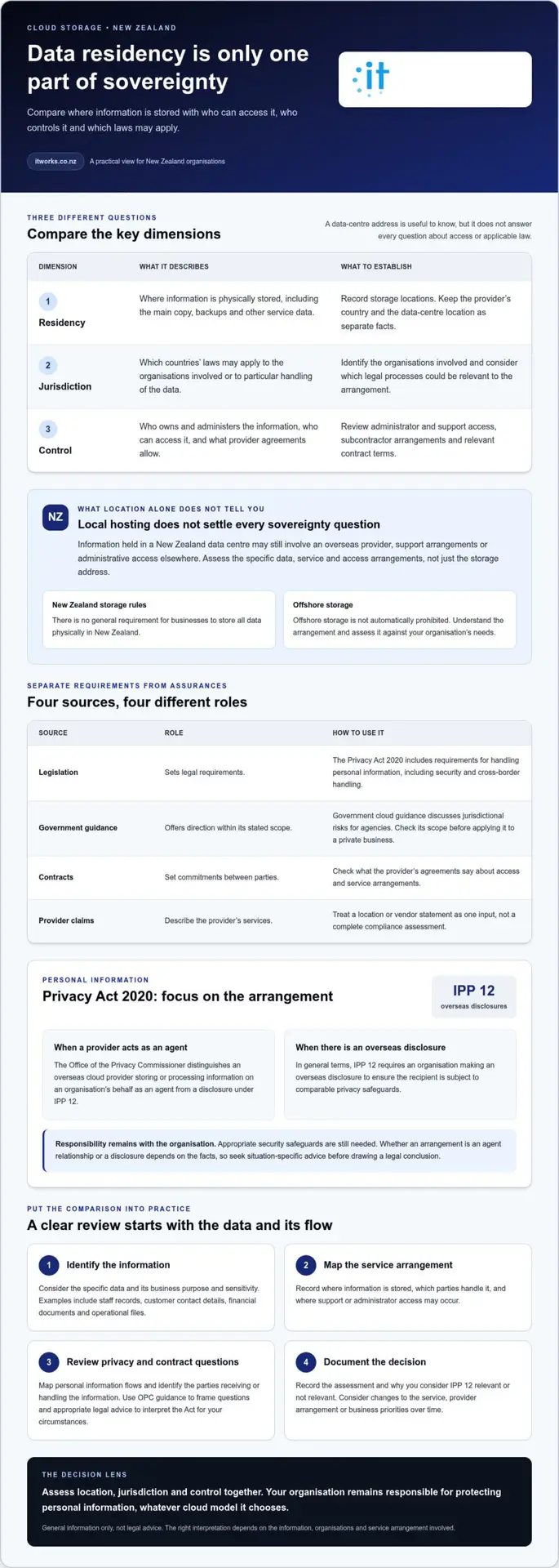
Data residency describes where information is physically stored. That may include the main copy, backups and other service data. It’s a useful detail to establish, but it doesn’t answer every question about sovereignty.
Jurisdiction concerns which countries’ laws may apply to the organisations involved or to particular handling of the data. Control concerns who owns and administers the information, who can access it, and what the provider’s agreements allow. These factors can overlap, but they aren’t interchangeable. Data held in a New Zealand data centre doesn’t, by location alone, settle every question about applicable law or access.
Why cloud storage makes the distinction relevant
Cloud services can separate the physical storage of information from the provider’s headquarters, support arrangements and administrative access. For example, a New Zealand organisation could store customer records in a local data centre while using a service operated by an overseas provider. Record the storage location and the provider’s country as separate facts. Neither one gives a complete picture of who may access the data or which legal processes could be relevant.
This matters for everyday business decisions. An organisation might hold staff records, customer contact details, financial documents or operational files in cloud systems. Understanding how these are stored and managed can inform privacy discussions, contract reviews and continuity planning. It can also help leaders plan for changes to a service or provider arrangement.
A practical review of data sovereignty laws NZ cloud storage should focus on the specific data, service and access arrangements, rather than a single assumption about location. New Zealand has no general requirement for businesses to store all data within the country, and offshore storage isn’t automatically prohibited. The sound approach is to understand the arrangements, assess them against your organisation’s needs and document a decision that supports responsible data handling and reliable operations.
Which NZ laws and guidance matter for cloud data?
This section provides general information, not legal advice or a complete account of every law that might apply. The right interpretation can depend on the type of information, the organisations involved and what the cloud provider does. Use these points as a starting place for a discussion with the Office of the Privacy Commissioner (OPC) or a New Zealand privacy lawyer.
Keep four things distinct: legislation sets legal requirements, government guidance offers direction within its stated scope, contracts set commitments between parties, and a provider’s claims describe its services. A location or vendor statement isn’t, by itself, a complete compliance assessment.
Privacy Act 2020 and overseas disclosures
The Privacy Act 2020 is central to how New Zealand organisations handle personal information. Its Information Privacy Principles (IPPs) cover areas including security and cross-border handling. For cloud storage, the relevant questions depend on the arrangement, not simply the country where information is hosted.
Information Privacy Principle 12 (IPP 12) concerns disclosures of personal information to overseas entities. In general terms, it requires an organisation making an overseas disclosure to ensure the recipient is subject to comparable privacy safeguards. However, the OPC distinguishes an overseas cloud provider storing or processing information on an organisation’s behalf as an agent from a disclosure under IPP 12. The organisation remains responsible for appropriate security safeguards. Whether an arrangement is an agent relationship or a disclosure depends on the facts, so get situation-specific advice before drawing a legal conclusion.
For a practical review, map the data flow, identify the parties receiving or handling personal information, and record why you consider IPP 12 relevant or not relevant. OPC guidance can help frame the questions, while legal counsel can interpret how the Act applies to your organisation’s circumstances.
Government cloud guidance and Māori data sovereignty
New Zealand Government cloud guidance discusses jurisdictional risks and considerations for agencies. It can help other organisations identify issues to assess, but government guidance doesn’t automatically impose identical duties on every private business. Check its stated scope and use it alongside your own legal obligations, provider terms and risk assessment.
Māori data sovereignty is a distinct consideration concerning Māori data and the rights and interests of Māori in how that data is governed. It can’t be reduced to choosing a New Zealand data centre. Where Māori data is involved, seek appropriate expertise and engage with relevant Māori perspectives on its collection, use, access and protection. A location decision alone doesn’t resolve questions of governance.
For organisations reviewing data sovereignty laws NZ cloud storage, careful interpretation is part of good technology governance. IT Works is a Wellington-based partner for cloud planning and technology strategy. Talk to IT Works about your technology strategy.
How to compare cloud storage sovereignty and control
Separate where information is stored from who operates the service, who can access it and what the agreement says. No single location field answers every sovereignty question. Compare the details using provider documentation and contract terms, not just a general claim about where a service is based.
Provider location and data-centre location are separate questions. A provider may be headquartered in one country while operating storage in another. Also consider support access, backups, subprocessors and dependencies on other services. These arrangements can affect how information is handled, even when the primary data location is clearly stated.
Who owns, administers and can access the data?
Start with the legal entity named in the agreement, then map the organisations involved in delivering the service. The provider may rely on subcontractors for support or other functions. Use its documentation to understand which administrator roles could access information, what authorisation is required and whether access activity is recorded. Keep these technical controls distinct from the legal entity responsible for the service.
For example, a provider’s local support contact and the organisation operating the cloud service may be different entities. Record each entity and its role, rather than treating a local contact as proof that all administration takes place locally.
What do contracts and service terms explain?
Review the agreement and related service terms for information about data location, processing, access, retention and deletion. Check how subprocessors are identified and how changes to them or the service are communicated. Note any gaps or broad wording. Don’t assume what an unclear clause means: flag it for legal review and consider how it affects your organisation’s requirements.
Where data relates to Māori, include appropriate governance considerations in the assessment, not only location and access. The Tertiary Education Commission’s overview of Māori Data Sovereignty provides context for this distinct perspective.
For organisations assessing data sovereignty laws NZ cloud storage, a documented comparison makes trade-offs visible and easier to review. Talk to IT Works about your technology strategy.
A practical NZ cloud sovereignty assessment for your organisation
A structured assessment connects cloud decisions with the information being handled and the way the business operates. It isn’t a legal compliance certificate. It’s a practical record of what you considered, what you decided and where you need further advice.
Work through these stages in order, involving the people responsible for the data, the cloud service and the relevant business process.
- Classify the data. Identify the information being stored or processed, its business purpose and sensitivity. For example, distinguish general working documents from personal information or records that support a core business process.
- Map systems and people. Record which cloud services hold or handle the information, who uses them and which business processes depend on them. Include connected services and relevant provider or subcontractor roles where known.
- Set out requirements. Identify privacy, contractual and operational requirements that may apply. Discuss legal interpretation with an appropriate adviser, and record practical needs such as access, recovery and availability for business continuity.
- Review arrangements. Compare provider documentation and contract terms with your requirements. Consider data locations, administrative access, support arrangements, subprocessors, backups, retention and deletion. Note anything you couldn’t establish.
- Record the decision. Capture the chosen arrangement, reasons, decision owner, responsibilities, accepted risks and any actions requiring technical or legal input. Make unresolved questions visible, with an owner and a next step.
- Set review points. Decide when to revisit the assessment, including after material changes to data use, providers, contracts or business requirements.
Map data, services and business requirements
Make the map useful to both business and technology decision-makers. Note the data types, systems, user groups and processes involved, then describe what the business needs from the service. A system supporting day-to-day operations may have different recovery needs from one used for occasional reference. Include continuity needs alongside sovereignty considerations so the review reflects how the organisation needs to function.
Review controls, record decisions and revisit them
Use provider material and contract terms to check how data is handled and who can access it. Where an answer is unclear, record the question rather than making an assumption. Assign ownership for decisions and follow-up actions. Review the record when the service or its use changes, or when business priorities shift. This makes the assessment useful for ongoing governance, rather than a document completed once.
Assessment checklist: classify the information, map services and access, identify requirements, review provider arrangements, document decisions and owners, then set review triggers. This supports a reasoned decision; it doesn’t certify legal compliance.
For organisations applying data sovereignty laws NZ cloud storage considerations to real business needs, a clear assessment links cloud planning with continuity and accountability.
Make cloud sovereignty part of practical IT governance
Cloud sovereignty works best as part of routine technology governance, not as a one-off location decision. For organisations with 15 to 75 staff, clear ownership and review processes can help keep cloud arrangements aligned with business needs as services and priorities change.
Requirements vary. The right arrangement depends on the data involved, the cloud service and the organisation’s legal, operational and business context. One cloud model won’t suit every situation. The goal is to make informed decisions that support responsible data handling while enabling people to work effectively.
Align cloud arrangements with business priorities
Start with the outcomes your organisation needs. Consider how information supports daily work, customer service and planned growth. Assess a cloud arrangement not only by where data is held, but also by how it supports productivity, security and continuity if systems or service arrangements change.
Connect the review to cybersecurity and business continuity planning. Clarify who is accountable for access decisions, how provider arrangements fit existing security controls, and what the business needs to restore or continue essential processes. This helps leaders understand dependencies and make practical trade-offs without assuming one location or provider model is automatically best.
A technology roadmap can keep the work connected. Record key cloud services, the business processes that depend on them, organisational priorities and who owns each review. Include planned changes, such as adopting a new service or changing how information is used, so sovereignty is considered as part of broader planning rather than after decisions are made.
Get practical guidance for your cloud environment
Cloud decisions involve both strategy and day-to-day operations. A review can bring together business priorities, data handling, provider terms, cybersecurity controls and continuity requirements. For legal interpretation, involve an appropriate adviser. For technical and operational planning, map the current environment and clarify how responsibilities are shared across your organisation and cloud providers.
IT Works combines Cloud Solutions and technology advisory with practical operational support, helping organisations connect technology planning with business goals. This can support a structured review of cloud arrangements without promising a particular legal outcome.
By treating data sovereignty laws NZ cloud storage as one part of governance, organisations can make cloud decisions that reflect the information they handle, their responsibilities and the way their business needs to operate. Keep the rationale, decision owner and review points clear, and revisit them when material changes occur.
Set a clear direction for your cloud decisions
Cloud choices can shape how easily your organisation adapts as its needs change. Use the assessment as a starting point for a broader discussion about what your systems need to support next, whether that’s a new way of working, a planned service change or closer alignment between technology and business priorities.
Understanding data sovereignty laws NZ cloud storage can help leaders frame those conversations with more confidence. Identify the questions that matter most for your organisation, then bring the relevant business and technology perspectives together. An appropriate adviser can address legal questions, while cloud planning can consider how your services fit the direction of the business.
IT Works brings Cloud Solutions and technology strategy together with practical operational support for New Zealand organisations.
A thoughtful conversation can turn uncertainty into a clearer path forward.
Frequently Asked Questions
Do New Zealand data sovereignty laws require cloud data to stay in New Zealand?
No, there’s no blanket requirement for businesses to keep all cloud data in New Zealand. Before setting an internal location rule, distinguish a business preference from a condition imposed by a contract or a requirement that applies to your organisation or information. If a customer agreement or sector-specific rules are relevant, have an appropriate adviser interpret them before selecting a service or planning a migration.
Does using a New Zealand cloud provider mean New Zealand law is the only law that applies?
No. A provider’s New Zealand base doesn’t establish that only New Zealand law is relevant. Identify the legal entity named in your agreement and the entities involved in operating the service. Keep that information with the service record, then ask a New Zealand privacy lawyer to assess jurisdiction questions relevant to your circumstances. A provider’s marketing description alone isn’t a substitute for that review.
Can overseas cloud support staff access data stored in New Zealand?
Possibly, depending on the provider’s service and support arrangements. Test a practical scenario, such as a support request involving a specific file or mailbox: could staff view its contents, or would they only see technical information? Record what the provider’s documentation says about this distinction and how support access is approved. This helps your team understand the implications of a support request, rather than relying only on storage location.
What does Information Privacy Principle 12 mean for overseas cloud services?
IPP 12 sets requirements for certain disclosures of personal information to overseas entities, including comparable privacy safeguards. The OPC says an overseas cloud provider acting as an agent to store or process information for an organisation isn’t treated as an IPP 12 disclosure, though the organisation remains responsible for security safeguards. Document what the provider does with the information and get legal advice on whether the agent distinction applies to your arrangement.
How can a business check where its cloud data is stored?
Check the documentation for the specific service and configuration your organisation uses, rather than relying on a provider’s general description. Record the selected region and whether the documentation addresses separate information, such as backups. Keep a dated copy of the relevant service details with your cloud records. If the service doesn’t clearly explain a location that matters to your organisation, record it as an open question for follow-up.
What is the difference between data sovereignty and data residency?
Residency concerns where data is physically stored. Sovereignty is the wider question of control and applicable law. Use residency information to answer a location requirement, such as a contract condition, and assess sovereignty by considering the provider’s legal entity, access arrangements and governance. This stops a location field being mistaken for a complete assessment of the service.
Does Māori data sovereignty apply to every organisation’s data?
No, the concept relates specifically to Māori data and its governance, rather than automatically describing all information held by every organisation. If your organisation works with information about Māori people, culture or resources, consider its context and seek appropriate expertise. The question is not only where the information sits, but whether the people and communities connected to it have a meaningful role in decisions about its use and protection.
What should a New Zealand business review before moving data to cloud storage?
Before migration, check how the service will fit existing workflows and connected systems, and plan how information can be retrieved if the organisation changes services later. Confirm who will coordinate the move, who will approve access and how the business will validate that essential information is available after transfer. For data sovereignty laws NZ cloud storage decisions, identify any contract or privacy questions that need advice before migration begins.