
If your technology partner only reaches out when something breaks, they aren’t actually managing your IT; they’re simply reacting to your downtime. It’s a common frustration for New Zealand leaders who feel trapped by hidden contract costs and helpdesks that don’t share their sense of urgency. Learning how to choose a managed IT provider in NZ that your organisation can truly rely on is the first step toward turning your technology into a strategic asset rather than a persistent cost centre.
You need to know that your staff stay productive, your data is secure under the 2026 privacy amendments, and your expenses remain predictable as you scale. Most importantly, you deserve a clear technology roadmap that aligns with your specific business goals over the next three years. This process isn’t just about fixing laptops; it’s about finding a partner who understands the human side of technical challenges and acts as a steady guide for your team.
This guide provides a structured framework to evaluate potential partners, from assessing their cybersecurity maturity to ensuring they offer the strategic guidance required in a modern business. You’ll discover how to move away from reactive cycles and toward a collaborative relationship that creates genuine confidence for your staff in Auckland, Wellington, or anywhere across the country.
Key Takeaways
- Move beyond reactive “break-fix” support to a model where technology is a strategic asset that drives your business goals forward.
- Master how to choose a managed IT provider in NZ by prioritising local expertise and a clear three-year technology roadmap.
- Evaluate potential partners based on their ability to provide layered cybersecurity that builds resilience without relying on scare tactics.
- Use a practical checklist to scrutinise a provider’s strategic planning and their alignment with New Zealand’s specific regulatory standards.
- Shift your focus from technical features to business outcomes, ensuring your IT investment delivers predictable costs and enhanced staff productivity.
Beyond the Helpdesk: Why Your NZ Organisation Needs a Strategic Technology Partner
Many Kiwi organisations still operate under the assumption that IT support is something you call upon only when a screen goes dark or a server fails. This reactive “break-fix” approach was common a decade ago, but it’s increasingly risky in a business environment that demands constant uptime and absolute data integrity. When you consider what managed IT services are in a modern context, the focus shifts from fixing problems to preventing them entirely. This evolution is central to understanding how to choose a managed IT provider in NZ that actually adds value to your bottom line.
Technology should be viewed as a strategic asset that enables growth, not just another line item on your expense report. When IT is managed purposefully, it creates a foundation for organisational resilience. It allows your leadership team to focus on high-level objectives while knowing the underlying systems are stable, secure, and scalable. Transitioning away from a model of “keeping the lights on” means your technology starts working for you, rather than your team working around the technology.
The Limitations of Traditional IT Support
Waiting for technology to fail before addressing it is the most expensive way to manage your infrastructure. It leads to unpredictable invoices and sudden, large capital outlays that disrupt your cash flow. Beyond the financial cost, reactive support creates a culture of frustration. Staff productivity drops when they constantly battle slow systems; their morale suffers when they feel the organisation hasn’t provided the right tools for the job.
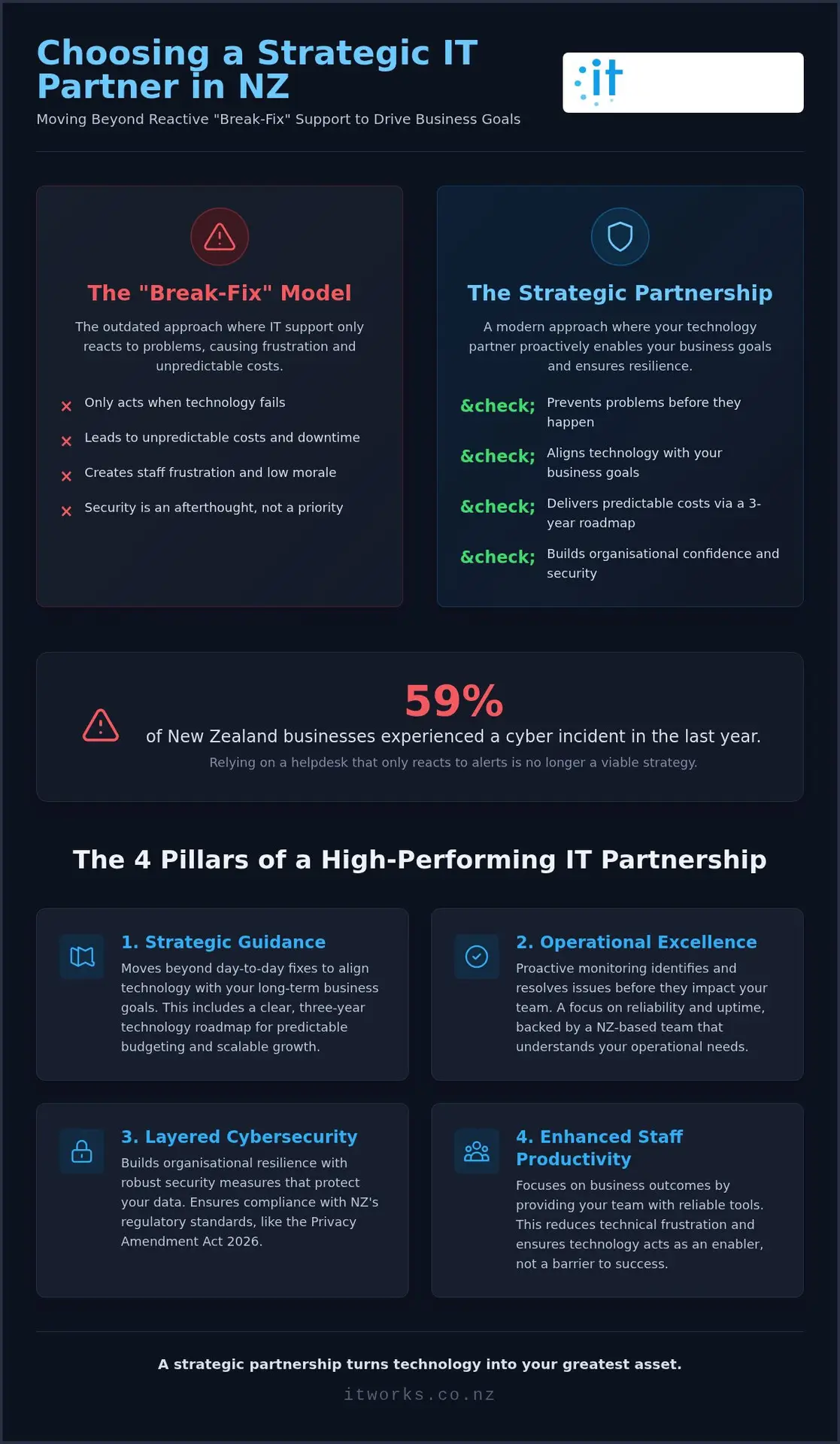
A reactive provider rarely looks at your security posture until after an incident occurs. With 59% of New Zealand businesses experiencing a cyber incident in the last year, relying on a helpdesk that only reacts to alerts is no longer a viable strategy. Technical debt accumulates quickly when you only fix what’s broken, eventually hindering your ability to adopt new efficiencies or respond to market changes.
Defining the Strategic Partnership Model
A strategic partnership replaces the “cost centre” mentality with a focus on long-term outcomes. Instead of just managing hardware, a true partner aligns technology with your specific business goals. This involves creating a clear technology roadmap that outlines necessary upgrades and security enhancements over a three-year period. It allows for predictable budgeting and ensures your team isn’t tripped up by outdated systems.
Choosing a provider with a local NZ team ensures they understand our specific regulatory environment, such as the Privacy Amendment Act 2026. They provide better cultural and operational alignment, acting as an extension of your own team rather than a distant service provider. This grounded approach is essential when learning how to choose a managed IT provider in NZ that can lead your organisation through complex technical shifts with a sense of calm reliability.
The 4 Pillars of a High-Performing Managed IT Partnership
A truly effective partnership rests on more than just technical competence. It requires a shared vision for how technology enables your specific organisational goals. When you explore Key criteria for NZ business leaders, you’ll find that the best providers act as an extension of your leadership team. They prioritise four critical pillars to ensure your systems remain an asset rather than a burden. Understanding these pillars is essential when researching how to choose managed IT provider NZ services that actually deliver long-term value.
Strategic guidance is the first pillar. It moves the conversation beyond hardware procurement and into the realm of business technology strategy. Your partner should provide a clear technology roadmap that outlines necessary investments for the next three years. This structured approach allows for predictable budgeting and ensures your systems scale seamlessly as your headcount grows. It replaces the stress of unexpected technical failures with a sense of calm, planned progression.
Operational excellence forms the second pillar. Reliability is the baseline for any professional service. A high-performing provider uses proactive monitoring to identify and resolve potential issues before they disrupt your staff. Because our team is entirely NZ-based, you receive support that understands your local context without the frustration of offshore helpdesks or slow response times. This operational stability allows your team to remain productive and focused on their core roles.
Cybersecurity That Builds Confidence
Resilience is built on confidence, not fear. A modern security posture moves beyond basic antivirus software to implement a layered approach. This includes robust identity management, multi-factor authentication, and regular user awareness training to empower your staff. The goal is to reduce organisational risk and ensure your data remains secure under the latest privacy regulations. By focusing on risk reduction rather than just reacting to threats, your provider creates a secure environment where your team can work without anxiety.
Practical AI and Automation Readiness
AI is a practical tool for enhancing productivity, not a replacement for your workforce. A forward-thinking partner guides you through the adoption of tools like Microsoft Copilot while ensuring responsible governance. They help you identify manual tasks that can be automated to improve data accuracy and free up your team for higher-value work. This pillar ensures your organisation is ready for new developments without compromising data security or operational integrity. You can talk to IT Works about your technology strategy to see how these pillars can be integrated into your specific business model.
Evaluating the Market: Key Criteria for NZ Business Leaders
Selecting a technology partner requires looking beyond a glossy brochure or a list of technical specifications. When you’re researching how to choose managed IT provider NZ options, the distinction between a local expert and an offshore helpdesk is often the most critical factor. Local presence in cities like Auckland, Wellington, or Christchurch isn’t just about proximity. It’s about having a partner who understands the specific operational challenges and regulatory requirements of New Zealand organisations. On-the-ground expertise ensures that when a complex issue arises, you have access to professionals who share your context and sense of urgency.
Industry experience is another vital benchmark. A provider that understands the unique needs of NZ non-profits and SMEs will approach your infrastructure differently than one focused on large-scale multinationals. They should demonstrate a track record of helping similar organisations achieve stability and growth. This experience allows them to anticipate common hurdles and suggest practical solutions that have already proven successful in the local market. Transparency is equally important; you should expect regular reviews and clear reporting that translates technical performance into business outcomes.
Service Level Agreements (SLAs) are often misunderstood as mere response time guarantees. While it’s helpful to know how quickly someone will acknowledge your ticket, the metric that truly matters is resolution time. A high-performing partner prioritises getting your team back to work. They should be held accountable for the health of your entire system, not just for how fast they answer the phone. This shift in focus ensures that the provider is incentivised to prevent problems rather than just reacting to them.
Understanding IT Pricing Models
The “break-fix” model often appears cost-effective on the surface, but it creates a fundamental conflict of interest where your provider profits from your downtime. In contrast, a fixed-fee managed service model aligns your goals with theirs. They’re incentivised to keep your systems running perfectly to minimise their own workload. A truly all-inclusive monthly fee should cover proactive maintenance, security monitoring, and strategic planning. Watch out for hidden costs in technology procurement or licensing, such as selecting the best web hosting for business, that can quickly inflate a seemingly “budget” contract.
The Importance of Cultural Fit
Technical skill is a baseline, but cultural fit makes the partnership sustainable. Your IT provider should feel like an extension of your internal team, speaking in plain English rather than hiding behind technical jargon. They should act as a steady guide, helping you understand how technical decisions impact your staff productivity and data security. When checking references, ask other NZ business leaders about the provider’s communication style and whether they feel like a collaborative ally or a distant service provider.
The Decision-Maker’s Checklist: Questions That Reveal a Provider’s True Value
Finalising your selection requires more than comparing monthly subscription costs. When you are determining how to choose managed IT provider NZ partners, the proposal phase is your best opportunity to test their strategic depth. A provider’s true value isn’t found in their ability to reset passwords; it is found in how they anticipate risks and prepare your organisation for future growth. Use this structured checklist to move beyond surface-level promises and uncover the reality of their service delivery.
- Step 1: Demand a documented strategic process. Ask to see an example of a technology roadmap they have created for a similar organisation. This should show a clear three-year trajectory for hardware cycles, cloud migrations, and security enhancements.
- Step 2: Scrutinise their cybersecurity framework. A professional partner should align their recommendations with recognised standards, such as the CERT NZ Critical 10. Ask how they measure your current maturity against these benchmarks.
- Step 3: Test the escalation procedures. It is easy to promise a 30-minute response time, but what happens when a complex issue requires senior engineering input? Ask for a clear map of their support tiers and who takes accountability when things get difficult.
- Step 4: Review their Microsoft 365 optimisation approach. Most NZ businesses pay for features they never use. Your partner should show you how to extract more value from your existing licenses through better collaboration and automation.
- Step 5: Assess their growth vision. Your IT needs will change as you scale from 20 to 100 staff. Ensure the provider has the capacity and experience to lead that journey without outgrowing their own service model.
Red Flags to Spot During the Proposal Stage
Be wary of providers who lead the conversation with specific hardware or software products before they have spent time listening to your organisational challenges. If a proposal feels like a generic sales pitch rather than a tailored strategy, it is unlikely they will act as a true partner. Vague security claims are another significant warning sign. If they cannot document the specific framework they use to protect your data, your organisation remains at risk. Finally, look for transparency in procurement. A reliable partner will be open about hardware margins and software licensing costs, ensuring there are no hidden surprises in your monthly invoice.
Questions for Your Potential Account Manager
The person managing your relationship is just as important as the person fixing your server. Ask them how they ensure your technology stays aligned with your three-year growth plan. Inquire about their specific process for proactive risk management; they should be looking for vulnerabilities before they become outages. Finally, ask how they help your staff get more value out of the tools you already pay for. A partner who focuses on user enablement and productivity is far more valuable than one who simply “keeps the lights on.”
Building a Future-Ready Partnership with IT Works
Selecting a technology partner is one of the most significant decisions a leadership team can make. It is not merely about finding someone to manage your servers; it is about finding a guide who can help you navigate the complexities of modern business with confidence. When you understand how to choose managed IT provider NZ organisations can rely on, you realise that the most successful partnerships are built on a foundation of shared goals and mutual trust. At IT Works, we act as a strategic extension of your team, ensuring your technology remains a stable platform for growth rather than a source of persistent stress.
Our approach combines high-level strategic vision with the reliable day-to-day support your staff need to stay productive. We understand that for a mid-sized organisation, every minute of downtime has a direct impact on your bottom line. By focusing on organisational resilience and practical stability, we help you move away from reactive technical management and toward a future where your technology is a clear competitive advantage. Our entirely NZ-based team ensures you always have access to experts who understand your local context and are committed to your long-term success.
The IT Works Difference: Outcomes Over Products
We believe that technology should be a quiet enabler of business success. This means we prioritise outcomes over individual products or technical features. Instead of overwhelming you with jargon, we focus on reducing operational friction and enhancing the way your team works together. We integrate cybersecurity, practical AI enablement, and cloud optimisation into a single, cohesive roadmap that aligns with your three-year growth plan. This structured approach ensures that every technical investment you make is purposeful and contributes to your organisational goals.
For those seeking Managed IT Services Wellington or nationwide, our commitment remains the same: providing sophisticated guidance that is both accessible and pragmatic. We help you get more value out of the tools you already pay for, such as Microsoft 365, while ensuring your data remains secure under the latest privacy regulations. By focusing on the human side of technical challenges, we replace the typical anxiety of IT management with a sense of calm reliability.
Next Steps for Your Organisation
The journey toward a more resilient future begins with a clear understanding of your current position. We recommend starting with a technology alignment review to identify hidden risks and uncover opportunities for improved productivity. This process provides a baseline for your future roadmap and ensures that your technology strategy is grounded in reality. If you are currently feeling underserved by your existing support, we can manage a seamless transition that minimises disruption to your staff.
Talk to IT Works about your technology strategy to discover how a strategic partnership can help your organisation thrive in the years ahead. We are here to provide the steady, expert guidance you need to turn technology into your greatest asset.
Securing Your Organisational Future
Selecting the right technology partner is a deliberate step toward long-term stability and growth. By shifting your focus from reactive repairs to proactive technology roadmapping, you ensure that every technical decision supports your broader business goals. A partnership with a 100% NZ-based support team provides the cultural alignment and local expertise necessary to navigate evolving privacy standards and operational challenges with ease.
As you determine how to choose managed IT provider NZ services that fit your specific needs, remember that the most valuable partners are those who prioritise your staff’s productivity and data security. From strategic AI enablement to robust cybersecurity, your technology should act as a steady foundation for innovation. Moving beyond the stress of technical management allows your leadership team to focus on what truly matters: leading your organisation toward a resilient and successful future.
We look forward to helping you turn your technology into a powerful asset that drives your organisation forward with confidence.
Frequently Asked Questions
What is the difference between a helpdesk and a managed IT provider?
A helpdesk is a reactive service designed to fix technical issues after they occur. In contrast, a managed IT provider takes a proactive, strategic approach to your entire technology ecosystem. They focus on preventing downtime through regular maintenance and aligning your systems with your long-term business goals. This is a fundamental concept when learning how to choose a managed IT provider in NZ that acts as a partner rather than a distant service.
How much should managed IT services cost for a mid-sized NZ business?
Pricing typically follows a predictable per-user, per-month model rather than an unpredictable hourly rate. This structure ensures your IT costs remain stable even as your organisation scales. The total investment depends on the complexity of your security requirements and the level of strategic guidance you need. Choosing a fixed-fee model aligns your provider’s incentives with your own, as they profit from keeping your systems running smoothly.
Is it difficult to switch from my current IT provider to a new one?
Switching providers is a structured process that shouldn’t disrupt your daily operations. A professional partner will manage the entire transition, including auditing your existing infrastructure and coordinating the handover with your outgoing provider. They focus on a seamless transfer of knowledge and credentials to ensure your staff experience no downtime during the changeover.
Do I really need a local NZ-based IT team, or is offshore support okay?
A local NZ-based team provides significant advantages in cultural alignment and regulatory compliance. They possess a deep understanding of local laws, such as the Privacy Amendment Act 2026, which offshore helpdesks may overlook. Having experts on the ground in cities like Wellington or Auckland ensures they can provide physical support when needed and build a more personal, collaborative relationship with your team.
What should be included in a standard Managed IT Service Agreement?
A robust agreement should clearly define resolution times and the specific security layers included in your service. It must outline how your data is backed up, how often systems are patched, and the frequency of strategic roadmap meetings. Look for transparency regarding what is considered in-scope to avoid unexpected invoices for standard maintenance tasks.
How can a managed IT provider help with my cybersecurity insurance requirements?
Managed providers play a critical role in meeting the stringent requirements set by cybersecurity insurers. They implement and document the necessary controls, such as multi-factor authentication and managed endpoint detection, which insurers now demand. This proactive stance helps reduce your organisational risk and can lead to more favourable insurance terms.
What role does an IT provider play in my organisation’s AI adoption?
Your provider should act as a guide for responsible AI adoption, focusing on practical productivity gains. They ensure that tools like Microsoft Copilot are implemented with strict data governance to prevent sensitive information from being exposed. The goal is to enhance staff output while maintaining a secure and controlled environment for your organisational data.
How often should I expect to meet with my IT partner for strategic reviews?
You should expect to meet with your technology partner for strategic reviews at least once a quarter. These sessions are vital for assessing your progress against your technology roadmap and adjusting for any new business challenges. Regular communication ensures your IT strategy remains perfectly aligned with your three-year growth plan.